


Synonym name:
Catalogue No.: BP1351
Cas No.: 23445-00-3
Formula: C20H20O11
Mol Weight: 436.369
Botanical Source: Gentiana campestris, Swertia randaiensis, Swertia japonica and Swertia perennis
Purity: 95%~99%
Analysis Method: HPLC-DAD or/and HPLC-ELSD
Identification Method: Mass, NMR
Packing: Brown vial or HDPE plastic bottle
Can be supplied from milligrams to grams.
For Reference Standard and R&D, Not for Human Use Directly.
Inquire for bulk scale.
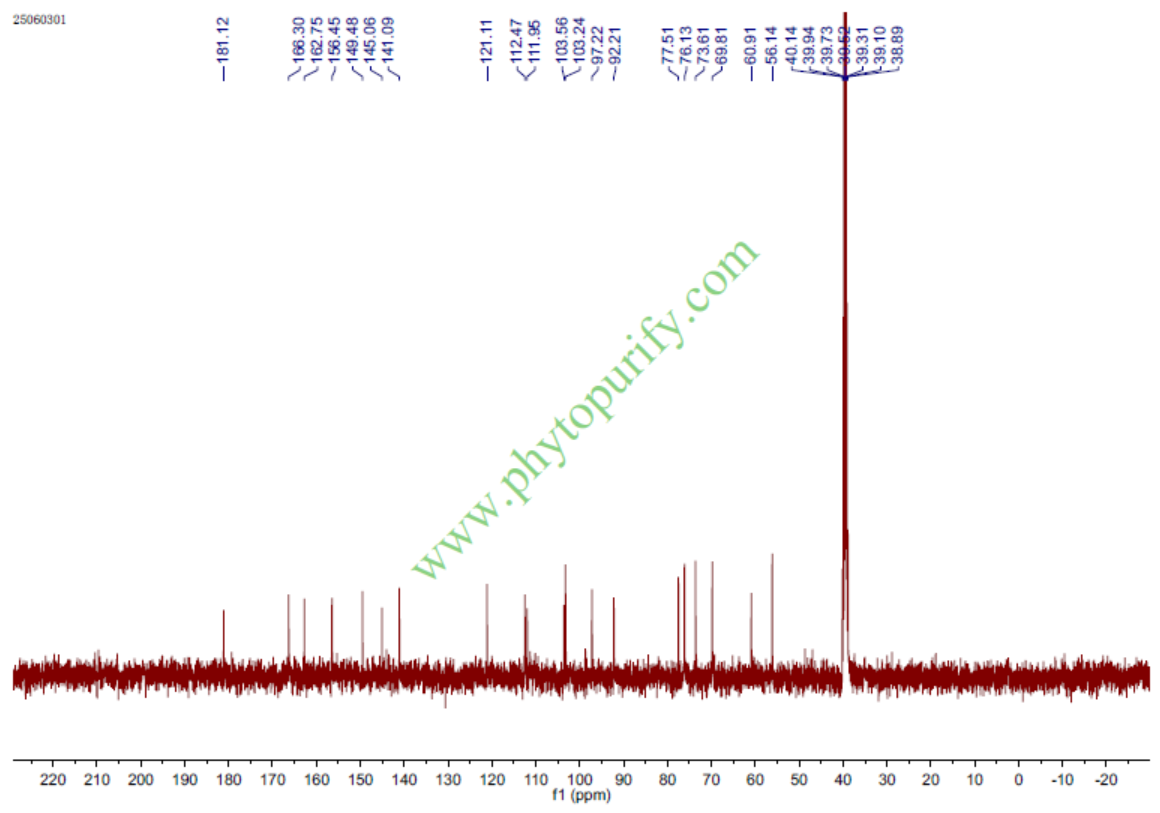
NMR of Swertianolin
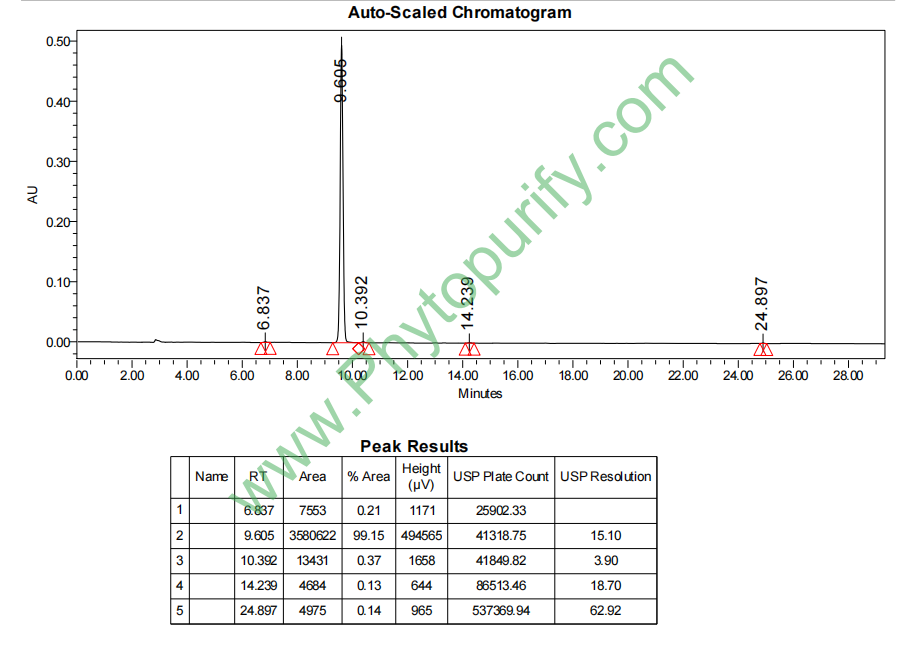
HPLC of Swertianolin
Storage conditions:Short-term storage at 2~8℃, long-term storage at -20 ~ -80℃
179.2800
.0202
.0070
2.1452
.5146
.1908
Low
72.1708
3.9697
Yes
No
No
No
Yes
No
1.5
Yes
Yes
Yes
No
Natural products, as an important treasure trove for drug discovery, play an irreplaceable role in the history of human disease prevention and treatment. Among them, xanthenone compounds are increasingly attracting the attention of pharmacological researchers due to their structural diversity and wide range of biological activities. Dangyao alcohol glycoside, as a representative xanthenone carbon glycoside, has a CAS number of 23445-00-3 and is mainly isolated from various plants in the Gentianaceae family. In recent years, with the deepening of modern pharmacological research, medicinal glycosides have shown various biological activities, including anti-inflammatory, antioxidant, antibacterial, and neuroprotective effects. Especially in complex disease models such as neuroinflammation, Helicobacter pylori infection, sepsis, and Alzheimer's disease, glycosides have shown significant regulatory potential. Its core mechanism of action involves the inhibition of p38 mitogen activated protein kinase phosphorylation and nuclear factor kappa B signaling pathway, thereby downregulating the production of nitric oxide, reactive oxygen species, and various inflammatory mediators. This article aims to systematically review the chemical properties, plant sources, pharmacological activities, molecular mechanisms of action, and pharmacological properties of medicinal glycosides, in order to provide comprehensive scientific references for the in-depth research and potential drug development of this natural product.
The chemical name of the medicinal alcohol glycoside is 1,5,8-trihydroxy-3-methoxyxanthone-8-O - β - D-glucopyranoside, which is a typical xanthone carbon glycoside compound. Its molecular formula is C20H20O11 and its molecular weight is 436.3690. Structurally, its parent nucleus is tricyclic xanthenone, with hydroxyl groups attached at positions 1, 5, and 8, and methoxy substitution at position 3. One hydroxyl group (usually at position 8) is linked to a molecule of β - D-glucose through a glycosidic bond. This carbon glycoside structure has better chemical stability and enzymatic resistance in vivo compared to oxygen glycosides.
Its physical and chemical properties determine its bioavailability and functional characteristics. The calculated lipid water partition coefficient LogP value is about 0.0202, indicating that the compound has good hydrophilicity. The topological polarity surface area is as high as 179.28 Å ², which is mainly attributed to the numerous hydroxyl and sugar structures in the molecule, and also indicates that its transmembrane permeability may be limited. Its water solubility value is 2.1452 (usually measured in mg/mL or log mol/L, which needs to be defined in conjunction with specific calculation software, but the value itself indicates that it has a certain degree of water solubility). These parameters collectively point to the possibility of poor membrane permeability, particularly in the blood-brain barrier where the ability to penetrate is predicted to be "low," posing a challenge to its efficacy in treating central nervous system diseases. However, its hERG inhibition risk is negative, and the Ames test value is 1.5 (usually considered negative if it is less than 2), indicating that its cardiotoxicity risk and genotoxicity risk are relatively low, and it has a certain basis for drug safety.
Dangyao alcohol glycoside is mainly distributed in Gentianaceae plants and is one of the characteristic components of various medicinal plants. Its main plant sources include:
1. Field Gentiana One of the classic sources of medicinal glycosides in plants.
2. swertia punicea Swertia plants are important resources for discovering and isolating medicinal glycosides.
3. Other Gentianaceae plants This component can also be detected or isolated in various plants of the genera Swertia and Gentiana.
Its extraction and separation usually follow the conventional process of natural product chemistry. Firstly, the dried plant material is crushed and subjected to reflux extraction or ultrasound assisted extraction using polar solvents such as methanol, ethanol, or aqueous ethanol. The crude extract obtained was concentrated under reduced pressure and subjected to gradient extraction using solvents such as petroleum ether, ethyl acetate, and n-butanol. Due to its strong hydrophilicity, the glycoside was mainly enriched in the n-butanol extraction site. Further purification mostly depends on column chromatography technology. Silica gel, macroporous adsorption resin, polyamide or dextran gel are often used as stationary phases, and chloroform methanol, ethyl acetate methanol water systems are used for gradient elution. High performance liquid chromatography, especially preparative HPLC, is the ultimate key step in obtaining high-purity medicinal glycoside monomers. In recent years, some green extraction techniques such as supercritical fluid extraction and microwave-assisted extraction have also been explored to improve extraction efficiency and protect thermosensitive components.
A large number of in vitro and in vivo pharmacological experiments have confirmed that the medicinal glycoside has multiple biological activities, laying the foundation for its application research in various diseases.
Anti inflammatory and antioxidant activity This is one of the core pharmacological effects of medicinal glycosides. In the lipopolysaccharide induced macrophage (such as RAW264.7) inflammation model, the drug glycoside can dose dependently inhibit the excessive production of nitric oxide and prostaglandin E2, while significantly reducing the level of intracellular reactive oxygen species. Its anti-inflammatory effect has been validated in various animal models, such as mouse ear swelling model, arthritis model, etc.
Anti Helicobacter pylori activity When medicinal alcohol glycosides show direct inhibitory and bactericidal effects on both standard and clinical isolates of Helicobacter pylori. The research reported that its half maximal inhibitory concentration was 6.1 μ M, and the lowest bactericidal concentration reached 91.7 μ M. Its function is not limited to sterilization, but also inhibits the urease activity of Helicobacter pylori (which is a key virulence factor for its colonization in gastric acid environment), and reduces bacterial adhesion to gastric epithelial cells, demonstrating the potential of multi-target anti Helicobacter pylori.
Neuroprotection and Anti Alzheimer's Potential In the β - amyloid protein induced neuronal injury or microglial activation model, the drug glycoside can increase cell survival rate, alleviate oxidative stress and inflammatory response. Animal behavioral experiments have shown that it can improve learning and memory impairment in Alzheimer's disease model mice. Its neuroprotective effect is closely related to its strong anti neuroinflammatory properties.
Immune regulation and anti sepsis effects Sepsis is a fatal systemic inflammatory response syndrome. Research has shown that medicinal glycosides can significantly improve the survival rate of septic mice induced by cecal ligation and perforation surgery. Its mechanism involves regulating the functional balance of immune cells (such as macrophages and T cells), inhibiting excessive pro-inflammatory responses, and possibly promoting the expression of anti-inflammatory factors, thereby restoring immune homeostasis.
Other activities Preliminary studies also suggest that the medicinal glycoside may have certain effects in inhibiting hepatitis B virus replication and relieving pain, but further research is needed to confirm this.
The multiple pharmacological activities of medicinal glycosides stem from their regulation of complex cellular signaling networks, and their mechanisms of action have been extensively studied at the molecular and pathway levels, involving multiple key targets.
Inhibition of core anti-inflammatory signaling pathway:
Neural inflammation related target network In the context of neurodegenerative diseases, the target network of action of glycosides is more complex.
Antioxidant mechanism In addition to reducing the generation of reactive nitrogen and oxygen species by inhibiting iNOS and COX-2, the structure of the glycoside itself gives it direct free radical scavenging ability and can upregulate the activity of endogenous antioxidant systems in cells, such as superoxide dismutase and glutathione peroxidase.
The multiple mechanisms of anti Helicobacter pylori In addition to direct antibacterial effects, it also involves inhibiting bacterial urease (possibly by binding to its active center nickel ions), interfering with bacterial biofilm formation, and reducing gastric mucosal damage caused by Helicobacter pylori infection through anti-inflammatory effects on the host cell side.
Although the pharmacological activity of medicinal glycosides is significant, their potential to develop into clinical drugs still requires systematic evaluation.
Preliminary analysis of drug properties Based on its physicochemical parameters (medium molecular weight, high TPSA, low LogP), the glycoside of the drug basically conforms to the Lipinski Five Rules, but its high polarity may lead to unsatisfactory oral bioavailability. Its blood-brain barrier penetration prediction is low, which is a major challenge for treating central nervous system diseases and may require improvement through structural modifications or drug delivery systems such as nanoparticles and liposomes.
Current status of pharmacokinetic research At present, there are relatively limited reports on pharmacokinetic studies of the Dangyao glycoside system, which is a key direction for future research. Limited animal experiments suggest that its oral absorption may be poor and it may undergo extensive metabolism in the body, such as hydrolysis of glycosides (to form aglycones), glucuronidation or sulfation of hydroxyl groups, and other II binding reactions. Its aglycones may have different activities and distribution characteristics. Further research is needed on its absolute bioavailability, tissue distribution (especially whether it can effectively enter brain tissue), identification of metabolites, and main excretion pathways.
Preliminary evaluation of safety The preliminary toxicity data currently available shows that when the drug glycoside is within the effective dose range, its toxicity to normal cells is relatively low. HERG inhibition negative and Ames test negative are important early safety signals, but comprehensive preclinical safety evaluation is still needed, including acute toxicity, long-term toxicity, reproductive toxicity, etc.
Pharmaceutical Science Challenge To improve its bioavailability, it may be necessary to develop new drug delivery systems. For example, utilizing phospholipid complexes, cyclodextrin inclusion complexes, or self microemulsion systems to enhance their lipid solubility and intestinal absorption; Design brain targeted nanocarriers to overcome the blood-brain barrier.
As a natural lead compound with multiple targets and functions, medicinal alcohol glycosides have shown broad application prospects in various disease fields, but also face many challenges.
Potential therapeutic areas:
Future research directions and challenges:
As a natural flavonoid glycoside derived from traditional medicinal plants, medicinal alcohol glycosides have become a highlight in natural product pharmacology research due to their unique chemical structure and diverse pharmacological activities. It exhibits clear effects in anti-inflammatory, antioxidant, antibacterial, neuroprotective, and immune regulation by inhibiting key inflammatory pathways such as p38/NF - κ B, providing new candidate molecules and ideas for the treatment of major diseases such as Helicobacter pylori infection, Alzheimer's disease, and sepsis. However, its poor membrane permeability and limited pharmacokinetic data are currently the main bottlenecks restricting its development. Future research should focus on further elucidating its multi-target mechanism of action, systematically evaluating its pharmacological properties, and optimizing it through medicinal chemistry and pharmacology methods. With the continuous deepening of interdisciplinary research, medicinal glycosides are expected to gradually develop from potential lead compounds into innovative drugs or functional ingredients with clinical application value, contributing their unique value to human health.
