


Synonym name: Paclitaxel Related Compound A
Catalogue No.: BP0332
Cas No.: 71610-00-9
Formula: C45H53NO14
Mol Weight: 831.912
Botanical Source: Alkaloid from Taxus wallichiana, the bark of Taxus yunnanensis and Cephalotaxus mannii
Purity: 95%~99%
Analysis Method: HPLC-DAD or/and HPLC-ELSD
Identification Method: Mass, NMR
Packing: Brown vial or HDPE plastic bottle
Can be supplied from milligrams to grams.
For Reference Standard and R&D, Not for Human Use Directly.
Inquire for bulk scale.
HPLC of Cephalomannine
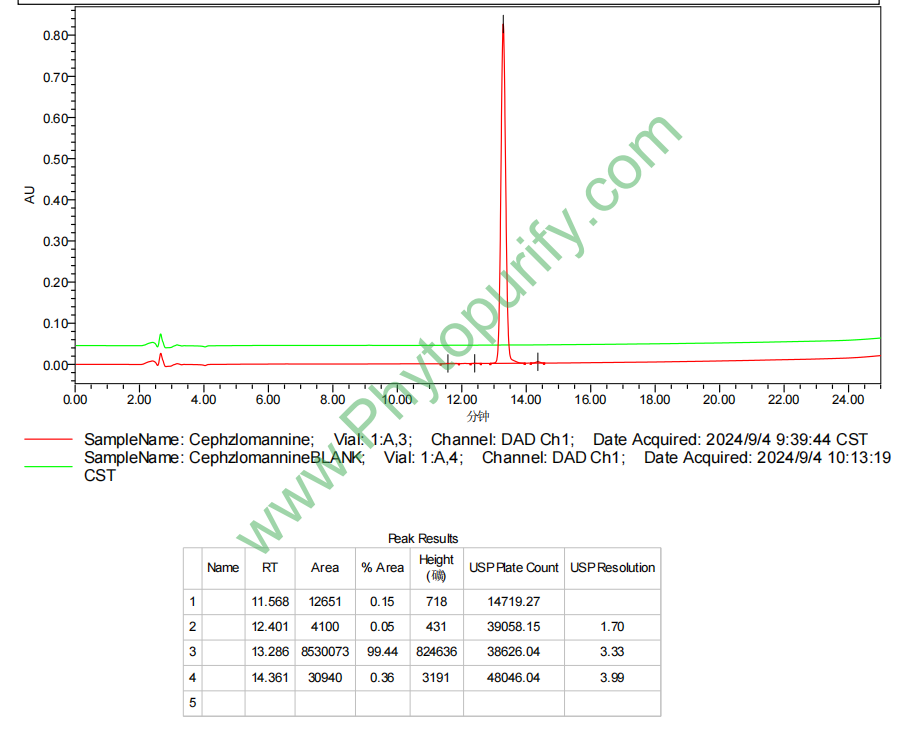
Storage conditions:Short-term storage at 2~8℃, long-term storage at -20 ~ -80℃
Cephalomannine (CAS number: 71610-00-9), as a natural paclitaxel alkaloid, has attracted widespread attention in the field of anti-tumor drug development in recent years. This compound is mainly derived from the genus Cryptomeria(Taxus Spp.) is isolated and extracted from plants, structurally similar to the classic paclitaxel, showing significant anti-cancer activity, especially in the treatment of malignant tumors such as leukemia, demonstrating potential clinical application value. Sanjianshanning alkaloid not only has oral biological activity, but also becomes an important candidate molecule for chemotherapy drug development due to its unique molecular structure and mechanism of action.
This article aims to systematically review the chemical structure and physicochemical properties, plant sources and extraction methods, pharmacological activity and mechanism of action, pharmacological evaluation and pharmacokinetic characteristics of Sanjianning alkaloid. Combined with its molecular targets in leukemia and other tumor diseases, it explores its clinical application prospects and development trends, providing theoretical basis and research reference for natural product pharmacology and anti-tumor drug development.
Sanjianshanning alkaloid is a complex diterpenoid alkaloid of the taxane class, with a molecular formula of C47H51NO14 and a molecular weight of 847.90. Its chemical structure is highly similar to paclitaxel, both containing a unique taxane skeleton and multiple hydroxyl and ester groups, endowing it with unique pharmacological activity. The LogP value of Sanjianning alkaloid is about 2.8, indicating its moderate lipid solubility, which is beneficial for cell membrane penetration and oral absorption.
The molecular surface area (TPSA) is as high as 239.36 Å ², and the number of hydrogen bond acceptors is 14, indicating its high molecular polarity, which may affect its ability to pass through the cell membrane and pharmacokinetic behavior. The low permeability of the blood-brain barrier suggests limited distribution in the central nervous system, which may reduce the risk of central nervous system toxicity. The current research on its hepatotoxicity, cardiotoxicity, and hERG channel inhibition is not sufficient, and the Ames mutagenicity test results are not clear. Further systematic evaluation of its safety is needed.
Sanjianshan alkaloid is mainly found in plants of the Sanjianshan genus, such as Taxus chinensis、Taxus cuspidata Wait. The plants of the genus Cryptomeria have become an important natural source of anti-tumor drugs due to their abundant taxane diterpenoid alkaloids. Traditionally, the extraction of sophocarpine is carried out using organic solvent extraction combined with multi-stage chromatographic separation and purification techniques.
The commonly used extraction process includes: crushing the dried wood of the Chinese fir genus and using polar solvents such as methanol, ethanol, or ethyl acetate for extraction; Subsequently, impurities are removed through liquid-liquid distribution; Separate and purify using techniques such as silica gel column chromatography and reverse phase high-performance liquid chromatography (RP-HPLC); Finally, high-purity sophocarpine was obtained. In recent years, green extraction techniques such as supercritical CO2 extraction and microwave-assisted extraction have gradually been applied to the extraction of sophocarpine, improving extraction efficiency and reducing environmental pollution.
Sanjianshan alkaloid, as a paclitaxel analogue, mainly exerts anti-tumor effects by stabilizing microtubule structure, blocking cell mitosis, inhibiting tumor cell proliferation. It exhibits significant cytotoxicity in various tumor cell lines, particularly high sensitivity in leukemia cells.
In vitro experiments have shown that berberine can induce tumor cell cycle arrest in the G2/M phase and promote cell apoptosis. Animal model studies have also confirmed its effectiveness in inhibiting tumor growth and prolonging survival. Compared with paclitaxel, berberine has better oral activity, demonstrating potential clinical advantages.
In addition, berberine also has a certain inhibitory effect on multidrug-resistant (MDR) tumor cells, possibly by inhibiting the drug efflux mechanism mediated by P-glycoprotein (P-gp), increasing the intracellular accumulation of chemotherapy drugs, and enhancing the efficacy.
The anti-tumor mechanism of Sanjianning alkaloid mainly relies on its binding and stabilizing effect on microtubules, preventing microtubule depolymerization, leading to cell division arrest and apoptosis. In addition, for hematological malignancies such as leukemia, berberine also involves the regulation of multiple key molecular targets:
In summary, Sanjianning alkaloid exerts its anti-tumor effect through multi-target and multi pathway synergistic effects, especially demonstrating unique molecular mechanism advantages in leukemia treatment.
The high molecular weight (847.90 Da) and high polarity (TPSA 239.36 Å ²) of Sanjianning alkaloid pose challenges to its pharmacokinetic properties. Its moderate lipid solubility (LogP 2.8) facilitates membrane penetration, but its high number of hydrogen bond receptors may limit its oral absorption and bioavailability.
Current research has shown that berberine has good oral activity, which is relatively rare among paclitaxel compounds and may be attributed to its structural modification and metabolic stability. The low permeability of the blood-brain barrier reduces the risk of central nervous system toxicity, but also limits its therapeutic potential for brain tumors.
In terms of safety, the hepatotoxicity, cardiotoxicity, and hERG channel inhibitory effects of berberine are not yet clear, and a systematic toxicology and safety evaluation is needed. Pharmacokinetic studies have shown that the metabolism of berberine in vivo is relatively complex, mainly through the liver enzyme system, with a moderate half-life and certain in vivo stability.
In the future, drug delivery systems need to be combined to optimize their in vivo distribution, enhance bioavailability and targeting, reduce potential toxic side effects, and promote their clinical translation.
Sanjianshan alkaloid, as a powerful supplement to paclitaxel anti-tumor drugs, has shown broad application prospects, especially in the treatment of hematological malignancies such as leukemia. Its oral activity provides patients with a more convenient route of administration, improving the limitations of traditional paclitaxel that requires intravenous infusion.
With the in-depth analysis of its molecular targets and mechanisms of action, berberine is expected to be used in combination with other targeted drugs and immunotherapy drugs to achieve synergistic effects. In addition, based on its structural characteristics, the development of drug chemical modification and nanocarrier technology will further enhance its pharmacokinetic performance and tumor targeting.
Future research should focus on:
Sanjianshanning alkaloid, as a natural product with significant anti-tumor activity, has important research value and application potential in the field of anti-cancer drug development due to its unique chemical structure and multi-target mechanism of action. Although the current understanding of its pharmacokinetics and safety is not comprehensive, its good oral activity and therapeutic potential for tumors such as leukemia provide a solid foundation for clinical translation.
In the future, by combining modern medicinal chemistry, molecular biology, and drug delivery technology, berberine is expected to become a new generation of highly efficient and low toxicity anti-tumor drugs, bringing new therapeutic hope to cancer patients. Continuous and in-depth basic and clinical research will be the key to promoting its clinical application.
