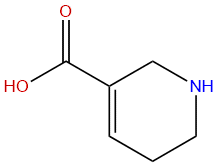


Product name: Guvacine HCl
Synonym name: Guvacine 498-96-4
Catalogue No.: BP4087
Cas No.: 6027-91-4
Formula: C6H9NO2(Free Base)
Mol Weight: 127.143
Botanical Source: 1,2,5,6-Tetrahydronicotinic acid
Physical Description:
Type of Compound: Alkaloids
Purity: 95%~99%
Analysis Method: HPLC-DAD or/and HPLC-ELSD
Identification Method: Mass, NMR
Packing: Brown vial or HDPE plastic bottle
Storage: Store in a well closed container, protected from air and light. Put into refrigerate or freeze for long term storage.
Whenever possible, you should prepare and use solutions on the same day. However, if you need to make up stock solutions in advance, we recommend that you store the solution as aliquots in tightly sealed vials at -20℃. Generally, these will be useable for up to two weeks.
The product could be supplied from milligrams to grams
Inquire for bulk scale.
For Reference Standard and R&D, Not for Human Use Directly.
Storage conditions:Short-term storage at 2~8℃, long-term storage at -20 ~ -80℃
Guvacine HCl (CAS number: 6027-91-4) is a naturally occurring alkaloid in Areca catechu, which has attracted much attention due to its unique neuroregulatory activity. As an effective inhibitor of gamma aminobutyric acid (GABA) uptake, norbetel nut alkaloid hydrochloride has important pharmacological significance in the field of neuroscience research. GABA, as the main inhibitory neurotransmitter in the central nervous system, plays a crucial role in regulating its uptake system to maintain a balance between neural excitation and inhibition. Norbetel nut alkaloid hydrochloride exhibits the potential to regulate neurotransmitter dynamics by inhibiting GABA transporters (GATs), particularly GAT-1, GAT-2, and GAT-3, thereby affecting the pathological processes of various neurological and psychiatric disorders.
In recent years, with a deeper understanding of the neural regulatory mechanisms, the mechanism of action, molecular targets, and pharmacological parameters of betel nut alkaloid hydrochloride have gradually been revealed, promoting its potential application research in the treatment of neurological diseases. This article aims to systematically review the chemical structure and physicochemical properties, plant sources and extraction methods, pharmacological activity, mechanism of action, pharmacological evaluation, and clinical application prospects of betel nut alkaloid hydrochloride. It is expected to provide scientific basis and research direction for the further development of this compound.
The molecular formula of betel nut alkaloid hydrochloride is C6H13NO2, with a molecular weight of 127.1430. Its structure is an organic base containing nitrogen atoms, specifically in the form of the hydrochloride salt of betel nut alkaloid. The LogP value of this compound is -1.9524, indicating its strong hydrophilicity and good water solubility (54.2116 mg/mL), which has a positive impact on the bioavailability and in vivo distribution of the drug. Its topological polar surface area (TPSA) is 49.33 Å ², indicating that its molecules have moderate polarity, which is conducive to penetrating biological membranes.
Betelnut alkaloid hydrochloride has a high blood-brain barrier (BBB) permeability, which is particularly important for central nervous system drugs. It does not inhibit hERG channels, and the Ames mutagenicity test result is 0.0, indicating high safety and low toxicity risk. These physicochemical and safety parameters have laid a solid foundation for its development as a neurological drug.
Betel nut alkaloid hydrochloride mainly exists in Areca catechu, a plant of the palm family and widely distributed in tropical Asia. The seeds and fruits of betel nut are rich in various alkaloids, among which betel nut alkaloids and their derivatives are the main ones. Betel nut alkaloid hydrochloride is one of its important components.
Traditional extraction methods often use solvent extraction combined with acid-base separation technology. The specific steps include: crushing the dried betel nut, extracting it with ethanol or methanol, concentrating the extract and adjusting the pH to acidity with hydrochloric acid to form a hydrochloride salt to improve water solubility. Subsequently, high-purity betel nut alkaloid hydrochloride was obtained through purification methods such as liquid-liquid extraction and column chromatography. Modern extraction techniques such as ultrasound assisted extraction and microwave-assisted extraction have also been applied to improve extraction efficiency and purity.
In addition, given the wide variety of alkaloids in betel nut, strict control of process parameters is required during the extraction process to avoid component degradation and impurity mixing, ensuring the production of products that meet pharmaceutical standards.
As a GABA uptake inhibitor, the main pharmacological effect of areca nut alkaloid hydrochloride is focused on regulating inhibitory neurotransmission in the central nervous system. In vitro experiments showed that the inhibitory effect of the compound on rat GABA transporters GAT-1, GAT-2, and GAT-3 was concentration dependent, with IC50 values of 39 μ M, 58 μ M, and 378 μ M, respectively, indicating that its inhibition of GAT-1 and GAT-2 was more significant.
GAT-1 is mainly distributed in neurons and astrocytes, responsible for the reuptake and clearance of GABA, and regulating the concentration of GABA in synaptic cleft. GAT-2 and GAT-3 are mainly present in cerebrospinal fluid and astrocytes, and are involved in non synaptic regulation of GABA. Norbetel nut alkaloid hydrochloride inhibits these transporters, prolongs the action time of GABA in synaptic cleft, and enhances GABA mediated neuroprotective effects.
Animal model studies have shown that betel nut alkaloid hydrochloride has anti anxiety, anti epileptic, and neuroprotective effects. In the anxiety model, the compound significantly reduced the anxiety behavior of animals, suggesting that it may achieve anti anxiety effects by enhancing GABAergic neurotransmission. In the epilepsy model, norbetel nut alkaloid hydrochloride prolongs the latency of epileptic seizures, reduces seizure frequency, and demonstrates good antiepileptic potential. In addition, its neuroprotective effect on neuronal ischemia-reperfusion injury models suggests its application value in neurodegenerative diseases.
The core mechanism of action of norbetel nut alkaloid hydrochloride is to inhibit GABA transporters, increase the concentration of GABA in synaptic cleft, and enhance GABA_A and GABA_B receptor-mediated inhibitory neurotransmission. This mechanism is of great significance for regulating neural excitability and maintaining neural network stability.
In addition to GABA transporters, norbetel nut alkaloid hydrochloride may also affect various neuroregulatory targets, including monoamine oxidase A (MAOA), monoamine oxidase B (MAOB), α 7-nicotinic acetylcholine receptor (CHRNA7), dopamine receptors (DRD1, DRD2, DRD3, DRD4, DRD5), and serotonin receptors (HTR1A, HTR2A). These targets play key roles in neurotransmitter metabolism, neural excitation regulation, and emotion control.
For example, MAOA and MAOB are involved in the metabolism of dopamine, norepinephrine, and serotonin, regulating emotions and cognitive function; CHRNA7 receptor regulates cognition and neuroprotection; Dopamine receptors and serotonin receptors are directly involved in regulating emotions, behavior, and mental states. The regulatory effect of betel nut alkaloid hydrochloride on these targets may synergize with its GABAergic mechanism, forming a multi-target and multi pathway neural regulatory network.
Molecular docking and in vitro binding experiments support the binding potential of norbetel nut alkaloid hydrochloride to the aforementioned targets, indicating its broad neuroregulatory activity, providing a theoretical basis for the development of new drugs targeting neurological and psychiatric disorders such as depression, anxiety, and Parkinson's disease.
From the perspective of medicinal properties, betel nut alkaloid hydrochloride exhibits multiple advantageous characteristics. Its molecular weight is relatively low (127-1430), which conforms to Lipinski's rule and is beneficial for oral absorption. A negative LogP value (-1.9524) indicates strong hydrophilicity, which facilitates dissolution and distribution in body fluids. The TPSA is 49.33 Å ², below the threshold of 90 Å ², indicating its good cell membrane permeability, especially the ability to cross the blood-brain barrier.
In terms of pharmacokinetics, betel nut alkaloid hydrochloride is expected to have good oral bioavailability due to its high water solubility and low molecular weight. Its high blood-brain barrier permeability enables it to effectively act on the central nervous system, meeting the key requirements of neurological drugs. The metabolic pathways in the body are not yet fully understood, but given their simple structure, they may mainly undergo relatively rapid metabolic transformation through the liver enzyme system.
The safety evaluation showed that norbetel nut alkaloid hydrochloride did not inhibit hERG channels and reduced the risk of arrhythmia. The Ames test result is negative, indicating no significant genetic toxicity. In addition, preliminary toxicological studies have not shown significant acute or subchronic toxicity, supporting further drug development.
Norbetel nut alkaloid hydrochloride, as an effective GABA uptake inhibitor, has broad potential for neural regulation, especially in anxiety disorders, epilepsy, depression, and neurodegenerative diseases, with promising application prospects. Its multi-target mechanism of action provides the possibility for multidimensional treatment of complex neurological diseases, especially in cases where the efficacy of single target drugs is limited, the multiple regulatory advantages of norbetel nut alkaloid hydrochloride are obvious.
Future research should focus on the following aspects: firstly, systematic pharmacokinetic and toxicological evaluation, clarifying its in vivo behavior and safe dose range; The second is to deeply analyze its interaction mechanism with multiple neural regulatory targets and reveal its multi-target synergistic effect; The third is to carry out efficacy verification of preclinical animal models, especially for behavioral and physiological indicators of neurological and psychiatric disorders; The fourth is to explore its potential in combination therapy, especially its synergistic effect with other neuroregulatory drugs.
In addition, based on the structural characteristics of betel nut alkaloid hydrochloride, chemical modification and drug design will also be effective strategies to enhance its efficacy and selectivity. By optimizing its structure, enhancing its selective inhibition of specific GABA transporter subtypes, or improving its pharmacokinetic performance, it will provide a more solid foundation for its clinical translation.
As a natural alkaloid derived from betel nut, the hydrochloride of betel nut alkaloids has shown broad research and application prospects in the field of neural regulation due to its unique mechanism of inhibiting GABA uptake. Its excellent physicochemical properties, high blood-brain barrier permeability, and safety provide favorable conditions for its development as a neurological drug. In the future, through in-depth pharmacological mechanism research, systematic pharmacokinetic and toxicological evaluations, as well as the advancement of preclinical and clinical studies, norbetel nut alkaloid hydrochloride is expected to become a new drug for the treatment of various neurological and psychiatric disorders, contributing to the improvement of patients' quality of life.
