


Product name: Apiin
Synonym name:
Catalogue No.: BP0182
Cas No.: 26544-34-3
Formula: C26H28O14
Mol Weight: 564.496
Botanical Source: Apium graveolens L.
Physical Description:
Type of Compound: Flavonoids
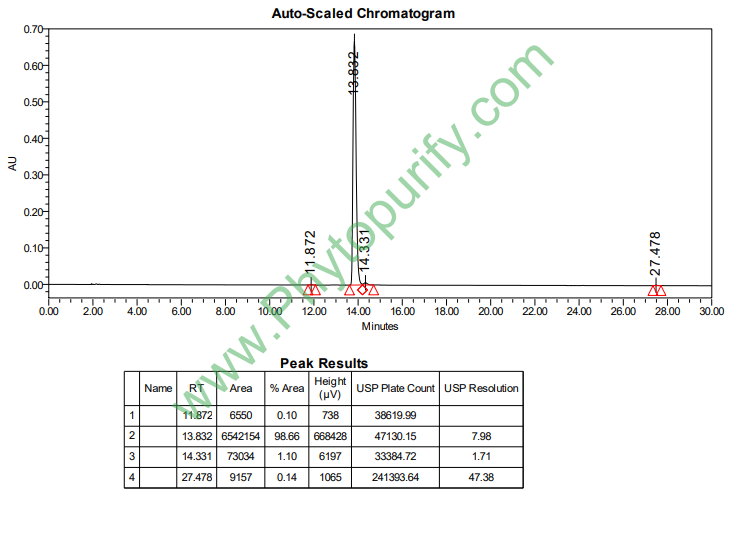
Purity: 95%~99%
Analysis Method: HPLC-DAD or/and HPLC-ELSD
Identification Method: Mass, NMR
Packing: Brown vial or HDPE plastic bottle
Storage: Store in a well closed container, protected from air and light. Put into refrigerate or freeze for long term storage.
Whenever possible, you should prepare and use solutions on the same day. However, if you need to make up stock solutions in advance, we recommend that you store the solution as aliquots in tightly sealed vials at -20℃. Generally, these will be useable for up to two weeks.
The product could be supplied from milligrams to grams
Inquire for bulk scale.
Chengdu Biopurify Phytochemicals Ltd. is a leading company in the research, development, manufacture and marketing of High Quality Phytochemicals and Extracts(especially Active Ingredients from Traditional Chinese Medicine,TCM), Natural Active Pharmaceutical Ingredients worldwide.
The main services:
A. Supply active ingredients and reference standards of TCM, from mgs to kgs scale
B. Custom extraction and purification, target Herb Active Ingredients
C. Custom synthesis and semi-synthesis for Natural Active Ingredients
D. CR(contract research), CM(contract manufacture) and PD(process development) services from lab scale, pilot scale to commercial scale(GMP is also available)
E. TCM compounds library for drug screen,more than 3000 compounds available, many of them are rare and unique.
HPLC of Apiin
Storage conditions:Short-term storage at 2~8℃, long-term storage at -20 ~ -80℃
228.9700
-.5068
-.5162
1.1367
.4815
.0749
Low
82.8739
4.6268
Yes
No
No
No
Yes
No
1.2
Yes
Yes
Yes
Yes
Flavonoids, as a widely distributed class of secondary metabolites in nature, have attracted much attention in pharmacological research due to their diverse biological activities. Apiin, also known as apigenin 7-O - β - D-apigenin glycosyl - (1 → 2) - β - D-glucoside, is a structurally unique flavonoid carbon glycoside with a CAS number of 26544-34-3. It is not only a characteristic component of various plants, especially Umbelliferae plants (such as celery), but also gradually stands out from many natural products due to its significant anti-inflammatory, antioxidant, and potential anti-tumor activities, becoming a research hotspot in the fields of natural product pharmacology and medicinal chemistry. Traditionally, plant extracts rich in apigenin have been used in folk medicine to alleviate inflammation related symptoms. Modern pharmacological research has gradually revealed that apigenin can exert its biological effects through multiple targets and pathways, especially as an effective inhibitor of inducible nitric oxide synthase (iNOS), playing a key role in regulating inflammatory responses. In addition, its potential interactions with various tumor related targets such as ABCB1, HIF1A, TOP2A, etc. provide scientific clues for its application in tumor prevention and adjuvant therapy. This article aims to systematically review the chemical properties, plant sources, pharmacological activities, mechanisms of action, medicinal properties, and clinical application prospects of apigenin, in order to provide comprehensive academic references for the deep development and utilization of this natural product.
Celery glycoside is a β - D-glucoside flavonoid compound with a molecular formula of C26H28O14 and a molecular weight of 564.4960. Its core structure is 5,7,4 '- trihydroxyflavone (i.e. apigenin), which is connected to a disaccharide chain through a glycosidic bond on the 7th hydroxyl group of the apigenin nucleus. The disaccharide chain consists of one molecule of β - D-glucose and one molecule of β - D-apiose, with apiose attached to glucose via (1 → 2) bonds, forming a unique apiose glycosidic structure. This glycosylation modification not only significantly affects its physicochemical properties, but is also closely related to its biological activity and metabolic stability.
From the analysis of physical and chemical properties, the theoretical lipid water partition coefficient (LogP) of apigenin is about -0.5068, indicating its good hydrophilicity. Its topological polar surface area (TPSA) is as high as 228.9700 Å ², mainly attributed to the numerous hydroxyl and glycosyl oxygen atoms in the molecule, which determine its strong ability to form hydrogen bonds. Both calculation and experimental data show that it has good water solubility (about 1.1367 mg/mL), which is beneficial for its absorption and distribution in organisms. However, the higher polarity and TPSA also limit its ability to penetrate the lipid bilayer, indicating lower blood-brain barrier permeability. In terms of preliminary safety assessment, the Ames test value of apigenin is 1.2, indicating a low risk of mutagenicity; Meanwhile, existing models predict that it has no significant inhibitory effect on hERG potassium channels, indicating a lower potential risk of arrhythmia. These basic pharmacological parameters lay the foundation for its subsequent pharmacological research.
Celery glycosides are mainly found in plants of the Umbelliferae family, with celery being the most common source(Apium graveolens L.), Especially in the leaves, stems, and seeds of celery, the content is relatively high. In addition, in parsley(Petroselinum crispum)Fennel(Foeniculum vulgare)And the presence of apigenin has also been found in some Asteraceae plants. Its content in the plant body is significantly affected by factors such as variety, growth environment, harvest season, and location.
The extraction of apigenin from plant materials is usually carried out using solvent extraction method. Due to the high polarity of apigenin, methanol, ethanol, or their aqueous solutions are commonly used extraction solvents. In order to improve extraction efficiency, modern extraction techniques such as ultrasound assisted extraction (UAE), microwave-assisted extraction (MAE), and pressurized liquid extraction (PLE) have been widely used. These methods destroy plant cell walls through physical means, accelerate solvent permeation and solute diffusion, and can achieve higher yields of apigenin in a shorter time and with less solvent. For example, using a 70% ethanol solution for ultrasonic extraction can effectively enrich apigenin from celery leaves.
The crude extract after extraction usually requires further separation and purification to obtain high-purity apigenin. The conventional purification strategy includes: first, using macroporous adsorption resins (such as AB-8, D101) for initial enrichment to remove most impurities such as sugars and proteins; Subsequently, intermediate purification was performed using silica gel column chromatography, polyamide column chromatography, or preparative thin-layer chromatography; The final high-purity preparation relies heavily on high-performance liquid chromatography, especially preparative reverse phase high-performance liquid chromatography (Prep HPLC), which uses a C18 column and gradient elution with methanol water or acetonitrile water (often containing a small amount of formic acid or acetic acid to adjust pH) as the mobile phase. Structural confirmation was performed through nuclear magnetic resonance (NMR), mass spectrometry (MS), and comparison with standard samples.
A large number of pharmacological studies in vitro and in vivo have confirmed that apigenin has various biological activities, among which anti-inflammatory and antioxidant effects are the most prominent, and it has potential effects such as anti-tumor and cardiovascular protection.
1. Anti inflammatory activity:
The anti-inflammatory effect of apigenin is its most concerned pharmacological characteristic. In the J774.A1 macrophage model stimulated by lipopolysaccharide (LPS), apigenin can dose dependently inhibit the excessive production of nitric oxide (NO) by downregulating the protein and mRNA expression of inducible nitric oxide synthase (iNOS). NO is a key mediator in the inflammatory response, and its excessive production is associated with various chronic inflammatory diseases. In addition, studies have shown that apigenin can inhibit the release of pro-inflammatory cytokines such as TNF - α, IL-6, IL-1 β, and may exert a wide range of anti-inflammatory effects by regulating the activation of inflammatory signaling pathways such as nuclear factor kappa B (NF - κ B) and mitogen activated protein kinases (MAPKs). In animal models of acute inflammation such as carrageenan induced paw edema in rats, apigenin also showed good anti-inflammatory effects.
2. Antioxidant activity:
The phenolic hydroxyl group in the structure of apigenin is the chemical basis for its antioxidant capacity. It can directly scavenge free radicals such as DPPH free radicals, ABTS ⁺ free radicals, and superoxide anions, exhibiting significant in vitro antioxidant capacity. In addition, it can enhance the endogenous antioxidant defense system of cells, such as upregulating the activity of superoxide dismutase (SOD) and glutathione peroxidase (GSH Px), and reducing oxidative stress damage caused by the accumulation of reactive oxygen species (ROS). This antioxidant effect complements its anti-inflammatory, anti apoptotic, and cell protective effects.
3. Antitumor potential:
Although apigenin is classified as a compound related to "benign tumors", its target of action suggests broad anti-tumor research value. Research has shown that apigenin may interfere with the growth and survival of tumor cells through multiple pathways:
- Reverse multidrug resistance (MDR): Its related target ABCB1 (P-glycoprotein) is one of the main MDR proteins that lead to tumor chemotherapy failure. Celery glycoside may act as a regulator of ABCB1, inhibiting its efflux pump function, thereby increasing the accumulation of chemotherapy drugs in tumor cells and enhancing chemotherapy sensitivity.
- Inhibition of tumor angiogenesis: The target HIF-1 α (hypoxia inducible factor-1 α) is a key transcription factor for tumors to adapt to hypoxic environments and promote angiogenesis. Celery glycoside may interfere with the stability or transcriptional activity of HIF-1 α, thereby inhibiting tumor angiogenesis.
- Affects DNA topology: TOP2A (Topoisomerase II α) is an enzyme essential for DNA replication and transcription, and is also a target of many chemotherapy drugs. Celery glycoside may interfere with tumor cell DNA metabolism by affecting TOP2A function.
- Inducing cell cycle arrest and apoptosis: Some studies suggest that apigenin can induce G2/M phase cell cycle arrest in certain cancer cells, activate the caspase pathway, and promote cell apoptosis.
- Inhibition of transfer related enzymes: As an inhibitor of extracellular alpha sialidase (EC 3.2.1.18), apigenin may affect cell surface glycosylation, thereby interfering with the adhesion, migration, and invasion processes of tumor cells.
4. Other activities:
Celery glycoside also has potential activities such as antibacterial, antiviral, hepatoprotective, and hypoglycemic effects. For example, it can reduce sorbitol accumulation by inhibiting the activity of aldose reductase (AKR1B1), which has potential significance for the prevention and treatment of complications of diabetes.
The pharmacological effects of apigenin are the result of its interaction with multiple molecular targets and regulation of complex cellular signaling networks. The main mechanisms and targets revealed by current research include:
1. Inhibition of iNOS/NO pathway:
This is the core mechanism of the anti-inflammatory effect of apigenin. Under inflammatory stimuli such as LPS, apigenin can effectively prevent the activation of the NF - κ B signaling pathway. It may inhibit the activity of I κ B kinase (IKK), prevent the phosphorylation and degradation of I κ B α, thereby suppressing the nuclear translocation of NF - κ B p65 subunit and its binding to DNA, ultimately downregulating the transcription of inflammation related genes such as iNOS. Meanwhile, inhibition of MAPK pathways such as p38 and JNK may also be involved.
2. Regulating oxidative stress and Nrf2 pathway:
In addition to directly clearing free radicals, apigenin can also activate the key transcription factor for cell defense against oxidative stress - nuclear factor E2 related factor 2 (Nrf2). Celery glycoside may promote the dissociation and transfer of Nrf2 from the cytoplasmic chaperone protein Keap1 into the nucleus, binding to antioxidant response elements (ARE) and initiating the expression of a series of downstream phase II detoxifying enzymes and antioxidant enzymes (such as HO-1, NQO1, GCLC), thereby systematically enhancing the antioxidant capacity of cells.
3. Intervention in tumor related signaling pathways and targets:
- ABCB1/P-gp: Celery glycoside may act as a competitive or allosteric inhibitor, directly binding to the drug binding site or ATP binding site of ABCB1, inhibiting its ATPase activity and thereby blocking its efflux function towards substrate chemotherapy drugs.
- HIF-1α: In the hypoxic microenvironment of tumors, apigenin may reduce the protein synthesis of HIF-1 α by inhibiting upstream signaling pathways such as PI3K/Akt/mTOR or MAPK; Or by promoting its degradation through the ubiquitin proteasome pathway, reducing its protein stability.
- TOP2A: Celery glycoside may stabilize the "cleavage complex" formed between TOP2A and DNA in a manner similar to certain flavonoids, leading to DNA double strand breaks that cannot be reconnected and triggering DNA damage reactions.
- ABL1: Although there is limited research, as a non receptor tyrosine kinase, ABL1 plays an important role in cell proliferation and stress response, and apigenin may have a regulatory effect on its activity.
4. Inhibit sialidase:
The inhibitory effect of apigenin on EC 3.2.1.18 (exonuclease - α - sialidase) may affect the sialylation levels of cell surface glycoproteins and glycolipids, thereby regulating intercellular recognition, immune response, and pathogen infection processes.
Although apigenin has shown good biological activity in vitro, its drug affinity and in vivo pharmacokinetic behavior are key factors determining its successful development as a drug.
Drug Evaluation:
Based on its physicochemical properties, apigenin meets most of the conditions in the Rule of Five for class drugs (except for 564 for molecular weight<500; hydrogen bond donor<5; hydrogen bond acceptor<10; LogP<5), but its larger molecular weight and higher polarity are the main challenges for oral absorption. Its good water solubility is beneficial for formulation development, but its low lipid solubility and high TPSA may result in low oral bioavailability and difficulty in crossing the blood-brain barrier. The preliminary safety warning (hERG negative, Ames negative) provides a good starting point for it.
Pharmacokinetic studies:
At present, there is relatively limited pharmacokinetic research on the apigenin system, but based on the study of its glycoside structure and analogues, its general behavior can be inferred:
- Absorption: After oral administration, apigenin may be partially absorbed in its original form in the gastrointestinal tract, but more importantly, it is hydrolyzed by glycosidases secreted by the gut microbiota to form aglycones such as apigenin, which are absorbed. Its absorption rate and degree may be affected by food and gut microbiota status.
- Distribution: After absorption, the prototype drug and its metabolites are widely distributed in the body, but due to their high polarity, they are mainly distributed in tissues such as blood, liver, and kidneys, with less amount entering the brain and adipose tissue.
- Metabolism: The liver is its main metabolic site. In addition to hydrolysis reactions, apigenin and its aglycones may undergo extensive phase II metabolism, including glucuronidation, sulfation, methylation, etc., producing various metabolites. These metabolic processes are the main reason for their rapid clearance in the body, and may also generate new active or inactive substances.
- Excretion: Metabolites are mainly excreted in urine through the kidneys, and some may also enter the intestine through bile and be excreted in feces.
To improve its bioavailability, pharmaceutical strategies such as developing phospholipid complexes, cyclodextrin inclusion complexes, nanoemulsions, solid dispersions, or liposomes are important directions for future research.
Celery glycoside, as a natural active ingredient with multiple targets and functions, has shown broad application prospects in the prevention and treatment of various diseases, but also faces many challenges.
Potential application areas:
1. Chronic inflammatory diseases: As a natural iNOS inhibitor and anti-inflammatory agent, apigenin is expected to be developed as a functional food or plant medicine for adjuvant treatment of arthritis, colitis, atherosclerosis, neuroinflammation (such as Alzheimer's disease), etc.
2. Tumor adjuvant therapy and chemoprevention: It has multiple mechanisms such as reversing multidrug resistance, inhibiting angiogenesis, and inducing apoptosis, making it a potential sensitizer or adjuvant therapy for tumor chemotherapy. Meanwhile, its antioxidant and anti-inflammatory properties are also applicable for chemoprevention of tumors.
3. Metabolic disorders: It may improve diabetes and its complications (such as cataract and neuropathy) by inhibiting AKR1B1 and antioxidant stress.
4. Functional food and cosmetic additives: With its antioxidant and anti-inflammatory properties, it can be widely used in health foods, beverages, and cosmetics with anti-aging and skin soothing effects.
Challenges and future research directions:
1. In depth study of the mechanism of action: At present, the understanding of the target of apigenin is still mainly based on correlation analysis and preliminary verification, and it is necessary to use chemical biology methods (such as affinity fishing, molecular docking, gene knockout/knockdown) to clarify its direct target and precise molecular mechanism.
2. Preclinical and clinical studies of the system: It is urgent to carry out standardized animal pharmacological evaluations to verify their efficacy and optimal dosing regimens in different disease models. More importantly, a comprehensive preclinical safety evaluation (acute toxicity, chronic toxicity, reproductive toxicity, etc.) must be conducted and ultimately advanced to clinical trials to confirm its safety and efficacy in the human body.
3. Optimization of drug properties: To address the bottleneck of low bioavailability, it is necessary to strengthen pharmaceutical and medicinal chemistry research. By modifying its structure (such as preparing prodrugs, synthesizing derivatives) or developing novel delivery systems, its solubility, membrane permeability, and metabolic stability can be improved.
4. Resources and Sustainability: Develop efficient and environmentally friendly extraction and purification processes, and explore biosynthetic pathways (such as synthetic biology) to meet the needs of future large-scale production.
Celery glycoside, as a plant derived flavonoid carbon glycoside, has become an important bridge connecting traditional medicinal wisdom with modern pharmacological research due to its unique chemical structure and rich pharmacological activity. From inhibiting iNOS expression to exert anti-inflammatory effects, to regulating multiple tumor related targets such as ABCB1 and HIF1A to demonstrate anti-tumor potential, its multi-target action characteristics are in line with the concept of modern multifactorial disease treatment. Despite facing challenges such as bioavailability in drug development, as the mechanism of action is further elucidated, drug delivery technology advances, and systematic clinical research is conducted, apigenin is expected to gradually move from a potential lead compound to a functional candidate or high-value functional ingredient. In the future, interdisciplinary collaborative research will accelerate the revelation of the comprehensive value of apigenin, providing an important natural source and scientific basis for the development of new anti-inflammatory, anti-tumor, and metabolic disease treatment drugs.
