


Product name: Apigenin
Synonym name: 4',5,7-Trihydroxyflavone; Apigenol; Pelargidenone; Versulin
Catalogue No.: BP0177
Cas No.: 520-36-5
Formula: C15H10O5
Mol Weight: 270.24
Botanical Source: Found free or as glycosides in the stems, roots, leaves, seeds or fruit of a very wide range of plant spp. Found also in some fossil leaf tissues
Physical Description: Yellow powder
Type of Compound: Flavonoids
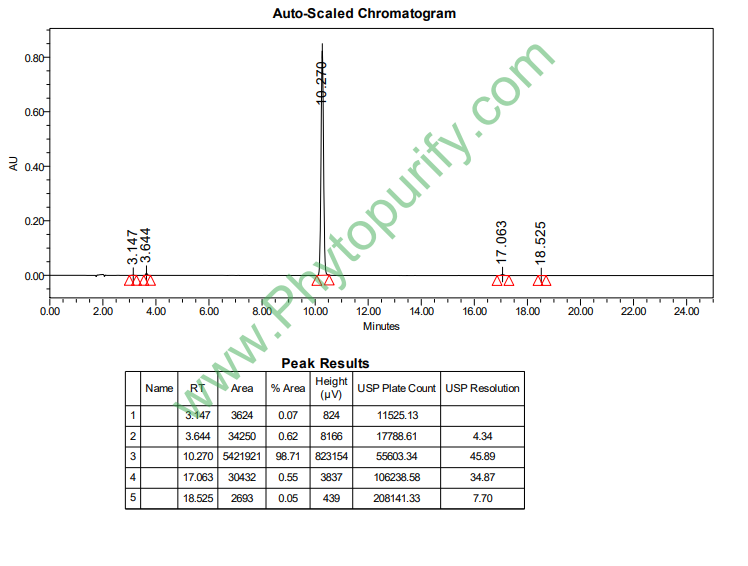
Purity: 95%~99%
Analysis Method: HPLC-DAD or/and HPLC-ELSD
Identification Method: Mass, NMR
Packing: Brown vial or HDPE plastic bottle
Storage: Store in a well closed container, protected from air and light. Put into refrigerate or freeze for long term storage.
Whenever possible, you should prepare and use solutions on the same day. However, if you need to make up stock solutions in advance, we recommend that you store the solution as aliquots in tightly sealed vials at -20℃. Generally, these will be useable for up to two weeks.
The product could be supplied from milligrams to grams, up to kilograms
Inquire for bulk scale.
Descriptions:
Apigenin, a naturally occurring plant flavone (4', 5, 7,-trihydroxyflavone) abundantly present in common fruits and vegetables including parsley, onions, oranges, tea, chamomile, wheat sprouts and some seasonings, has been shown to possess remarkable anti-inflammatory, antioxidant and anti-carcinogenic properties. [1]
Apigenin may have the potential for prevention and therapy for prostate cancer, apigenin treatment resulted in induction of apoptosis as determined by DNA fragmentation, PARP cleavage, fluorescence microscopy and flow cytometry, also resulted in down-modulation of the constitutive expression of NF-kappaB/p65.[2]
Apigenin has anti-hepatoma activity is as effective as 5-FU and its apoptotic mechanism might be mediated through the p53-dependent pathway and the induction of p21 expression.[3]
Apigenin possesses therapeutic potential against cancers, the combination of gemcitabine and apigenin enhances anti-tumor efficacy through Akt and NF-kappa B activity suppression and apoptosis induction.[4]
References:
[1] Patel D, Shukla S, Gupta S. Int J Oncol, 2007, 30(1):233-45.
[2] Gupta S, Afaq F, Mukhtar H. Oncogene, 2002, 21(23):3727-38.
[3] Chiang, Lien-Chai, Ng, et al. Cancer Lett, 2006, 237(2):207-14.
[4] Lee S H, Ryu J K, Lee K Y, et al. Cancer Lett, 2008, 259(1):39-49.
[5] Yang H Y, Wang X M, Gang D U, et al. Lishizhen Medicine & Materia Medica Research, 2008, 19(12):2994-5.
HPLC of Apigenin
Storage conditions:Short-term storage at 2~8℃, long-term storage at -20 ~ -80℃
90.9000
2.2045
1.8956
.0625
2.0408
12.1405
Low
91.2511
2.2527
Yes
No
Yes
No
Yes
No
0.6
Yes
No
Yes
No
Natural products, as a treasure trove of drug discovery, play an irreplaceable role in the history of human disease prevention and treatment. Flavonoids, as one of the major categories, have attracted much attention for their wide range of biological activities and low toxicity. Apigenin (CAS number: 520-36-5), chemical name 4 ', 5,7-trihydroxyflavone, is one of the typical representatives of flavonoids. It is widely present in various vegetables, fruits (such as celery, parsley, chamomile, grapefruit), and Chinese herbs (such as honeysuckle, summer dry grass), and is a common phytochemical component in daily diet.
Early research mainly focused on its antioxidant properties. However, with the development of molecular pharmacology, apigenin exhibits multidimensional biological activities far beyond antioxidant, including significant anti-inflammatory, anti angiogenic, neuroprotective, cardioprotective, and broad-spectrum anti-cancer potential. Its mechanism of action involves precise regulation of multiple signaling pathways and key targets, such as inhibiting the nuclear factor kappa B (NF - κ B) pathway, regulating the mitogen activated protein kinase (MAPK) pathway, inducing cell cycle arrest and apoptosis, etc. In recent years, research has further revealed its potential value in antiviral (such as inhibiting the replication of enterovirus 71 EV71) and metabolic diseases.
It is worth noting that the research on apigenin has shifted from basic activity screening to deeper mechanisms of action and disease associations. For example, its interaction with rare disease-related targets such as ESR2 and NFE2L2 in Miyoshi myopathy provides clues for exploring new therapeutic strategies. This article aims to systematically review the chemical properties, plant sources, multidimensional pharmacological activities, molecular mechanisms of action, medicinal characteristics, and clinical application prospects of apigenin, in order to provide comprehensive academic references for the in-depth development and transformation research of this natural product.
Celery extract is a trihydroxyflavone, with its basic parent nucleus being 2-phenylchromenone. Specifically, its chemical structure is the substitution of hydroxyl groups (- OH) at the 7th position of the A ring and the 4th and 5th positions of the B ring in the flavonoid skeleton, forming a 4 ', 5,7-trihydroxyflavonoid structure. Its molecular formula is C15H10O5 and its molecular weight is 270.24 g/mol.
This specific hydroxyl substitution pattern is the structural basis for its physicochemical properties and biological activity. Three phenolic hydroxyl groups endow it with excellent hydrogen bond donor ability, with a total polar surface area (TPSA) of 90.9 Å ², which affects its solubility and interaction with biomolecules. The lipid water partition coefficient (LogP) of apigenin is about 2.20, indicating that it has moderate lipophilicity and can passively diffuse through cell membranes, but at the same time, it also limits its solubility in water (about 0.0625 mg/mL, which is slightly soluble). Therefore, its bioavailability faces challenges and is often improved through structural modifications or delivery systems such as nanomaterials and phospholipid complexes.
In terms of spectral characteristics, apigenin exhibits characteristic absorption in the ultraviolet region, with maximum absorption wavelengths typically around 267 nm and 338 nm, corresponding to the absorption of the B-cyclic cinnamoyl system and the A-cyclic benzoyl system, respectively. Its crystals are usually yellow needle shaped. Celery extract can undergo extensive metabolism both in vivo and in vitro, including II binding reactions such as glucuronidation, sulfation, and methylation, producing various metabolites such as apigenin 7-glucuronide. It is also an effective inhibitor of CYP2C9, indicating the potential risk of drug drug interactions when used in combination therapy.
Celery extract is widely distributed in nature and is a secondary metabolite of many edible and medicinal plants.
Main plant sources:
1. Vegetables and Vanilla: Celery(Apium graveolens)The leaves and stems are the source of its name, but the content is not the highest. Parsley(Petroselinum crispum)It is one of the most abundant sources in the diet. In addition, onions, broccoli, and thistle also contain a certain amount of apigenin or its glycosides.
2. fruit Citrus fruits, such as grapefruits and oranges, have a higher content in their skin and flesh.
3. Medicinal plants and flowers Chamomile(Matricaria chamomilla)It is an important source of apigenin in traditional herbs and is commonly used in tea drinks. Honeysuckle flower(Lonicera japonica)Summer withered grass(Prunella vulgaris)Scutellaria baicalensis(Scutellaria baicalensis)Commonly used traditional Chinese medicines also contain apigenin or its derivatives.
4. Other Some grains and beans also contain small amounts of apigenin.
In plants, apigenin often exists in the form of glycosides (such as apigenin 7-O-glucoside), which are usually more water-soluble but require hydrolysis by glycosidases in gut microbiota or tissues to form aglycones before they can be fully absorbed and exert their main biological activity.
Extraction and Separation Methods:
Obtaining apigenin from plant materials usually follows the conventional process of natural product chemistry:
1. Extract Common solvent extraction methods include hot reflux extraction, ultrasound assisted extraction, microwave-assisted extraction, etc. Methanol, ethanol, acetone, and their aqueous solutions are commonly used solvents due to their good solubility in flavonoids. Supercritical CO2 extraction technology is also used for the extraction of high-purity apigenin due to its advantages of being green, efficient, and solvent-free.
2. Enrichment and Purification After concentration, the crude extract is preliminarily enriched with flavonoids through liquid-liquid extraction (such as extraction with ethyl acetate or n-butanol). Further purification relies on column chromatography techniques such as silica gel column chromatography, polyamide column chromatography, and high-performance liquid chromatography (HPLC) preparative chromatography. According to the polarity of the target product, different ratios of gradient elution systems such as chloroform methanol and petroleum ether ethyl acetate are selected.
3. appraisal The purified compound was structurally confirmed by melting point determination, ultraviolet spectroscopy (UV), infrared spectroscopy (IR), mass spectrometry (MS), and nuclear magnetic resonance spectroscopy (NMR, especially 1H-NMR and 13C-NMR). High performance liquid chromatography-mass spectrometry (HPLC-MS) is commonly used for qualitative and quantitative analysis of apigenin in complex samples.
A large number of in vitro and in vivo studies have confirmed that apigenin has diverse pharmacological activities, and its core functions can be summarized as follows:
1. Anti inflammatory and immune regulatory activity
Celery extract is a classic natural anti-inflammatory agent. It can effectively inhibit the excessive production of nitric oxide (NO), prostaglandin E2 (PGE2), and pro-inflammatory cytokines (such as TNF - α, IL-1 β, IL-6) in macrophages induced by stimuli such as lipopolysaccharide (LPS). Its anti-inflammatory effect is closely related to the inhibition of inducible nitric oxide synthase (iNOS) and cyclooxygenase-2 (COX-2) expression, providing potential therapeutic ideas for inflammation related diseases such as arthritis, colitis, and asthma.
2. Antitumor activity
Apigenin has growth inhibition and apoptosis promoting effects on a variety of cancer cell lines (such as breast cancer, lung cancer, prostate cancer, colon cancer, leukemia, liver cancer), while its toxicity to normal cells is relatively low, showing good selectivity. Its anti-cancer mechanisms are diverse, including inducing cell cycle arrest (often in the G2/M phase), activating mitochondrial and endoplasmic reticulum stress pathways to induce apoptosis, inducing autophagy (such as in leukemia cells), inhibiting cancer cell invasion and metastasis, and inhibiting angiogenesis (anti angiogenesis). These characteristics make it a candidate molecule for cancer chemoprevention and adjuvant therapy.
3. Cardiovascular protective effect
Celery extract exerts cardiovascular protective effects through multiple pathways such as antioxidant stress, inhibition of abnormal proliferation of vascular smooth muscle cells, improvement of endothelial function, and antiplatelet aggregation. Animal models show that it can alleviate atherosclerosis, reduce myocardial ischemia-reperfusion injury, and has the potential of anti hypertension and anti arrhythmia.
4. Neuroprotective and anti anxiety effects
Celery extract can cross the blood-brain barrier (although with low permeability) and exert its effects in the central nervous system. It exhibits anti anxiety and mild sedative effects, and its mechanism may be related to regulating the gamma aminobutyric acid (GABA) system. In addition, its powerful antioxidant and anti-inflammatory properties help to combat oxidative damage and neuroinflammation in neurodegenerative diseases such as Alzheimer's disease and Parkinson's disease, and can exert protective effects by regulating pathways such as Nrf2.
5. Antiviral and antibacterial activity
Research has shown that apigenin can effectively inhibit the replication of enterovirus 71 (EV71) by inhibiting the activity of the internal ribosome entry site (IRES) of the virus and regulating the c-Jun N-terminal kinase (JNK) signaling pathway in host cells. This has implications for the prevention and treatment of hand, foot, and mouth disease. In addition, it also has inhibitory effects on certain bacteria and fungi.
6. Association with other diseases
Emerging research suggests that apigenin can be used in metabolic diseases (such as diabetes and its complications), osteoarthritis, and some rare diseases such as miyoshi myopathy It may have a regulatory effect. Its effect may be achieved by affecting related targets such as ESR2 and NFE2L2, which expands the research scope of its clinical application.
The pleiotropic pharmacological effects of apigenin stem from its extensive regulation of cellular signaling networks. Its function is not through a single target, but through "multi-target, micro regulation" that affects multiple key pathways and molecules.
1. Regulation of core signaling pathways
* NF - κ B pathway Celery extract is an effective inhibitor of the NF - κ B pathway. It can prevent the phosphorylation and degradation of I κ B α, thereby inhibiting NF - κ B nuclear translocation and the transcription of downstream pro-inflammatory and pro survival genes (such as COX-2, iNOS, Bcl-2, cyclin D1), which is one of its core mechanisms for anti-inflammatory and anticancer effects.
* MAPK pathway Celery extract can regulate the phosphorylation levels of MAPK family members (ERK, JNK, p38). Its regulatory effect varies in different cellular environments. For example, when inhibiting EV71 virus replication, it downregulates JNK phosphorylation; In some cancer cells, it may activate the JNK/p38 pro apoptotic pathway.
* PI3K/Akt pathway This pathway is a key regulator of cell survival and proliferation. Celery extract is often reported to inhibit the phosphorylation of PI3K and Akt, thereby promoting apoptosis and enhancing sensitivity to chemotherapy drugs.
* Nrf2/ARE pathway As the main regulator of cellular antioxidant defense, the Nrf2 pathway is an important mediator for apigenin to exert antioxidant and cell protective effects. Celery extract can promote Nrf2 nuclear translocation, activate antioxidant response elements (ARE), upregulate the expression of phase II detoxifying enzymes and antioxidant proteins such as heme oxygenase-1 (HO-1) and quinone oxidoreductase 1 (NQO1).
2. Key molecular targets
* Cell cycle and apoptosis related proteins Apigenin upregulates p53, p21/WAF1, downregulates cyclins (such as cyclin D1, cyclin B1) and cyclin dependent kinases (such as CDK4, CDK6)Leading to cell cycle arrest. At the same time, it regulates the balance of Bcl-2 family proteins (upregulation of pro apoptotic Bax/Bak and downregulation of anti apoptotic Bcl-2/Bcl xL), activating the caspase cascade reaction.
* Epigenetic regulatory targets Celery extract is an inhibitor of histone deacetylase (HDAC), particularly exhibiting inhibitory effects on HDAC1, 2, 3, and 8. This leads to high acetylation of histones, chromatin relaxation, and activation of the expression of certain tumor suppressor genes.
* Hormone receptors and transcription factors Celery extract can interact with estrogen receptor β(ESR2)It may be related to its role in breast cancer and bone metabolism. As a core transcription factor for antioxidant stress,NFE2L2(Nrf2) It is an important direct or indirect target of its action.
* Transporters and ion channels Research suggests that apigenin may affect multidrug resistance associated protein 1(ABCC1/MRP1)This is related to its ability to reverse the potential of tumor multidrug resistance. Regulating factors of transmembrane conduction in cystic fibrosis(CFTR)In related studies, apigenin has also been explored as a potential regulator, which intersects with research on diseases such as Miyoshi myopathy.
* Cytochrome P450 enzyme As mentioned earlier, apigenin is an effective inhibitor of CYP2C9, which is a key pharmacokinetic target affecting drug metabolism.
Despite its wide range of biological activities, apigenin faces challenges in drug development due to its poor solubility and oral bioavailability.
Pharmacokinetic characteristics:
* absorb After oral administration, apigenin is mainly absorbed in the intestine through passive diffusion. However, its glycoside form has low solubility, and the binding reactions of glucuronidation and sulfation in the intestine are very rapid, resulting in low absolute bioavailability (estimated to be less than 10% in animal studies). After ingestion of its glycoside form (such as apigenin 7-glucoside), it needs to be hydrolyzed by gut microbiota, and absorption may be slightly improved, but the first pass effect is still significant.
* distribution After absorption, apigenin rapidly binds to plasma proteins and is widely distributed to various tissues throughout the body, including the liver, lungs, kidneys, etc. Due to its moderate LogP value but high TPSA, its penetration blood-brain barrier The ability is predicted and confirmed as low But it is not completely impossible to enter the central nervous system.
* Metabolism The liver is the main site of apigenin metabolism, and II binding reactions (glucuronidation and sulfation) are its main metabolic pathways. In addition, I-phase reactions such as methylation and hydroxylation also occur. Its properties as a CYP2C9 inhibitor may affect the blood drug concentration of drugs metabolized by the enzyme, such as warfarin.
* excretion Celery extract and its metabolites are mainly excreted through urine and bile.
safety evaluation:
Existing toxicological data indicate that apigenin has a high level of safety.
* Genotoxicity:Ames test result 0.6(Usually expressed as a multiple of the number of mutant colonies relative to the control, less than 2 is considered negative), indicating that it is non mutagenic under testing conditions.
* cardiotoxicity:HERG inhibition The experimental results are as follows:No This indicates that it does not pose a risk of prolonging the QT interval in the heart, which is an important cardiac safety indicator.
* Acute and subchronic toxicity Animal experiments have shown that even at higher doses, the acute toxicity of apigenin is very low. Long term drug administration studies have not found significant organ toxicity.
Optimization strategy for drug properties:
To improve its bioavailability and efficacy, researchers have adopted various strategies:
1. Structural modification Synthesize prodrugs with higher lipid solubility (such as esterified derivatives) or derivatives with better water solubility (such as phosphate esters, amino acid conjugates).
2. New delivery system Using nanotechnology, such as preparing apigenin nanocrystals, liposomes, solid lipid nanoparticles, polymer micelles, etc., significantly improves their solubility, stability, and targeting.
3. Phospholipid complex Forming complexes with phospholipids can improve their lipid solubility and membrane permeability.
4. Eutectic/co amorphous Forming eutectic or co amorphous systems with other medicinal excipients to alter their solid-state properties and increase dissolution rate.
Celery extract has gone from being a dietary component to a clinical therapeutic drug, with broad prospects, but the path still needs to be explored.
Current application and clinical research stage:
At present, apigenin is mainly circulated in the market as a dietary supplement and functional food ingredient. Most of its clinical research is in the early stages (Phase I or II), exploring its potential in cancer adjuvant therapy, inflammatory diseases, metabolic syndrome, and other areas. For example, there are clinical trials evaluating the effect of apigenin supplements on the quality of life and biomarkers of patients with breast cancer, or on the improvement of symptoms of patients with knee osteoarthritis.
Future development direction:
1. Exploration of mechanism based precision therapy In depth research on the interaction between apigenin and specific disease targets (such as ESR2, NFE2L2, CFTR, etc. related to Miyoshi myopathy) may open up new pathways for its application in rare diseases and specific subtypes of cancer. Its characteristics as an HDAC inhibitor and Nrf2 activator are worthy of further exploration in epigenetic therapy and oxidative stress-related diseases.
2. Combination therapy strategy By utilizing the multi-target properties and chemotherapy sensitization effect of apigenin, it is expected to be combined with existing chemotherapy drugs, targeted drugs, or immune checkpoint inhibitors to reduce their dosage, minimize toxic side effects, and overcome drug resistance. This is a highly promising direction for transformation.
3. Breakthrough in formulation technology Developing an efficient, stable, and targeted new delivery system for apigenin is the key to solving its drug development bottleneck and achieving clinical translation. Intelligent responsive nanomaterials (such as pH responsive and enzyme responsive) may achieve precise drug release at disease sites.
4. Synthetic Biology Production With the development of synthetic biology technology, the efficient and sustainable production of apigenin and its rare derivatives using microbial cell factories (such as yeast and Escherichia coli) is expected to solve the resource, cost, and environmental problems faced by plant extraction.
5. Population nutrition intervention and preventive medicine Given its extremely high dietary safety and extensive health benefits, in-depth research on the long-term health benefits of specific populations (such as cancer high-risk individuals, chronic inflammation patients) consuming apigenin through diet or supplements has important public health implications.
As an outstanding representative of natural flavonoids, the research process of apigenin reflects a profound leap from traditional edible value to modern molecular pharmacology. It exhibits remarkable biological activity in multiple dimensions, including anti-inflammatory, anticancer, neuroprotective, and cardiovascular protection, through its unique chemical structure of 4 ', 5,7-trihydroxyflavone and its multi-target and multi pathway mode of action. Although its poor solubility and bioavailability pose major obstacles to clinical translation, modern pharmaceutical and medicinal chemistry technologies are providing powerful solutions for this.
From inhibiting the NF - κ B inflammatory pathway to activating Nrf2 antioxidant defense, from inducing tumor cell apoptosis to regulating rare disease-related targets, the mechanism network of action of apigenin is becoming increasingly clear. Future research should focus more on: 1) validating its efficacy and elucidating precise mechanisms in specific disease models, especially those closely related to targets such as ESR2 and NFE2L2; 2) Promote the development of formulations based on novel delivery systems and complete preclinical and clinical evaluations of the systems; 3) Explore its maximum value as a "chemical sensitizer" or "disease modifier" in combination therapy.
In summary, apigenin is not only an important lead compound that provides a template for designing novel multi-target drugs, but also has great potential to be developed into an innovative drug for treating specific inflammatory diseases, cancer, or metabolic diseases through formulation innovation and indication focus. Continuous and in-depth research on it will undoubtedly contribute significant efforts to the modernization of natural product development and human health.
