


Product name: Solasodine
Synonym name: Solancarpidine; Purapuridine; Solanidine S; Solancarpine
Catalogue No.: BP1322
Cas No.: 126-17-0
Formula: C27H43NO2
Mol Weight: 413.646
Botanical Source: Solanum nigrum L.
Physical Description:
Type of Compound: Alkaloids
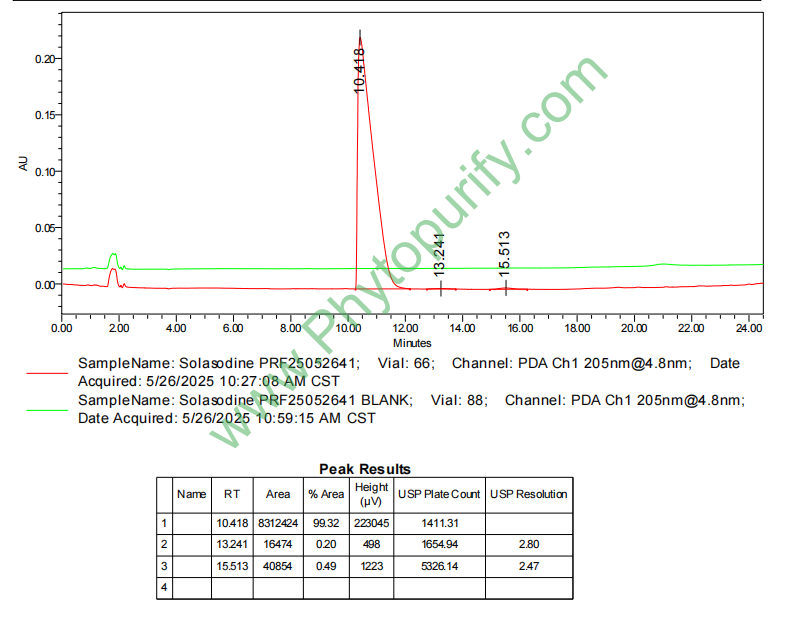
Purity: 95%~99%
Analysis Method: HPLC-DAD or/and HPLC-ELSD
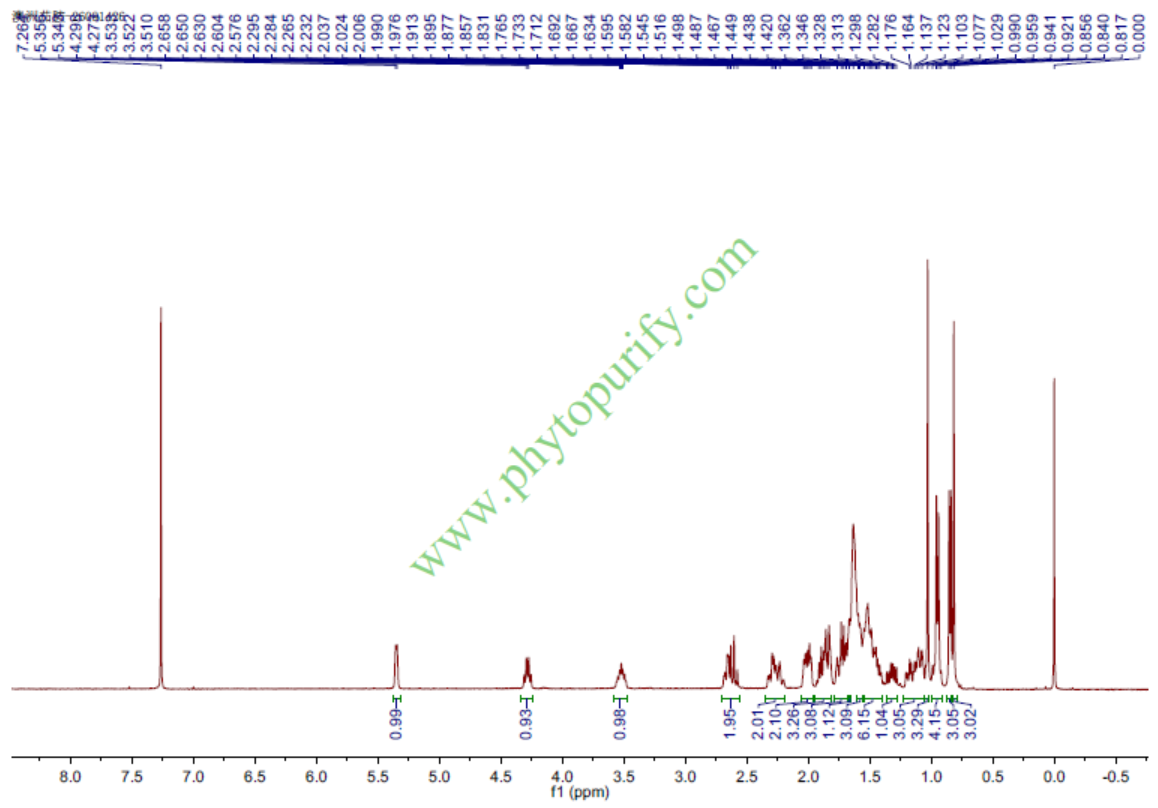
Identification Method: Mass, NMR
Packing: Brown vial or HDPE plastic bottle
Storage: Store in a well closed container, protected from air and light. Put into refrigerate or freeze for long term storage.
Whenever possible, you should prepare and use solutions on the same day. However, if you need to make up stock solutions in advance, we recommend that you store the solution as aliquots in tightly sealed vials at -20℃. Generally, these will be useable for up to two weeks.
The product could be supplied from milligrams to grams
Inquire for bulk scale.
Description:
Solasodine has anticonvulsant, anti-oxidant, neuroprotection, and central nervous system depressant activities.Solasodine stimulates in situ neurogenesis from resident neuronal progenitors as part of neuron replacement therapy.
References:
J Chromatogr B Analyt Technol Biomed Life Sci. 2014 Jul 15;963:24-8.
Development and validation a liquid chromatography mass spectrometry for determination of solasodine in rat plasma and its application to a pharmacokinetic study.
Solasodine is a poisonous alkaloid chemical compound that occurs in plants of the Solanaceae family.
METHODS AND RESULTS:
A simple and selective liquid chromatography mass spectrometry method for determination of Solasodine in rat plasma was developed and validated over the range of 3-1,000 ng/mL. Chromatographic separation was achieved on a C18 (2.1 mm×50 mm, 3.5 μm) column with acetonitrile-0.1% formic acid in water as mobile phase with gradient elution. The flow rate was set at 0.4 mL/min. After addition of midazolam as internal standard (IS), liquid-liquid extraction by ethyl acetate was used as sample preparation. An electrospray ionization source was applied and operated in positive ion mode; selective ion monitoring mode was used for quantification with target ions m/z 414 for Solasodine and m/z 326 for IS. Mean recoveries of Solasodine in rat plasma were in the range of 87.6-94.1%. Matrix effects for Solasodine were between 94.9% and 102.3%. Coefficient of variation of intra-day and inter-day precision were both <13%. The accuracy of the method ranged from 94.4% to 105.3%.
CONCLUSIONS:
The method was successfully applied to a pharmacokinetic study of Solasodine after oral administration of 20mg/kg in rats.
Eur J Pharmacol. 2014 Feb 15;725:40-6.
Solasodine protects rat brain against ischemia/reperfusion injury through its antioxidant activity.
Ischemic stroke is the second leading cause of death worldwide. The major limitation of stroke management is the lack of clinically effective therapy. Antioxidants have been demonstrated as potent neuroprotective agents by enhancing the defense mechanism(s), whereas reducing the oxidative stress in the ischemic stroke models. In the present study, we evaluated neuroprotective potential of Solasodine, an antioxidant glycoalkaloid of Solanum species, against global model of ischemia in rats.
METHODS AND RESULTS:
Ischemia/reperfusion (I/R)-injury produced marked elevation in lipid peroxidation (LPO) and nitric oxide (NO), whereas superoxide dismutase (SOD), catalase (CAT), and glutathione (GSH) levels were decreased in experimental animals. Prior administration of Solasodine (100 and 200mg/kg, p.o.) significantly heightened SOD, CAT, GSH and total thiols, whereas reduced LPO and NO levels in the brain. Interestingly, brain coronal sectioning and histopathology studies revealed a marked reversal of I/R-provoked neuronal damage in the Solasodine treatment groups.
CONCLUSIONS:
Taken together, our study, for the first time, demonstrates neuroprotective potential of Solasodine against global ischemia-induced cerebral injury in experimental rats. We propose that the neuroprotection offered by Solasodine could be attributed, at least in part, to its anti-oxidant property.
HPLC of Solasodine
HNMR of Solasodine
Storage conditions:Short-term storage at 2~8℃, long-term storage at -20 ~ -80℃
41.4900
4.8443
3.1257
.0076
3.2279
8.2712
High
79.2084
5.3940
No
No
No
Yes
No
No
0.0
No
No
Yes
No
Natural products, as an important treasure trove for drug discovery, play an irreplaceable role in the history of human disease treatment. Among them, steroid alkaloids have always been a hot topic in medicinal chemistry and pharmacology research due to their unique chemical structure and wide range of biological activities. Solasodine (CAS number: 126-17-0), also known as Purapuridine, is a steroid alkaloid glycoside widely present in Solanaceae plants. Early research focused on its value as a precursor material for the synthesis of steroid hormones such as cortisone and sex hormones. However, with the development of modern molecular pharmacology technology, the diverse biological activities exhibited by Australian solanine itself, especially its significant anti-tumor, neuroprotective, anti-inflammatory and other effects, have elevated it from an industrial raw material to a highly promising candidate drug molecule. Research has shown that Australian solanine can effectively induce apoptosis in various cancer cells by intervening in the interaction between p53 and MDM2, regulating key targets such as cell cycle proteins and Bcl-2 family proteins, and demonstrating clear prospects in the treatment of malignant tumors such as prostate cancer. In addition, its activities in anti atherosclerosis, antifungal and nervous system diseases have also attracted much attention. This article aims to systematically review the chemical properties, plant sources, pharmacological activities, molecular mechanisms of action, medicinal characteristics, and clinical application potential of Australian solanine, in order to provide comprehensive academic references for the in-depth development and transformation research of this natural product.
The chemical name of Australian solanine is (22R, 25R) - spirosteron-5-en-3 β - ol, with a molecular formula of C27H43NO2 and a molecular weight of 413.6460. Its core structure belongs to spirostane alkaloids, which are composed of a steroid nucleus (cyclopentane and phenanthrene) connected to a nitrogen-containing F-ring through a spiro atom. This unique helical structure is a key feature that distinguishes it from other steroid compounds, and is closely related to its specific biological activity and interaction mode with target proteins. The 3-carbon atom in the molecule is connected to a β - configured hydroxyl group, which is one of its important active groups.
From the analysis of physical and chemical properties, the lipid water partition coefficient (LogP) of Australian solanine is 4.8443, indicating its strong lipophilicity. Its topological polar surface area (TPSA) is 41.49 Å ², which is relatively small. These parameters collectively determine its poor water solubility, approximately 0.0076 mg/mL, which to some extent limits its solubility and bioavailability in aqueous media. On the other hand, higher lipophilicity also indicates that it is easy to penetrate cell membranes and may have higher blood-brain barrier permeability, which is consistent with its reported neuroprotective activity. Preliminary pharmacological risk assessment shows that Australian solanine has potential hERG potassium channel inhibition risk (positive), which may be related to prolonged QT interval in the heart and is an area that needs to be focused on for subsequent structural optimization. The Ames test result was 0.0, indicating that no mutagenicity was observed under the test conditions, which is a favorable preliminary safety signal.
Australian solanine is mainly distributed in various plants of the Solanaceae family, and is a glycoside element of a class of glycoside alkaloids (such as Australian solanine alkaloids and Australian solanine glycosides) in these plants. Common plants rich in Australian solanine include Solanum aviculare, Solanum nigrum, Solanum mammosum, as well as the buds, flowers, and immature fruits of potatoes (Solanum tuberosum) and tomatoes (Solanum lycopersicum). Among these plants, Australian solanine often exists in the form of glycosides as a secondary metabolite, which may play a role in defending against pests and diseases.
The extraction and purification of Australian solanine from plant materials typically involves the following steps: first, the dried plant material is crushed, and then refluxed or ultrasound assisted extraction is performed using alcohols (such as methanol, ethanol) or mixed solvents to obtain the crude extract of total alkaloids. Subsequently, the alkaloids are treated with acidic water (such as dilute hydrochloric acid) to dissolve into salts, and then alkalized (such as ammonia water) to precipitate free alkaloids, which is a classic acid-base extraction method. Further purification can be achieved through column chromatography technology, often using silica gel, alumina, or macroporous adsorption resin as the stationary phase, and gradient elution with mixed solvents such as chloroform methanol. Modern separation techniques such as high-speed countercurrent chromatography (HSCCC) and preparative high-performance liquid chromatography (HPLC) have also been applied to the preparation of high-purity Australian solanine. Due to the limited content and complex extraction process in plants, chemical semi synthetic and total synthetic routes are also being explored in order to achieve large-scale supply.
Numerous in vitro and in vivo pharmacological studies have confirmed that Australian solanine has a wide and diverse range of biological activities.
The pharmacological effects of Australian solanine, especially its anti-tumor effect, are achieved through network regulation by intervening in multiple key signaling pathways and molecular targets. The following will elaborate on prostate cancer-related targets:
Inducing cell apoptosis:
Inhibition of proliferation and survival signals:
Affects hormone metabolism and drug resistance:
anti-oxidative stress:
In summary, Australian solanine promotes its strong anti-cancer and other biological activities through multi-target and multi pathway synergistic effects.
Although Australian solanine has significant pharmacological activity, its medicinal properties still face challenges and require comprehensive evaluation.
The clinical application prospects of Australian solanine are broad, but the road to transformation is long and arduous.
Future research directions should focus on:
* structural optimization Based on computer-aided drug design and structure-activity relationship research, rational structural modification of Australian solanine was carried out with the aim of improving water solubility, eliminating hERG inhibitory toxicity, enhancing target selectivity and efficacy.
* Development of a new delivery system Developing targeted delivery systems using nanotechnology to increase drug concentration at tumor or lesion sites and reduce systemic toxicity.
* Deep analysis of the mechanism of action Using omics technologies (proteomics, metabolomics) and gene editing tools to more accurately depict its functional network, discover new biomarkers and combination therapy targets.
* Preclinical and clinical research Complete the safety evaluation of the system (acute toxicity, long-term toxicity, reproductive toxicity, etc.) and conduct effective pharmacokinetic studies, promote high-quality preclinical research, and lay a solid foundation for the final entry into clinical trials.
Australian solanine, as a naturally occurring steroid alkaloid with abundant sources, has evolved from a traditional precursor for steroid synthesis to a star molecule with diverse pharmacological activities and complex mechanisms of action. Its multi-target intervention ability in anti-tumor, especially prostate cancer treatment, provides a solid scientific basis for its drug development. Meanwhile, its potential in neuroprotection, anti-inflammatory and other fields cannot be ignored. However, its inherent pharmaceutical defects, such as poor water solubility and potential cardiac toxicity, are key bottlenecks that restrict its clinical application. Future research needs to integrate multidisciplinary forces such as medicinal chemistry, pharmacy, pharmacology, and clinical medicine, overcome existing challenges through structural optimization, dosage form innovation, and mechanism exploration, fully unleash the therapeutic potential of Australian solanine, and potentially provide new candidate drugs for the treatment of various major human diseases.
