


Product name: Solamargine
Synonym name: Alpha-Solamargine
Catalogue No.: BP1320
Cas No.: 20311-51-7
Formula: C45H73NO15
Mol Weight: 868.071
Botanical Source: Solanum nigrum L.
Physical Description:
Type of Compound: Alkaloids
Purity: 95%~99%
Analysis Method: HPLC-DAD or/and HPLC-ELSD
Identification Method: Mass, NMR
Packing: Brown vial or HDPE plastic bottle
Storage: Store in a well closed container, protected from air and light. Put into refrigerate or freeze for long term storage.
Whenever possible, you should prepare and use solutions on the same day. However, if you need to make up stock solutions in advance, we recommend that you store the solution as aliquots in tightly sealed vials at -20℃. Generally, these will be useable for up to two weeks.
The product could be supplied from milligrams to grams
Inquire for bulk scale.
Chengdu Biopurify Phytochemicals Ltd. is a leading company in the research, development, manufacture and marketing of High Quality Phytochemicals and Extracts(especially Active Ingredients from Traditional Chinese Medicine,TCM), Natural Active Pharmaceutical Ingredients worldwide.
The main services:
A. Supply active ingredients and reference standards of TCM, from mgs to kgs scale
B. Custom extraction and purification, target Herb Active Ingredients
C. Custom synthesis and semi-synthesis for Natural Active Ingredients
D. CR(contract research), CM(contract manufacture) and PD(process development) services from lab scale, pilot scale to commercial scale(GMP is also available)
E. TCM compounds library for drug screen,more than 3000 compounds available, many of them are rare and unique.
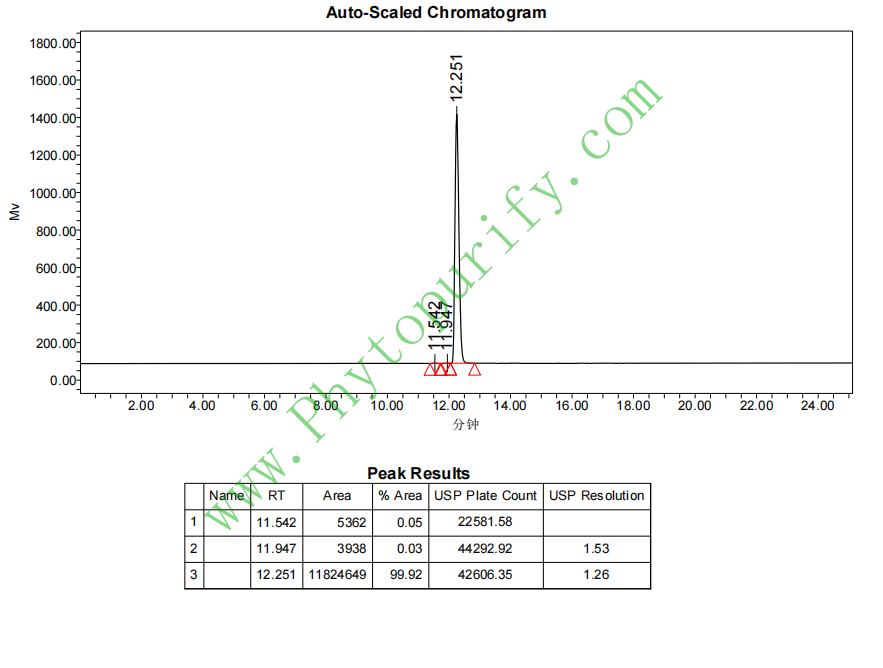
HPLC of Solamargine
Storage conditions:Short-term storage at 2~8℃, long-term storage at -20 ~ -80℃
238.4800
2.3890
1.1179
.0926
.5777
.6330
Low
58.4820
6.7505
No
No
Yes
No
No
No
0.0
Yes
No
Yes
No
Cancer is one of the leading causes of death worldwide. Despite significant advances in modern medicine such as surgery, radiation therapy, and chemotherapy, traditional chemotherapy drugs still face challenges such as toxic side effects, drug resistance, and tumor metastasis and recurrence, which severely limit clinical efficacy. Therefore, searching for efficient, low toxicity, and multi-target novel anti-cancer lead compounds from natural products has become an important strategy for drug development. Solamargin (CAS number: 20311-51-7), a steroid alkaloid derived from Solanaceae plants, has attracted much attention in recent years due to its broad-spectrum anticancer activity and unique mechanism of action in various malignant tumors. Research has shown that Australian solanine can not only induce cancer cell apoptosis and inhibit proliferation through various pathways, but also effectively inhibit tumor cell migration and invasion. It also has inhibitory effects on multidrug resistance (MDR) related proteins such as P-glycoprotein (P-gp), demonstrating the potential to overcome tumor drug resistance. This article aims to systematically review the chemical structure, plant origin, pharmacological activity, molecular mechanism of action, pharmacological evaluation, and clinical application prospects of Australian solanine, in order to provide comprehensive scientific references for the in-depth research and drug development of this natural product.
Australian solanine is a glycosidic steroid alkaloid with its parent nucleus being Solasodine, belonging to the spirosteroid alkaloid class. Its chemical structure consists of hydrophobic steroidal glycosides (solanine) and hydrophilic sugar chains. The sugar chain is usually connected to the C-3 hydroxyl group of the aglycone, formed by a glycosidic bond between one molecule of rhamnose and one molecule of galactose. This amphiphilic structure is crucial for its biological activity.
According to the provided pharmacological parameters, the molecular weight of Australian solanine is 868.0710, which belongs to the category of macromolecular compounds. The calculated lipid water partition coefficient (LogP) is 2.3890, indicating that the compound has a certain lipophilicity but is not highly lipophilic. The topologically polar surface area (TPSA) is as high as 238.4800 Å ², mainly attributed to the large number of hydrogen bond donor and acceptor sites brought by multiple hydroxyl, amino, and sugar ring structures in the molecule. High TPSA values are usually associated with poor cell membrane permeability. The water solubility parameter is 0.0926, indicating its low solubility in water, which is consistent with its high molecular weight and complex glycoside structure. These physicochemical properties collectively determine its poor pharmacokinetic properties: blood-brain barrier permeability is predicted to be "low", meaning it is difficult to enter the central nervous system; HERG inhibition is' no ', indicating that its risk of cardiac toxicity may be low; The Ames test result is 0.0, indicating that it has no mutagenicity and low genetic toxicity risk. Overall, Australian solanine is a natural product with high polarity, poor water solubility, limited membrane permeability, but initially promising safety, which provides direction for its subsequent structural modification and formulation improvement.
Australian solanine is mainly found in various plants of the Solanaceae family, Solanum genus, and is particularly abundant in some traditional medicinal plants. Common plant sources include Solanum aviculare, Solanum mammosum, Solanum nigrum, and Solanum indicum. These plants have long been used in traditional medicine in many parts of the world to treat diseases such as inflammation, infections, and tumors.
The extraction of Australian solanine from plant materials is usually carried out using organic solvent extraction method. The common process is as follows: first, dry plant parts (if solid or aboveground) are crushed, and then polar organic solvents (such as methanol, ethanol, or methanol water mixture) are used for leaching or reflux extraction. After vacuum concentration, the crude extract is dissolved in acidic water (such as dilute hydrochloric acid) to convert alkaloids into salts, while lipid soluble impurities are separated. After alkalization (such as ammonia), free alkaloids are extracted by organic solvents (such as chloroform, dichloromethane, or ethyl acetate). The crude alkaloids obtained need to be purified through further chromatographic separation techniques, such as silica gel column chromatography, reverse phase column chromatography (such as C18 column), and high performance liquid chromatography (HPLC). Modern separation techniques such as high-speed countercurrent chromatography (HSCCC) have also been applied for efficient separation of such alkaloids. Optimization of extraction processes, such as ultrasound assisted extraction and microwave-assisted extraction, can help improve extraction efficiency and yield of target compounds.
A large number of in vitro and in vivo studies have confirmed that Australian solanine has broad anti-tumor activity against various human cancer cell lines, and its pharmacological effects are mainly reflected in the following aspects:
Cytotoxic effects Lycopene has significant growth inhibition and cytotoxicity effects on many cancer cells, such as liver cancer (such as HepG2), breast cancer (such as MCF-7, MDA MB-231), lung cancer, colon cancer, cervical cancer, prostate cancer, etc. Its function has the characteristic of non selective cytotoxicity, but it is more sensitive to certain cancer cells.
Inducing cell apoptosis This is one of the core anti-cancer mechanisms of Australian solanine. It can activate the caspase cascade through the mitochondrial pathway (endogenous pathway) and death receptor pathway (exogenous pathway), leading to programmed cell death in cancer cells. Research has shown that it can downregulate the expression of anti apoptotic protein Bcl-2, upregulate the expression of pro apoptotic proteins such as Bax, induce mitochondrial membrane potential loss and cytochrome C release.
Inhibition of cell proliferation and cycle arrest Australian solanine can block cancer cells at specific stages of the cell cycle, most commonly the G2/M phase, thereby preventing cell division and inhibiting their unlimited proliferation.
Inhibit migration and invasion Tumor metastasis is the main cause of cancer treatment failure. As described, Australian solanine can significantly inhibit the migration and invasion ability of liver cancer HepG2 cells. The mechanism is closely related to the downregulation of the expression and activity of matrix metalloproteinases MMP-2 and MMP-9. MMPs are key enzymes that degrade the extracellular matrix, and inhibition of their activity can effectively hinder the infiltration and metastasis of tumor cells.
Reverse multidrug resistance (MDR)Australian solanine itself is a substrate and inhibitor of P-glycoprotein (P-gp, encoded by the ABCB1 gene). It can competitively bind to P-gp, inhibit its efflux pump function, thereby increasing the accumulation of other chemotherapy drugs (such as doxorubicin) in drug-resistant cancer cells and restoring cancer cell sensitivity to chemotherapy. In addition, the study also suggests that it may also have a regulatory effect on ABCG2 (breast cancer resistance protein).
Other activities Some studies have also reported that Australian solanine has anti-inflammatory, antifungal, and antiviral activities, but its anti-cancer activity is currently the absolute focus of research.
The anticancer effect of Australian solanine involves a complex multi-target and multi pathway regulatory network. According to the relevant disease and target information provided, its mechanism of action in breast cancer can be systematically described as follows, and these mechanisms are also applicable to other cancer types to a large extent:
Inducing apoptosis related targets:
Regulating energy metabolism and autophagy:
Affects cell signal transduction:
Inhibition of key enzymes involved in invasion and metastasis:
Regulating hormone receptors and drug-resistant proteins:
Other potential targets:
In summary, Australian solanine forms a synergistic anti-cancer network by simultaneously acting on multiple key biological processes and signaling nodes such as apoptosis, proliferation, metabolism, metastasis, and drug resistance, which is its advantage as a multi-target natural anti-tumor drug.
Although Australian solanine has shown strong anti-cancer potential in vitro, its medicinal properties face significant challenges, mainly due to its unfavorable physicochemical properties.
Australian solanine, as a multi-target and multifunctional natural anti-cancer candidate, has broad clinical application prospects, but the road ahead is long, and breakthroughs need to be made in the following directions:
combination therapy Given its unique ability to reverse MDR, the combination of Australian solanine with existing chemotherapy drugs such as paclitaxel, doxorubicin, cisplatin, etc. is an attractive clinical development strategy. This combination is expected to reduce the dosage of chemotherapy drugs, minimize toxic side effects, and overcome or delay the development of drug resistance. The combination with targeted drugs or immune checkpoint inhibitors is also worth exploring.
structural optimization Based on its pharmacophore and pharmacological shortcomings, carry out reasonable structural modifications. For example, modifying the sugar moiety to improve metabolic stability, or modifying the steroid parent ring to optimize the lipid water partition coefficient and activity, in order to obtain derivatives or analogues with higher activity and better pharmacokinetic properties.
Advanced delivery system development Combining Australian solanine with nanotechnology and targeted technology to develop efficient, low toxicity, and targeted formulations is the key to promoting its clinical translation. For example, develop targeted liposomes targeting the HER2 receptor of breast cancer, or nanoparticles targeting the pH response of tumor microenvironment.
In depth mechanism research Although multiple targets have been identified, their precise initial targets, cross dialogues between pathways, and dominant mechanisms in different types of cancer still need to be further elucidated. The application of systems biology methods (such as proteomics, metabolomics) and gene editing techniques (such as CRISPR-Cas9) will help to comprehensively reveal their functional networks.
Preclinical and clinical research It is necessary to complete preclinical pharmacodynamic (more in vivo models), pharmacokinetic, and safety evaluations that meet the standards. On this basis, design a reasonable clinical trial plan, gradually promote Phase I (safety, pharmacokinetics), Phase II (efficacy, dose exploration), and Phase III (confirmatory) clinical studies, and ultimately verify its efficacy and safety in specific cancer patient populations.
Australian solanine is a highly valuable steroid alkaloid anti-cancer lead compound discovered from traditional medicinal plants. It induces apoptosis by regulating signaling axes such as AMPK/STAT3/BCL2, inhibits MMP anti metastasis, and targets ABC transporters to reverse drug resistance, demonstrating unique advantages of multi-target and multi pathway synergistic effects. However, its inherent physicochemical property defects, such as low solubility and poor pharmacokinetic properties, severely limit its direct clinical application. Future research should focus on optimizing its structure through drug chemical modification and developing new formulations using advanced drug delivery technologies to improve its bioavailability and targeting. At the same time, we will conduct in-depth research on its molecular mechanism network and actively explore its combined application strategies with existing therapies. With the gradual resolution of these scientific issues, Australian solanine is expected to move from the laboratory to clinical practice, providing a new treatment option for cancer patients, especially those who are resistant to traditional chemotherapy, demonstrating the sustained vitality of natural products in modern drug development.
