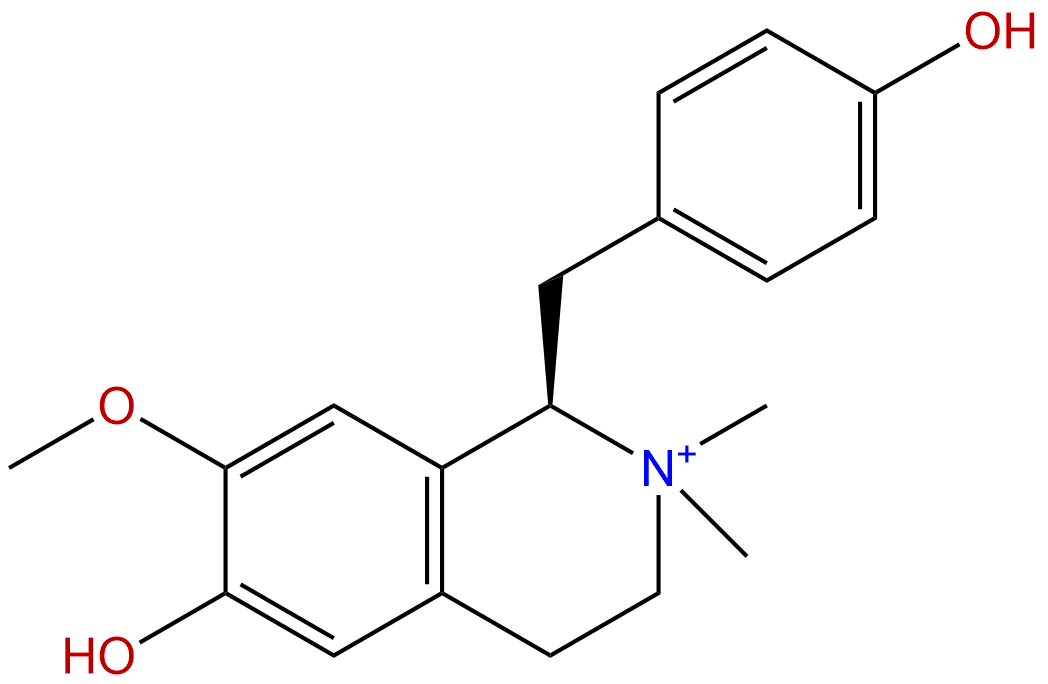


Product name: Lotusine
Synonym name: D-(-)-Lotusine
Catalogue No.: BP2002
Cas No.: 6871-67-6
Formula: C19H24NO3+
Mol Weight: 314.404
Botanical Source:
Physical Description:
Type of Compound: Alkaloids
Purity: 95%~99%
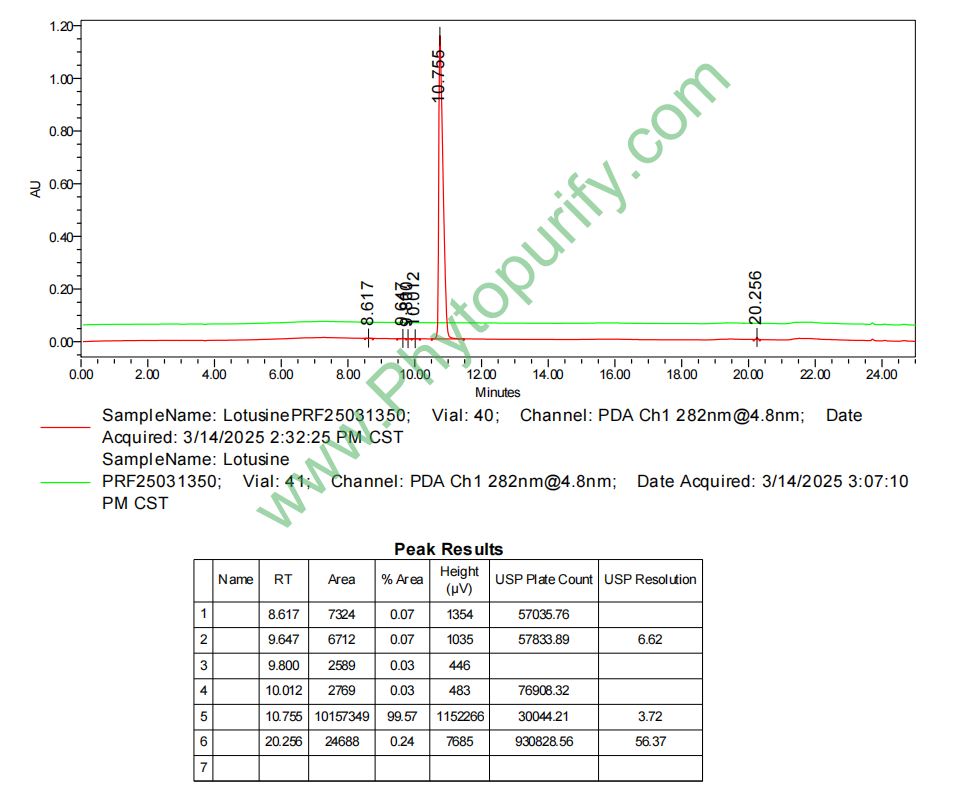
Analysis Method: HPLC-DAD or/and HPLC-ELSD
Identification Method: Mass, NMR
Packing: Brown vial or HDPE plastic bottle
Storage: Store in a well closed container, protected from air and light. Put into refrigerate or freeze for long term storage.
Whenever possible, you should prepare and use solutions on the same day. However, if you need to make up stock solutions in advance, we recommend that you store the solution as aliquots in tightly sealed vials at -20℃. Generally, these will be useable for up to two weeks.
The product could be supplied from milligrams to grams
Inquire for bulk scale.
For Reference Standard and R&D, Not for Human Use Directly.
HPLC of Lotusine
Storage conditions:Short-term storage at 2~8℃, long-term storage at -20 ~ -80℃
49.6900
-1.0229
-1.0259
.2530
.5793
6.5811
Low
61.3611
3.1562
No
No
No
No
Yes
No
0.0
No
No
No
No
Lotusine, also known as (S) -6,7-dimethoxy-1- (3,4-dihydroxybenzyl) -1,2,3,4-tetrahydroisoquinoline, is a compound derived from the water lily plant in the family Nymphaeaceae(Nelumbo nucifera The green embryo of Gaertn. is a quaternary ammonium isoquinoline alkaloid isolated from the traditional Chinese medicine "Lotus Seed Heart". Its CAS number is 6871-67-6, molecular formula is C19H24NO3+, and molecular weight is approximately 314.40 g/mol. Since its discovery, lotus seed quaternary ammonium alkaloids have received continuous attention from researchers in natural product chemistry and pharmacology due to their unique chemical structure and significant biological activity. Early research has revealed that it has a regulatory effect on the cardiovascular system, especially myocardial electrophysiological activity, which can affect action potentials and slow inward currents of Purkinje fibers in the heart. Modern target screening techniques further confirm that it can specifically act on multiple cardiac ion channel proteins, demonstrating potential antiarrhythmic activity. As a natural compound derived from medicinal and edible plants, lotus seed quaternary ammonium alkaloids not only provide modern scientific annotations for understanding the traditional efficacy of lotus seed hearts, but also provide valuable lead compounds for the development of new cardiovascular disease treatment drugs. This article will systematically elaborate on its chemical essence, sources, pharmacological mechanisms, drug properties, and research prospects.
The chemical structure of quaternary ammonium alkaloids in lotus hearts is the material basis for their biological activity. Its SMILES is represented as:COc1cc2c(cc1O)CC[N+](C)(C)[C@@H]2Cc1ccc(O)cc1This structure reveals several key features: firstly, it is a positively charged quaternary ammonium ion (N+), which determines its good water solubility; Secondly, the structure contains two methoxy groups (- OCH3) and two phenolic hydroxyl groups (- OH), which contribute to its hydrophilicity and may participate in hydrogen bonding interactions; Thirdly, the presence of a chiral center ([C @ @ H]) in the molecule suggests its potential for stereoselective biological activity.
From the analysis of the provided pharmacological parameters:
- Molecular weight (MW):314.4050 g/mol, Far below 500 Da, it falls within the common range of small molecule drugs.
- Lipid water partition coefficient (LogP/LogD)They are -1.0229 and -1.0259, respectively. This value is negative, indicating that lotus seed quaternary ammonium alkaloid is a Highly hydrophilic The compound. This is mainly attributed to its quaternary ammonium salt structure and multiple polar groups. High hydrophilicity is beneficial for its dissolution in aqueous media such as body fluids.
- Topological Polarity Surface Area (TPSA)49.6900 Å ². This value reflects the surface area of polar atoms (such as O, N) in the molecule and is an important parameter for predicting drug absorption and permeability. Usually, drugs with TPSA>140 Å ² have poor intestinal absorption. The TPSA value of lotus root quaternary ammonium salt is moderate, indicating that it may have certain membrane permeation potential, but the positive charge of quaternary ammonium salt is the main factor limiting its passive transmembrane diffusion.
- Water solubility 0.2530 (usually measured in mg/mL or mol/L, where database values are relative), combined with its negative LogP, indicates good water solubility.
- Caco-2 permeability: 6.5811 (relative value). The Caco-2 cell model is commonly used to simulate intestinal absorption. This value needs to be judged based on the standards of the specific model, but usually higher positive values indicate a certain degree of active or passive transport potential, which may be related to the existence of certain structures in the molecule that are conducive to transport, but should be interpreted with caution.
- Plasma protein binding rate (PPB)61.3611%, at a moderate level, means that about 61% of compounds in the blood bind to plasma proteins, while the rest exist in free form, which may affect their distribution and efficacy.
In summary, lotus seed quaternary ammonium alkaloid is a small molecule, strongly hydrophilic, positively charged quaternary ammonium alkaloid. These physicochemical properties profoundly affect their absorption, distribution, metabolism, and excretion (ADME) processes in living organisms.
The plant source of quaternary ammonium alkaloids in lotus hearts is single and clear, that is Lotus plumule Lotus seed heart is a lotus plant in the family Nymphaeaceae(Nelumbo nucifera Dry young leaves and embryonic roots in mature seeds. Lotus, also known as lotus, is an ancient medicinal and edible plant. Its roots (lotus roots), leaves, flowers, seeds (lotus seeds), and embryos (lotus seed hearts) can all be used as medicine.
In traditional Chinese medicine theory, lotus seeds have a cold nature and a bitter taste, and are associated with the heart and kidney meridians. The main traditional effects are Clear the mind and calm the nerves, communicate with the heart and kidneys, astringent essence to stop bleeding It is commonly used to treat conditions such as heat entering the pericardium, delirium, heart kidney dysfunction, insomnia, nocturnal emissions, and blood heat vomiting. Among them, there is a potential correlation between the effect of "clearing the heart" and the effects of "sedation, antiarrhythmic, and blood pressure lowering" in modern medicine. People also often drink lotus seed hearts soaked in water to relieve symptoms such as restlessness, thirst, and palpitations.
As one of the main alkaloid components in lotus seed hearts, quaternary ammonium alkaloids are considered as the material basis for their "clearing heart fire" effect. Extracting and isolating lotus seed quaternary ammonium alkaloids from the heart of lotus seeds, and associating them with modern cardiovascular pharmacological activity, is a typical example of modernization research in traditional Chinese medicine. Starting from traditional medication experience, chemical separation and activity screening are used to clarify their "efficacy substance" relationship.
Existing research data clearly indicates that the core pharmacological activity of lotus seed quaternary ammonium alkaloids is concentrated in cardiovascular system Especially Antiarrhythmic treatment aspect. Its English description of "having anti hypertensive and antibacterial activity" suggests a broader spectrum of action, but based on the provided target information, its anti arrhythmic mechanism has been further revealed.
Core mechanism of action: multi-target regulation of cardiac ion channels
The occurrence of arrhythmia is closely related to the dysfunction of ion channels in myocardial cells. The target of Lianxin quaternary ammonium alkaloid involves multiple key cardiac ion channel subunits, which constitute the molecular basis of its anti arrhythmic effect:
KCNH2 (hERG channel)Encoding the alpha subunit of fast delayed rectifier potassium current (IKr). IKr is one of the main currents for repolarization of action potentials in ventricular myocytes during phase 3. Inhibition of hERG channels can lead to prolonged action potential duration (APD), which may induce apical torsion transition ventricular tachycardia (TdP). The database shows that lotus seed quaternary ammonium alkaloid "hERG_inhibition: No", which is a very positive signal, indicating that it does not inhibit the hERG channel, thus Reduced its potential risk of inducing severe ventricular arrhythmias Improved its safety as an antiarrhythmic drug.
KCNQ1 (KvLQT1) and KCNE1 (MinK)KCNQ1 and auxiliary subunit KCNE1 jointly form a slow delayed rectifier potassium current (IKs) channel. IKs play an important compensatory role in repolarization during increased heart rate. Adjusting this channel can affect APD and cardiac electrical stability.
SCN5A The alpha subunit encoding the voltage-gated sodium channel (Nav1.5) of the heart is responsible for rapid depolarization (INa) of the action potential phase 0. The blockade of sodium channels is the main mechanism of action of class I antiarrhythmic drugs (such as quinidine and lidocaine), which inhibits sodium currents, slows down conduction velocity, and prolongs the effective refractory period.
CACNA1C The α 1C subunit encoding L-type voltage-gated calcium channel (Cav1.2) is responsible for the plateau phase calcium influx (ICa-L) of action potential phase 2. Calcium channel blockers (such as verapamil and diltiazem) are class IV antiarrhythmic drugs that reduce calcium influx and decrease the autonomy and conductivity of the sinoatrial and atrioventricular nodes.
Mechanism integration and scientific explanation:
Lotus seed quaternary ammonium alkaloid can simultaneously act on multiple targets mentioned above, suggesting that it may be a Multi channel regulator This multi-target mode of action may bring unique advantages:
- synergistic effect Simultaneously regulating potassium, sodium, and calcium currents may produce a synergistic anti arrhythmic effect, such as reducing abnormal excitation by moderately inhibiting sodium or calcium currents, while optimizing the repolarization process by regulating potassium currents (especially IKs, rather than dangerous IKr) to restore stable cardiac electrical activity.
- Reduce the risk of arrhythmia Traditional single channel blockers, especially potent hERG inhibitors, often have arrhythmogenic side effects due to excessive prolongation of the QT interval. Lotus seed quaternary ammonium alkaloids do not inhibit hERG, but may achieve therapeutic goals by regulating other repolarized potassium currents (such as IKs) or affecting calcium/sodium currents, theoretically with higher safety.
- The influence on action potential and Purkinje fiber current Early studies described its effect on action potentials and slow inward currents in cardiac Purkinje fibers, which is highly consistent with the target information of CACNA1C (L-type calcium channel). Purkinje fibers are a rapid conduction system within the ventricle, and their abnormal calcium currents are associated with certain types of arrhythmias. The regulation of lotus seed quaternary ammonium alkaloid on this current may be a direct manifestation of its anti arrhythmic effect.
Therefore, lotus root quaternary ammonium alkaloids may restore disrupted cardiac electrophysiology through a relatively balanced multi ion channel regulation mechanism, thereby exerting anti arrhythmic effects. Its "anti hypertensive" activity may also be partially derived from its regulation of vascular smooth muscle calcium channels or other mechanisms.
Based on the provided pharmacological parameters and combined with classical methods Lipinski's Five Rules Preliminary evaluation using Rule of Five (Ro5) can analyze the potential of lotus seed quaternary ammonium alkaloids as oral medications.
Lipinski's Five Rules Compliance Analysis:
1. Molecular weight<500 Da 314.4050, compliant.
2. LogP < 5-1.0229, far less than 5, compliant.
3. Number of hydrogen bond donors (HBD)From a structural perspective, phenolic hydroxyl (- OH) is a clear hydrogen bond donor. SMILES shows two phenolic hydroxyl groups, therefore HBD ≥ 2 (possibly 2 or 3, depending on whether an exchangeable proton is attached to the quaternary ammonium nitrogen, usually the N+of the quaternary ammonium salt does not act as a hydrogen bond donor). Normally, HBD ≤ 5 is required to comply.
4. Number of hydrogen bond acceptors (HBA)The O atoms (methoxy and hydroxyl groups) and positively charged N atoms in the structure are both hydrogen bond acceptors. Usually requires HBA ≤ 10, compliant.
Lianxin quaternary ammonium alkaloid Fully comply with Lipinski's five rules This is often seen as a positive indicator of the compound's good oral absorption potential.
In depth interpretation of other key pharmacological parameters:
- Blood-brain barrier penetrability (BBB-permeability)Annotated as' low '. This is consistent with its strong hydrophilicity (LogP is negative) and positively charged characteristics. For drugs primarily targeting the peripheral cardiovascular system,Low BBB penetration is an advantage It can avoid central nervous system side effects such as dizziness and drowsiness.
- Absorption and penetration The Caco-2 permeability data (6.5811) suggests the possibility of a certain intestinal absorption mechanism, but the Peff (effective permeability coefficient) is 0.5793, which belongs to a lower range. Considering its high hydrophilicity and charge, it is expected that Oral bioavailability may be moderate or low It may rely on active transporters in the intestine or passive diffusion through cellular pathways (limited by molecular size and charge). This may be a key link that needs to be optimized in the development of its pharmaceutical products.
- Toxicity risk:
- Ames test: 0.0 (usually negative), indicating no direct bacterial gene mutation toxicity.
- chromosome aberration Marked as' yes', this is a signal that requires high vigilance. Indicating that at the cellular level in vitro, this compound may cause chromosomal damage and has potential Genetic toxicity risk This is a critical safety issue that must be thoroughly evaluated and ruled out in its preclinical development.
- Toxicity to other organs Serum biochemical indicators (ALT, AST, ALK, GGT) are all marked as "no", indicating that no obvious liver injury signals were displayed under the test conditions. Skin, respiratory sensitization, and phototoxicity are all negative.
Comprehensive evaluation:
Lotus Heart Quaternary Ammonium Alkaloids Molecular characteristics(Compliant with Ro5) and mechanism of action It demonstrates a promising starting point for drug development in terms of multi-target targeting and avoiding high-risk hERG inhibition. Its clear plant origin and traditional application background also provide a certain historical basis for its safety. However, it There are two main challenges facing the development of pharmaceuticals One is Pharmacokinetic properties The absorption and distribution caused by high hydrophilicity and charge may be poor, and the oral bioavailability needs to be improved; Second Potential genetic toxicity risk(Chromosomal aberration positive), this must be clarified in further toxicology studies, as confirmation may seriously hinder its development. In addition, the metabolic stability of its quaternary ammonium salt structure in vivo and whether it is easily hydrolyzed by cholinesterase also need to be explored.
Research Status:
At present, research on quaternary ammonium alkaloids in lotus hearts is still in progress Preclinical stage A large amount of work is focused on its extraction and separation, chemical synthesis, preliminary pharmacological activity screening, and exploration of its mechanism of action. The existing research has firmly established it as one of the key components of lotus seed's cardiovascular activity, and confirmed its anti arrhythmic and hypotensive effects in cell and animal models. Target research has progressed from early descriptions of electrophysiological phenomena to the molecular level of specific ion channels (such as KCNQ1/KCNE1, CACNA1C, etc.). However, there are still some gaps in the research: there is a lack of systematic pharmacokinetic studies (ADME) data; The specific potency, selectivity, and comprehensive effects of its multi-target action in different pathological models have not been fully elucidated; The potential toxicity of the aforementioned chromosomal aberrations requires more authoritative and in-depth evaluation.
Application prospects:
1. As a novel antiarrhythmic lead compound The biggest application prospect of lotus seed quaternary ammonium alkaloid lies in its development as Multi channel regulated antiarrhythmic drugs Its characteristic of not inhibiting hERG may make it safer than some existing drugs. By optimizing its pharmacokinetic properties through structural modification (such as increasing lipid solubility to improve absorption, but balancing the effect of its charge on activity) and reducing potential toxicity, it is expected to obtain candidate drugs.
2. Modernization and Quality Control of Traditional Chinese Medicine As one of the characteristic active ingredients of lotus seed heart, lotus seed quaternary ammonium alkaloids can be used to establish the formula for lotus seed heart medicinal materials and their preparations (such as compound formulas containing lotus seed heart)Quality Standard Conduct quantitative analysis to ensure the stability and consistency of product efficacy.
3. Development of functional foods and health products Given the consumption history of lotus seed heart itself, lotus seed heart extract rich in quaternary ammonium alkaloids can be used to develop health foods that assist in regulating blood pressure and improving palpitations, with high market acceptance.
4. Mechanism of Action Research Tool As a natural multi ion channel regulator, lotus root quaternary ammonium alkaloids can be used to study the complex network regulation of cardiac electrophysiology molecular probe To help scientists gain a deeper understanding of the pathological mechanisms underlying arrhythmia.
Future research directions:
- In depth mechanism research Using patch clamp and other techniques, quantitatively study the concentration effect relationship and state dependence (use dependence or voltage dependence) of lotus seed quaternary ammonium alkaloids on ion channel currents at various target sites.
- Comprehensive pharmacokinetic evaluation Systematically study its absorption, distribution, metabolism, and excretion processes on animal models, clarify its oral bioavailability, half-life, major metabolites, and pathways.
- System toxicology assessment Especially for follow-up studies on positive results of "chromosomal aberration", it is necessary to confirm its genetic toxicity risk in different experimental systems (in vivo and in vitro) and explore its toxicity mechanism.
- Research on Structural Optimization and Structure Performance Relationship On the premise of retaining its multi-target activity advantages and safety characteristics, chemical modification can be used to improve its drug defects (such as poor oral absorption) while eliminating potential toxicity hazards.
Conclusion
Lianxin quaternary ammonium alkaloid is a unique natural active molecule derived from the traditional Chinese medicine lotus seed heart. It has attracted the attention of drug developers with its unique multi cardiac ion channel regulation mechanism, safety features that avoid hERG inhibition, and structure that complies with drug like rules. Although it still needs to overcome the challenges of pharmacokinetics and potential toxicity on its path to becoming a drug, its unique mode of action and value make it have broad exploration space and bright application prospects in the development of new cardiovascular drugs, modernization of traditional Chinese medicine, and development of life science research tools. The continuous in-depth research on quaternary ammonium alkaloids in lotus hearts may not only lead to the development of new therapeutic drugs, but also further reveal the modern scientific value contained in ancient plant wisdom.
