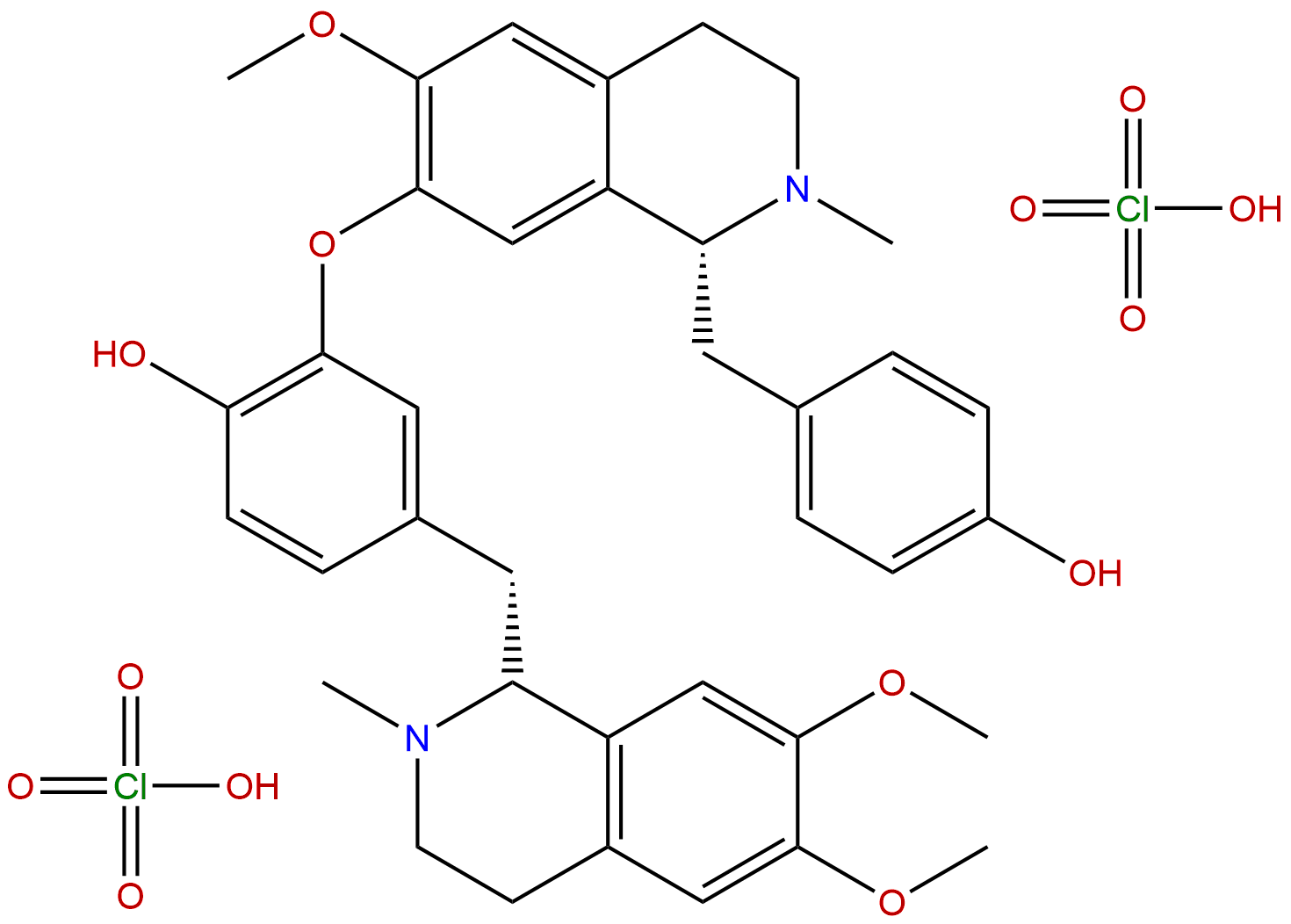


Product name: Liensinine Diperchlorate
Synonym name: 2385-63-9
Catalogue No.: BP3230
Cas No.: 5088-90-4
Formula: C37H44Cl2N2O14
Mol Weight: 811.659
Botanical Source:
Physical Description: White powder
Type of Compound: Alkaloids
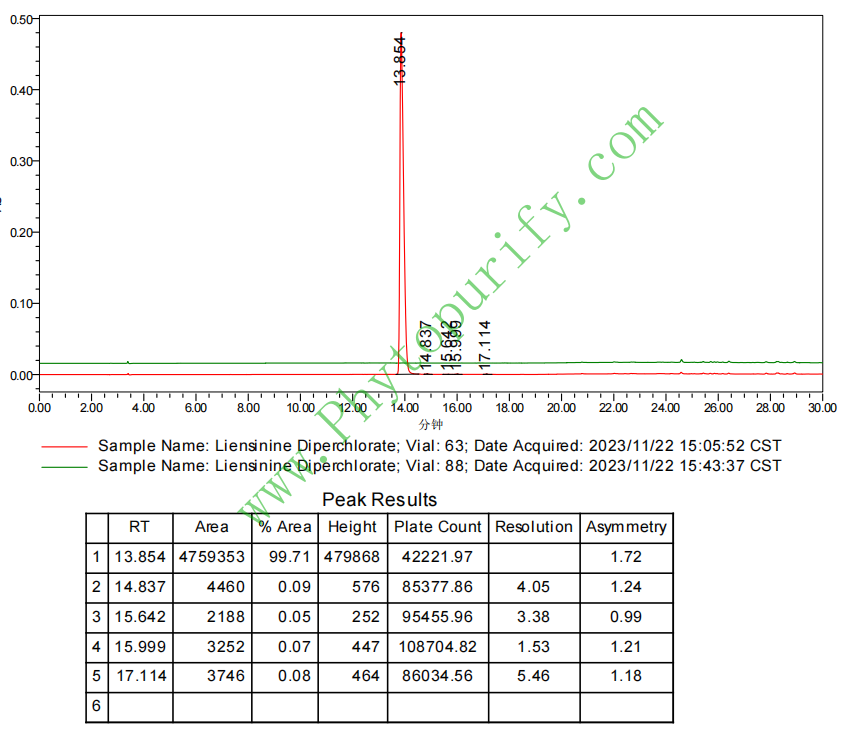
Purity: 95%~99%
Analysis Method: HPLC-DAD or/and HPLC-ELSD
Identification Method: Mass, NMR
Packing: Brown vial or HDPE plastic bottle
The product could be supplied from milligrams to grams. Inquire for bulk scale.
We provide solution to improve the water-solubility of compounds, thereby facilitating the variety of activity tests and clinic uses.
For Reference Standard and R&D, Not for Human Use Directly.
HPLC of Liensinine Diperchlorate
Storage conditions:Short-term storage at 2~8℃, long-term storage at -20 ~ -80℃
83.8600
5.7906
4.6315
.0395
3.3047
12.9424
Low
89.3184
4.0711
No
No
Yes
Yes
No
No
0.0
No
No
No
No
Natural products have always been an important treasure trove for innovative drug discovery, among which alkaloid compounds have attracted much attention due to their structural diversity and significant biological activity. Liansinine Diperchlorate (CAS: 5088-90-4) is a bisbenzylisoquinoline alkaloid salt extracted from the seed embryos of the traditional medicinal plant Nelumbo nucifera Gaertn. Its parent compound, Liansinine, was isolated and identified as early as the 1960s, but for a long time, its research has mainly focused on traditional anti arrhythmic and antihypertensive effects. In recent years, with the increasingly prominent role of cellular autophagy in the occurrence and development of diseases, the new role of berberine and its perchlorate as autophagy/mitophagy inhibitors has been revealed, opening up a new dimension for their pharmacological research. This review aims to systematically summarize the chemical characteristics, plant sources, multi-target pharmacological activities, and especially the mechanism of action of lotus seed alkaloid perchlorate as an autophagy inhibitor. It also provides a comprehensive evaluation of its pharmacological properties and clinical application prospects, in order to provide comprehensive scientific references for the in-depth research and potential drug development of this compound.
Lotus seed alkaloid perchlorate is a salt formed by the combination of lotus seed alkaloid and perchloric acid. The chemical structure of its parent compound, lotus seed alkaloid, belongs to the bisbenzylisoquinoline alkaloid, which is composed of two isoquinoline units connected by ether bonds and carbon chains, with a molecular formula of C37H42N2O6. After the formation of perchlorate, the molecular weight increased to 610.7510. This structure endows it with typical alkaloid properties.
From the analysis of parameters related to drug properties, this compound has high lipid solubility, with a calculated LogP value of 5.7906, indicating good transmembrane permeability, but it may also affect its water solubility. Its topological polar surface area (TPSA) is 83.86 Å ², which is relatively moderate. The measured water solubility is relatively low, at 0.0395 mg/mL, which may be a limiting factor for its oral bioavailability. Pharmacokinetic prediction shows that its ability to cross the blood-brain barrier is low, and it mainly acts on the peripheral system. It is worth noting that preliminary computer predictions or in vitro experiments suggest that it has an inhibitory effect on hERG potassium channels, which is consistent with the characteristics of many antiarrhythmic drugs, but also potentially suggests the risk of cardiac toxicity that may induce tip twist ventricular tachycardia (TdP), which is a key monitoring link in subsequent development. The Ames test result is 0.0, which preliminarily indicates that there is no mutagenicity under the experimental conditions, providing some early support for its safety.
Lianxin perchlorate is derived from the mature seed embryo of Nelumbo nucifera Gaertn, a plant in the Nymphaeaceae family, commonly known as the "lotus seed heart". Lotus seed heart has the functions of clearing heart fire, calming liver fire, stopping bleeding, and consolidating essence in traditional Chinese medicine theory. It is commonly used to treat restlessness, insomnia, hypertension, and other conditions. This provides a traditional medical basis for the modern pharmacological research of lotus seed alkaloids.
The classic method of extracting and separating lotus alkaloids from lotus seed hearts is usually through organic solvent extraction combined with chromatographic separation. The general process is as follows: Grind the dried lotus seed heart, extract it by reflux with polar solvents such as ethanol or methanol, combine the extracts and concentrate them under reduced pressure to obtain the extract. The extract is dissolved in acidic water (such as dilute hydrochloric acid), and insoluble substances are filtered out. Then, it is alkalized with ammonia water or other alkaline agents until alkaline. At this point, alkaloids are released and extracted using organic solvents such as chloroform or ethyl acetate. The crude alkaloids obtained are then subjected to repeated silica gel column chromatography, preparative thin-layer chromatography, or high-performance liquid chromatography (HPLC) for separation and purification, resulting in the production of lotus seed alkaloid monomer. To obtain perchlorate, purified lotus seed alkaloid can be dissolved in an appropriate solvent to form a salt with perchloric acid. After crystallization and recrystallization, pure lotus seed alkaloid perchlorate can be obtained. Modern technologies such as high-speed countercurrent chromatography (HSCCC) have also been applied to improve separation efficiency and yield. The optimization of extraction process aims to improve the yield and purity of the target product to meet the needs of pharmacological research and subsequent development.
Lotus seed alkaloid perchlorate exhibits a wide range of pharmacological activities, and its research has expanded from traditional cardiovascular fields to include anti fibrosis, anti-tumor, and other aspects.
Cardiovascular system activity This is its earliest field of research. Lianxin alkaloid has significant Antiarrhythmic treatment It has an antagonistic effect on various experimental arrhythmia models, such as those induced by aconitine, barium chloride, and chloroform adrenaline. Its effect is similar to quinidine and belongs to broad-spectrum antiarrhythmic drugs. At the same time, it exhibits clear Hypotensive effect and Vascular smooth muscle relaxation The effect can dilate peripheral blood vessels and reduce peripheral resistance, which is closely related to its antihypertensive mechanism.
Anti pulmonary fibrosis In recent years, studies have found that berberine has an improving effect on experimental pulmonary fibrosis induced by bleomycin or silica. It can alleviate alveolar inflammation, inhibit fibroblast proliferation and collagen deposition, and its mechanism may be related to regulating the TGF - β 1/Smad signaling pathway, inhibiting epithelial mesenchymal transition (EMT), and regulating autophagy.
Antitumor activity and its association with autophagy inhibition Studies have revealed that liensinine and its salts can inhibit the proliferation and induce apoptosis of many tumor cells (such as breast cancer, liver cancer and lung cancer cells). Of particular importance is its anti-tumor effect and its role as Autophagy/Mitochondrial Autophagy Inhibitors The characteristics are closely interconnected. Autophagy is often activated in tumor cells as a survival mechanism in response to metabolic stress and chemotherapy drugs. Lianxin alkaloids enhance the sensitivity of tumor cells to apoptotic signals by inhibiting autophagy flow and blocking the self-protection pathway of tumor cells through autophagy, or by synergizing with chemotherapy drugs.
Other activities There are also studies reporting its potential activities such as antioxidant, anti-inflammatory, and sedative properties, but further research is needed.
The pharmacological effects of berberine perchlorate involve a complex regulatory network of multiple targets and pathways, and its core mechanism can be analyzed from two levels: cardiovascular targets and autophagy related targets.
1. Cardiovascular related targets:
Its anti arrhythmic effect is mainly achieved through the regulation of multiple ion channels in myocardial cells. According to the provided target information, its action network covers sodium, potassium, calcium channels and receptor systems:
* Sodium channels (SCN5A, SCN1A)Inhibiting late sodium current helps stabilize myocardial cell membrane potential and counteract certain types of tachyarrhythmia.
* potassium channels This is a key target group. including:
* Fast delayed rectifier potassium channel (KCNH2, encoding hERG protein)Inhibiting the I2 Kr current, prolonging the action potential duration (APD) and effective refractory period (ERP) are the main mechanisms by which it exerts class III antiarrhythmic effects, but are also associated with potential hERG inhibition induced cardiac toxicity.
* Other potassium channels (KCNA5, encoding Kv1.5, mediating ultra fast delayed rectification potassium current I2 Kur; KCNQ1/KCNE1, Encoding Slow Delay Rectified Potassium Current I2 Ks Inhibition of these channels collectively affects the process of myocardial repolarization.
* Calcium channel (CACNA1C)Inhibiting L-type calcium current (I-Ca-L), reducing calcium influx, can lower myocardial contractility, slow down atrioventricular conduction, and help combat arrhythmias caused by triggering activity.
* receptor system As follows:Cholinergic M2 receptor (CHRM2) and Nicotinic acetylcholine receptor alpha 7 subunit (CHRNA7)It may indirectly regulate cardiac function by affecting autonomic nervous tension. In addition, regarding Na+/K+- ATPase (ATP1A1) The potential impact may also be involved in its positive muscle strength or electrophysiological effects.
This multi ion channel blocking property gives it a "multi-channel blocker" characteristic similar to amiodarone, which may be the molecular basis for its broad-spectrum anti arrhythmic effect.
2. Autophagy/Mitochondrial Autophagy Inhibition Mechanism:
This is its emerging and highly anticipated mechanism of action. Autophagy is the process by which cells degrade and recover their own components, while mitochondrial autophagy is a specific form of autophagy that selectively clears damaged mitochondria. Lianxin has been proven to be an effective inhibitor of autophagic flux. Although its specific molecular target has not been fully elucidated, studies have shown that it does not act through the classical mTOR pathway, but may act in the late stage of autophagosome lysosome fusion. It can:
*Increasing the accumulation of autophagy marker LC3-II, accompanied by an increase in p62/SQSTM1 protein levels, indicates that autophagosome clearance is blocked.
*Inhibiting the process of damaged mitochondria being cleared by autophagy through the PINK1/Parkin pathway leads to the accumulation of dysfunctional mitochondria in cells, an increase in reactive oxygen species (ROS) production, and ultimately triggers cell apoptosis.
*In tumor research, this autophagy inhibition ability can reverse the drug resistance of tumor cells and exhibit synergistic anti-tumor effects when combined with chemotherapy drugs.
Based on its physical and chemical properties and existing research, a preliminary evaluation of the pharmacological properties of berberine perchlorate is conducted
At present, there is still a lack of complete pharmacokinetic parameters (such as t1/2, AUC, Cmax, Vd, CL, etc.) regarding the lotus seed alkaloid perchlorate system in public literature, which is a key data gap that must be filled in order to move towards drug development.
The clinical application prospects of berberine perchlorate are based on its multi-target pharmacological activity, but it also faces many challenges.
Potential application directions:
1. As a novel antiarrhythmic drug Its multi ion channel blocking properties make it a potential candidate drug for treating complex and refractory arrhythmias such as atrial fibrillation. Especially when it also has anti hypertensive effects, it may have a dual benefit for patients with arrhythmia complicated with hypertension. However, the risk of arrhythmia caused by hERG inhibition must be strictly controlled through structural optimization or precise dosing regimens.
2. As an anti pulmonary fibrosis drug Regarding the current clinical lack of specific drugs for pulmonary fibrosis (such as idiopathic pulmonary fibrosis, IPF), Lianxin alkaloid has shown potential for development by intervening in the fibrosis process through multiple pathways. Its autophagy regulatory role is increasingly being recognized in fibrotic diseases.
3. As an adjuvant for tumor therapy (autophagy inhibitor)This is the most innovative direction. By utilizing its autophagy inhibition properties, combined with conventional chemotherapy, radiotherapy, or targeted therapy, it is expected to overcome tumor drug resistance and improve the efficacy of existing therapies. At present, many autophagy inhibitors (such as hydroxychloroquine) have entered clinical trials in cancer. Lianxin, as a novel autophagy inhibitor from natural sources, has unique development value.
4. Other In the field of cardiovascular disease, its application in diseases such as heart failure and myocardial hypertrophy can also be explored, which are often accompanied by abnormal activation of autophagy.
Challenges and Prospects Faced:
1. Optimization of drug properties The primary task is to address the issues of poor water solubility and oral absorption. The application of modern pharmaceutical technologies such as nanocrystals, liposomes, cyclodextrin inclusion complexes, etc. is crucial.
2. In depth evaluation of security Systematic preclinical toxicology studies, especially detailed evaluation of the cardiac QT interval, are crucial in determining whether it can enter clinical trials. It is necessary to explore its therapeutic window and possibly reduce hERG inhibitory activity through structural modification.
3. Deep exploration of mechanisms The exact molecular targets of autophagy inhibitors still need to be clarified. Does it directly affect fusion related proteins such as STX17, SNAP29, VAMP8, or does it affect lysosomal function? The clarification of the target will help design better derivatives.
4. Clinical translational research It is necessary to conduct standardized pharmacological, pharmacokinetic, and toxicological studies to obtain the complete set of data required for IND (New Drug Clinical Trial Application). Considering its pleiotropy, there needs to be a clear strategy for selecting clinical indications.
Future research should focus on: ① designing and synthesizing a series of lotus seed alkaloid derivatives, optimizing solubility and reducing hERG toxicity while retaining pharmacological activity; ② Using modern molecular biology and chemical biology techniques to elucidate its precise targets for inhibiting autophagy; ③ Conduct high-quality preclinical and clinical research to validate its effectiveness and safety in specific disease models and patients.
As a natural alkaloid isolated from traditional Chinese medicinal materials, the research process of lotus root alkaloid perchlorate reflects a typical path from traditional use to modern multi-target drug discovery. From its initial cardiovascular activity to the newly revealed mechanism of autophagy/mitochondrial autophagy inhibition in recent years, this compound has continuously demonstrated remarkable pharmacological potential and scientific value. It exerts cardiovascular protection by regulating multiple ion channels, while intervening in autophagy, a core cellular homeostasis process, opening up new battlefields in fields such as anti fibrosis and anti-tumor. However, its inherent pharmaceutical defects (such as low water solubility, potential hERG inhibition risk) and unclear deep action targets constitute the main bottlenecks for its clinical drug translation. Future research requires interdisciplinary collaboration in chemistry, pharmacology, pharmacy, and other fields to deeply analyze their structure-activity relationships and mechanisms of action, actively utilize modern drug development technologies for structural optimization and dosage form improvement, and conduct systematic and rigorous preclinical evaluations. Only in this way can this ancient natural molecule be revitalized, potentially providing new candidate drugs for the treatment of major diseases such as arrhythmia, tissue fibrosis, and tumors, achieving a leap from "lotus seed heart" to "innovative drugs".
