


Synonym name:
Catalogue No.: BP0858
Cas No.: 2586-96-1
Formula: C37H42N2O6
Mol Weight: 610.751
Botanical Source: Alkaloid from seed embryo of Nelumbo nucifera (East Indian lotus) (Nelumbonaceae)
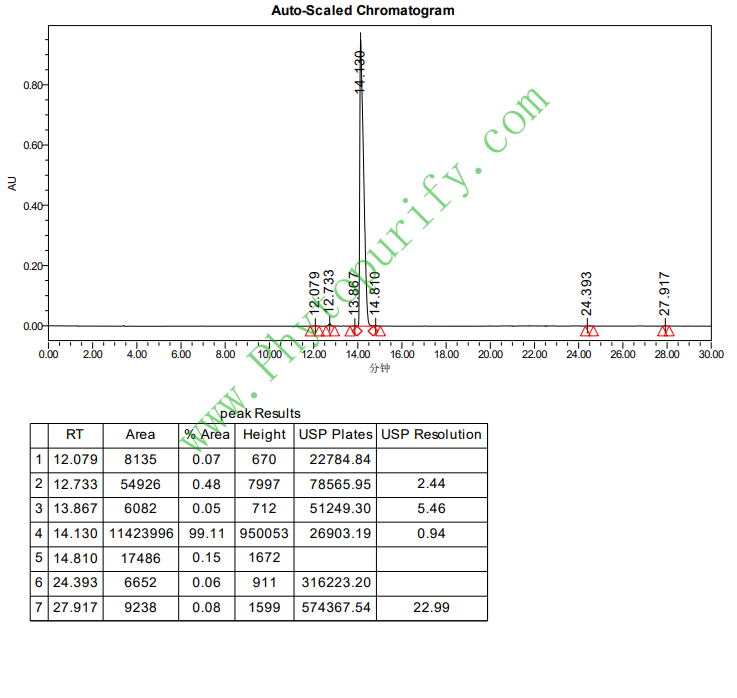
Purity: 95%~99%
Analysis Method: HPLC-DAD or/and HPLC-ELSD
Identification Method: Mass, NMR
Packing: Brown vial or HDPE plastic bottle
Can be supplied from milligrams to grams.
For Reference Standard and R&D, Not for Human Use Directly.
Inquire for bulk scale.
Description:
Liensinine is a human ether-a-go-go-related gene (hERG) inhibitor and a novel autophagy/mitophagy inhibitor, which can antagonize the ventricular arrhythmias. It exerts remarkable effect against thrombosis and possesses strong effect against platelet aggregation and coagulation.
References:
Zhongguo Zhong Yao Za Zhi. 2013 Jan;38(2):239-44.
[Effect of berberine, liensinine and neferine on HERG channel expression].
Immunofluorescence and Western blot methods were adopted for qualitative and quantitative detections of the effect of different concentrations of berberine, Liensinine and neferine on the expression of stable transfection in HERG potassium channel in HEK-293 cells, as well as the effect of different concentrations of berberine on protein expression of Ikr channel in cardiac muscular tissues, in order to investigate the anti-arrhythmic mechanism of berberine, Liensinine and neferine.
METHODS AND RESULTS:
Western blot method was used to detect protein expression of HERG channel in HERG-HEK cells. Immunofluorescence method as well as confocal laser microscope were used to detect the effect of different concentrations of berberine, Liensinine and neferine on protein expression of HERG channel. Western blot method was used to detect the effect of different concentrations of berberine on protein expression of Ikr channel in cardiac muscular tissues as well as the effect of berberine, Liensinine and neferine on protein expression of stable transfection in HERG potassium channel in HEK-293 cells. Western blot experiment manifested that stable transfection of HEK293 cells containing HERG genes could increase protein expression of HERG channel. Berberine (10, 30 micromol x L(-1)) remarkably inhibited protein expression of HERG channel in HERG-HEK cells (P < 0.01). Berberine (10, 20 mg x kg(-1)) also inhibited protein expression of Ikr channel in rat ventricular tissues (P < 0.05). Liensinine (3, 10, 30 micromol x L(-1)) increased protein expression of HERG channel in HERG-HEK cells (P < 0.05). Neferine showed no effect on protein expression of HERG channel in HERG-HEK cells.
CONCLUSIONS:
The stably transfection of HERG-HEK cells can increase protein expression of HERG channel. Berberine shows inhibitory effect on protein expressions of in vitro HERG-HEK cells and Ikr channel in rat ventricular tissues. Liensinine improves protein expression of HERG channe in HERG-HEK cells. Neferine shows no effect on protein expression of HERG channel.
Autophagy. 2015;11(8):1259-79.
A novel autophagy/mitophagy inhibitor liensinine sensitizes breast cancer cells to chemotherapy through DNM1L-mediated mitochondrial fission.
Autophagy inhibition has been widely accepted as a promising therapeutic strategy in cancer, while the lack of effective and specific autophagy inhibitors hinders its application.
METHODS AND RESULTS:
Here we found that Liensinine, a major isoquinoline alkaloid, inhibits late-stage autophagy/mitophagy through blocking autophagosome-lysosome fusion. This effect is likely achieved via inhibiting the recruitment of RAB7A to lysosomes but not to autophagosomes. We further investigated the effects of autophagy inhibition by Liensinine on the therapeutic efficacy of chemotherapeutic drugs and found that cotreatment of Liensinine markedly decreased the viability and increased apoptosis in breast cancer cells treated with various chemotherapeutic agents. Mechanistically, we found that inhibition of autophagy/mitophagy by Liensinine enhanced doxorubicin-mediated apoptosis by triggering mitochondrial fission, which resulted from dephosphorylation and mitochondrial translocation of DNM1L. However, blocking autophagosome/mitophagosome formation by pharmacological or genetic approaches markedly attenuated mitochondrial fission and apoptosis in cells with combinatatorial treatment. Moreover, Liensinine was synergized with doxorubicin to inhibit tumor growth in MDA-MB-231 xenograft in vivo.
CONCLUSIONS:
Our findings suggest that Liensinine could potentially be further developed as a novel autophagy/mitophagy inhibitor, and a combination of Liensinine with classical chemotherapeutic drugs could represent a novel therapeutic strategy for treatment of breast cancer.
HPLC of Liensinine
Storage conditions:Short-term storage at 2~8℃, long-term storage at -20 ~ -80℃
Lianxinine (CAS number: 2586-96-1) is a substance mainly found in lotus(Nelumbo nucifera Isoquinoline alkaloids in Gaertn seed embryos. As a natural product with multiple biological activities, berberine has attracted widespread attention in the field of pharmacology in recent years. Its unique autophagy and mitochondrial autophagy inhibition make it a hot topic molecule for studying cell homeostasis regulation and related disease treatment. In addition, the protective effect of Lianxin alkaloid in the cardiovascular system is outstanding, covering various pharmacological effects such as anti arrhythmia, anti hypertension, vascular smooth muscle relaxation, and anti pulmonary fibrosis. This article aims to systematically review the chemical structure, sources, pharmacological activity, mechanism of action, pharmacological evaluation, and clinical application prospects of lotus seed alkaloids, providing theoretical basis and reference for subsequent basic research and drug development.
Lianxin alkaloid belongs to the isoquinoline alkaloid class, with a molecular formula of C37H44N2O6 and a molecular weight of 610.7510. Its chemical structure is characterized by two isoquinoline rings connected by a carbon chain, forming a unique dimer structure. The LogP value of lotus seed alkaloid is 5.7906, indicating its high lipid solubility. The TPSA (topological polar surface area) is 83.8600, indicating moderate polarity, but low water solubility (0.0395 mg/mL), which has a certain impact on its absorption and distribution in vivo. The low blood-brain barrier permeability of lotus seed alkaloids suggests that their activity in the central nervous system may be limited. It is worth noting that berberine exhibits hERG channel inhibitory activity, indicating that its potential cardiotoxicity risk needs to be rigorously evaluated during drug development. The Ames test result is 0.0, indicating no significant genetic toxicity.
Lianxin is mainly derived from lotus seeds(Nelumbo nucifera Extraction from Gaertn seed embryos. Lotus plants are widely used in traditional Asian medicine, and their seed embryos contain abundant alkaloid components. The extraction method usually uses organic solvents such as methanol and ethanol for extraction, combined with acid-base separation and column chromatography purification techniques to obtain high-purity lotus seed alkaloids. In recent years, the application of ultrasound assisted extraction and microwave-assisted extraction technologies has improved the extraction efficiency and purity of lotus seed alkaloids. In addition, high-performance liquid chromatography (HPLC) and mass spectrometry (LC-MS) are widely used for qualitative and quantitative analysis of lotus seed alkaloids, ensuring the quality control of extracts.
Lotus seed alkaloids have diverse pharmacological activities, covering areas such as cardiovascular protection, anti fibrosis, anti-inflammatory, and autophagy regulation.
The protective effect of lotus seed alkaloid in the cardiovascular system is one of its most well-known pharmacological effects. Research has shown that berberine can effectively inhibit arrhythmia, improve myocardial ischemia-reperfusion injury, lower blood pressure, and exert vasodilatory effects by dilating vascular smooth muscle. Its mechanism of action involves regulating various cardiovascular related targets, such as thrombocytopenin (SELP), peroxisome proliferator activated receptor gamma (PPARG), angiotensin-converting enzyme (ACE), protein kinase B (AKT1), β 2-adrenergic receptor (ADRB2), potassium channel protein (KCNH2), nitric oxide synthase 3 (NOS3), intercellular adhesion molecule (ICAM1), and vascular cell adhesion molecule (VCAM1). By regulating these targets, berberine can improve vascular function, inhibit inflammatory reactions, reduce myocardial cell apoptosis, and promote myocardial repair.
Pulmonary fibrosis is a progressive lung disease characterized by fibrosis of lung tissue and functional decline. Lianxin alkaloid significantly improves the pathological state of pulmonary fibrosis model animals by inhibiting the proliferation and transdifferentiation of pulmonary fibroblasts, reducing the inflammatory response of lung tissue. The mechanism may be related to the inhibition of autophagy pathway, blocking abnormal cellular autophagy activity, thereby alleviating fibrosis process.
Lianxin, as an autophagy/mitochondrial autophagy inhibitor, plays a crucial role in regulating cellular homeostasis. Autophagy is a protective mechanism for the degradation of damaged organelles and proteins within cells, while mitochondrial autophagy specifically targets the selective degradation of damaged mitochondria. Lianxin alkaloids inhibit the expression and activity of autophagy related proteins, block the formation of autophagosomes and the clearance of mitochondria, and affect cellular energy metabolism and apoptosis signaling. This characteristic provides a theoretical basis for its potential applications in tumors, neurodegenerative diseases, and cardiovascular diseases.
In addition, lotus seed alkaloids also exhibit multiple pharmacological activities such as anti-inflammatory, antioxidant, and vascular smooth muscle relaxation. Its anti-inflammatory effect reduces tissue inflammation by inhibiting the release of inflammatory factors and the expression of cell adhesion molecules. The antioxidant effect helps to alleviate cellular damage caused by oxidative stress.
The multi-target mechanism of action of lotus seed alkaloid is the basis of its pharmacological activity. Lianxin exerts its protective effect by regulating key cardiovascular proteins and signaling pathways.
Lianxin alkaloid forms a complex pharmacological network through the synergistic regulation of these targets, exerting its multidimensional biological effects.
The pharmacological evaluation of lotus seed alkaloids shows that they have certain development potential, but there are also challenges. Its high molecular weight and LogP value suggest strong lipid solubility, which may affect oral bioavailability and in vivo distribution. The low water solubility limits the development of its formulations, and it is necessary to improve solubility through drug carriers or chemical modifications. The low permeability of the blood-brain barrier limits its application in central nervous system diseases.
Lianxin alkaloids exhibit hERG channel inhibitory activity, indicating a potential risk of cardiac toxicity that requires special attention in preclinical safety evaluations. The negative result of Ames test indicates a low risk of genetic toxicity, which is beneficial for subsequent drug development.
In terms of pharmacokinetics, existing research is relatively limited. Preliminary in vivo metabolic experiments indicate that lotus seed alkaloids are metabolized by the liver and mainly undergo biotransformation through the CYP450 enzyme system. Further research is needed on the activity and toxicity of the metabolites. Lianxin alkaloid is widely distributed in the body, but its plasma protein binding rate is high, which affects its effective concentration.
Lianxin alkaloid has broad application prospects in the field of cardiovascular disease due to its multi-target and multi effect pharmacological properties. Its anti arrhythmic, antihypertensive, and vascular protective effects provide potential new drug candidate molecules for the treatment of hypertension, coronary heart disease, and myocardial ischemia. The anti fibrotic activity has also opened up new directions for the treatment of lung diseases.
As an autophagy/mitochondrial autophagy inhibitor, berberine exhibits unique advantages in regulating cell metabolism and apoptosis, and is expected to be applied in fields such as tumors and neurodegenerative diseases. However, the low water solubility and potential cardiac toxicity of lotus seed alkaloids are the main obstacles to their clinical translation. Future research should focus on optimizing drug formulations, modifying structures to enhance bioavailability and safety, while delving into their molecular mechanisms and metabolic pathways.
In addition, research on the combination of lotus seed alkaloids and modern drug treatment strategies is also worth conducting, such as evaluating the synergistic effects and drug interactions with existing anti cardiovascular drugs. Through interdisciplinary collaboration, promote the transition of lotus seed alkaloids from laboratory to clinical applications.
Lianxin alkaloid, as a source from Nelumbo nucifera The isoquinoline alkaloids in seed embryos exhibit rich pharmacological activities, especially in the fields of cardiovascular protection and autophagy regulation, which are of great value. Its multi-target mechanism of action provides new ideas for the treatment of complex diseases. Despite challenges such as poor water solubility and potential cardiac toxicity, with the continuous advancement of extraction technology, drug design, and safety evaluation, berberine is expected to become an important candidate molecule for natural product drug development. Future research needs to further deepen its pharmacological mechanism, optimize drug properties, promote its clinical translation, and benefit the vast number of patients.
