


Product name: Neferine
Synonym name: 4''-O-Methylliensinine; Methylliensinine
Catalogue No.: BP0987
Cas No.: 2292-16-2
Formula: C38H44N2O6
Mol Weight: 624.778
Botanical Source: Nelumbo nucifera Gaertn.
Physical Description:
Type of Compound: Alkaloids
Purity: 95%~99%
Analysis Method: HPLC-DAD or/and HPLC-ELSD
Identification Method: Mass, NMR
Packing: Brown vial or HDPE plastic bottle
The product could be supplied from milligrams to grams
Inquire for bulk scale.
Description:
Neferine, a autophagy inducer, which has anti-amnesic, sedative, anti-anxiety, antidepressant, cardioprotective, anti- pulmonary fibrosis,anti-cancer, antioxidant and anti-inflammatory capacities. It inhibited ChEs, BACE1, NF-kappaB, PI3K/Akt/mTOR pathway, Neferine has effects similar to rosiglitazone in decreasing fasting blood glucose, insulin, TG, TNF-alpha and enhancing insulin sensitivity in insulin resistant rats.
References:
Eur J Pharmacol. 2012 Feb 29;677(1-3):47-54.
Neferine, an alkaloid ingredient in lotus seed embryo, inhibits proliferation of human osteosarcoma cells by promoting p38 MAPK-mediated p21 stabilization.
Identification of natural products that have antitumor activity is invaluable to the chemoprevention and therapy of cancer. The embryos of lotus (Nelumbo nucifera) seeds are consumed in beverage in some parts of the world for their presumed health-benefiting effects.
METHODS AND RESULTS:
In this report we studied the effects of Neferine, a major alkaloid component in lotus embryos, on human osteosarcoma cells and the underlying mechanisms. We found that Neferine possessed a potent growth-inhibitory effect on human osteosarcoma cells, but not on non-neoplastic human osteoblast cells. The inhibitory effect of Neferine on human osteosarcoma cells was largely attributed to cell cycle arrest at G1. The induction of G1 arrest was p21(WAF1/CIP1)-dependent, but was independent of p53 or RB (retinoblastoma-associated protein). The up-regulation of p21 by Neferinewas due to an increase in the half-life of p21 protein. We examined four kinases that are known to affect the stabilization of p21, and found that p38 MAPK and JNK were activated by Neferine. However, only SB203580 (an inhibitor of p38), but not SP600125 (the inhibitor of JNK), can attenuate the up-regulation of p21 in response to Neferine. Furthermore, the p21-stabilizing effect of Neferine was abolished when p38 was silenced by RNA interference. Finally, we showed that Neferine treatment led to an increased phosphorylation of p21 at Ser130 that was dependent on p38.
CONCLUSIONS:
Our results for the first time showed a direct antitumor effect of Neferine, suggesting that consumption of Neferine may have cancer-preventive and cancer-therapeutic benefit.
J Ethnopharmacol. 2009 Jul 6;124(1):98-102.
Neferine enhances insulin sensitivity in insulin resistant rats.
Neferine was isolated from green seed embryo of Nelumbo nucifera Gaertn which has been used as an anti-obesity agent in traditional Chinese herbal medicine. This study was conducted to investigate the effects of Neferine on enhancing insulin sensitivity in insulin resistant rats compared with rosiglitazone and to potentially reveal its role in mediating the anti-obesity properties of Nelumbo nucifera Gaertn.
METHODS AND RESULTS:
Fasting blood glucose (FBG), fasting blood insulin (FINS), triglycerides (TG) and tumor necrosis factor-alpha (TNF-alpha) were measured, and the oral glucose tolerance test for 2-h plasma glucose level (2-h PG) was carried out. The glucose infusion rate (GIR) was used to measure the insulin sensitivity by hyperinsulinemic euglycemic clamp technique. The levels of FBG, FINS, TG, TNF-alpha and 2-h PG all decreased significantly in the rosiglitazone and Neferine groups compared with the insulin resistance (IR) model group. Neferine diminished the 2-h PG more than did rosiglitazone treatment. Compared to the IR model group, the treatments of Neferine and rosiglitazone remarkably increased GIRs but no difference between these two treatments themselves was evident.
CONCLUSIONS:
These data demonstrate that Neferine has effects similar to rosiglitazone in decreasing fasting blood glucose, insulin, TG, TNF-alpha and enhancing insulin sensitivity in insulin resistant rats.
Phytomedicine. 2008 Dec;15(12):1117-24.
Effects of extracts and neferine from the embryo of Nelumbo nucifera seeds on the central nervous system.
The effects of embryos of the seeds of Nelumbo nucifera on the central nervous system were studied in mice.
METHODS AND RESULTS:
MeOH extracts of embryos of Nelumbo nucifera seeds significantly inhibited locomotor activity in mice. The MeOH extract was successively partitioned between H(2)O and n-hexane, between H(2)O and CHCl(3), and between H(2)O and n-BuOH. CHCl(3) extracts strongly inhibited locomotor activity in mice, although other extracts had no effect on locomotor activity. The main alkaloid of CHCl(3) extracts, Neferine, dose-dependently inhibited locomotor activity in mice. Neferine induced hypothermia in mice and apparently potentiated thiopental-induced sleeping time. An anxiolytic, diazepam, decreased locomotor activity, rectal temperature and enhanced sleep elicited by thiopental, similar to Neferine. In addition, Neferine and diazepam showed anti-anxiety effects in the elevated plus maze test. Neferine did not affect muscle coordination by the rota-rod test. Neferine did not affect strychnine- nor picrotoxin-induced seizure. In contrast, diazepam had apparent muscle relaxant and anti-convulsant effects.
CONCLUSIONS:
These results suggest that Neferine has several central effects and that Neferine may participate in the efficacy of the sedative effects of embryos of the seeds of Nelumbo nucifera. The mechanisms of the sedative effects of Neferine are not similar to those of diazepam.
Cardiovasc Toxicol. 2013 Jun;13(2):168-79.
Protective effect of neferine against isoproterenol-induced cardiac toxicity.
The present study was designed to investigate the cardioprotective effect of Neferine against isoproterenol-induced myocardial infarction.
METHODS AND RESULTS:
Neferine was given orally for 30 days, and isoproterenol was injected subcutaneously for 2 days. Histopathological examination of heart tissue of isoproterenol-treated rats showed myocardial necrosis. Biochemical analysis of isoproterenol-treated rats showed significant increase in the serum marker enzymes--creatine kinase, lactate dehydrogenase, and aspartate transaminase and increased serum glycoprotein components with a concomitant decrease in the heart tissue homogenate when compared to control. Increased lipid peroxidation and decreased antioxidants reduced glutathione, superoxide dismutase, catalase, glutathione-S-transferase, glutathione peroxidase and altered lipid profile in serum and tissue was also recorded in the isoproterenol-treated rats, whereas the rats which received Neferine pre-treatment followed by isoproterenol injection showed minimal histological changes, absence of inflammation, and a significant decrease in the serum marker enzymes and serum glycoprotein components with a concomitant increase in the heart tissue homogenate when compared to isoproterenol group. Neferine pre-treatment restored the altered biochemical parameters and lipid profile to near normal.
CONCLUSIONS:
The results of the present study showed that Neferine exerts strong antioxidant property against isoproterenol-induced oxidative stress and can be used as a potent cardioprotective agent against isoproterenol-induced myocardial infarction.
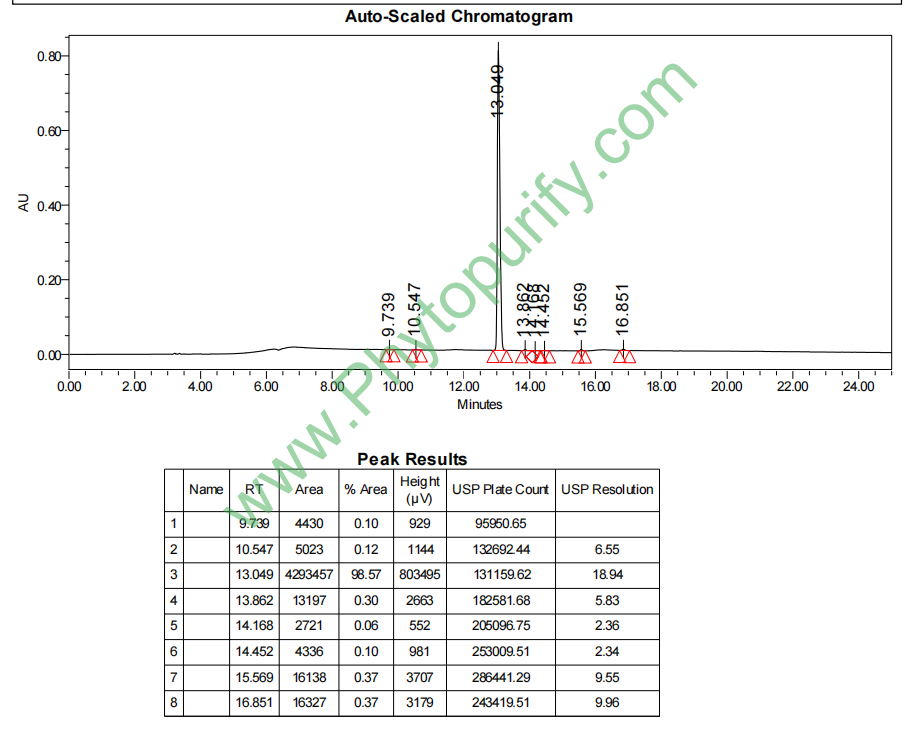
HPLC of Neferine
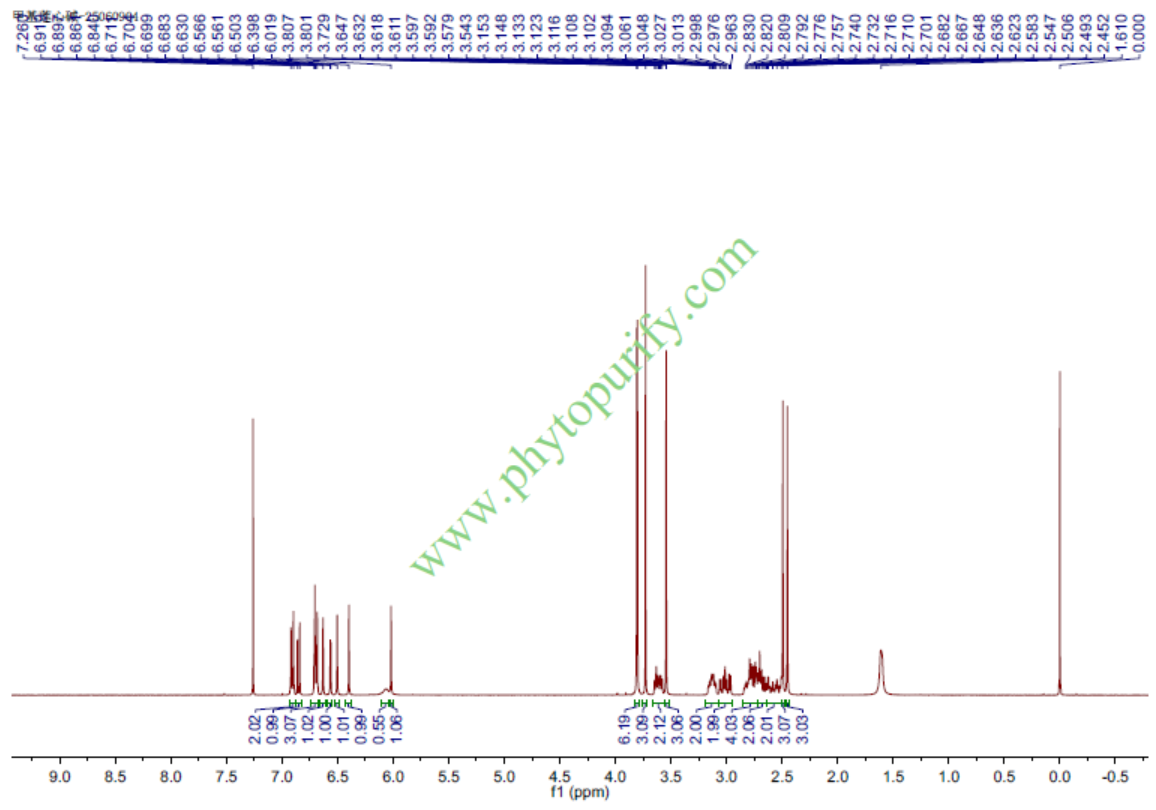
HNMR of Neferine
Storage conditions:Short-term storage at 2~8℃, long-term storage at -20 ~ -80℃
Neferine, also known as methyl naringenin, is a typical bisbenzylisoquinoline alkaloid mainly isolated from the seeds of Nelumbo nucifera Gaertn. As one of the main active ingredients of traditional Chinese medicine lotus seeds, lotus alkaloids have received widespread attention in the field of natural product pharmacology in recent years due to their diverse biological activities and potential medicinal value. Especially in the prevention and treatment of cardiovascular diseases, lotus alkaloids exhibit significant protective effects, and their mechanism of action is closely related to various cellular signaling pathways and molecular targets.
The pharmacological activities of lotus alkaloids include anti-inflammatory, antioxidant, anti fibrotic, anti-tumor, and neuroprotective effects, among which the strong inhibitory effect on the nuclear factor kappa B (NF - κ B) signaling pathway is particularly prominent. NF - κ B, as a key regulatory factor in inflammatory response and cell survival, is closely related to the occurrence and development of various cardiovascular diseases due to its abnormal activation. Lotus alkaloids exhibit good cardiovascular protective potential by regulating NF - κ B and its downstream targets.
This article provides a systematic review of the chemical structure and physicochemical properties, plant sources and extraction methods, pharmacological activity and mechanism of action, pharmacological evaluation and pharmacokinetic characteristics of lotus alkaloids, and explores their clinical application prospects in depth. The aim is to provide scientific basis and theoretical support for the drug development and clinical application of this natural product.
Neferine has the chemical formula C38H44N2O6 and a molecular weight of 624.7780. It belongs to the bisbenzylisoquinoline alkaloid class. Its structural feature is that two isoquinoline units are connected by a methyl bridge to form a dimer structure, which has high molecular complexity and stereochemical characteristics. This structure endows lotus alkaloids with unique biological activity and the ability to bind to multiple targets.
In terms of physicochemical properties, the LogP value of lotus alkaloids is 6.4982, indicating their high hydrophobicity and extremely low water solubility (0.0146 mg/mL), which has a significant impact on their absorption and distribution in vivo. Its polar surface area (TPSA) is 72.86 Å ², indicating that the molecule has certain polar groups that facilitate interactions with biomolecules. The low penetration ability of the blood-brain barrier indicates limited distribution in the central nervous system.
In addition, lotus alkaloids exhibit hERG channel inhibitory activity, indicating a potential risk of cardiac toxicity that requires special attention in drug development. The Ames test result is 0.0, indicating no significant genotoxicity and high safety.
Lotus alkaloids mainly exist in the seeds (lotus seeds) and hearts of the lotus plant Nelumbo nucifera. Lotus seeds, as a traditional Chinese medicinal herb, have a long history and are widely used in the field of traditional Chinese medicine. The content of lotus alkaloids varies depending on plant species, growth environment, and harvesting period.
The extraction method usually combines organic solvent extraction with column chromatography technology. Common extraction solvents include methanol, ethanol, and their aqueous solutions. The specific steps are generally as follows:
In recent years, the application of new technologies such as ultrasound assisted extraction and microwave-assisted extraction has improved the extraction efficiency and purity of lotus alkaloids, laying the foundation for their industrial production.
Lotus alkaloids exhibit multiple protective effects in the cardiovascular system. Numerous in vitro and in vivo experiments have shown that lotus alkaloids can significantly improve myocardial ischemia-reperfusion injury, reduce myocardial cell apoptosis, inhibit inflammatory reactions, alleviate myocardial fibrosis, and regulate vascular contractile function.
Specifically manifested as:
Lotus alkaloids inhibit the NF - κ B signaling pathway, reduce the expression of pro-inflammatory cytokines such as TNF - α and IL-6, and alleviate inflammatory responses. In addition, its antioxidant effect is manifested by clearing free radicals, inhibiting lipid peroxidation, and protecting cells from oxidative damage.
In addition to cardiovascular protection, lotus alkaloids also exhibit various biological activities such as anti-tumor, neuroprotective, and anti fibrotic effects, providing possibilities for the development of multi-target drugs.
The pharmacological effects of lotus alkaloids are mainly achieved by regulating multiple signaling pathways and key molecular targets. Its core mechanism of action focuses on inhibiting NF - κ B activation, thereby regulating downstream inflammation and cell survival related gene expression.
NF - κ B, as a hub of inflammatory response, is involved in various cardiovascular pathological processes. Lotus alkaloids inhibit the phosphorylation and degradation of I κ B α, suppress NF - κ B nuclear translocation and DNA binding activity, reduce the transcription of pro-inflammatory genes, and achieve anti-inflammatory and protective effects.
In summary, lotus alkaloids achieve their complex pharmacological effects through multi-target and multi pathway synergistic effects, reflecting the advantages of multi-target regulation of natural products.
The medicinal properties of lotus alkaloids are influenced by their physicochemical properties and biological activity. The high hydrophobicity (LogP 6.4982) and extremely low water solubility limit its oral bioavailability, and drug formulation technologies such as nanocarriers and liposomes are needed to improve in vivo absorption.
The low permeability of the blood-brain barrier suggests that it mainly acts on peripheral tissues, reducing the risk of central nervous system side effects. Inhibition of hERG channels suggests potential cardiac toxicity and should be given special attention in preclinical safety evaluations.
A negative Ames test indicates a low risk of genotoxicity and good safety. Current pharmacokinetic studies have shown that lotus alkaloids are slowly absorbed and widely distributed after oral administration, but their metabolic pathways and excretion mechanisms still require further research.
Given the multi-target effects and excellent anti-inflammatory and antioxidant properties of lotus alkaloids in cardiovascular protection, their development prospects as an adjuvant therapy for cardiovascular diseases are broad. Future research should focus on:
In addition, the multiple biological activities of lotus alkaloids provide potential applications in fields such as tumors and neurodegenerative diseases, which are worth further exploration.
As a kind of dibenzylisoquinoline alkaloid derived from the traditional Chinese medicine lotus seed, lotus alkaloid shows a good potential for drug development by virtue of its significant NF - κ B inhibitory effect and multi target cardiovascular protective activity. Although there are certain challenges in terms of its physicochemical properties and safety, modern drug design and formulation technology have the potential to overcome these limitations and achieve clinical translation.
In the future, combined with systematic pharmacological mechanism research and clinical validation, lotus alkaloids are expected to become important candidates in the development of natural product drugs, providing new strategies and choices for the prevention and treatment of cardiovascular diseases.
