

Storage conditions:Short-term storage at 2~8℃, long-term storage at -20 ~ -80℃
100.9900
2.0000
1.5000
High
90.0000
No
No
No
Yes
No
Positive
10 Methoxycamptothecin (hereinafter referred to as 10-MCPT) is a compound derived from Camptotheca acuminata(Camptotheca acuminata)The natural bioactive derivatives obtained from the separation belong to the family of camptothecin alkaloids. Camptothecin compounds have become an important source of anti-cancer drug development due to their significant anti-tumor activity. Since the first isolation of camptothecin (CPT) from camptothecin in the 1960s, research on its structural optimization and derivative development has continued to deepen. 10-MCPT, as a naturally occurring derivative, has gradually attracted widespread attention from academia and the pharmaceutical industry due to its unique chemical structure and excellent biological activity.
At present, 10-MCPT has been proven to exhibit strong cytotoxicity in various tumor cell lines, especially in ovarian cancer cell line 2774 where its anti-tumor activity is superior to structurally similar 10 hydroxycamptothecin. In addition, the latest research suggests that 10-MCPT may play a regulatory role in non tumor diseases such as Acute Kidney Injury (AKI), involving multiple key molecular targets such as HIF1A and HDAC6, expanding its potential therapeutic applications.
This article provides a systematic review of the chemical structure and physicochemical properties, plant sources and extraction methods, pharmacological activity and mechanism of action, pharmacological evaluation and pharmacokinetic characteristics of 10 methoxycamptothecin. Finally, it explores its clinical application prospects and development trends, aiming to provide theoretical basis and reference for the in-depth research and drug development of this natural product.
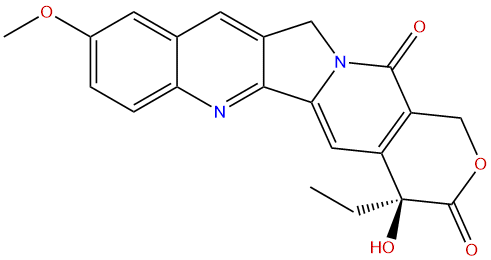
The chemical structure of 10 methoxycamptothecin is based on the classical camptothecin skeleton, with a molecular formula of C20H19N2O5 and a molecular weight of 378.38. Its structural features mainly include the fusion of a five membered lactone ring and an indolidine ring system, with the 10th hydroxyl group replaced by a methoxy group to form a 10 methoxy substituent. The change in this structure has a significant impact on the polarity, lipophilicity, and binding ability of the molecule to the target.
In terms of physical and chemical properties, the LogP value of 10-MCPT is about 2.0, indicating its moderate lipid solubility, which is beneficial for membrane penetration and in vivo distribution. The topological polar surface area (TPSA) is 100.99 Å ², indicating that it has a certain polarity that may affect its absorption and blood-brain barrier penetration ability. The number of hydrogen bond acceptors is 7, indicating that it has strong hydrogen bonding forces when binding with biomolecules.
It is worth noting that 10-MCPT has a high blood-brain barrier penetration ability (BBB: High), which provides the possibility for its potential application in central nervous system related diseases. In terms of toxicity assessment, although its liver toxicity and cardiac toxicity are not yet clear, the hERG channel inhibition test is negative, indicating a low risk of cardiac toxicity. However, the Ames mutagenicity test result was positive, indicating a potential genotoxicity risk that needs to be addressed and optimized in subsequent drug development.
10 methoxycamptothecin is mainly derived from camptothecin(Camptotheca acuminata)The bark, leaves, and roots. Camptotheca is a plant belonging to the family Verbenaceae and the genus Camptotheca, widely distributed in southern China and Southeast Asia. As a traditional Chinese medicinal herb, it has a long history. Modern research has revealed that it contains various alkaloids, among which camptothecin and its derivatives are the most pharmacologically active ingredients.
The extraction of 10-MCPT usually uses solvent extraction combined with chromatographic separation technology. Common extraction solvents include methanol, ethanol, and their aqueous solutions, and their polarity differences are utilized to achieve preliminary separation. Subsequently, high-purity 10 methoxycamptothecin was further purified by methods such as silica gel column chromatography and reverse phase high performance liquid chromatography (RP-HPLC).
In recent years, researchers have introduced ultrasound assisted extraction, microwave-assisted extraction, and efficient membrane separation technologies to improve extraction efficiency and purity, significantly reducing extraction time and increasing yield. In addition, plant cell culture and engineering of biosynthetic pathways have also been explored for the controllable production of 10-MCPT, aiming to address the issues of limited natural resources and environmental impact.
The core pharmacological activity of 10 methoxycamptothecin is its significant anti-tumor effect. Multiple in vitro cell experiments have shown that 10-MCPT exhibits strong cytotoxicity against ovarian cancer cell line 2774, lung cancer cell line A549, colon cancer cell line HCT116, and others. Compared to 10 hydroxycamptothecin, 10-MCPT showed a lower half maximal inhibitory concentration (IC50) at the same concentration, indicating its superior anti-cancer efficacy.
Its anti-tumor mechanism mainly relies on inhibiting DNA topoisomerase I, blocking DNA replication and transcription processes, and inducing cancer cell apoptosis. In addition, 10-MCPT can exert synergistic anti-cancer effects by activating intracellular apoptotic signaling pathways (such as caspase family) and inhibiting tumor cell proliferation related signaling pathways (such as PI3K/Akt).
In addition to its anti-tumor activity, 10-MCPT exhibits a certain protective effect in the acute kidney injury (AKI) model. Research has found that 10-MCPT can regulate various molecular targets related to AKI, including hypoxia inducible factor 1 alpha (HIF1A), histone deacetylase 6 (HDAC6), endothelin receptor B (EDNRB), mast cell enzyme (CMA1), and adenosine receptor A2B (ADORA2B). These targets play a key role in regulating renal ischemia-reperfusion injury, inflammatory response, and cell apoptosis, suggesting that 10-MCPT may alleviate renal injury through a multi-target synergistic regulatory mechanism.
In addition, the blood-brain barrier penetration of 10-MCPT is relatively high, suggesting its potential application value in neurological diseases, although related research is still in its infancy.
The main mechanism of action of 10 methoxycamptothecin is focused on the inhibition of DNA topoisomerase I. Topoisomerase I is an important enzyme that maintains the supercoiled structure and replication transcription process of DNA. 10-MCPT stabilizes the topoisomerase I-DNA complex, preventing the recovery of DNA strands, leading to the accumulation of DNA breaks, cell cycle arrest, and apoptosis.
In addition to its anti-tumor effects, the regulatory mechanism of 10-MCPT on acute kidney injury related targets is gradually being revealed:
HIF1A As a key transcription factor in hypoxia response, HIF1A regulates cellular adaptation to hypoxic environments. 10-MCPT may alleviate renal hypoxia injury by regulating the expression or activity of HIF1A.
HDAC6 The inhibition of HDAC6, which participates in cellular stress response and protein deacetylation, helps alleviate inflammation and cell apoptosis. The regulation of HDAC6 by 10-MCPT may promote the survival of kidney cells.
EDNRB Endothelial receptor B is involved in vascular constriction and cell signaling, and its regulation by 10-MCPT helps improve renal blood flow and function.
CMA1 Mast cell enzymes play a role in inflammatory response, and 10-MCPT may alleviate inflammatory damage by regulating CMA1.
ADORA2B Adenosine receptor A2B regulates immune response and cell protection, and the effect of 10-MCPT on it helps alleviate renal inflammation and cell apoptosis.
These multi-target mechanisms provide theoretical support for the application of 10-MCPT in non tumor diseases.
The pharmacological parameters of 10 methoxycamptothecin indicate that it has certain potential for drug development. Moderate molecular weight (378.38) and LogP (2.0) are beneficial for the oral absorption and in vivo distribution of drugs. A higher number of TPSA and hydrogen bond receptors suggests a stronger binding ability to target proteins, but may also affect membrane permeability.
Its high blood-brain barrier penetration ability provides the possibility for the treatment of central nervous system diseases, but at the same time, potential neurotoxic risks need to be considered. A negative hERG channel inhibition test reduces the risk of cardiac toxicity, while a positive Ames test suggests a risk of genotoxicity, which needs to be given special attention during drug design and safety assessment.
Currently, there is limited pharmacokinetic data available for 10-MCPT. Previous studies have shown that it has good bioavailability and distribution characteristics in vivo, but the metabolic pathways and clearance mechanisms are not fully understood. In the future, in vitro and in vivo pharmacokinetic studies are needed to clarify its absorption, distribution, metabolism, and excretion (ADME) characteristics, providing a basis for clinical drug dosage and administration regimens.
10 methoxycamptothecin, as an excellent derivative of camptothecin natural products, has shown broad application prospects in the field of anti-tumor. Its high cytotoxicity and multi-target mechanism of action make it an important candidate molecule for developing novel anti-cancer drugs. Especially in the treatment of solid tumors such as ovarian cancer and lung cancer, 10-MCPT is expected to be used as a monotherapy or combination therapy to improve treatment efficacy and overcome drug resistance.
In addition, the potential therapeutic effect of 10-MCPT in non tumor diseases such as acute kidney injury has opened up new directions for its clinical application. By regulating multiple key molecular targets, 10-MCPT may become a renal protectant or adjuvant therapy drug, improving patient prognosis.
However, the genotoxicity risks and safety issues of 10-MCPT still require further research. In the future, its toxicological evaluation should be strengthened, and the molecular structure should be optimized to reduce potential toxicity. At the same time, conduct systematic pharmacokinetic and pharmacodynamic studies to clarify its in vivo behavior and dose-response relationship.
With the development of biosynthetic technology and drug delivery systems, the production process and drug formulations of 10-MCPT are expected to be improved, enhancing its clinical feasibility. Combining precision medicine strategies, personalized medication based on patient molecular characteristics will also become a future research focus.
As an important derivative of camptothecin, 10 methoxycamptothecin exhibits strong anti-tumor potential and multi-target regulation ability due to its unique chemical structure and significant biological activity. Its emerging applications in diseases such as acute kidney injury further enrich its pharmacological value. Despite facing safety challenges such as genotoxicity, 10-MCPT still has a good pharmacological basis and clinical translational potential.
In the future, interdisciplinary collaborative research is needed to deepen the understanding of the mechanism of action of 10-MCPT, optimize its drug properties, conduct systematic preclinical and clinical studies, and promote it as a safe and effective new anti-cancer and renal protective drug. With the continuous advancement of natural product pharmacology and drug development technology, 10 methoxycamptothecin is expected to play a more important role in modern medicine.
