
| Catalog No | Package | Original Price | Price | Inventory | Quantity | Operating |
|---|---|---|---|---|---|---|
| BP0308-20mg | 20mg | $30.00 | Sign in |
|


Product name: Camptothecin
Synonym name:
Catalogue No.: BP0308
Cas No.: 7689-03-4
Formula: C20H16N2O4
Mol Weight: 348.358
Botanical Source: Camptotheca acuminata.
Physical Description:
Type of Compound: Alkaloids
Purity: 95%~99%
Analysis Method: HPLC-DAD or/and HPLC-ELSD
Identification Method: Mass, NMR
Packing: Brown vial or HDPE plastic bottle
Storage: Store in a well closed container, protected from air and light. Put into refrigerate or freeze for long term storage.
Whenever possible, you should prepare and use solutions on the same day. However, if you need to make up stock solutions in advance, we recommend that you store the solution as aliquots in tightly sealed vials at -20℃. Generally, these will be useable for up to two weeks.
The product could be supplied from milligrams to grams
Inquire for bulk scale.
Chengdu Biopurify Phytochemicals Ltd. is a leading company in the research, development, manufacture and marketing of High Quality Phytochemicals and Extracts(especially Active Ingredients from Traditional Chinese Medicine,TCM), Natural Active Pharmaceutical Ingredients worldwide.
The main services:
A. Supply active ingredients and reference standards of TCM, from mgs to kgs scale
B. Custom extraction and purification, target Herb Active Ingredients
C. Custom synthesis and semi-synthesis for Natural Active Ingredients
D. CR(contract research), CM(contract manufacture) and PD(process development) services from lab scale, pilot scale to commercial scale(GMP is also available)
E. TCM compounds library for drug screen,more than 3000 compounds available, many of them are rare and unique.
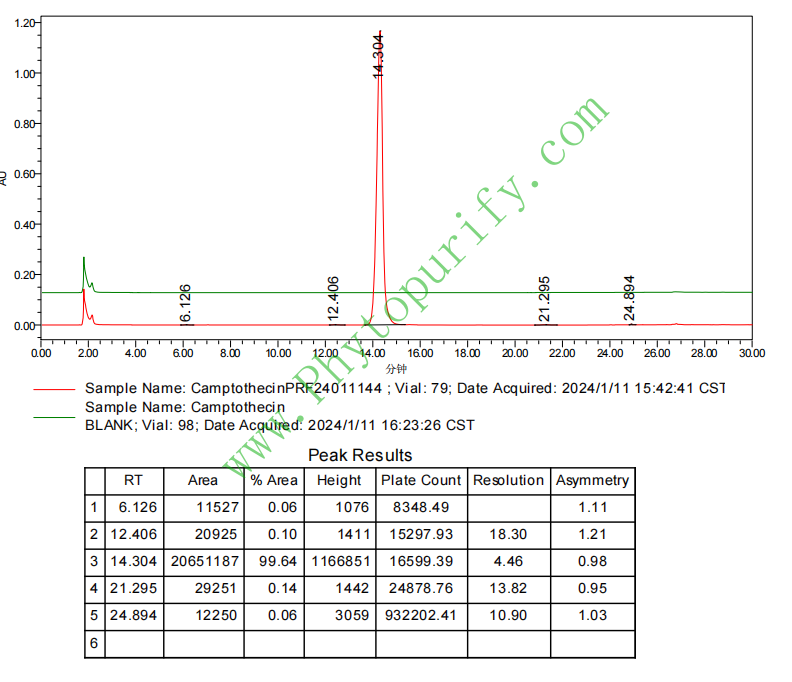
HPLC of Camptothecin
Storage conditions:Short-term storage at 2~8℃, long-term storage at -20 ~ -80℃
81.4200
1.8725
1.8726
.0131
2.2591
14.1415
High
86.0395
3.1755
No
No
No
No
Yes
Yes
1.2
Yes
No
No
Yes
Camptothecin (CPT), a pentacyclic quinoline alkaloid isolated from the Chinese endemic plant Camptotheca acuminata, has become a milestone in the fields of natural product medicinal chemistry and tumor pharmacology since its outstanding anti-tumor activity was discovered in the 1960s. Its unique chemical structure, consisting of a pyranoindoxazinoquinoline skeleton and a key E-ring δ - lactone, endows it with extraordinary ability to target DNA topoisomerase I (TOP1). Although early clinical trials were hampered by serious toxic side effects and poor water solubility, a deeper understanding of its mechanism of action directly led to the birth of semi synthetic derivatives such as Topotecan and Irinotecan, which were successfully applied in clinical settings and saved the lives of countless cancer patients. Camptothecin and its derivatives have become first-line or important drugs for the treatment of various solid tumors such as colorectal cancer, ovarian cancer, and small cell lung cancer. This article aims to systematically review the chemical properties, plant sources, pharmacological activities, multidimensional mechanisms of action centered around TOP1, challenges in drug development, and clinical translation prospects of camptothecin, in order to provide a comprehensive academic perspective for the in-depth development and design of new derivatives of this classic natural product.
The chemical structure of camptothecin is complex and unique, with a molecular formula of C20H16N2O4 and a molecular weight of 348.36. According to the IUPAC nomenclature, it is a (4S) -4-ethyl-4-hydroxy-1H-pyrano [3 ', 4': 6,7] indazino [1,2-b] quinoline-3,14 (4H, 12H) - dione. Its core skeleton is composed of five fused rings, A, B, C, D, and E: the A and B rings form the quinoline part, the C ring is the pyridone ring, the D ring is the hexagonal lactam ring, and the crucial E ring is a hexagonal α - hydroxy - δ - lactone ring. The S configuration at position C-20 is crucial for its biological activity.
In terms of physicochemical properties, camptothecin itself is a pale yellow needle shaped crystal, and its pharmacological parameters reveal its advantages and challenges as a lead compound. Its calculated LogP value is about 1.87, indicating that it has moderate lipophilicity. However, its topological polar surface area (TPSA) is as high as 81.42 Å ², and its water solubility is extremely low (about 0.0131 mg/mL), which directly makes it difficult to directly produce water-soluble injections and is a major obstacle to early clinical administration. Its E-ring lactone structure is highly susceptible to hydrolysis and ring opening under physiological pH (>7) conditions, forming an inactive carboxylate form. This pH dependent, reversible "lactone carboxylate" equilibrium greatly affects its in vivo activity and pharmacokinetic behavior. In addition, the Ames test value of 1.2 suggests that it may have weak direct mutagenicity, which is consistent with its nature as a gene toxin that interferes with DNA metabolism. It is worth noting that its blood-brain barrier permeability is predicted to be "high", which provides a potential chemical structural basis for its development for the treatment of central nervous system tumors, but may also indicate potential neurotoxic risks.
Camptothecin was initially isolated by American scientists Monroe E. Wall and Mansukh C. Wani in 1966 from the bark and trunk of the Chinese plant Camptotheca acuminata Decne. Camptotheca acuminata is mainly distributed in the Yangtze River Basin and southern provinces of China. The content of camptothecin in its fruit (Camptotheca acuminata fruit) is relatively high, making it the main raw material for subsequent industrial extraction. In addition, camptothecin and its analogues have also been found in Nothapodytes foetida, a plant in the Ranunculaceae family, as well as some plants in the Malvaceae family.
The traditional extraction method is mainly based on solvent method. The common process is to extract dried and crushed Camptotheca acuminata fruits or bark with organic solvents such as methanol, ethanol, or acetone, concentrate the extract, and perform liquid-liquid partitioning extraction with solvents such as chloroform or dichloromethane. Then, separation and purification are carried out using silica gel column chromatography, preparative high-performance liquid chromatography (HPLC), and other methods. With the advancement of technology, modern separation techniques such as macroporous adsorption resin and high-speed countercurrent chromatography have also been applied to the large-scale preparation of camptothecin to improve yield and purity.
However, plant extraction is limited by plant growth cycle, production environment, fluctuations in content, and ecological protection pressure. Therefore, alternative production methods have been widely studied. The chemical total synthesis route has been established, but the steps are cumbersome and the overall yield is low, making it difficult to meet commercial needs. At present, the most promising direction is biosynthesis and synthetic biology. Researchers have basically elucidated the biosynthetic pathway of camptothecin in Camptotheca acuminata, involving key enzymes such as isocoumarin synthase, strictosidine β - glucosidase, as well as a series of cytochrome P450 oxidase and methyltransferase. Using genetic engineering technology to introduce relevant gene clusters into microorganisms (such as yeast) or plant cells for heterologous expression, achieving fermentation production of camptothecin or its key precursors, is an important strategy for achieving sustainable and green supply in the future.
The most core and famous pharmacological activity of camptothecin is its powerful anti-tumor effect. It exhibits nanomolar level cytotoxicity against various tumor cell lines in vitro, including leukemia cells (L1210), colon cancer cells (HCT-8), lung cancer cells (A549), etc. In vivo experiments have also confirmed its significant growth inhibitory effect on various mouse transplant tumor models, such as sarcoma S180, Ehrlich ascites carcinoma, Lewis lung cancer, etc.
In addition to its direct cytotoxic effects, recent studies have found that camptothecin has a wider range of pharmacological activities, which are often intertwined with its induced DNA damage and cellular stress responses
1. Angiogenesis inhibition Camptothecin can inhibit the proliferation, migration, and tubular formation of vascular endothelial cells, downregulate the expression of vascular endothelial growth factor (VEGF), and thus inhibit the formation of tumor neovascularization.
2. Inducing cell apoptosis and autophagy Camptothecin strongly induces tumor cell apoptosis by activating the caspase cascade reaction, inducing mitochondrial membrane potential collapse, and regulating Bcl-2 family proteins (such as inhibiting Bcl-2 and Mcl-1). At the same time, it can also activate cellular autophagy, which may promote cell death or produce protective responses in specific situations, with complex effects.
3. immunomodulation Studies have shown that tumor cells treated with camptothecin may enhance immunogenic cell death by releasing damage related molecular patterns, potentially activating anti-tumor immune responses. Its inhibition of signaling pathways such as STAT3 may also improve the tumor immune microenvironment.
4. anti-inflammatory activity Camptothecin has a certain inhibitory effect on 5-lipoxygenase (ALOX5), which may interfere with the arachidonic acid metabolism pathway and exhibit anti-inflammatory potential, which is related to the regulation of tumor microenvironment.
5. Reverse multidrug resistance Some studies suggest that camptothecin or its derivatives may reverse the multidrug resistance of tumor cells to certain chemotherapy drugs to some extent by inhibiting functions such as P-glycoprotein (ABCB1).
The study of the mechanism of action of camptothecin is a model in the field of natural product molecular pharmacology. Its primary and classic molecular target is DNA Topoisomerase I。
1. Core mechanism: Stable TOP1-DNA cleavage complex of "toxic substances"
TOP1 is responsible for alleviating the supercoiled tension of DNA during DNA replication and transcription. Its mechanism is to temporarily cleave a DNA strand, forming a covalent TOP1-DNA cleavage complex (TOP1cc), which is reconnected after the strand passes through. Camptothecin does not inhibit the catalytic activity of TOP1, but acts as an "interface inhibitor" that specifically embeds into TOP1cc, binds to the enzyme and DNA simultaneously, stabilizes this transient complex, and prevents the reconnection of DNA single strands. This frozen TOP1cc is called a "cleavable composite". When the DNA replication fork advances to this point, it collides with the stable TOP1cc, causing the replication fork to stagnate and the DNA double strand to break. This irreparable DNA damage triggered by the replication process ultimately leads to cell cycle arrest (mainly in the S phase) and apoptosis through signaling pathways such as ATM/ATR and p53.
2. Key targets: TOP1
TOP1 is a necessary mediator for camptothecin to exert cytotoxic effects. Tumor cells, especially some rapidly proliferating cancer cells, often overexpress TOP1, making them more sensitive to camptothecin drugs. Mutations or changes in expression levels of TOP1 genes are one of the important mechanisms by which tumors develop drug resistance.
3. Downstream signal network and related targets
Camptothecin induced DNA damage activates a series of complex cellular stress and death signaling pathways, involving multiple targets associated with diseases such as colon cancer
* Apoptosis regulatory targets DNA damage activates p53, which in turn regulates downstream pro apoptotic proteins (such as Bax) and anti apoptotic proteins. Camptothecin can downregulate the expression of anti apoptotic proteins Bcl-2 and Mcl-1, lower the threshold for mitochondrial apoptosis, and promote the release of cytochrome C.
* Stress and survival signaling pathways:
* MAPK/ERK pathway DNA damage can activate MAPK1 (ERK2), and its sustained activation may be involved in the regulation of apoptosis or survival signals, depending on the cellular background.
* NF - κ B pathway Camptothecin may inhibit the nuclear translocation or activity of NF - κ B subunit RELA, thereby suppressing its mediated transcription of pro survival and anti apoptotic genes.
* STAT3 pathway Camptothecin can inhibit the phosphorylation and activation of STAT3, blocking its drive for cell proliferation, survival, and immune escape signals.
* AMPK pathway Cellular energy stress may activate AMPK (PRKAA1), which acts as an energy receptor that regulates metabolism, autophagy, and cell growth.
* Drug resistance related targets:
* External discharge pump ABCB1 Overexpression of P-glycoprotein can actively pump camptothecin out of cells, reducing its intracellular concentration, and is one of the main mechanisms of clinical drug resistance.
* Drug metabolism and detoxification system The glucuronidation of the active metabolite SN-38 of irinotecan by UGT1A1 enzyme is also associated with individual toxicity and efficacy differences.
4. Other potential interacting targets
The study also found that camptothecin can interact with some non TOP1 targets, such as binding to tyrosine kinase LCK, which may affect T cell signaling, but its contribution weight in anti-tumor is far less than TOP1.
The pharmacological properties of camptothecin as a lead compound have significant drawbacks, and its optimization process is highly representative.
Pharmacokinetic Challenge:
1. Solubility and dosage form The extremely poor water solubility makes it difficult to make intravenous injections. Early clinical trials used its sodium salt (in the form of an open-loop carboxylate), but it had low in vivo activity and high toxicity.
2. Instability of lactone ring At the pH of human blood (~7.4), the active lactone form rapidly hydrolyzes into inactive carboxylate salts, and the two reach dynamic equilibrium (lactone ratio is usually<10%). Only lactone forms can penetrate the cell membrane and exert pharmacological effects. This instability leads to low and fluctuating concentrations of active drugs in the body.
3. Plasma protein binding Camptothecin has a high affinity for human serum albumin (HSA), and the binding rate of the carboxylate form is much higher than that of the lactone form. This high protein binding limits the concentration of free active drugs, affecting tissue distribution and efficacy.
4. Distribution and Metabolism Camptothecin is widely distributed in the body and has high concentrations in the liver, kidneys, and intestines. It is mainly metabolized through the liver, involving oxidative metabolism of CYP450 enzyme systems (such as CYP3A4), and UGT mediated glucuronidation. The prototype drug and its metabolites are mainly excreted through bile and urine.
5. toxicity Early clinical trials have shown that its dose limiting toxicity includes severe bone marrow suppression (neutropenia, thrombocytopenia), hemorrhagic cystitis, and gastrointestinal toxicity (diarrhea, nausea, and vomiting). These toxicities are related to their mechanisms of action and distribution characteristics.
Optimization Strategy and Derivative Development:
In response to the above deficiencies, medicinal chemists have successfully developed clinical drugs through structural modifications:
* Topotecan Introducing dimethylaminomethyl at position 10 of camptothecin improves its water solubility and stability of the lactone ring. Mainly used for ovarian cancer and small cell lung cancer.
* Irinotecan (CPT-11)This is a prodrug that introduces a large piperidino-piperidinoyloxy group at position 7. It is mainly converted into the active metabolite SN-38 by carboxylesterase in the body (which is 100-1000 times more potent than irinotecan). The water solubility and lactone stability of SN-38 still pose challenges, but prodrug design has improved drug delivery performance, mainly for colorectal cancer. Its unique toxicity (delayed diarrhea) is related to the accumulation of SN-38 in the intestine.
* Other strategies Including the development of novel delivery systems such as liposomes, nanoparticles, and polymer prodrugs to protect the lactone ring, improve targeting, and reduce systemic toxicity.
The success of camptothecin based drugs has established their important position in tumor chemotherapy. Looking ahead to the future, its development prospects focus on the following aspects:
Camptothecin, a natural molecule derived from traditional Chinese medicinal plants, has profoundly influenced the development of modern cancer drug therapy with its unique chemical structure and pioneering TOP1 inhibition mechanism. From the initial setbacks to the successful launch of derivatives, its story perfectly illustrates the translational medicine path from natural products to modern drugs. Despite inherent limitations in drug efficacy, these challenges are gradually being transformed into innovative opportunities through continuous interdisciplinary research in medicinal chemistry, pharmacology, and molecular pharmacology. Currently, combining cutting-edge technologies such as nanotechnology, combination therapy, and synthetic biology, camptothecin, an ancient and classic compound, is showing new vitality. It will not only continue to serve as an important weapon for clinical cancer treatment, but also as a valuable tool for exploring tumor biology and developing new targeted strategies, playing an irreplaceable role in future biomedical research. The in-depth research on camptothecin will continue to provide profound insights and motivation for discovering and optimizing innovative drugs from natural treasure trove.
