


Synonym name:
Catalogue No.: BP0111
Cas No.: 39026-92-1
Formula: C21H18N2O5
Mol Weight: 378.384
Botanical Source: Alkaloid from Mappia foetida, Ervatamia heyneana, Nothapodytes foetida, Merrilliodendron megacarpum and Ophiorrhiza mungos. Prod. by Fusarium solani
Purity: 95%~99%
Analysis Method: HPLC-DAD or/and HPLC-ELSD
Identification Method: Mass, NMR
Packing: Brown vial or HDPE plastic bottle
Can be supplied from milligrams to grams.
For Reference Standard and R&D, Not for Human Use Directly.
Inquire for bulk scale.
HPLC of 9-Methoxycamptothecin
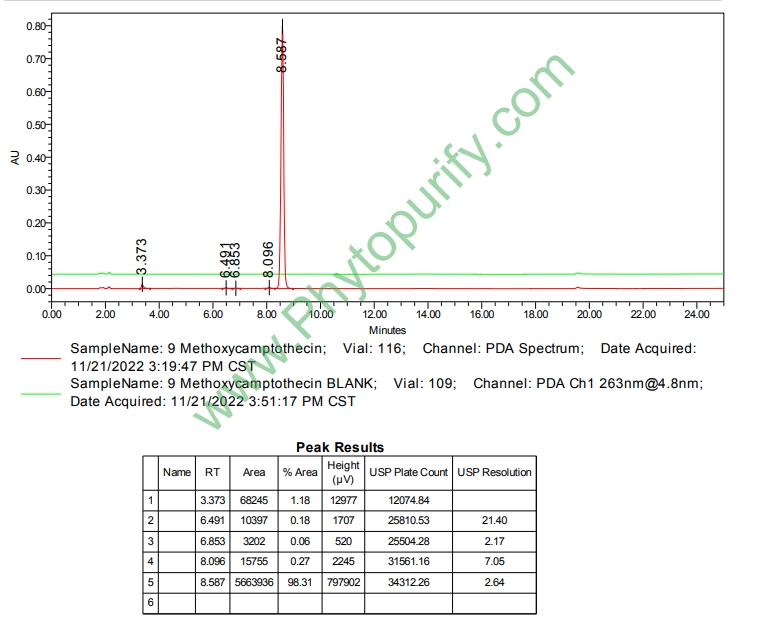
Storage conditions:Short-term storage at 2~8℃, long-term storage at -20 ~ -80℃
99.1900
1.8500
1.7900
High
90.0000
No
No
No
Yes
No
Positive
9-Methoxycamptothecin (9-MC) is a natural product with significant anti-tumor activity, belonging to the pyranose indole quinoline alkaloid class. It was first isolated from Camptotheca acuminata. As an important member of camptothecin (CPT) and its derivatives, 9-methoxycamptothecin has become a research hotspot in the field of anti-cancer drug development due to its unique chemical structure and excellent biological activity. In recent years, with the in-depth analysis of its molecular mechanism, the potential of 9-methoxycamptothecin in anti-tumor and immune regulation has gradually emerged, especially in the treatment of immune related diseases such as rheumatoid arthritis (RA), showing new application prospects.
This article provides a systematic review of the chemical structure and physicochemical properties, plant sources and extraction methods, pharmacological activity and mechanism of action, pharmacological evaluation and pharmacokinetic characteristics of 9-methoxycamptothecin. Combined with its potential targets in diseases such as rheumatoid arthritis, it explores its clinical application prospects and future research directions, aiming to provide theoretical basis and research references for natural product pharmacology and new drug development.
The chemical structure of 9-methoxycamptothecin is based on the pyranosindolequinone skeleton and has a typical five ring system, with the C-9 methoxy substituent being its key structural feature that distinguishes it from camptothecin. This structure endows it with unique physicochemical properties and biological activity.
The structural stability of 9-methoxycamptothecin is improved compared to camptothecin, and methoxy substituents have a significant impact on its topoisomerase I inhibitory activity and cytotoxicity. The pyran and indazole ring systems in its molecular structure provide key spatial configurations for its binding with DNA topoisomerase I.
9-Methoxycamptothecin is mainly derived from Camptotheca acuminata, a woody plant native to southern China and belonging to the family Wisteriaceae. Camptothecin, as a traditional Chinese medicinal herb, is rich in camptothecin alkaloids in its bark, leaves, and roots. Among them, 9-methoxycamptothecin has a low content and needs to be obtained through efficient extraction and separation techniques.
Solvent extraction
Using dried camptothecin plant materials as raw materials, reflux extraction is carried out using organic solvents such as methanol, ethanol, or ethyl acetate. After concentration, the extraction solution is subjected to acid-base adjustment and liquid-liquid extraction to remove impurities.
Column chromatography separation
Separate and purify the crude extract using silica gel column chromatography or reverse phase high performance liquid chromatography (RP-HPLC) technology. 9-Methoxycamptothecin is often eluted using a methanol water gradient due to its moderate polarity.
Crystallization purification
Further improve purity by solvent recrystallization, ensuring the structural integrity and biological activity of the compound.
In recent years, the application of supercritical fluid extraction (SFE) and membrane separation technology has significantly improved the extraction efficiency and purity of 9-methoxycamptothecin, laying the foundation for its large-scale production.
9-Methoxycamptothecin, as a topoisomerase I inhibitor, exhibits potent anti-tumor activity, especially showing significant cytotoxicity in various solid tumor cell lines. In addition, research has found that it also has the ability to induce cell cycle arrest and promote cancer cell apoptosis.
cell cycle arrest
9-Methoxycamptothecin can induce cancer cell arrest in the G2/M phase, block cell division, and inhibit tumor cell proliferation.
Inducing apoptosis
By activating the endogenous apoptotic pathway, regulating the expression of BCL2 family proteins, promoting mitochondrial membrane potential loss and activating caspase, it induces programmed cell death in tumor cells.
Topoisomerase I inhibition
As a specific inhibitor of topoisomerase I, 9-methoxycamptothecin stabilizes the DNA topoisomerase I complex, hindering DNA replication and transcription, leading to DNA breakage and cell death.
In recent years, the potential of 9-methoxycamptothecin in immune related diseases has gradually been discovered. Its therapeutic effect on autoimmune diseases such as rheumatoid arthritis is mainly achieved by regulating multiple signaling pathways and molecular targets.
The core mechanism of action of 9-methoxycamptothecin is to inhibit the activity of DNA topoisomerase I (TOP1), leading to DNA strand breaks and cell death. In addition, its role in diseases such as rheumatoid arthritis involves multiple molecular targets and signaling pathways.
TOP1 (Topoisomerase I)
9-Methoxycamptothecin binds to TOP1-DNA complex, preventing the unwinding of topoisomerase I, leading to DNA fragmentation accumulation and inducing tumor cell apoptosis.
BCL2 (B-cell lymphoma protein 2)
By regulating the expression balance of BCL2 family proteins, promoting apoptosis signaling and enhancing cell apoptosis.
TLR4 (Toll like receptor 4)
9-Methoxycamptothecin may participate in the regulation of immune inflammatory responses by inhibiting the TLR4 mediated signaling pathway, thereby reducing inflammation.
STAT3 (Signal Transduction and Transcription Activation Factor 3)
Inhibit the activation of STAT3, block pro-inflammatory and pro proliferative signals, and exert anti-inflammatory and anti-tumor effects.
ABCG2 (ATP binding cassette transporter G2)
Affects drug efflux and resistance, possibly by regulating ABCG2 expression to improve drug efficacy.
PRKCA and PRKCD (protein kinases C alpha and delta)
Regulate cell proliferation, differentiation, and apoptosis signaling pathways, and participate in the regulation of inflammation and immune responses.
ALOX5 (Lipoxygenase 5)
9-Methoxycamptothecin may alleviate inflammation by inhibiting ALOX5 activity and participating in the generation of inflammatory mediators.
NFE2L2 (nuclear factor erythroid 2 related factor 2)
Regulating oxidative stress response, promoting antioxidant gene expression, and protecting cells from oxidative damage.
TRPV1 (Transient receptor potential vanillic acid receptor 1)
Participating in pain and inflammation transmission may alleviate inflammation related symptoms by regulating TRPV1 activity.
In summary, 9-methoxycamptothecin exerts its anti-tumor and immune regulatory functions through multi-target and multi pathway synergistic effects, providing a molecular basis for its use in the treatment of tumors and autoimmune diseases.
The molecular weight (378.38) and LogP value (1.85) of 9-methoxycamptothecin comply with Lipinski's rule, indicating good drug similarity. Its TPSA is 99.19 Å ², indicating that the molecule has moderate polarity, which is beneficial for oral absorption and cell membrane penetration. The number of hydrogen bond receptors is 7, which is moderate and helps to form stable binding with target proteins.
The high permeability of the blood-brain barrier suggests its potential central nervous system activity, but potential central toxicity risks also need to be considered. The hERG channel has no inhibitory effect and reduces the risk of cardiac toxicity. However, a positive Ames test indicates potential genotoxicity, which needs to be evaluated and optimized during drug development.
At present, there is limited systematic pharmacokinetic research on 9-methoxycamptothecin, but based on its structure and studies of camptothecin like derivatives, it can be inferred that it has the following characteristics:
In the future, systematic research on its in vivo dynamics, metabolic pathways, and safety should be strengthened to provide scientific basis for clinical applications.
As a topoisomerase I inhibitor, 9-methoxycamptothecin has significant anti-tumor activity, especially in lung cancer, colorectal cancer, breast cancer and other solid tumors, showing potential therapeutic value. The mechanism of inducing G2/M phase arrest and promoting cancer cell apoptosis provides an important target for the development of anticancer drugs.
In addition, based on its regulatory effects on rheumatoid arthritis related targets such as BCL2, TLR4, STAT3, etc., 9-methoxycamptothecin has shown new application potential in the fields of immune regulation and anti-inflammatory. Rheumatoid arthritis, as a chronic autoimmune disease, has limited efficacy and significant side effects in current treatment methods. 9-methoxycamptothecin is expected to become a novel immunomodulatory agent.
However, the genotoxicity risk and potential side effects of 9-methoxycamptothecin still need to be further evaluated. Future research should focus on:
Through interdisciplinary collaboration and technological innovation, 9-methoxycamptothecin is expected to become an important candidate for natural anti-tumor and immunomodulatory drugs.
9-Methoxycamptothecin, as a natural pyranose indole alkaloid derived from camptothecin, exhibits potent anti-tumor and immune regulatory functions due to its unique chemical structure and significant topoisomerase I inhibitory activity. Its mechanism of action in inducing G2/M phase arrest and promoting apoptosis in cancer cells has been widely confirmed, and multi-target regulation of immune diseases such as rheumatoid arthritis provides new ideas for its clinical application.
Although its genotoxicity and safety issues still need to be addressed, with the continuous advancement of extraction and purification technology, drug design, and delivery systems, 9-methoxycamptothecin is expected to break through existing bottlenecks and become an important drug candidate in the fields of anti-cancer and immune regulation. Future research should focus on systematic pharmacodynamics, pharmacokinetics, and safety evaluation, promoting their clinical translation and advancing the development and innovation of natural product pharmacology.
