| Catalog No | Package | Original Price | Price | Inventory | Quantity | Operating |
|---|---|---|---|---|---|---|
| BP3863-5mg | 5mg | $350.00 | Sign in |
|


Storage conditions:Short-term storage at 2~8℃, long-term storage at -20 ~ -80℃
348.5800
-1.4595
-1.4673
6.5537
.3716
.1364
Low
72.6098
5.3156
Yes
No
No
No
Yes
No
0.0
Yes
Yes
Yes
Yes
Natural products, as an important source of drug discovery, play an irreplaceable role in maintaining human health and preventing diseases. Flavonoids, as one of the most widely distributed and structurally diverse secondary metabolites in nature, have attracted much attention due to their rich biological activity and low toxicity. Kaempferol and its glycoside derivatives are important members of flavonoids, widely present in various medicinal plants and daily diets. Among them, Kaempferol 3-sophoroside-7-glucoside (K3S7G), as a derivative of kaempferol with a unique glycosylation pattern, has gradually entered the field of researchers in recent years.
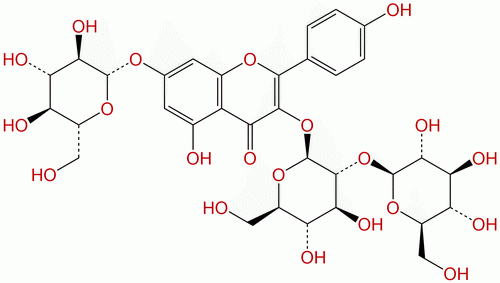
In the chemical structure of K3S7G, a sophorose (β - D-glucopyranose - (1 → 2) - β - D-glucopyranose) is connected to the 3rd hydroxyl group of the parent nucleus of kaempferol, and a β - D-glucopyranose group is connected to the 7th hydroxyl group. This dual sugar chain modification mode not only endows the molecule with unique physicochemical properties, but also significantly affects its biological activity performance. It is worth noting that K3S7G has been found in various traditional medicinal plants, such as Carthamus tinctorius, Ginkgo biloba, and certain cruciferous plants, suggesting that it may play an important role in the pharmacological effects of these plants.
From a pharmacological perspective, K3S7G exhibits various biological activities centered around antioxidant activity. Oxidative stress is considered as the common pathological basis of aging, cardiovascular diseases, neurodegenerative diseases, diabetes and its complications, inflammatory diseases and even tumor occurrence and development. Therefore, the search for efficient and low toxicity natural antioxidants has always been a hot topic in drug development. K3S7G demonstrates the potential as a novel antioxidant lead compound due to its potent free radical scavenging ability endowed by its polyphenol structure and its regulatory effects on multiple antioxidant related signaling pathways. In addition, its good water solubility and low toxicity further enhance its potential for drug development.
This article will systematically review the research progress of K3S7G from the aspects of chemical structure and physicochemical properties, plant sources and extraction methods, pharmacological activity research, mechanism of action and molecular targets, drug evaluation and pharmacokinetics, clinical application prospects and prospects, in order to provide reference for the in-depth research and development of this natural product.
The chemical name of K3S7G is kaempferol-3-O - β - D-glucopyranosyl - (1 → 2) - β - D-glucopyranoside-7-O - β - D-glucopyranoside, with a molecular formula of C ∝ H ₄₀₂₁ and a molecular weight of 772.6620 g/mol. The core of its structure is kaempferol (3,5,7,4 '- tetrahydroxyflavone), which is connected to sugar groups at positions 3 and 7, respectively. The 3-linked sophorose is a disaccharide formed by connecting two glucose units through a β -1 → 2 glycosidic bond, while the 7-linked sophorose is composed of a single glucose unit.
This glycosylation pattern is particularly unique in flavonoids. Usually, glycosylation at positions 3 and 7 of flavonol compounds is common, but disaccharide chain structures with disaccharides at positions 3 and monosaccharides at positions 7 are not common. The introduction of sugar groups not only increases the hydrophilicity of molecules, but also affects the interaction between molecules and biological targets through steric hindrance effects. In addition, the type, connection method, and quantity of sugar groups may affect the absorption, metabolism, and bioavailability of compounds.
According to computational chemistry predictions and experimental data, the physicochemical properties of K3S7G are as follows:
Lipid water partition coefficient (LogP)-1.4595. This negative value indicates that K3S7G has strong hydrophilicity, which is consistent with the presence of multiple hydroxyl and sugar groups in the molecule. High hydrophilicity means that the compound has good solubility in aqueous phase, but may have difficulty penetrating the lipid bilayer, thereby affecting its transmembrane absorption and ability to reach intracellular targets.
Topological Polarity Surface Area (TPSA): 348.5800 Å ². TPSA is an important parameter for measuring molecular polarity and hydrogen bonding ability, and it is generally believed that molecules with TPSA greater than 140 Å ² are difficult to penetrate the blood-brain barrier. The extremely high TPSA value of K3S7G is closely related to its high content of hydroxyl and ether oxygen atoms, indicating that its oral absorption may be poor and difficult to enter the central nervous system.
Water solubility 6.5537 (LogS). This value indicates that K3S7G has good water solubility, which provides favorable conditions for its distribution and excretion in biological fluids. Good water solubility is also beneficial for formulation development, especially in dosage forms such as injections and eye drops.
Blood-brain barrier penetrability: Low. Due to its high TPSA and hydrophilicity, K3S7G has extremely low ability to penetrate the blood-brain barrier. This characteristic poses a barrier in the treatment of central nervous system diseases, but becomes an advantage in the treatment of diseases that require avoiding central side effects.
HERG inhibition: No. HERG potassium channel inhibition is an important predictor of drug cardiac toxicity. K3S7G has no inhibitory effect on hERG channel, indicating its good cardiac safety and reducing the risk of arrhythmia caused by QT interval prolongation.
Ames test: 0.0. This result indicates that K3S7G did not exhibit mutagenicity in the Ames test, and the preliminary genotoxicity evaluation was negative, providing support for its safety.
Based on the above parameters, K3S7G exhibits typical "natural product like" characteristics: high polarity, high water solubility, low membrane permeability, and low toxicity. These properties determine that its pharmacokinetic behavior will be dominated by aqueous phase distribution, and oral bioavailability may be limited, but local administration or specific delivery systems may achieve better therapeutic effects.
The distribution of K3S7G in the plant kingdom has a certain selectivity, mainly found in plants of the following families and genera:
Asteraceae (Asteraceae)Carthamus tinctorius L. is one of the important sources of K3S7G. Red flowers, as a traditional Chinese medicine for promoting blood circulation and removing blood stasis, contain abundant flavonoids in their petals, among which K3S7G is one of the main active ingredients. Research has shown that the kaempferol glycosides in safflower are closely related to their anti-inflammatory, antioxidant, and antithrombotic activities.
Ginkgo family Ginkgo biloba L. leaf extract is a widely used dietary supplement internationally. Ginkgo biloba leaves contain various flavonol glycosides, including glycoside derivatives of kaempferol, quercetin, and isorhamnetin. Although K3S7G has a relatively low content in Ginkgo biloba leaves, as a member of the kaempferol glycoside family, it may contribute to the overall biological activity of Ginkgo biloba leaf extracts.
Brassicaceae family K3S7G has also been detected in certain cruciferous vegetables such as broccoli (Brassica oleracea var. italica) and kale (Brassica oleracea var. sabellica). These vegetables are an important component of daily diet, and their flavonoid content is closely related to antioxidant activity.
Fabaceae (Fabaceae)Some leguminous plants such as soybean (Glycine max) and alfalfa (Medicago sativa) also contain K3S7G, but the content is usually low.
Other sources In recent years, the presence of K3S7G has also been reported in certain plants of the Moraceae, Rosaceae, and Zingiberaceae families, suggesting that its distribution may be more widespread than previously thought.
The extraction of K3S7G is usually carried out using classical phytochemical methods, combined with modern separation techniques to improve efficiency and purity.
Extraction solvent selection Due to the high polarity of K3S7G, commonly used extraction solvents include methanol, ethanol, acetone water mixed solvents, and pure water. Among them, the ethanol water system is widely used due to its high safety and good edibility. Research has shown that 70% -80% ethanol aqueous solution has a higher extraction efficiency for flavonoid glycosides. For medicinal plants such as safflower, cold soaking or percolation methods are often used for extraction to avoid degradation of active ingredients caused by high temperatures.
Extraction process optimization Modern extraction techniques such as ultrasound assisted extraction (UAE), microwave-assisted extraction (MAE), and pressurized liquid extraction (PLE) have been applied to the extraction of K3S7G. Ultrasonic assisted extraction can significantly improve extraction efficiency and shorten extraction time by destroying cell walls through cavitation effect. Microwave assisted extraction utilizes the rapid heating effect of polar molecules in a microwave field to accelerate the dissolution of target components. The application of these green extraction technologies not only improves yield, but also reduces the use of organic solvents.
Separation and purification The separation and purification of K3S7G in crude extract is usually achieved by multi-step chromatography. Firstly, preliminary separation is carried out using macroporous adsorption resins (such as D101, AB-8), and flavonoid glycoside components are enriched by gradient elution with different concentrations of ethanol. Subsequently, further purification was performed by silica gel column chromatography, polyamide column chromatography or Sephadex LH-20 gel column chromatography. High performance liquid chromatography (HPLC) and high-speed countercurrent chromatography (HSCCC) are used to prepare high-purity samples. In recent years, preparative HPLC combined with mass spectrometry (LC-MS) has become the standard method for the separation and identification of K3S7G.
Content Determination The quantitative analysis of K3S7G is usually carried out using reverse phase high performance liquid chromatography (RPHPLC), with a C18 column as the stationary phase and acetonitrile water or methanol water systems as the mobile phase. The UV detection wavelength is usually set around 265 nm or 350 nm. Mass spectrometry detection, especially multi reaction monitoring mode MRM, can provide higher sensitivity and selectivity.
Antioxidant activity is the most core and extensively studied pharmacological activity of K3S7G. Oxidative stress refers to the imbalance between the generation of reactive oxygen species (ROS) and reactive nitrogen species (RNS) in the body and the antioxidant defense system, which is closely related to the occurrence and development of various diseases. K3S7G exerts antioxidant effects through various mechanisms:
Direct free radical scavenging The phenolic hydroxyl groups in K3S7G molecules, especially the B ring 4 '- OH and A ring 5,7-OH, can provide hydrogen atoms or electrons to free radicals, thereby neutralizing their activity. In vitro chemical experiments have shown that K3S7G has significant scavenging ability against DPPH radicals, ABTS ⁺ radicals, superoxide anions, and hydroxyl radicals, with a half maximal inhibitory concentration (IC ₅₀) at the micromolar level. Compared with the parent compound kaempferol, glycosylation modification did not significantly weaken its free radical scavenging ability, which may be due to the fact that although sugar groups occupy some hydroxyl groups, the core ortho diphenol structure (B-ring 3 ′, 4 ′ - dihydroxy) is preserved.
Metal ion chelation The hydroxyl and carbonyl structures of K3S7G can chelate transition metal ions (such as Fe ² ⁺, Cu ² ⁺), inhibit Fenton and Haber Weiss reactions, and thus reduce the generation of hydroxyl radicals. This mechanism is particularly important in iron overload related diseases.
Regulation of antioxidant enzyme activity In addition to its direct antioxidant effect, K3S7G can also exert indirect antioxidant effects by regulating the endogenous antioxidant enzyme system. Research has shown that K3S7G treatment can significantly increase the activity or expression levels of superoxide dismutase (SOD1, SOD2), catalase (CAT), glutathione peroxidase (GPX1), and heme oxygenase-1 (HMOX1). These enzymes form the first line of defense for the body's antioxidant defense, and their increased activity helps maintain cellular redox balance.
Oxidative stress is closely related to inflammatory response, and the antioxidant activity of K3S7G also extends to the anti-inflammatory field. Research has shown that K3S7G can inhibit lipopolysaccharide (LPS) - induced macrophage inflammatory response and reduce the production of pro-inflammatory cytokines such as tumor necrosis factor - α (TNF - α), interleukin-6 (IL-6), and interleukin-1 β (IL-1 β). In addition, K3S7G can also inhibit the expression of cyclooxygenase-2 (COX-2) and inducible nitric oxide synthase (iNOS), reducing the production of prostaglandin E ₂ and nitric oxide.
Based on its antioxidant and anti-inflammatory activities, K3S7G exhibits potential applications in skin protection. Ultraviolet (UV) radiation is the main environmental factor causing skin photoaging and skin cancer. UV irradiation can induce skin cells to produce a large amount of ROS, activate matrix metalloproteinases (MMPs), leading to collagen degradation and loss of skin elasticity. Research has shown that K3S7G can inhibit the expression of MMP1 and MMP3 in UVB induced skin fibroblasts, while promoting collagen synthesis. In addition, K3S7G can inhibit tyrosinase (TYR) activity and reduce melanin production, indicating its potential application value in whitening and skincare products.
Preliminary studies also suggest that K3S7G may have the following pharmacological activities:
- Cardiovascular protection By inhibiting the oxidation of low-density lipoprotein (LDL), improving endothelial function, and suppressing platelet aggregation, it exerts cardiovascular protection.
- neuroprotection Although the blood-brain barrier penetration is low, K3S7G shows a certain neuroprotective effect by reducing oxidative stress and inflammatory response in the model of cerebral ischemia-reperfusion injury.
- anti-diabetic: K3S7G may have therapeutic potential for type 2 diabetes by improving insulin resistance, promoting glucose uptake and inhibiting α - glucosidase activity.
The pharmacological activity of K3S7G involves multiple molecular targets and signaling pathways, among which antioxidant related targets are the most clear.
Nuclear factor E2 related factor 2 (NFE2L2, also known as NRF2) is a core transcription factor that cells use to respond to oxidative stress. Under normal physiological conditions, NRF2 binds to Kelch like ECH related protein 1 (KEAP1) and is in a state of ubiquitination degradation. When cells are stimulated by oxidative stress or electrophilic agents, NRF2 is released from KEAP1 and translocated to the nucleus, where it binds to antioxidant response elements (ARE) and initiates the transcription of downstream antioxidant and detoxifying enzyme genes.
Research has shown that K3S7G can activate the NRF2/ARE signaling pathway. The specific mechanism may include: the ortho diphenol structure of K3S7G can be oxidized to form quinone intermediates, which can modify the thiol group of KEAP1, leading to the release and activation of NRF2. After NRF2 activation, upregulated target genes include:
- SOD1 and SOD2 Catalytic dismutation of superoxide anions into hydrogen peroxide and oxygen.
- CAT Decompose hydrogen peroxide into water and oxygen.
- GPX1 Reduce hydrogen peroxide and organic peroxides using glutathione.
- HMOX1 Catalyze the degradation of hemoglobin to produce biliverdin and carbon monoxide with antioxidant activity.
MMP1 (interstitial collagenase) and MMP3 (matrix metalloproteinase) are key enzymes involved in extracellular matrix remodeling. In pathological conditions such as skin photoaging and arthritis, overexpression of MMPs leads to excessive degradation of collagen and proteoglycans. K3S7G downregulates the expression of MMP1 and MMP3 by inhibiting the MAPK and AP-1 signaling pathways, thereby protecting the integrity of the extracellular matrix.
Tyrosinase is the rate limiting enzyme in melanin synthesis, and its abnormally increased activity leads to pigmentation disorders. The inhibitory effect of K3S7G on TYR may be achieved through two mechanisms: one is direct chelation of copper ions in the active center of tyrosinase; The second is to reduce the reactive oxygen species generated during tyrosine oxidation through antioxidant effects, indirectly inhibiting enzyme activity.
From a systems pharmacology perspective, the role of K3S7G is not limited to a single target, but rather exerts overall effects by regulating a complex molecular network. The core nodes of this network include NRF2 (regulating antioxidant defense), MMP1/MMP3 (regulating extracellular matrix), and TYR (regulating melanin synthesis). The interaction between these targets (such as oxidative stress activating MMPs and NRF2 activation inhibiting inflammatory responses) makes the pharmacological effects of K3S7G synergistic and pleiotropic.
Based on the aforementioned physicochemical property parameters and preliminary pharmacological activity data, the pharmacological properties of K3S7G can be evaluated from the following aspects:
Advantage:
1. Good security The Ames test was negative, hERG showed no inhibition, and preliminary toxicity studies showed low toxicity, providing a safety guarantee for subsequent development.
2. Multi-target activity Simultaneously acting on multiple pathways such as antioxidant, anti-inflammatory, and anti-aging, in line with the concept of "multi-target therapy" in modern drug development.
3. Good water solubility Beneficial for formulation development, especially for injections, eye drops, and topical preparations.
4. natural source Can be extracted from various medicinal plants, with relatively abundant sources of raw materials.
challenge:
1. Low oral bioavailability High polarity, high TPSA, and low LogP values indicate that oral absorption of K3S7G may be poor. Glycoside compounds may be hydrolyzed by glycosidases in the intestine, but the absorption and metabolism of the hydrolysis product (kaempferol) still require further research.
2. Metabolic stability Flavonoid glycosides may undergo metabolic processes such as deglycosylation, methylation, sulfation, and glucuronidation in the body, and the activity of metabolites may differ from that of the parent compound.
3. Target selectivity Although multi-target activity has therapeutic advantages, it may also bring non-specific effects, and further evaluation of its selectivity index is needed.
At present, there is insufficient systematic research on the pharmacokinetics of K3S7G in vivo, but based on its physicochemical properties and studies of similar compounds, reasonable speculation can be made:
absorb After oral administration, K3S7G may be partially absorbed in the stomach and small intestine, but the absorption rate is relatively low. The β - glucosidase in the intestine may hydrolyze it into kaempferol and the glycosyl portion, which is then absorbed and undergoes phase II metabolism. Therefore, after oral administration of K3S7G, the main metabolites detected in the blood may be its metabolites rather than the parent compound.
distribution Due to its high hydrophilicity, K3S7G is mainly distributed in extracellular fluid and plasma, and its tissue distribution may be limited. The binding rate with plasma proteins still needs to be experimentally determined.
Metabolism The liver and intestine are the main sites of K3S7G metabolism. The metabolic pathways include: deglycosylation (producing kaempferol-3-O-sophorodisaccharide, kaempferol-7-O-glucoside or kaempferol), methylation (producing isorhamnetin derivatives), sulfation, and glucuronidation.
excretion K3S7G and its metabolites are mainly excreted through bile and urine. Due to its high molecular weight (>500 Da), bile excretion may be the main pathway.
To address the issue of low oral bioavailability of K3S7G, the following formulation strategies can be considered:
1. Nano delivery system Liposomes, nanoparticles, or solid lipid nanoparticles can improve the encapsulation efficiency and oral absorption of K3S7G.
2. Phospholipid complex Forming complexes with phospholipids can improve lipid solubility and promote transmembrane transport.
3. Prodrug design Chemical modification of the sugar moiety to increase membrane permeability and release active ingredients after enzymatic hydrolysis in vivo.
4. Local administration: Use its good water solubility and skin protection activity to develop external preparations (such as cream, gel) for skin care.
Based on the pharmacological activity spectrum and safety characteristics of K3S7G, its potential clinical applications mainly focus on the following areas:
1. Skin care and anti-aging The antioxidant, anti MMP, and tyrosinase inhibitory activities of K3S7G make it an ideal skincare ingredient. Can be used to develop anti wrinkle, whitening, and sunscreen products. Its good water solubility is beneficial for formulating refreshing skincare products, and its low irritation is suitable for use on sensitive skin.
2. Adjuvant therapy for oxidative stress-related diseases: At the early stage of cardiovascular diseases, diabetes complications, chronic inflammatory diseases and neurodegenerative diseases, K3S7G can be used as an antioxidant adjuvant to reduce oxidative damage and delay disease progress.
3. Food additives and functional foods As a natural antioxidant, K3S7G can be used for food preservation and functional food development. It has high safety and good water solubility, and is suitable for adding to beverages, dairy products, and baked goods.
4. Ophthalmic applications Given its antioxidant activity and low blood-brain barrier penetration (suggesting that eye barrier penetration may also be limited), local eye drops may be used to treat oxidative stress-related eye diseases such as cataracts and glaucoma.
Although K3S7G has shown promising research prospects, there is still a considerable distance to clinical application, and future research should focus on the following directions:
1. In depth pharmacokinetic studies A sensitive LC-MS/MS method needs to be established to systematically study the absorption, distribution, metabolism, and excretion characteristics of K3S7G in animals, and to clarify its oral bioavailability and metabolite profile.
2. Fine analysis of the mechanism of action Using gene knockout animal models, CRISPR-Cas9 technology, and omics methods, we aim to elucidate the molecular mechanism of K3S7G activation of the NRF2 signaling pathway and its interaction patterns with targets such as MMP and TYR.
3. In vivo pharmacological studies: To verify the therapeutic effect of K3S7G in a variety of animal models of oxidative stress related diseases (such as skin photoaging, myocardial ischemia reperfusion, diabetes nephropathy, etc.), and determine the effective dose and therapeutic window.
4. Formulation development and delivery system: To solve the problem of low oral bioavailability, develop new delivery systems (such as nano lotion, polymer micelles, phospholipid complexes) to improve the bioavailability and targeting of K3S7G.
5. Toxicological evaluation Conduct systematic acute toxicity, chronic toxicity, and reproductive toxicity studies to provide safety data support for clinical trials.
6. Structural optimization and structure-activity relationship By chemical synthesis or biotransformation methods, prepare structural analogues of K3S7G, study the relationship between glycosylation mode, hydroxyl number and position, and activity, and search for derivatives with stronger activity and better pharmacokinetic properties.
As a natural flavonoid glycoside with a unique disaccharide chain structure, kaempferol-3-O-sophorodisaccharide-7-O-glucoside has shown important research value in the field of natural product pharmacology due to its potent antioxidant activity, multi-target mechanism of action, and good safety. It has potential applications in skin protection, anti-inflammatory, and anti-aging by activating the NRF2/ARE signaling pathway, inhibiting MMP expression, and tyrosinase activity.
However, the research on K3S7G is still in its early stages, and the pharmacokinetic defects caused by its high polarity and low membrane permeability are the main bottlenecks restricting its clinical translation. Future research needs to develop efficient delivery systems or optimize structures based on a deep understanding of its mechanism of action, combined with modern medicinal chemistry and pharmacology methods, in order to transform this natural antioxidant into drugs or functional products with practical clinical application value.
From a broader perspective, the study of K3S7G also provides a typical case for us to understand the impact of glycosylation modifications on biological activity in natural products. Glycosylation not only affects the physicochemical properties and pharmacokinetic behavior of compounds, but also influences pharmacological activity by regulating interactions with biological targets. Thoroughly analyzing the relationship between glycosylation patterns and activity will provide important guidance for drug design based on natural products.
In summary, kaempferol-3-O-sophorodisaccharide-7-O-glucoside is a natural product molecule worthy of in-depth research. Although its transformation from laboratory research to clinical application is challenging, it also contains enormous scientific value and development potential. With the continuous advancement of analytical techniques, formulation science, and molecular pharmacology, we have reason to believe that this natural antioxidant will play a more important role in the future health industry.
Batch can search by a CAS number,one per line
