Shanbaifen-3-sophorodisase-7-rhamnoside: a natural anti-inflammatory candidate molecule derived from dragon carp leaves
1. Overview
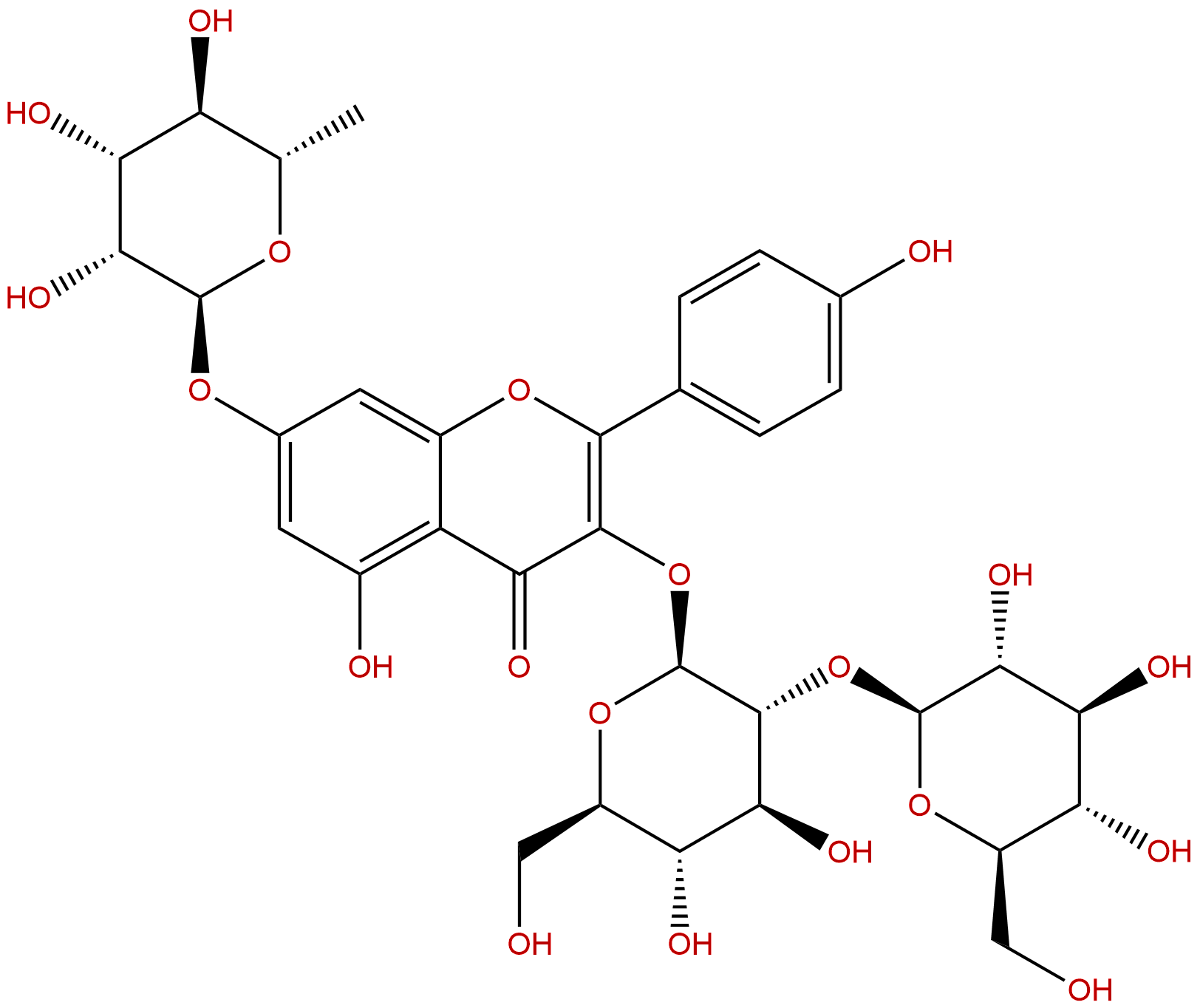
Kaempferol 3-sophoroside-7rhamnoside is a complex natural flavonoid glycoside with a CAS number of 93098-79-4, a molecular formula of C33H40O20, and a molecular weight of approximately 756.66 g/mol. This compound is a member of the flavonol glycoside family, and its parent nucleus is Kaempferol. It has two glycosides, sophoroside and rhamnoside, attached to the hydroxyl groups at positions 3 and 7, respectively. This unique glycosylation modification not only significantly alters its physicochemical properties, but also profoundly affects its biological activity and pharmacokinetic characteristics.
This compound is mainly derived from medicinal plants Dragon Leafy Leaf(Scientific name:Sauropus spatulifolius It was isolated from Phyllanthaceae. Longlei leaves have a long history of medicinal use in the folk culture of Lingnan region, often used to treat respiratory diseases such as cough and bronchitis. Modern pharmacological research has revealed that its extracts and monomeric components have a wide range of anti-inflammatory and immunomodulatory activities. In recent years, with a deeper understanding of the pathogenesis of autoimmune diseases, researchers have begun to focus on the potential of natural products in regulating immune signaling pathways. Due to its potential regulatory effects on multiple key targets related to inflammation and immunity, such as STAT3, IL2, TGFB1, FOXP3, and IL17A, particularly in Rheumatoid arthritis The role played in the pathological network has received attention from researchers in natural product pharmacy. This article will provide a systematic professional popularization of this potential natural molecule from the aspects of its chemical structure, plant origin, pharmacological mechanism, medicinal evaluation, and research prospects.
2. Chemical structure and physicochemical properties
The chemical structure of kaempferol-3-sophorodisase-7-rhamnoside is the material basis for its biological activity. The SMILES string provides a detailed description of its atomic connection order and stereochemistry:C[C@@H]1O[C@@H](Oc2cc(O)c3c(=O)c(O[C@@H]4O[C@H](CO)[C@@H](O)[C@H](O)[C@H]4O[C@@H]4O[C@H](CO)[C@@H](O)[C@H](O)[C@H]4O)c(-c4ccc(O)cc4)oc3c2)[C@H](O)[C@H](O)[C@H]1OThis structure indicates that it is a highly glycosylated flavonoid glycoside. The core of it is the 4 '- hydroxyflavonol skeleton of kaempferol, which is connected to an α - L-rhamnose via a glycosidic bond on the 7th hydroxyl group of the A ring and a sophorodisase via a 1 → 2 glycosidic bond on the 3rd hydroxyl group of the C ring (composed of two molecules of β - D-glucose). This disaccharide chain structure, especially the presence of sophorodisaccharides, increases its molecular weight and significantly enhances its hydrophilicity.
From the perspective of pharmacological parameters, its physicochemical properties exhibit typical characteristics of polysaccharide compounds:
- Molecular weight (MW):756.66 g/mol, Significantly exceeding the range of conventional small molecule drugs (usually<500 Da).
- Topological Polarity Surface Area (TPSA)Up to 328.35 Å ², mainly attributed to the abundant hydroxyl (- OH) and glycosidic oxygen atoms in the molecule, indicating strong hydrophilicity and the ability to form hydrogen bonds.
- Lipid water partition coefficient (LogP/LogD)They are -0.9663 and -0.9742, respectively. A negative LogP value clearly indicates that the compound has Highly hydrophilic It is distributed very little in a lipid environment. LogD is close to LogP, indicating that its dissociation state does not change significantly within the physiological pH range.
- Water solubility The value is 5.8804 (usually converted to log mol/L or mg/mL, depending on the database definition), combined with its high TPSA and negative LogP, it can be inferred that it has good water solubility.
- Membrane permeability The Caco-2 cell permeability (Caco2_permeability) is only 0.1361, which is an extremely low value, indicating that its ability to cross the intestinal epithelial cell membrane through passive diffusion is very poor. The effective permeability (Peff) is 0.3910, also in the low permeability range. This is consistent with its high molecular weight and high polarity structure.
- Blood-brain barrier penetrability (BBB-permeability)Clearly labeled as' low ', it means that the compound is difficult to enter the central nervous system, which may be an advantage for treating diseases outside the central nervous system (such as rheumatoid arthritis) by reducing central side effects, but also rules out the possibility of its use in central nervous system diseases.
In summary, kaempferol-3-sophorodisase-7-rhamnoside is a High polarity, high hydrophilicity, low fat solubility, poor membrane permeability Large molecule glycosides. These properties determine that its oral bioavailability may be low, and its absorption and distribution in the body will face challenges.
3. Plant sources and traditional applications
The plant source of kaempferol-3-sophorodisase-7-rhamnoside is Dragon Leafy Leaf(Dragon Tongue Leaf), scientific name Sauropus spatulifolius Beille, Belonging to the Phyllanthaceae family. This plant is mainly distributed in southern regions of China such as Guangdong, Guangxi, and Yunnan, and is also found in Southeast Asian countries.
In the traditional medical system, especially in the folk medicine of Lingnan region, the application history of Longliye is long. Its leaves are often used for:
1. Moisten the lungs and relieve cough: It is used to treat acute and chronic bronchitis, cough, asthma and other respiratory diseases. It is often stewed with lean meat as Tonic Diet.
2. Resolving phlegm and relieving asthma Used to alleviate symptoms such as excessive phlegm and asthma.
3. clear heat and detoxify It is also used in folk medicine to treat "heat diseases" such as sore throat, dry mouth and tongue.
These traditional effects are mostly based on empirical summaries, and their material basis has not been elucidated for a long time. Modern plant chemistry research has isolated and identified various active ingredients from dragon carp leaves, including flavonoids (such as kaempferol and its glycosides), alkaloids, volatile oils, organic acids, etc. Among them, flavonoid glycosides are considered important contributors to their anti-inflammatory, cough stopping, and phlegm resolving effects. As one of the structurally unique flavonoid glycosides, kaempferol-3-sophorodisase-7-rhamnoside has been found to link traditional applications with modern pharmacological effects (especially immune regulation), providing clues for explaining the modern scientific connotation of the "heat clearing" effect of dragon carp leaves - possibly related to its regulation of excessive immune response and inflammation.
It is worth noting that plants of the same genus Sauropus androgynus(Shougongmu) has received much attention for adverse reactions such as bronchitis caused by improper consumption, but Longlei leaves(S. spatulifolius)It is considered relatively safe at conventional medicinal doses. This suggests that even plants of the same genus may have significant differences in their chemical composition and biological activity, which require specific analysis.
4. Pharmacological activity and mechanism of action
According to database information, kaempferol-3-sophorodisase-7-rhamnoside is associated with five key targets (STAT3, IL2, TGFB1, FOXP3, IL17A) and correlated with them Rheumatoid arthritis This autoimmune disease. This outlines its potential core pharmacological effects for us:Through multi-target intervention, regulating immune cell function and inflammatory signaling pathways may alleviate the pathological progression of rheumatoid arthritis.
Below, we will analyze these targets and their roles in rheumatoid arthritis one by one, and speculate on the possible mechanism of action of the compound:
1. Signal transduction and transcription activator 3 (STAT3)
STAT3 is a key transcription factor in the Janus kinase (JAK) - STAT signaling pathway, which is crucial in immune and inflammatory responses. In the synovial tissue of rheumatoid arthritis, STAT3 is continuously activated, promoting abnormal proliferation, invasiveness, and production of inflammatory factors (such as IL-6, IL-17) in synovial fibroblasts, while inhibiting cell apoptosis. Inhibiting the STAT3 signaling pathway has become one of the important strategies for treating rheumatoid arthritis (such as JAK inhibitor tofacitinib). If kaempferol-3-sophorodisase-7-rhamnoside can inhibit the phosphorylation or nuclear translocation of STAT3, it may effectively suppress synovitis and proliferation.
2. Interleukin-2 (IL2)
IL-2 is mainly produced by activated T cells and has a dual function: at low concentrations, it promotes the differentiation and function of regulatory T cells (Tregs) and maintains immune tolerance; At high concentrations, it stimulates the proliferation of effector T cells and natural killer cells. In rheumatoid arthritis, the IL-2 signaling pathway may be disrupted. This compound may indirectly regulate the balance of T cell subsets by affecting the production or signaling of IL-2.
3. Transforming Growth Factor - β 1 (TGFB1)
TGF - β 1 is a multifunctional cytokine that plays a complex role in immune regulation. It can strongly induce the differentiation of initial T cells into FOXP3+regulatory T cells (Tregs) with immunosuppressive function, thereby suppressing the autoimmune response. However, in the joint microenvironment of rheumatoid arthritis, TGF - β 1 may also promote fibrosis and certain inflammatory processes. If this compound can interact with the TGF - β 1 signaling pathway, it may help restore the function of Treg cells and inhibit excessive autoimmune attacks.
4. Fork head box protein P3 (FOXP3)
FOXP3 is a lineage determining and functionally dominant transcription factor for regulatory T cells (Tregs). The functional deficiency or reduced number of Treg cells is an important characteristic of autoimmune diseases such as rheumatoid arthritis. Promoting the expression of FOXP3 and the stability of Treg cells is an ideal approach for treating autoimmune diseases. This compound may stabilize or enhance the expression of FOXP3 through upstream signaling (such as TGF - β 1 signaling) or direct action, thereby enhancing the immunosuppressive function of Treg.
5. Interleukin-17A (IL17A)
IL-17A is mainly produced by Th17 cells and is one of the core cytokines driving rheumatoid arthritis and tissue destruction. It can stimulate synovial cells, fibroblasts, and chondrocytes to produce various inflammatory mediators (such as IL-6, TNF - α, matrix metalloproteinases), leading to joint inflammation, cartilage destruction, and bone erosion. Directly inhibiting IL-17A or its receptors is an effective therapeutic strategy (such as Su Jin monoclonal antibody). This compound may alleviate joint damage by inhibiting the differentiation of Th17 cells (possibly related to STAT3 inhibition) or directly antagonizing the activity of IL-17A.
Hypothesis of mechanism of action integration:
Based on the above target analysis, we can propose an integrated mechanism of action hypothesis: kaempferol-3-sophorodisase-7-rhamnoside may act through Inhibition of STAT3 signaling pathway Playing a dual role: on the one hand, reducing the differentiation of pro-inflammatory Th17 cells and the production of IL-17A; On the other hand, it may synergize with other signals, such as the potential promotion of TGF - β 1 signaling,Promote the differentiation and function of FOXP3+regulatory T cells (Tregs)At the same time, it may regulate the microenvironment of IL-2, which is beneficial for immune tolerance. This multi-target regulation of the Th17/Treg balance, the core immune imbalance node of rheumatoid arthritis, holds promise for regulating immune abnormalities at the root, rather than just suppressing inflammatory symptoms. Of course, these speculations require further molecular docking, cell experiments, and animal model studies to verify their direct targets and specific regulatory mechanisms.
5. Evaluation of drug properties
Based on the provided pharmacological parameters, we objectively evaluated the potential of kaempferol-3-sophorodisase-7-rhamnoside as a drug by combining the classic "Rule of Five" and modern drug design concepts.
1. Compliance with Lipinski's Five Rules:
- Rule 1: Molecular weight (MW)<500 Da。not conform to The MW of this compound is 756.66 Da, far exceeding the standard of 500 Da.
- Rule 2: Lipid water partition coefficient (LogP)<5。Comply with Its LogP is -0.97, far less than 5.
- Rule 3: The number of hydrogen bond donors (HBDs) is less than 5。not conform to According to its structural formula (rich in hydroxyl groups), the number of HBDs far exceeds 5.
- Rule 4: The number of hydrogen bond acceptors (HBAs) is less than 10。not conform to There are numerous oxygen atoms (20 O) in the molecule, and the number of HBAs far exceeds 10.
- Rule 5: Number of rotatable keys It is usually recommended to be less than 10. The molecule has multiple glycosidic bonds and sugar ring connections, and the number of rotatable bonds may be relatively high.
Conclusion: This compound seriously violates three of Lipinski's five rules (MW, HBD, HBA). The Lipinski rule is a "warning line" based on oral absorption experience, and serious violations usually indicate Oral bioavailability will be very low。
2. Analysis of key pharmacological parameters:
- absorb The extremely low Caco-2 permeability (0.1361) and Peff (0.3910) directly confirm the prediction of poor intestinal absorption. High TPSA (328.35) and strong hydrophilicity are the main reasons for its poor membrane permeability. As glycoside compounds, they may be hydrolyzed by microorganisms or glycosidases on the intestinal mucosa, releasing aglycones (kaempferol) and glycosides. The LogP of kaempferol glycoside is about 1.5-2.5, with a small molecular weight and better absorption. Its pharmacological activity may be partially attributed to aglycones. Therefore, the in vivo effects of this compound may be the combined action of itself and/or its metabolites.
- distribution The plasma protein binding rate (PPB) is 73.52%, which is at a moderate level, meaning that about a quarter exists in free form and can be distributed to tissues. BBB penetration is low, and the risk of central exposure is low.
- Metabolism and toxicity Ames test, chromosomal aberration, hERG inhibition, skin/respiratory sensitization, phototoxicity, etc. are all negative or "none/no", indicating their Low risk of genetic toxicity and acute cardiac toxicity The initial safety is good. However, it should be noted that its labeling may cause an increase in serum alkaline phosphatase (ALK), gamma glutamyltransferase (GGT), aspartate aminotransferase (AST), and alanine aminotransferase (ALT), indicating Potential liver effects In the subsequent development, it is necessary to focus on evaluating its liver toxicity.
- excretion High hydrophilicity and medium molecular weight may lead to its main excretion through the kidneys.
3. Comprehensive evaluation of drug potential:
Shanbaifen-3-sophorodisase-7-rhamnoside as a lead compound Its advantages lie in its multi-target mechanism of action (targeting key pathways in rheumatoid arthritis), good water solubility, and initially demonstrated low genetic and cardiac toxicity.
The challenges it faces Main challenges Yes:Oral bioavailability is extremely low This is the biggest obstacle to its development into traditional oral small molecule drugs.
Development strategy suggestion:
1. Prodrug modification Esterification, acylation, and other modifications of its sugar or phenolic hydroxyl groups are carried out to prepare prodrugs with higher lipid solubility, in order to improve membrane permeability and oral absorption, and then hydrolyzed into active forms in vivo.
2. Non oral administration route Consider developing as injection(such as intravenous injection)Local administration formulation(such as intra-articular injection therapy for arthritis) or Transdermal drug delivery system Bypass the intestinal absorption barrier.
3. As a precursor of active metabolites (aglycones)By conducting in-depth research on its metabolic processes in the body and clarifying the contributions of its glycoside and aglycone forms, it may be possible that aglycones themselves are better candidates for development.
4. Simplification and optimization of structure Using it as a template, conduct structure-activity relationship studies, attempt to simplify sugar chains or modify the parent nucleus, and improve the drug like properties while retaining activity.
6. Research Status and Application Prospects
At present, there are relatively few specialized research literature on kaempferol-3-sophorodisase-7-rhamnoside, and its activity data mostly comes from activity tracking and isolation of plant extracts, as well as preliminary target prediction or screening. It is more commonly reported as a member of the family of dragon leaf or kaempferol glycosides. The direct action experimental evidence for its five specific targets (STAT3, IL2, TGFB1, FOXP3, IL17A) still needs to be enriched, and its detailed molecular mechanism, cellular level efficacy, and in vivo pharmacological evaluation are currently blank spots in research.
Future research directions:
1. Target validation and mechanism deepening Using surface plasmon resonance (SPR), isothermal titration calorimetry (ITC), molecular docking, and kinetic simulation techniques, verify its direct binding ability to targets such as STAT3 and IL-17A. Clarify its impact on Th17/Treg differentiation and regulation of downstream inflammatory cytokine networks in cell models related to rheumatoid arthritis, such as human synovial fibroblasts and peripheral blood mononuclear cell co culture systems.
2. In vivo efficacy evaluation Establish collagen induced arthritis (CIA) and other rheumatoid arthritis animal models, evaluate their therapeutic effects through different administration routes (intraperitoneal injection, gastric lavage, local joint injection), and clarify their in vivo active forms (prototype drugs or metabolites).
3. Pharmacokinetic study Systematically study its absorption, distribution, metabolism, and excretion processes in different species, especially identify its main metabolites, and provide a basis for structural optimization.
4. Structural optimization and derivative design Based on the structure-activity relationship, design and synthesize a series of sugar modified or parent nucleus modified derivatives to balance their water solubility and lipid solubility, and improve their drug properties.
Application prospects:
Despite facing challenges in bioavailability, kaempferol-3-sophorodisase-7-rhamnoside still shows clear application prospects:
- As a lead compound for immune regulation Its multi-target action on the immune core network of rheumatoid arthritis makes it an excellent starting point for developing novel immune modulators. Through rational drug chemical modification, it is expected to obtain candidate drugs with stronger activity and better properties.
- As a functional food or health supplement ingredient Given that it originates from traditional medicinal and edible plants and has good preliminary safety, further research can be conducted on its potential as a dietary supplement or functional food ingredient to assist in regulating immunity, preventing or alleviating mild inflammation.
- As an external anti-inflammatory agent: Its good water solubility and local action potential can be considered to develop topical gel, creams or patches for the local treatment of skin inflammation or arthritis.
- Elaborate on the connotation of traditional medical science In depth research on this compound will help to elucidate the molecular basis of the traditional efficacy of "clearing heat and relieving cough" of Longliye from a modern pharmacological perspective, and promote the modernization of traditional Chinese medicine.
In summary, kaempferol-3-sophorodisase-7-rhamnoside is a bridging molecule that connects traditional medicinal wisdom with modern disease target networks. It reveals the complexity and multi-target therapeutic potential of natural products, while also reminding us of the physical and chemical challenges faced by natural products when directly used as drugs. Future research needs to use modern drug design concepts for rational optimization while respecting its natural structural diversity, in order to revitalize this ancient phytochemical molecule and bring new hope to patients with autoimmune diseases such as rheumatoid arthritis.