


Synonym name:
Catalogue No.: BP0098
Cas No.: 105454-04-4
Formula: C47H51NO14
Mol Weight: 853.918
Botanical Source: From Taxus brevifolia (Taxaceae)
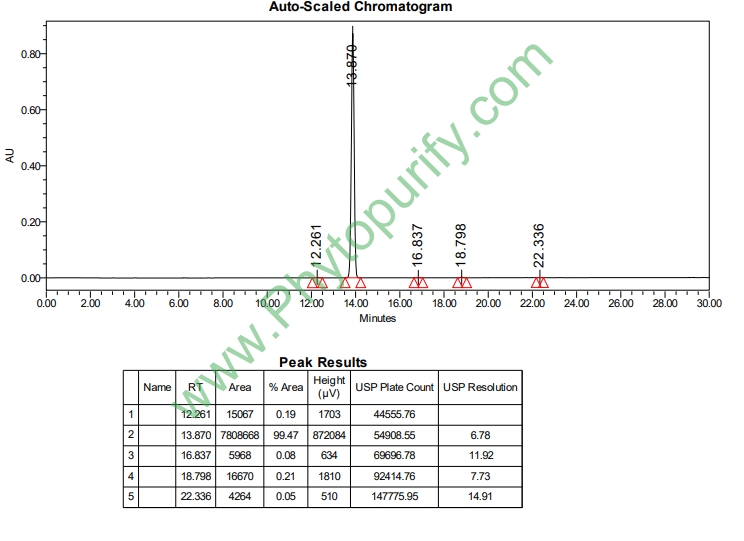
Purity: 95%~99%
Analysis Method: HPLC-DAD or/and HPLC-ELSD
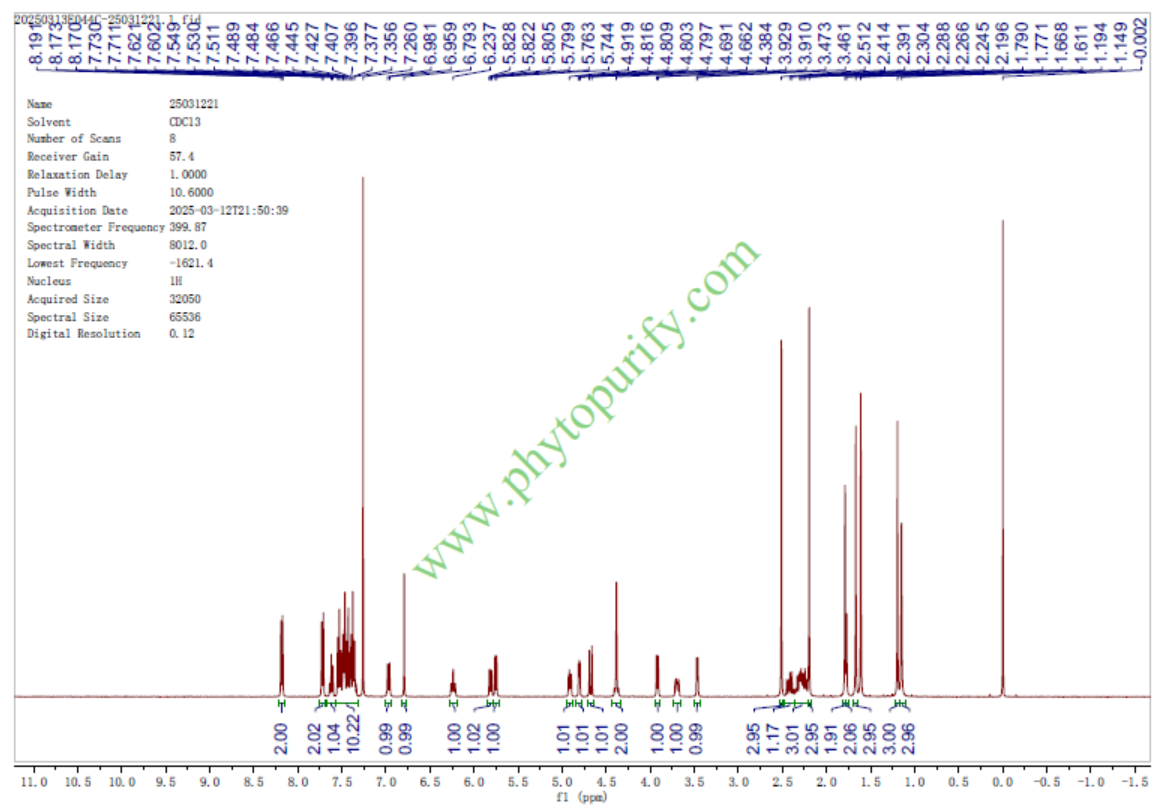
Identification Method: Mass, NMR
Packing: Brown vial or HDPE plastic bottle
Can be supplied from milligrams to grams.
For Reference Standard and R&D, Not for Human Use Directly.
Inquire for bulk scale.
Description:
7-Epitaxol is the major derivative of taxol found in cells and taxol (paclitaxel) is a well-known natural-source cancer drug.
References:
J Pharmacol Exp Ther. 1987 Aug;242(2):692-8.
Taxol is converted to 7-epitaxol, a biologically active isomer, in cell culture medium.
The hydrolysis products of taxol have been isolated by high-performance liquid chromatography and identified by nuclear magnetic resonance and mass spectroscopy. In contrast to taxol, the major hydrolysis product, baccatin III, has little cytotoxic activity and does not promote in vitro microtubule assembly.
METHODS AND RESULTS:
In cell culture medium, the concentration of taxol decreases with time and 7-Epitaxol, which exhibits properties comparable to those of taxol both on cells and on in vitro microtubuli polymerization, is formed. Baccatin III is found in small quantities in the cell medium, although it is barely detectable within the cells.
CONCLUSIONS:
It is concluded that 7-Epitaxol is the major derivative of taxol found in cells and that its presence does not alter, in a major way, the overall biological activity of taxol.
HPLC of 7-Epitaxol
HNMR of 7-Epitaxol
Storage conditions:Short-term storage at 2~8℃, long-term storage at -20 ~ -80℃
233.1900
3.5000
3.5000
Low
Unknown
Unknown
No
Unknown
No
Unknown
7-Epipaclitaxel (CAS number: 105454-04-4), as the main intracellular derivative of paclitaxel, has attracted widespread attention in the field of natural product pharmacology in recent years. Paclitaxel is a classic anti-tumor drug isolated from plants of the Taxus genus, which is widely used in the treatment of various malignant tumors due to its unique microtubule stabilization mechanism. 7-paclitaxel, as its isomer, has a highly similar structure to paclitaxel, but exhibits certain differences in biological activity and pharmacokinetic properties, especially in the potential treatment of non tumor diseases such as heart failure, demonstrating unique research value.
This article aims to systematically review the chemical structure and physicochemical properties, plant sources and extraction methods, pharmacological activity, mechanism of action and molecular targets, pharmacological evaluation, and pharmacokinetic characteristics of 7-paclitaxel, with a focus on exploring its potential application prospects in related diseases such as heart failure. The aim is to provide theoretical basis and research direction for subsequent basic research and clinical translation.
7-paclitaxel is an isomer of paclitaxel, with the same molecular formula as paclitaxel, but with a change in the spatial configuration of the carbon atom at position 7. The molecular weight is 853.9 Da and the LogP value is 3.5, indicating moderate lipophilicity that facilitates membrane penetration. Its topological polar surface area (TPSA) is 233.19 Å ², and the number of hydrogen bond acceptors is as high as 14, indicating that the molecule has strong polarity and hydrogen bond formation ability, which has a significant impact on its binding affinity with target proteins and drug solubility.
Structurally, 7-paclitaxel retains the core diterpenoid skeleton and side chains of paclitaxel, but the surface isomerism at position 7 may result in different affinities and kinetic characteristics when bound to microtubule proteins. The low blood-brain barrier penetration ability of this isomer suggests its limited distribution in the central nervous system, which may reduce the risk of central nervous system toxicity. Toxicological evaluation shows that 7-paclitaxel has no significant hepatotoxicity, cardiotoxicity, or hERG channel inhibition, demonstrating a good safety profile. However, Ames mutagenicity test data is still lacking and further supplementation is needed.
7-paclitaxel mainly exists in the cells of Taxus plants, especially in Taxus spp., which are rich in paclitaxel. Its production mechanism is believed to be the epigenetic isomer formed by enzymatic reactions of paclitaxel in plant cells, which belongs to an important intermediate in the paclitaxel metabolic network.
Traditionally, the extraction of paclitaxel and its derivatives is carried out using organic solvent extraction combined with liquid chromatography separation technology. The specific steps include:
In recent years, the development of cell culture technology and biosynthetic engineering has also provided a new approach for the production of 7-paclitaxel, especially by using paclitaxel cell suspension culture combined with metabolic engineering modification to improve its yield and purity, and reduce dependence on natural resources.
7-paclitaxel, as an isomer of paclitaxel, was initially studied for its anti-tumor activity. Multiple in vitro cell experiments have shown that 7-paclitaxel has significant cytotoxicity against various cancer cell lines, inhibiting cell proliferation and inducing apoptosis. Its mechanism of action is similar to paclitaxel, mainly by stabilizing microtubule structures and blocking the mitotic process of the cell cycle.
In recent years, with a deeper understanding of the multi-target mechanisms of natural products, the potential pharmacological effects of 7-paclitaxel in cardiovascular diseases, especially heart failure, have gradually been revealed. Heart failure, as a complex multifactorial disease, involves multiple pathological pathways such as energy metabolism disorders, oxidative stress, inflammatory response, and cell apoptosis. 7-paclitaxel exhibits the potential to regulate myocardial cell metabolism, inhibit inflammation, and protect myocardial function by modulating multiple key targets.
Specific pharmacological activities include:
These multi-target effects make 7-paclitaxel a potential therapeutic candidate molecule for complex diseases such as heart failure.
The mechanism of action of 7-paclitaxel is mainly based on its binding and regulation with key proteins in cells, reflecting the characteristics of multi-target and multi pathway.
AMPK activation
AMPK, as a cellular energy sensor, plays a central role in maintaining myocardial energy homeostasis. 7-paclitaxel can activate AMPK, promote glucose uptake and fatty acid oxidation, improve energy supply to myocardial cells, and alleviate metabolic disorders in heart failure.
EHMT2 inhibition
EHMT2 is a histone methyltransferase involved in myocardial fibrosis and gene expression regulation. 7-paclitaxel reduces pathological myocardial remodeling and improves cardiac function by inhibiting EHMT2 activity.
APP adjustment
APP and its metabolites are closely related to cell apoptosis. 7-paclitaxel regulates APP expression and metabolism, reduces myocardial cell apoptosis rate, and protects myocardial structural integrity.
PTPN1 regulation
PTPN1 participates in insulin signaling and affects myocardial metabolism. 7-paclitaxel improves insulin resistance and promotes myocardial metabolism normalization by regulating PTPN1 activity.
MAOA inhibition
MAOA catalyzes the degradation of monoamine neurotransmitters, and its high activity can exacerbate oxidative stress. 7-paclitaxel inhibits MAOA, reduces oxidative damage, and protects myocardial cells.
ESR2 regulation
ESR2 mediates the cardiovascular protective effect of estrogen. 7-paclitaxel exerts anti-inflammatory and anti fibrotic effects by regulating ESR2 signaling.
ABC transporter regulation
ABCB1 and ABCG2 are involved in drug efflux, affecting the concentration and efficacy of drugs within cells. The regulation of these two transporters by 7-paclitaxel helps optimize their efficacy and reduce drug resistance.
ALOX15 inhibition
ALOX15 is involved in lipid peroxidation and inflammatory reactions. 7-paclitaxel inhibits enzyme activity and alleviates myocarditis.
FEN1 impact
FEN1 participates in DNA repair and protects the stability of the cell genome. 7-paclitaxel enhances the repair ability of myocardial cells and reduces damage by regulating FEN1.
In summary, 7-paclitaxel has the potential to treat heart failure by regulating myocardial cell metabolism, inflammatory response, and apoptosis through multi-target synergistic effects.
The pharmacological parameters of 7-paclitaxel show that it has good potential for drug development. Although the molecular weight of 853.9 Da is relatively large, it is more common in natural products. A LogP value of 3.5 indicates moderate lipid solubility, which is beneficial for cell membrane penetration and tissue distribution. A higher number of TPSA and hydrogen bond acceptors suggests better water solubility, which facilitates absorption and distribution in vivo.
The low penetration ability of the blood-brain barrier reduces the risk of adverse reactions in the central nervous system. Hepatotoxicity, cardiotoxicity, and hERG channel inhibition were all negative, indicating good safety. The data of Ames mutagenicity test is not yet clear, and further genetic toxicity evaluation is needed in the future.
In terms of pharmacokinetics, 7-paclitaxel is similar to paclitaxel and may be metabolized through the liver metabolic enzyme system (such as CYP450), with the main excretion pathways being bile and urine. Its metabolic stability and half-life need to be further clarified through in vitro and in vivo experiments to guide dosage design and optimize dosing regimens.
Modern pharmaceutical formulation technologies such as nanocarriers and liposome encapsulation have been applied to the delivery of paclitaxel drugs. In the future, it may be considered to combine 7-paclitaxel with advanced delivery systems to improve its bioavailability and targeting, and reduce side effects.
As the main derivative of paclitaxel, the potential of 7-paclitaxel in the field of anti-tumor has been preliminarily confirmed, but its application prospects in non tumor diseases such as heart failure are even broader. The pathogenesis of heart failure is complex, and the efficacy of single target drugs is limited. The multi-target regulatory advantage of 7-paclitaxel provides a theoretical basis for it to become a new type of heart failure treatment drug.
Future clinical development should focus on:
In addition, based on the structural characteristics of 7-paclitaxel, structural optimization and derivative design will be carried out to enhance its efficacy and pharmacokinetic performance, which will provide more possibilities for its clinical translation.
7-paclitaxel, as the main derivative of paclitaxel, possesses the complex structure and multi-target regulatory ability of natural products, demonstrating unique pharmacological activity and good pharmaceutical properties. Its role in the field of anti-tumor has been widely studied, and in recent years, its potential application in cardiovascular diseases such as heart failure has gradually emerged, becoming a new hotspot in natural product pharmacology research.
In the future, by combining modern medicinal chemistry, molecular biology, and drug delivery technology, the mechanism of action and pharmacokinetic characteristics of 7-paclitaxel will be thoroughly elucidated, and systematic preclinical and clinical research will be carried out to lay a solid foundation for its development into a multifunctional, efficient, and safe new therapeutic drug, promoting its clinical application in the treatment of tumors and cardiovascular diseases, and benefiting the vast number of patients.
