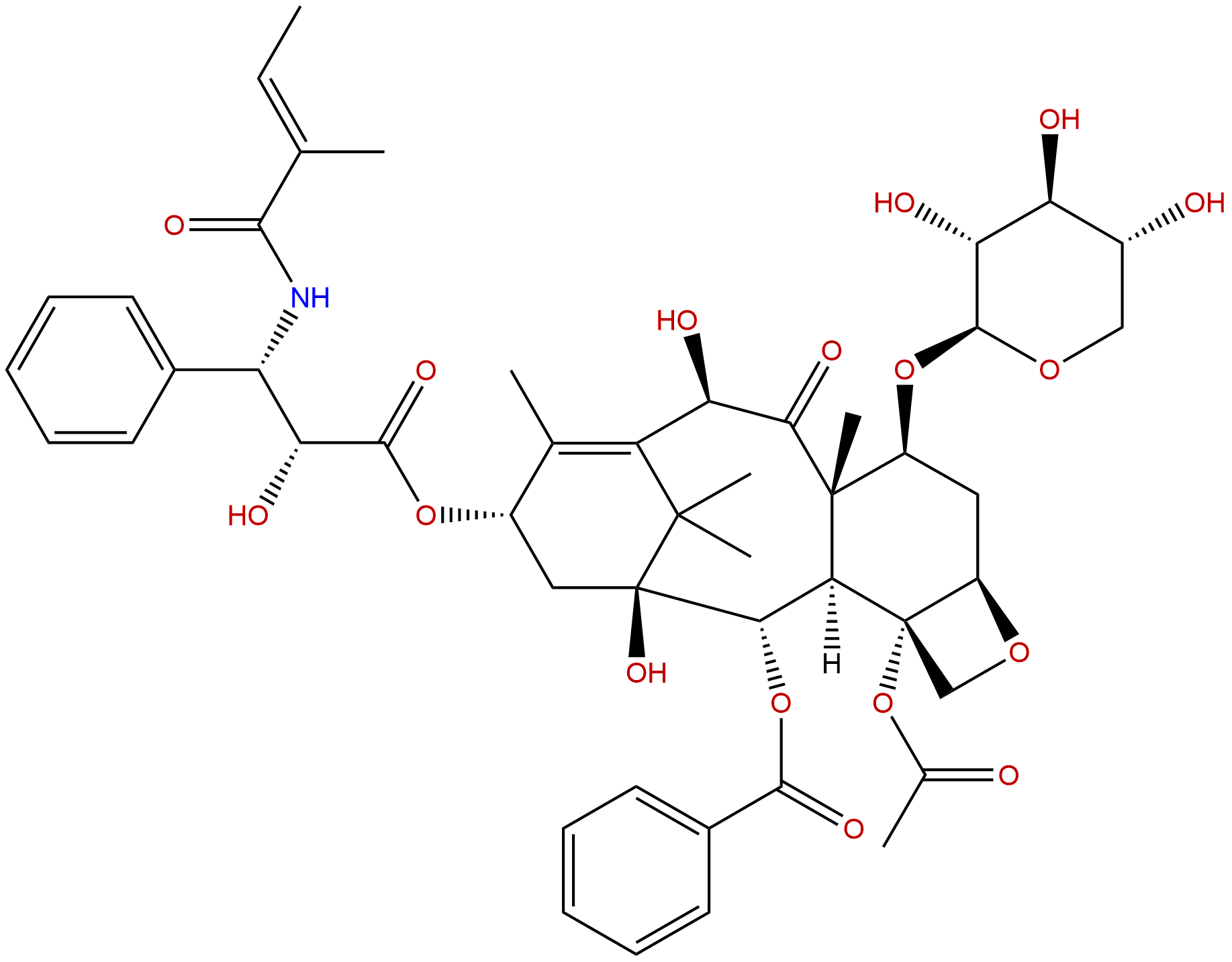


Product name: 7-Xylosyl-10-deacetyltaxol B
Synonym name: 10-Deacetyl-7-xylosyltaxol B;10-Deacetylcephalomannine 7-xyloside;7-Xylosyl-10-deacetylcephalomannine
Catalogue No.: SBP03711
Cas No.: 90332-64-2
Formula: C48H59NO17
Mol Weight: 921.99
Botanical Source:
Physical Description:
Type of Compound: Diterpenoids
Purity: 95%~99%
Analysis Method: HPLC-DAD or/and HPLC-ELSD
Identification Method: Mass, NMR
Packing: Brown vial or HDPE plastic bottle
The product could be supplied from milligrams to grams. Inquire for bulk scale.
We provide solution to improve the water-solubility of compounds, thereby facilitating the variety of activity tests and clinic uses.
For Reference Standard and R&D, Not for Human Use Directly.
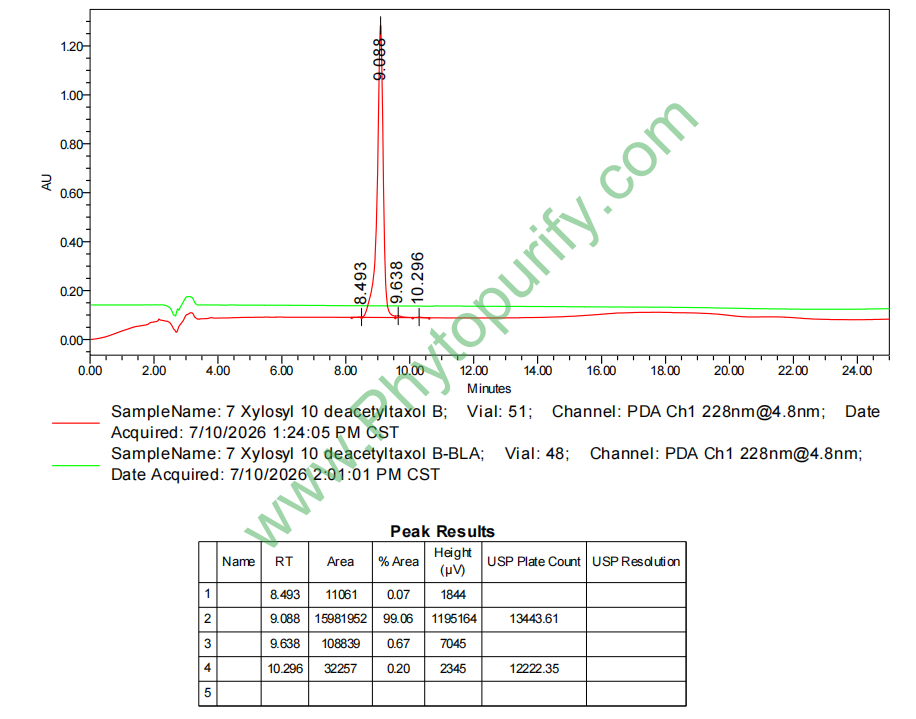
HPLC of 7-Xylosyl-10-deacetyltaxol B
Storage conditions:Short-term storage at 2~8℃, long-term storage at -20 ~ -80℃
274.1400
2.1371
2.1369
.0610
.4831
.3601
Low
83.4403
6.5723
Yes
No
No
No
No
No
0.0
Yes
Yes
Yes
Yes
7-Xylosyl-10-deacetyl paclitaxel B (CAS number: 90332-64-2) is a structurally complex and biologically active taxane diterpenoid compound. As one of the natural derivatives of the star anti-cancer drug Paclitaxel, it is mainly isolated from Taxus chinensis plants. The discovery and in-depth study of this compound is an important achievement in the interdisciplinary field of natural product chemistry and tumor pharmacology, aiming to search for new candidate molecules with better activity, lower toxicity, or the ability to overcome existing drug resistance from the vast "chemical family" of paclitaxel.
Since paclitaxel was approved for clinical use in the late last century, it has become a first-line drug for the treatment of ovarian cancer, breast cancer, non-small cell lung cancer and other solid tumors. Its core mechanism of action is to induce tumor cell apoptosis by stabilizing microtubule proteins and inhibiting cell mitosis. However, paclitaxel has limitations such as poor water solubility, susceptibility to drug resistance, and certain neurotoxicity. Therefore, scientists continuously screen and semi synthesize its analogues from natural sources in order to optimize their pharmaceutical properties. 7-Xylosyl-10-deacetylpaclitaxel B entered the field of researchers in this context. Preliminary pharmacological studies have shown that the compound has clear anti-tumor activity, such as the ability to inhibit the growth of S180 sarcoma in experimental models. Its unique structural modification - introducing a xylose group at the C-7 position of the paclitaxel core and deacetylating at the C-10 position - may endow it with physicochemical properties, metabolic characteristics, and target networks different from paclitaxel, which is worthy of systematic exploration.
This article will provide a comprehensive professional science popularization interpretation of this promising natural product from its chemical structure, plant origin, multi-target pharmacological mechanism, pharmacological evaluation, and research prospects.
The molecular formula of 7-xyloyl-10-deacetylpaclitaxel B is C48H59NO17, with a molecular weight of up to 921.99 g/mol, and it belongs to the category of macromolecular natural products. Its structure is based on the classic tetracyclic [11.3.1.0 ³, ¹¹.0 ⁴, ⁹] heptadecane taxane skeleton, and is connected by complex side chains and sugar groups. From the analysis of SMILES strings and structural expressions, it can be seen that its core features are:
1. C-10 deacetylation Compared to paclitaxel, this position lacks an acetoxy group (- OCOCH ∝) and becomes a hydroxyl group. This change may affect the polarity of the molecule, its interaction with target proteins, and metabolic stability.
2. Xylosylation at position C-7 A xylose unit is connected through a glycosidic bond at position C-7. Xylose is a five carbon sugar, and its introduction significantly increases the hydrophilicity and spatial volume of the molecule, which may have profound effects on the solubility, cell membrane penetration, and pharmacokinetic behavior of the compound.
Analyze the physicochemical properties based on its pharmacological parameters:
- Molecular weight (MW):921.99 Da, Far beyond conventional small molecule drugs (usually<500 Da), this poses challenges for their oral absorption and transmembrane transport.
- Lipid water partition coefficient (LogP/LogD)The LogP value is 2.14, and the LogD value is similar (2.14). This indicates that the compound is in a neutral molecular state at physiological pH and has moderate lipophilicity. In theory, this numerical range is advantageous for compounds to penetrate cell membranes, but it needs to be evaluated comprehensively based on their high molecular weight and high polarity surface area.
- Polarized surface area (TPSA)Up to 274.14 Å ², reflecting the presence of numerous hydrogen bond donors and acceptors (from multiple hydroxyl, ester, amide, and sugar groups) in the molecule. High TPSA is often associated with low membrane permeability and low oral bioavailability.
- Water solubility The measured water solubility is about 0.061 mg/mL, which belongs to insoluble compounds. This is similar to paclitaxel, which is a common feature of such highly hydrophobic skeleton molecules and a key issue that needs to be addressed in formulation development.
Overall, this compound is a glycosylated, highly polar, and high molecular weight derivative of taxane, and its unique structure is the material basis for its biological activity and unique pharmaceutical behavior.
7-Xylosyl-10-deacetylpaclitaxel B is mainly derived from Taxaceae plants in the Taxus genus. The database specifies its source as Taxus chinensis That is, the Chinese yew. The genus Taxus is a precious medicinal plant resource worldwide. Although there is no direct record of its use in traditional medicine, the excavation of its modern medicinal value can be regarded as a legend in natural product research.
Paclitaxel was initially isolated from the bark of Taxus brevifolia. Due to the extremely low content of paclitaxel in plants (about 0.01%) and slow growth of Taxus chinensis, early drug production caused serious damage to wild resources. This dilemma has driven research in multiple areas: 1) chemical total synthesis and semi synthesis (using 10 deacetylbaccatin III extracted from the branches and leaves of European yew as a precursor); 2) Plant cell culture technology; 3) Search for new active analogues from different species and parts of Taxus chinensis.
Chinese yew (T. chinensis), as an endemic species in China, is an important resource for searching for paclitaxel and its derivatives. Researchers have isolated and identified dozens of taxane compounds from its bark, branches, and leaves, among which 7-xyloyl-10-deacetylpaclitaxel B is one of them. The study of these natural derivatives is not only to search for new "paclitaxel", but also to understand the structure-activity relationship (SAR) of taxane compounds, that is, how small changes in chemical structure affect their activity, selectivity, and toxicity. The glycosylation modifications carried out by plants during the biosynthesis process (such as xylosylation in this case) are often a way for them to regulate their activity or store and transport, and these natural "designs" provide valuable inspiration for medicinal chemists.
Existing data indicate that 7-xyloyl-10-deacetylpaclitaxel B has anti-tumor activity and can inhibit the growth of S180 sarcoma, a mouse transplant tumor model. More noteworthy is that the database suggests that its effects involve multiple key tumor related targets:BCL2, EGFR, TP53, KRAS, and CDKN1A This indicates that its anti-tumor mechanism may be beyond the classic "microtubule stabilization" single mode of paclitaxel, showing the characteristics of multi-target and multi-channel intervention.
Based on the functions of each target, provide a scientific explanation of its potential mechanism of action
Direct microtubule action and apoptosis induction (core mechanism):
As a derivative of paclitaxel, its core function is likely to be to promote microtubule polymerization and stabilize microtubule structure, thereby blocking the cell cycle in the G2/M phase and preventing tumor cell mitosis. This mitotic disaster will ultimately initiate the process of cell apoptosis.
Regulating the apoptotic pathway (BCL2, TP53 target association):
Intervention in growth signaling pathway (EGFR, KRAS target association):
Affects cell cycle checkpoint (CDKN1A target association):
Mechanism integration hypothesis:
7-Xyloyl-10-deacetylpaclitaxel B may first bind to microtubules through its taxane skeleton, causing mitotic arrest. This primary stress signal activates monitoring proteins such as TP53. Activated TP53 upregulates CDKN1A (p21) to enhance cycle arrest, and reduces apoptosis threshold by regulating the balance of BCL2 family proteins (inhibiting BCL2 and promoting pro apoptotic proteins). Meanwhile, this compound may interfere with the abnormal activation of growth signaling pathways such as EGFR/KRAS through molecular interactions that have not been fully elucidated, thereby inhibiting the proliferation driving signals of tumor cells from the source. This multidimensional intervention on "cytoskeleton cell cycle apoptosis signal transduction" constitutes a comprehensive network of its anti-tumor activity, which may give it unique advantages over certain tumor types or drug-resistant cell lines.
Based on the provided pharmacokinetic parameters, we conducted a preliminary evaluation of the potential of 7-xyloyl-10-deacetylpaclitaxel B as a drug using standards such as Lipinski's Rule of Five
Lipinski Five Rule Compliance:
Absorption, distribution, metabolism, excretion (ADME) characteristics:
Comprehensive evaluation of drug properties:
As a candidate anti-tumor drug for injection, its evaluation criteria are different from those of small molecule oral drugs. Although oral administration is poor, Abraxane, similar to paclitaxel, can be prepared through appropriate formulation techniques such as nanoparticles, liposomes, albumin binding, etc ®), It can improve its solubility and delivery efficiency. Its multi-target mechanism of action is advantageous, but molecular complexity may lead to difficulties and high costs in chemical synthesis or biological fermentation production. The key development challenge lies in:Optimize drug delivery formulations to improve pharmacokinetics; Clarify its safety, especially liver toxicity risk, through systematic preclinical toxicology studies; Verify its advantages over paclitaxel in terms of efficacy or overcoming drug resistance.
At present, research on 7-xyloyl-10-deacetylpaclitaxel B is still ongoing Preclinical exploration stage The existing literature mainly focuses on its phytochemical isolation, structural identification, and preliminary in vitro cytotoxic activity screening. The report on the in vivo inhibitory activity of S180 sarcoma provides preliminary evidence for its anti-tumor efficacy. However, there are still many gaps in the in-depth analysis of its detailed mechanism of action (especially direct evidence of action with non classical targets such as EGFR and KRAS), systematic pharmacokinetic behavior, toxicological characteristics, and structure-activity relationships.
Future research directions may focus on the following areas:
Application Prospects:
If subsequent studies can confirm its significant advantages in specific tumor types (such as KRAS mutant or paclitaxel resistance) and its safety is controllable, 7-xyloyl-10-deacetylpaclitaxel B is expected to be developed as a novel injectable anti-tumor drug. More likely, it serves as a lead compound, inspiring medicinal chemists to design a new generation of structurally improved taxane drugs. In addition, its glycosylation structure also provides an interesting template for studying the biosynthetic pathways of natural products and utilizing synthetic biology techniques for production.
In short, 7-xyloyl-10-deacetylpaclitaxel B is another molecular treasure gifted to us by the natural product treasure trove. It serves as a bridge from traditional plants to modern precision medicine, and its complex structure embodies the ingenuity of natural creations. Its multi-target activity suggests potential new strategies for combating the complex disease of tumors. Although the road ahead is long and challenging, from basic research to clinical applications, each step of in-depth exploration will add knowledge and hope for us to ultimately overcome cancer.
