


Synonym name:
Catalogue No.: BP1197
Cas No.: 38963-94-9
Formula: C16H22O7
Mol Weight: 326.345
Botanical Source: Artemisia santolinifolia, Pinus spp., Rheum spp. and raspberries
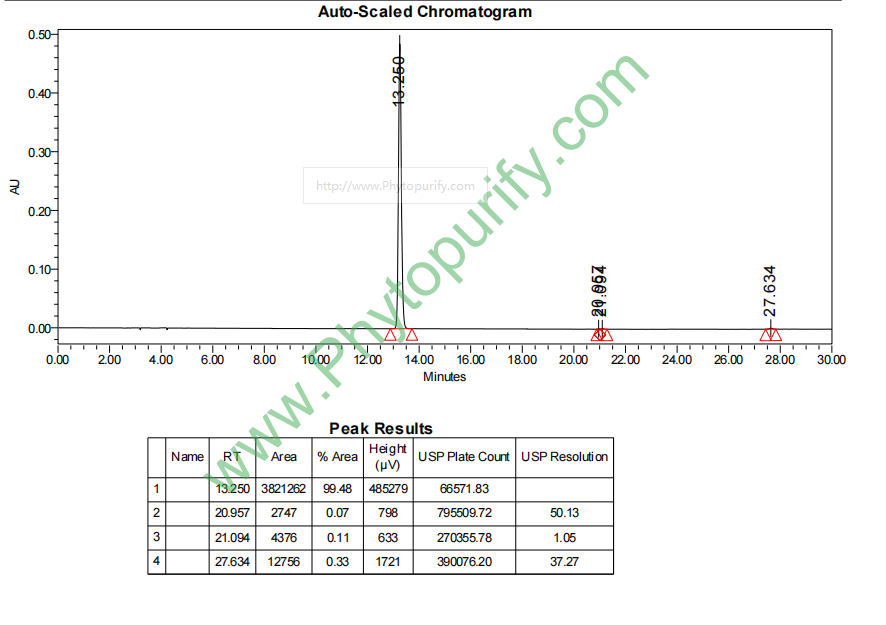
Purity: 95%~99%
Analysis Method: HPLC-DAD or/and HPLC-ELSD
Identification Method: Mass, NMR
Packing: Brown vial or HDPE plastic bottle
Can be supplied from milligrams to grams.
For Reference Standard and R&D, Not for Human Use Directly.
Inquire for bulk scale.
Description:
Raspberry ketone glucoside has lasting effects for the inhibition of melanogenesis and various melanogenic factors after the degradation in the skin.
References:
Journal of Society of Cosmetic Chemists of Japan, 2001, 35(2):120-126.
Lasting Effect of Raspberry Ketone Glucoside on Whitening.
Tyrosinase is well-known as a key enzyme responsible for the production of melanin in melanocytes. It is also known that inflammatory reactions such as active oxygen species and melanogenic factors in the skin are induced by UV irradiation.
METHODS AND RESULTS:
The keys to suppress melanin synthesis are considered to be not only the inhibition of tyrosinase activity but also that of inflammatory reactions. Raspberryketone glucoside (RKG) in raspberry fruit (Rubus ideaeus) had the inhibitory effect on the melanin synthesis. As a result of an investigation with the glycosides that have similar structure of RKG at its glycoside moieties and alkyl chain, the structure of RKG was found to be suitable as an inhibitory factor on melanogenesis. RKG released raspberry ketone (RK) gradually after the reaction with both homogenated and desquamated cells of the stratum corneum. In addition to the inhibitory effect of melanin synthesis, RK also showed remarkable functions such as the scavenge of nitric oxide (NO) which was considered to induce pigmentation of human skin through activation of melanogenesis and the inhibition of the inflammation-related reactions such as production of superoxide anion and lipid peroxide.
CONCLUSIONS:
These data indicated that RKG had lasting effects for the inhibition of melanogenesis and various melanogenic factors after the degradation in the skin.
HPLC of Raspberry ketone glucoside
Storage conditions:Short-term storage at 2~8℃, long-term storage at -20 ~ -80℃
116.4500
-.0337
-.0342
9.9675
.7418
.2136
Low
34.9499
3.3807
Yes
No
No
No
No
No
0.0
Yes
Yes
Yes
Yes
In the modern society that pursues health and beauty, excessive skin pigmentation, such as melasma, freckles, and post inflammatory pigmentation, has become an important skin problem that affects people's quality of life. The biosynthesis of melanin, also known as melanin production, is a physiological process catalyzed by multiple enzymes and precisely regulated by a complex signal network. Traditional whitening agents such as hydroquinone, although effective, often come with skin irritation, cytotoxicity, and even carcinogenic risks. Therefore, the development of efficient and safe natural melanin production inhibitors has become a research hotspot in the fields of cosmetics and skin pharmacology. Raspberry ketone glucoside, as a natural glycoside compound derived from Rosaceae plants, has attracted much attention in recent years due to its significant in vitro and in vivo whitening activity. It not only directly targets the core regulatory pathway of melanin production, but also exhibits excellent antioxidant potential, providing a highly promising candidate molecule for the development of multi-target, low irritant new skin whitening and photoprotective agents. This article aims to systematically review the chemical properties, plant sources, pharmacological activities, molecular mechanisms of action, pharmacological characteristics, and application prospects of raspberry ketone glucoside, in order to provide comprehensive scientific references for related research and development.
Raspberry ketone glucoside, chemical name 4- (4-hydroxyphenyl) but-2-one-4 '- O - β - D-glucoside, CAS number 38963-94-9. Its molecular structure is composed of hydrophobic aromatic ligands - raspberry ketone (p-hydroxyphenylbutanone) and hydrophilic D-glucose units connected by β - glycosidic bonds. This glycosylation modification significantly alters the physicochemical properties of the parent compound raspberry ketone. Its molecular weight is 326.3450, and the calculated lipid water partition coefficient (LogP) is -0.0337, indicating that the molecule has a high degree of hydrophilicity. The topologically polar surface area (TPSA) is as high as 116.45 Å ², which is mainly attributed to the abundant hydroxyl groups and oxygen atoms on the sugar ring in the molecule, further confirming its strong polarity characteristics. The theoretically calculated water solubility value is 9.9675, indicating good solubility in water, which is beneficial for its application in water-based cosmetic formulations. Based on its low LogP value and high TPSA value, it can be predicted that the compound has a lower ability to cross the blood-brain barrier, which to some extent reduces its potential risk of central nervous system side effects. The preliminary screening data for drug efficacy shows that the hERG inhibition risk is negative, and the Ames test result is also 0.0, indicating that it may not have cardiotoxicity or genotoxicity. The preliminary safety assessment is good.
Raspberry ketone glucoside is mainly found in the fruits of various Rosaceae plants, especially in raspberries. In addition, there are also small amounts of distribution in berries such as raspberries and blackberries. In plants, it usually exists as a precursor or storage form of raspberry ketone, and its glycosidic structure can increase water solubility, making it easy to store in plant vacuoles and release active raspberry ketone through endogenous glycosidase hydrolysis when needed.
The extraction method mainly relies on modern natural product separation and purification technology. The conventional process begins with the extraction or ultrasound assisted extraction of dry plant materials using organic solvents such as methanol, ethanol, or aqueous ethanol to maximize the acquisition of polar components. After filtration and concentration, the crude extract is often preliminarily enriched using macroporous adsorption resin column chromatography, which separates glycoside compounds by adsorption of resin and elution with different concentrations of ethanol. Further purification relies on high-performance liquid chromatography technology, especially preparative reverse phase HPLC, which optimizes the ratio of mobile phase (usually methanol water or acetonitrile water system) to ultimately obtain high-purity raspberry ketone glucoside monomers. In recent years, green extraction techniques such as supercritical CO ₂ extraction (which requires the addition of entrainers to enhance the dissolution of polar components) and high-speed countercurrent chromatography have also been explored and applied in the separation and preparation of such compounds due to their high efficiency and low solvent residue.
The core pharmacological activity of raspberry ketone glucoside is concentrated in the field of skin pharmacology, manifested by its potent inhibition of melanin production and extensive antioxidant damage protection.
1. Melanogenesis inhibition activity This activity has been fully validated in various models. In vitro experiments using a mouse melanoma B16F10 cell model showed that raspberry ketone glucoside significantly reduced intracellular melanin content in a dose-dependent manner, and its half maximal inhibitory concentration (IC ₅₀) value showed that its efficacy was superior to or comparable to some classic whitening ingredients. More importantly, in the zebrafish embryo model in vivo, the compound can effectively inhibit tail melanin deposition induced by alpha melanocyte stimulating hormone, intuitively confirming its overall biological whitening effect, and has no significant toxicity to zebrafish embryo development, indicating its good biocompatibility.
2. Antioxidant damage activity Oxidative stress is a key factor leading to skin photoaging, pigmentation, and various chronic diseases. The antioxidant activity of raspberry ketone glucoside is not simply the direct clearance of free radicals, but is more reflected in its ability to systematically activate the intracellular antioxidant defense system. Research has shown that it can upregulate the expression of a series of downstream antioxidant and detoxifying enzyme genes, including superoxide dismutase, catalase, glutathione peroxidase, and heme oxygenase-1, by regulating the nuclear factor E2 related factor 2 signaling pathway. This activation of the endogenous antioxidant network in cells enables it to provide more lasting and comprehensive cellular protection against oxidative damage caused by external factors such as ultraviolet radiation and chemical pollutants.
The whitening and antioxidant effects of raspberry ketone glucoside are based on a clear molecular mechanism involving the cross regulation of multiple signaling pathways.
1. The core mechanism of melanin production inhibition: activation of IL-6/JAK1/STAT3 pathway and inhibition of MITF
The key transcriptional regulatory factors for melanin production are microphthalmia related transcription factors. MITF directly regulates the transcriptional expression of key enzymes involved in melanin synthesis, such as tyrosinase and tyrosinase related protein-1. The unique feature of raspberry ketone glucoside is that it does not directly inhibit TYR enzyme activity, but activates its downstream JAK1 kinase by upregulating the expression of interleukin-6. Activated JAK1 phosphorylates signal transducer and activator of transcription factor 3, causing it to form a dimer and transfer to the nucleus. The nuclear entry of p-STAT3 as a transcription factor can bind to the promoter region of the MITF gene, but interestingly, this binding is not activated, but rather inhibit The transcriptional activity of MITF. The decrease in MITF expression level directly leads to a significant reduction in the mRNA and protein expression levels of its downstream target genes TYR and TYRP1, ultimately reducing melanin biosynthesis at the source. This "flanking" strategy of inhibiting the core transcription factor (MITF) by activating a pathway (IL-6/JAK1/STAT3) is a highlight of its mechanism of action.
2. The hub of antioxidant defense: activation of NRF2/ARE pathway
In the face of oxidative stress, raspberry ketone glucoside plays the role of a cellular defense "switch". Its active ingredients (possibly itself or metabolites) can interfere with the ubiquitination degradation of NRF2 by KEAP1 protein, promoting the dissociation and stable accumulation of NRF2 from the cytoplasm, followed by translocation to the nucleus. In the nucleus, NRF2 binds to antioxidant response elements and initiates the transcription of a series of II phase detoxifying enzymes and antioxidant protein genes, including SOD1, SOD2, CAT, GPX1, HMOX1, etc. These enzymes together form a powerful antioxidant network, synergistically clearing reactive oxygen species such as superoxide anions and hydrogen peroxide, reducing lipid peroxidation and DNA oxidative damage, thereby protecting melanocytes and other skin cells from oxidative stress-induced apoptosis and functional disorders.
Based on its physicochemical properties and preliminary biological data, raspberry ketone glucoside exhibits good pharmacological potential as an external skin active ingredient.
Pharmacokinetic characteristics As a glycoside compound, its transdermal absorption characteristics are crucial. Its moderate molecular weight and hydrophilicity may facilitate its passage through the stratum corneum. However, intact glycoside molecules in the skin may be hydrolyzed by β - glucosidase widely present in the epidermis and dermis, releasing the glycoside raspberry ketone. Therefore, the actual effective substance form in its body may be itself, its aglycone, or the synergistic effect of both. At present, research on its systemic pharmacokinetics (such as oral absorption, distribution, metabolism, excretion) is still blank, mainly because its development direction focuses on topical application. In vitro transdermal experiments and local pharmacokinetic studies on the skin will be important steps in evaluating its topical effectiveness in the future.
Analysis of the advantages of medicinal properties:
1. High security No hERG inhibition and Ames mutagenicity risk warning, preliminary cell and zebrafish models also showed low toxicity.
2. Good water solubility: The excellent hydrophilicity makes it easy to be formulated into water-based, gel or essence and other formulations that consumers like, and the formula is stable.
3. Multi-target effect Simultaneously intervening in the two core pathological pathways of melanin production and oxidative stress may have a synergistic effect, reducing the dosage of single target inhibitors and potential drug resistance.
4. natural source In line with the market's consumption trend towards natural and green ingredients.
challenges faced:
1. Skin penetration and metabolism It is necessary to conduct in-depth research on the efficiency of its complete form of transdermal absorption, as well as the metabolic transformation process within the skin tissue, in order to clarify its true active form and duration of action.
2. Stability of formulations Glycoside bonds may undergo hydrolysis under extreme pH or long-term storage, and their stability needs to be ensured through pH adjustment, antioxidant addition, and other methods in the formula.
3. System exposure risk Although the blood-brain barrier penetration is low, the potential effects of systemic exposure after transdermal absorption still need to be evaluated if used extensively for a long time.
The unique pharmacological properties of raspberry ketone glucoside have brought broad application prospects in multiple fields.
1. Functional cosmetics and topical medications for the skin This is its most direct application direction. As a new generation of natural whitening active ingredient, it can be widely used in whitening and spot lightening essence, lotion, face cream, facial mask and other products. Its antioxidant properties make it equally suitable for anti-aging, sun protection, and repair products, providing light protection and reducing oxidative stress damage. In the future, it can be explored to combine it with other functional ingredients such as vitamin C, niacinamide, and tranexamic acid to develop synergistic whitening or full effect skincare solutions.
2. Adjuvant therapy for pigmentary skin diseases For diseases such as melasma and post inflammatory pigmentation, the combination of conventional treatments (such as lasers and topical medications) with topical preparations containing this ingredient may enhance efficacy and reduce recurrence by inhibiting melanin synthesis and reducing local inflammatory oxidative status.
3. In the field of food and health products Given its natural origin and antioxidant activity, it has the potential to be used as a functional food additive or ingredient in oral beauty and health products for internal regulation of skin health. But this requires first completing a systematic oral safety evaluation and pharmacokinetic study.
4. Future research directions:
* Deepening the mechanism of action It is necessary to verify its efficacy and mechanism in normal human epidermal melanocytes and 3D skin models, and explore other potential activities such as anti-inflammatory and anti-aging effects.
* structural optimization By synthesizing its different sugar or acyl derivatives, improving its lipid solubility, skin permeability, or stability to specific enzymes, to obtain better candidate molecules.
* Clinical translational research Conduct standardized randomized, double-blind, placebo-controlled clinical trials to scientifically evaluate their effectiveness, safety, and optimal concentration for human use.
* Green scale production Explore the use of synthetic biology techniques, such as microbial fermentation, to achieve efficient and sustainable large-scale production, in order to solve the problems of limited plant extraction sources and high costs.
Raspberry ketone glucoside, as a natural active glycoside derived from berries, exhibits clear and powerful biological activity in inhibiting melanin production and resisting oxidative damage through its dual mechanisms of inhibiting MITF transcription by activating the IL-6/JAK1/STAT3 pathway and enhancing cellular antioxidant defense by activating the NRF2 pathway. Its good water solubility, preliminary safety data, and multi-target action characteristics make it a star candidate molecule for developing efficient and safe topical skin whitening and antioxidants. Although further exploration is still needed in terms of transdermal metabolism, formulation stability, and complete clinical evidence, with the continuous deepening of understanding of its molecular mechanism and the advancement of formulation technology, raspberry ketone glucoside is expected to move from the laboratory to the market, not only occupying a place in the high-end cosmetics field, but also possibly providing new natural solutions for the adjuvant treatment of pigmentary skin diseases. Its research paradigm also provides useful reference for discovering glycoside active ingredients with novel mechanisms of action from traditional medicinal plants.
