


Synonym name: Scopoletin glucoside; Murrayin
Catalogue No.: BP1276
Cas No.: 531-44-2
Formula: C16H18O9
Mol Weight: 354.311
Botanical Source: Scopolia japonica, Hedera helix and others
Purity: 95%~99%
Analysis Method: HPLC-DAD or/and HPLC-ELSD
Identification Method: Mass, NMR
Packing: Brown vial or HDPE plastic bottle
Can be supplied from milligrams to grams.
For Reference Standard and R&D, Not for Human Use Directly.
Inquire for bulk scale.
HPLC of Scopolin
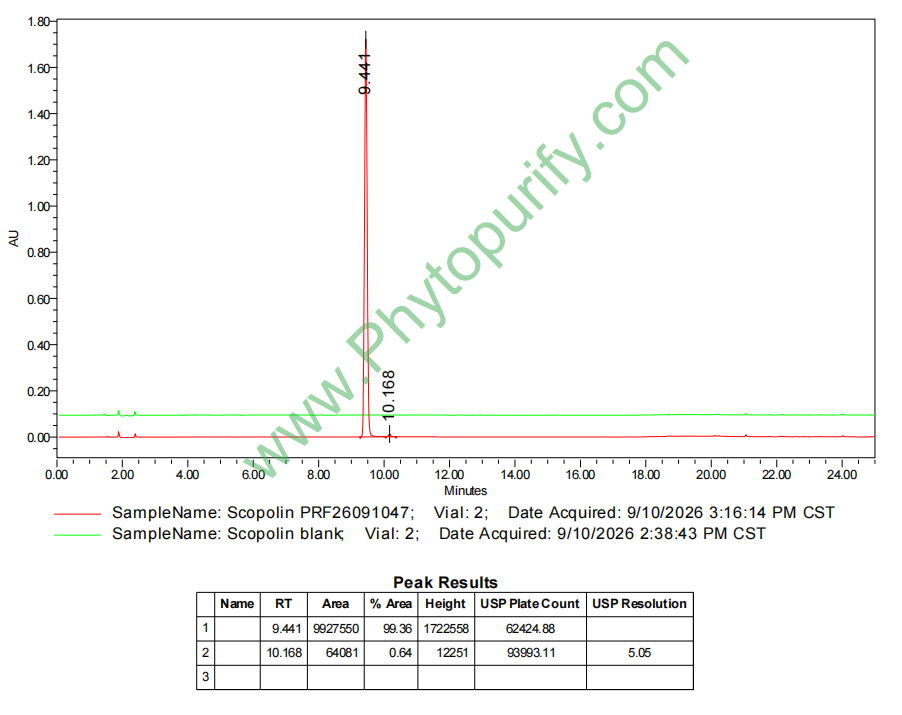
Storage conditions:Short-term storage at 2~8℃, long-term storage at -20 ~ -80℃
138.8200
-.1870
-.1873
8.8163
.6229
.6519
Low
43.5071
3.6102
Yes
No
No
No
Yes
Yes
0.9
Yes
Yes
Yes
Yes
Coumarin compounds are a class of benzo [a] - pyranone derivatives widely found in nature, which have attracted much attention due to their diverse chemical structures and extensive biological activities. Scopolalin (CAS number: 531-44-2), as an important member of the coumarin family, is a natural product formed by the glycosidic bond between the coumarin nucleus and the glucose group. For a long time, Scopolatin and its aglycone Scopolatin have been found in various medicinal plants, traditionally believed to have basic activities such as anti-inflammatory and antioxidant effects. However, with the deepening of modern pharmacological research techniques, the biological functional profile of scopolamine has been greatly expanded, and its role in emerging metabolic diseases and nervous system regulation has gradually emerged. Especially in recent years, research has found that scopolamine can significantly alleviate liver steatosis by activating the signaling pathway mediated by the deacetylase SIRT1, providing a new potential candidate molecule for the prevention and treatment of non-alcoholic fatty liver disease (NAFLD). Meanwhile, its potential association with various neurotransmitter system targets such as SLC6A4, HTR1A, GABA_A receptor subunits suggests its application value in the field of central nervous system (CNS) diseases such as sedation and anti anxiety. This article aims to systematically review the chemical properties, plant sources, pharmacological activities, molecular mechanisms of action, pharmacological characteristics, and clinical application prospects of scopolamine, in order to provide comprehensive scientific references for the deep development and transformation research of this natural product.
The chemical name of scopolamine is 7-hydroxy-6-methoxycoumarin-7-O - β - D-glucoside. Its molecular formula is C ₁₆ H ₁₈ O ₉, and its molecular weight is 354.3110 g/mol. Structurally, its parent nucleus is 6-methoxy-7-hydroxycoumarin (i.e. scopoletin), which is connected to a D-glucose group via a β - glycosidic bond at the 7th phenolic hydroxyl group. This glycosylation modification significantly alters the physicochemical properties and biological activity of its parent aglycone.
In terms of physicochemical properties, the introduction of glycosidic bonds greatly enhances the hydrophilicity of scopolamine. The calculated lipid water partition coefficient (LogP) is -0.1870, indicating that it has good hydrophilic properties. The topologically polar surface area (TPSA) is as high as 138.82 Å ², mainly attributed to the hydrogen bond acceptor sites formed by multiple oxygen atoms in the molecule, including hydroxyl groups on the sugar ring and carbonyl and methoxy groups on the coumarin ring. The theoretically calculated water solubility value is 8.8163 (usually expressed in log mol/L or related units), further confirming its good solubility in aqueous media, which is beneficial for its development and in vivo absorption in aqueous formulations. However, its high polarity and TPSA also pose challenges to its transmembrane transport, especially its blood-brain barrier (BBB) permeability is predicted to be "low", indicating that direct entry of the prototype drug into the central nervous system may be limited and its brain delivery efficiency needs to be improved through structural modifications or delivery systems. In addition, preliminary pharmacological risk assessment shows that it has no significant inhibitory effect on hERG potassium channels (hERG inhibition: No), and the Ames test result is 0.9 (usually a value close to 1 indicates no significant mutagenicity), indicating low risks of cardiac and genetic toxicity and a relatively good safety starting point.
Scopolaside is widely distributed in the plant kingdom, especially abundant in Solanaceae, Asteraceae, and Brassicaceae plants. Initially, it was isolated and identified from plants such as Hyoscyamus. It is worth noting that scopolamine has also been isolated from the roots of the modern research model plant Arabidopsis thaliana, providing an excellent system for studying its biosynthesis and regulation using molecular genetic tools. In various traditional medicinal plants, such as Artemisia annua, Atropa belladonna, and some Artemisia plants, the presence of scopolamine is often detected. It is usually considered as a storage and transport form of scopoletin in plant bodies, participating in plant defense responses (such as antioxidant and pathogen resistance) and growth and development regulation.
The extraction of scopolamine from plant materials is often carried out using organic solvent extraction method. Methanol, ethanol, or ethanol water mixed solvents are widely used due to their good solubility in coumarin glycosides. The typical extraction process includes: heating and refluxing the dried and crushed plant materials (such as roots and leaves) with an appropriate concentration of ethanol (such as 70% -80%) or ultrasound assisted extraction several times, combining the extraction solutions, and concentrating them under reduced pressure to obtain the extract. Subsequently, preliminary separation was carried out using the polarity and solubility differences of scopolamine. Large pore adsorption resin (such as D101, AB-8) column chromatography was commonly used, and gradient elution was performed with water and different concentrations of ethanol. Scopolatin is usually enriched in the 20% -40% ethanol elution site. Further purification relies on silica gel column chromatography, reverse phase silica gel (such as ODS) column chromatography, and high-performance liquid chromatography (HPLC) preparation techniques. Thin layer chromatography (TLC) and HPLC are commonly used methods for identification and content determination by comparing with standard samples. In recent years, green technologies such as supercritical fluid extraction and microwave-assisted extraction have also been explored to improve extraction efficiency and selectivity.
The pharmacological activity research of scopolamine has expanded from traditional anti-inflammatory and antioxidant fields to modern medical hotspots such as metabolic diseases and neurological diseases.
1. Liver protection and anti steatosis effects: This is one of the most anticipated activities of scopolamine in recent years. In animal models of non-alcoholic fatty liver disease (NAFLD)/non-alcoholic steatohepatitis (NASH) induced by high-fat diet (HFD) or methionine choline deficiency (MCD) diet, scopolamine intervention can significantly reduce liver weight and liver index, reduce lipid droplet accumulation in liver cells, and improve liver histopathological scores (such as steatosis, ballooning, and inflammatory infiltration). Its function is closely related to reducing the levels of alanine aminotransferase (ALT) and aspartate aminotransferase (AST) in serum, as well as regulating the lipid profile (reducing triglycerides and total cholesterol).
2. Sedation and central nervous system regulation activity: Although the BBB permeability of scopolamine is limited, its aglycone scopoletin or in vivo metabolites may mediate central effects. Pharmacological studies have shown that scopolamine and its related compounds exhibit sedative and anti anxiety potential. In autonomous activity experiments (such as opening experiments), it can reduce the spontaneous activity of animals; In anxiety models such as elevated cross maze, it shows anti anxiety like effects. These effects suggest that they may exert their effects by affecting the monoamine or amino acid neurotransmitter system.
3. Anti inflammatory and antioxidant effects: As a classic coumarin derivative, scopolamine has the ability to scavenge free radicals such as DPPH and ABTS, and can enhance the activity of intracellular antioxidant enzymes such as superoxide dismutase (SOD) and glutathione peroxidase (GSH Px), while reducing malondialdehyde (MDA) levels. In the lipopolysaccharide (LPS) - induced macrophage (such as RAW264.7) inflammation model, it can inhibit the production of nitric oxide (NO), prostaglandin E2 (PGE2), and downregulate the expression of inducible nitric oxide synthase (iNOS), cyclooxygenase-2 (COX-2), and various pro-inflammatory cytokines (such as TNF - α, IL-1 β, IL-6).
4. Other activities: The study also reported that scopolamine has analgesic, anti diabetes (improving insulin resistance), anti angiogenesis and certain antibacterial activities, showing its pharmacological potential in many aspects.
The molecular mechanism by which scopolamine exerts its diverse pharmacological effects is gradually being elucidated, involving multiple key signaling pathways and molecular targets.
1. Activation of SIRT1 signaling pathway: In terms of anti hepatic steatosis, the core mechanism of scopolamine is the activation of silencing information regulatory factor 1 (SIRT1). SIRT1 is a NAD ⁺ - dependent class III histone deacetylase, which is a core regulatory factor in cellular energy metabolism and stress response. Research has shown that scopolamine can upregulate the protein expression and activity of SIRT1 in liver tissue. Activated SIRT1 undergoes deacetylation and activates downstream targets such as peroxisome proliferator activated receptor gamma co activator 1 alpha (PGC-1 alpha) and forkhead box protein O1 (FoxO1), thereby:
* Promote fatty acid oxidation: Activated PGC-1 α upregulates the expression of mitochondrial biosynthesis and fatty acid beta oxidation related genes (such as CPT1 α), accelerating fatty acid breakdown.
* Inhibit fat production: SIRT1 can deacetylate and inhibit sterol regulatory element binding protein-1c (SREBP-1c), which is a transcription factor that regulates key enzymes involved in fatty acid and triglyceride synthesis (such as ACC, FAS), thereby inhibiting de novo synthesis of liver fat.
* Improving insulin sensitivity: By regulating insulin signaling pathway related proteins, liver insulin resistance can be alleviated.
* Inhibiting inflammation and oxidative stress: SIRT1 can inhibit the transcriptional activity of nuclear factor kappa B (NF - κ B) and reduce the production of pro-inflammatory factors; Simultaneously enhancing antioxidant defense by activating FoxO.
2. Regulation of targets related to the nervous system: The sedative activity of scopolamine may be achieved through multi-target interactions:
* 5-hydroxytryptamine (5-HT) system: It may interact with the 5-hydroxytryptamine transporter (SLC6A4), affecting the reuptake of 5-HT in the synaptic cleft and indirectly regulating 5-HT levels. Meanwhile, the potential effect on 5-HT1A receptor (HTR1A) may mediate its anti anxiety effect.
* Gamma aminobutyric acid (GABA) system: GABA_A receptors are the main targets mediating sedation and hypnosis. Scopolatin may enhance GABAergic neurotransmission and produce central inhibitory effects by affecting different subunits of GABA_A receptors (such as GABRA1, GABRB2, GABRG2). This may be one of the main molecular basis for its sedative effect.
3. Anti inflammatory and antioxidant pathways: In addition to inhibiting NF - κ B through SIRT1, scopolamine can also activate the nuclear factor E2 related factor 2 (Nrf2) signaling pathway. Nrf2 is the central regulator of cellular antioxidant response, which is activated and translocated to the nucleus, initiating the expression of phase II detoxifying enzymes and antioxidant proteins such as heme oxygenase-1 (HO-1) and quinone oxidoreductase 1 (NQO1), thereby systematically enhancing the cell's ability to resist oxidative damage and inflammation.
The pharmacological evaluation based on calculations and preliminary experimental data shows that scopolamine, as a drug lead compound, has both advantages and challenges.
Advantages: The molecular weight is moderate (354 Da), which meets the basic requirements of the five rules for generic drugs. Good water solubility is beneficial for the development of formulations and the improvement of oral bioavailability. There was no significant hERG channel inhibition or mutagenic risk (Ames test negative), laying a solid foundation for its safety assessment. Its natural product identity also implies that it usually has good biocompatibility.
Challenge aspect: The main challenge lies in its poor membrane permeability, manifested as high TPSA and low LogP values. This directly leads to its prediction Low blood-brain barrier permeability This limits its potential as a sedative drug prototype molecule to directly act on the central nervous system. After oral administration, glycoside compounds are easily hydrolyzed by the gut microbiota or β - glucosidase on the intestinal mucosa to produce the glycoside scopoletin, which may have different absorption, distribution, and activity characteristics. Therefore, the pharmacokinetic behavior of scopolamine in vivo may be a comprehensive reflection of its prototype and metabolites.
At present, pharmacokinetic studies on the scopolamine system are relatively limited. Based on its structural characteristics and similar compounds, it is speculated that:
* Absorption: After oral administration, it may be partially absorbed in the upper small intestine through passive diffusion, but the degree and rate of absorption are greatly affected by hydrolysis. Glycoside scopoletin has higher lipid solubility and may be better absorbed.
* Distribution: The prototype drug is mainly distributed in blood and blood rich tissues such as the liver and kidneys, but the amount entering the brain is limited. Glycosides may have a wider distribution.
* Metabolism: The liver is the main metabolic organ and may undergo II binding reactions such as glucuronidation and sulfation. The hydrolysis mediated by gut microbiota is an important first pass metabolic pathway.
* Excretion: Metabolites are mainly excreted through the kidneys and urine.
Future research needs to clarify its absolute bioavailability, plasma protein binding rate, major metabolites, and excretion pathways through in vitro and in vivo experiments. To improve its pharmacological properties, especially for CNS indications, consideration may be given to Prodrug design(such as esterification modification to improve lipid solubility and BBB penetration, enzyme interpretation of radiotype in the brain) or development New drug delivery system(such as nanoliposomes, polymer micelles, and brain targeted peptide modified nanoparticles).
The multi-target and multi pathway pharmacological properties of scopolamine have depicted broad prospects for its application in various disease fields, but it also faces challenges from laboratory to clinical translation.
1. Potential clinical application directions:
* Non alcoholic fatty liver disease (NAFLD/NASH): This is one of the most promising directions. Based on its clear activation of SIRT1, improvement of liver lipid metabolism and inflammation, scopolamine is expected to be developed as a natural source drug or functional food ingredient for the treatment of NAFLD/NASH. Can be used in combination with existing therapies (such as insulin sensitizers) to achieve synergistic effects.
* Mild to moderate anxiety and sleep disorders: Although BBB permeability is a barrier, its sedative and anti anxiety activities are clear. After breaking through the BBB through prodrug strategies or delivery systems, or utilizing the central effects of peripheral metabolites such as aglycones, it may be developed into a novel sedative and sedative drug, especially suitable for patients who need to avoid dependence and tolerance to traditional benzodiazepines.
* Diseases related to metabolic syndrome: Its anti-inflammatory, antioxidant and insulin resistance improving effects have potential value in the prevention and treatment of type 2 diabetes, obesity and cardiovascular complications.
* Adjuvant anti-inflammatory therapy: Can be used as an adjuvant treatment option for chronic inflammatory diseases such as arthritis and colitis.
2. Future research prospects and challenges:
* In depth mechanism research: It is necessary to use gene knockout/knockdown techniques, molecular docking, and site directed mutagenesis to confirm the direct interaction sites and precise mechanisms with targets such as SIRT1 and GABA_A receptor subunits.
* Systematic pharmacokinetics and metabolism research: A complete ADME (absorption, distribution, metabolism, excretion) study must be conducted to clarify its in vivo fate, active metabolites, and species differences.
* Optimization of drug properties: Conduct systematic structural modification and structure-activity relationship research for target indications (especially CNS diseases), or design intelligent drug delivery systems to improve their pharmacokinetic deficiencies.
* Comprehensive preclinical safety evaluation: Strictly evaluate the long-term toxicity, reproductive toxicity, carcinogenicity, and other aspects to ensure the safety of its clinical application.
* Research on the synergistic effect of multiple components: As a natural product, it often coexists with other components in the original plant. Studying its interaction with coexisting components is of great significance for the development of standardized botanical extracts.
As a natural coumarin glycoside, scopolamine has evolved from a minor component in traditional medicinal plants to a star molecule with clear pharmacological activity in the fields of metabolic and neurological diseases. The mechanism of activating the SIRT1 pathway to combat hepatic steatosis provides new ideas and targets for drug therapy of NAFLD; And its potential association with the 5-HT and GABA systems reveals its potential application in psychiatric and neurological disorders. Although there are challenges in drug development, especially in blood-brain barrier permeability, this provides an opportunity for innovation in the fields of medicinal chemistry and pharmacy. With a more detailed analysis of its molecular mechanism of action, comprehensive elucidation of its pharmacokinetic behavior, and the application of structure based rational drug design and advanced delivery technology, scopolamine is expected to successfully enter clinical practice from an excellent drug lead compound, contributing its unique value as a natural product to human health. Future research should focus on interdisciplinary collaboration to promote the substantial progress of this compound from basic research to translational medicine.
