Introduction/Overview
Anisodamine hydrobromide (CAS number: 55449-49-5) is derived from the Solanaceae plant Anisodamine(Anisodus tanguticus)A tropane alkaloid found in rhizomes, with its active ingredient being scopolamine. Since its isolation and identification in the mid-20th century, this compound has been widely used in clinical practice for the treatment of infectious shock, smooth muscle spasm, microcirculation disorders, and other diseases due to its significant anticholinergic activity. In traditional cognition, scopolamine is mainly used as a non subtype selective muscarinic (M) and nicotinic (N) cholinergic receptor antagonist, exerting its pharmacological effects of spasmolysis and improving microcirculation by blocking the action of acetylcholine.
In recent years, with the deepening of research, the pharmacological spectrum of scopolamine hydrobromide has been greatly expanded. Research has found that in addition to its classic anticholinergic effects, it also exhibits multiple biological activities such as antioxidant, anti-inflammatory, anti apoptotic, and immune regulation. Of particular note, emerging pharmacological and network pharmacology evidence suggests that scopolamine hydrobromide may have potential therapeutic effects in complex central nervous system disorders, particularly depressive disorders, by acting on key targets such as the sigma 1 receptor (SIGMAR1), acetylcholinesterase (ACHE), multiple serotonin receptors (such as HTR2B, HTR7), dopamine D1 receptor (DRD1), and monoamine transporters (SLC6A3, SLC6A4). This discovery breaks the limitations of its traditional peripheral effects and opens up a new research direction for the new use of its old medicine.
This article aims to systematically review the chemical characteristics, plant sources, pharmacological activities of scopolamine hydrobromide, and focus on its potential mechanisms of action and molecular targets in central nervous system diseases such as depression. At the same time, based on its pharmacological parameters, the clinical application prospects are scientifically discussed.
Chemical structure and physicochemical properties
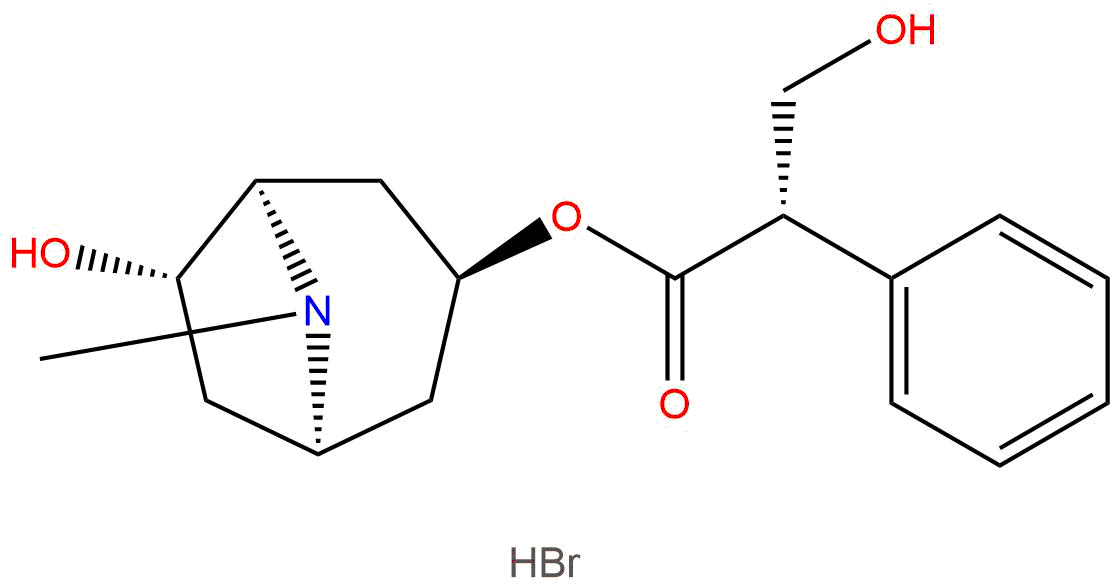
Scopolamine hydrobromide is the hydrobromide form of scopolamine, with a molecular formula of C17H23NO4 · HBr and a molecular weight of 305.3740. The chemical structure of scopolamine belongs to the tropane alkaloid class, with its parent nucleus being tropane (tropane). It is highly similar in structure to atropine and scopolamine, but differs in the 6th hydroxyl group, specifically 6 (S) - hydroxyscopolamine. This subtle structural difference significantly distinguishes it from atropine (with strong central effects and high toxicity) and scopolamine (with strong central inhibitory effects) in terms of pharmacological activity and toxicity, exhibiting weak central excitatory effects, higher selectivity for peripheral anticholinergic effects, and relatively fewer side effects.
From the perspective of physical and chemical properties, its calculated lipid water partition coefficient (LogP) is 1.0216, indicating that the compound has a certain lipophilicity but is not highly lipophilic. The topological polar surface area (TPSA) is 70.0000 Å ², reflecting the presence of multiple hydrogen bond acceptors (such as ester groups, hydroxyl groups, and tertiary amine nitrogen atoms) in the molecule. Its water solubility value is 17.4573 (usually measured in mg/mL or logS, indicating moderate to high solubility), thanks to its salt form (hydrobromide) which increases ionic properties and facilitates dissolution and distribution in body fluids. The key pharmacological prediction parameters show that the compound has a high blood-brain barrier (BBB) permeability, which provides an important material basis for its potential central nervous system pharmacological effects. In addition, its hERG inhibition risk is' no ', and the Ames test result is 0.0 (indicating no mutagenicity), providing favorable support for its further development based on these preliminary in vitro safety data.
Plant sources and extraction methods
The direct natural source of hydrobromic acid scopolamine is the plant scopolamine in the family Solanaceae(Anisodus tanguticus (Maxim.) Pascher), Mainly distributed in the Qinghai Tibet Plateau and surrounding high-altitude areas of China. The dried rhizomes of Scopola aspera are the main parts for extracting scopolamine, and other plants of the same genus, such as Tanggute Scopola aspera, also contain this component.
The traditional extraction and separation process is mainly based on the universality of alkaloids. The general process is as follows: After drying and crushing the roots and stems of Scotropha acutissima, appropriate concentrations of ethanol or dilute acid (such as sulfuric acid, hydrochloric acid) are used for percolation or reflux extraction to dissolve the alkaloids in salt form. After concentration, the extract is adjusted to alkaline with alkali (such as ammonia water, sodium hydroxide) to allow the alkaloids to precipitate freely, and then extracted with organic solvents (such as chloroform, dichloromethane). After dehydration and concentration of the extraction solution, crude total alkaloids were obtained. Subsequently, using chromatographic techniques such as silica gel column chromatography and high-performance liquid chromatography (HPLC), further separation and purification were carried out to obtain scopolamine monomer. Finally, high-purity scopolamine hydrobromide can be obtained by salt formation and recrystallization of scopolamine hydrobromide.
With the development of biotechnology, plant cell culture and synthetic biology methods have also been explored for the production of scopolamine and its precursors, in order to achieve sustainable and controllable production. However, traditional extraction methods are still the main production methods.
Pharmacological activity research
The pharmacological activities of scopolamine hydrobromide are extensive and can be divided into two categories: classical effects and emerging effects.
1. Classic pharmacological activity:
* Anticholinergic effects, spasmolytic effects, and improvement of microcirculation: As a non subtype selective M/N cholinergic receptor antagonist, it can competitively block the effects of acetylcholine on smooth muscles (gastrointestinal tract, bronchi, blood vessels, etc.) and glands, thereby relieving spasms, inhibiting secretion, and dilating blood vessels. This is the core mechanism of its clinical use in treating acute abdominal pain, organophosphate poisoning, and septic shock (by improving microcirculation).
* Cellular protective effect: In various organ ischemia/reperfusion injury models (such as heart, brain, intestine, and kidney), scopolamine has shown clear protective effects, which are closely related to its improvement of microcirculation, reduction of calcium overload, inhibition of inflammatory response, and oxidative stress.
2. Emerging pharmacological activities:
* Antioxidant and anti-inflammatory activities: Numerous studies have confirmed that scopolamine can effectively scavenge oxygen free radicals, inhibit lipid peroxidation, and enhance the activity of endogenous antioxidant enzymes such as superoxide dismutase (SOD) and glutathione peroxidase (GSH Px). At the same time, it can inhibit the activation of key inflammatory signaling pathways such as nuclear factor kappa B (NF - κ B), downregulate the expression of pro-inflammatory cytokines such as tumor necrosis factor - α (TNF - α), interleukin-6 (IL-6), and interleukin-1 β (IL-1 β), thereby exerting a powerful anti-inflammatory effect. This forms the basis for its treatment of inflammatory diseases such as sepsis, acute lung injury, pancreatitis, and potential neuroprotective effects.
* Potential effects on central nervous system diseases: This is currently one of the most closely watched research directions. Both clinical observations and basic research suggest that scopolamine may have an improving effect on depression and anxiety like behavior. In animal models of chronic stress-induced depression, treatment with scopolamine significantly improved behavioral despair (forced swimming, tail suspension test) and loss of pleasure (sugar water preference) in animals. Its antidepressant potential is not a single mechanism, but involves multiple regulators of the monoamine neurotransmitter system, cholinergic system, neuroinflammation, and neuroplasticity.
Mechanism of action and molecular targets
For depression disorders, the mechanism of action of scopolamine hydrobromide exhibits multi-target characteristics, which are highly consistent with the targets predicted by network pharmacology
-
SIGMAR1 receptor activation/regulation: The σ -1 receptor is a molecular chaperone protein located in the endoplasmic reticulum membrane, playing a key role in regulating cellular stress, calcium homeostasis, neuroplasticity, and neuroprotection. It is an important target for rapidly acting antidepressants. Research has shown that scopolamine may be a ligand for the σ -1 receptor. By activating the σ -1 receptor, it can promote the expression of brain-derived neurotrophic factor (BDNF), enhance synaptic plasticity, and inhibit endoplasmic reticulum stress and neuronal apoptosis, which may be one of the core mechanisms by which it exerts antidepressant effects.
-
Regulation of the cholinergic system:
- Acetylcholinesterase (ACHE) inhibition: Scopolamine may have mild ACHE inhibitory activity or indirectly regulate cholinergic signaling through other pathways. Moderately enhancing cholinergic transmission is associated with improving cognition and emotions, but excessive activation may lead to depression, and its specific mode of action needs further clarification.
- Inhibition of muscarinic receptors (CHRM1, CHRM3): As a classic M receptor antagonist, it may regulate neuronal excitability and neurotransmitter release by blocking M1 and M3 receptors in specific central brain regions such as the cortex and hippocampus, affecting emotional circuits. Overactivation of M receptors is associated with stress response and depressive behavior, and antagonistic effects may bring benefits.
-
Regulation of monoamine neurotransmitter system:
- 5-hydroxytryptamine (5-HT) system: Scopolamine may act on 5-HT2B and 5-HT7 receptors. The regulation of 5-HT2B receptors is associated with neurogenesis and antidepressant effects, while 5-HT7 receptors are emerging antidepressant targets, and their antagonists exhibit antidepressant and pro cognitive effects.
- Dopamine (DA) system: The effect of dopamine D1 receptor (DRD1) may regulate reward and motivation circuits in brain regions such as the prefrontal cortex, improving depression related pleasure loss and motor dysfunction.
- Monoamine transporter: The potential regulation of dopamine transporter (SLC6A3) and serotonin transporter (SLC6A4) may affect the concentration of monoamine neurotransmitters in synaptic cleft, similar to the action pathway of classical antidepressants.
-
Anti neuroinflammation and antioxidant: The "neuroinflammatory hypothesis" of depression suggests that the activation of microglia leads to the release of pro-inflammatory cytokines, which is an important link in the occurrence of depression. The powerful anti-inflammatory and antioxidant properties of scopolamine can inhibit excessive activation of microglia, reduce central inflammation levels, protect neurons from oxidative damage, and improve depressive like behavior.
In summary, scopolamine hydrobromide may pass through“Activation of the σ -1 receptor is the core, synergistically regulating the monoaminergic and cholinergic systems, supplemented by powerful anti-inflammatory, antioxidant, and neuroprotective effects”The multidimensional mechanism enables it to exert its potential antidepressant efficacy.
Evaluation of drug properties and pharmacokinetics
Based on the given parameters and existing literature, scopolamine hydrobromide exhibits good pharmacological properties.
- Absorption and distribution: Oral administration has rapid but incomplete absorption (bioavailability of about 30-50%), while injection administration has a fast onset of action. Its moderate LogP value and high blood-brain barrier permeability prediction ensure its effective distribution to tissues throughout the body, including the central nervous system, which is a prerequisite for its central role.
- Metabolism and excretion: Scopolamine is mainly metabolized in the liver and converted into inactive or less active metabolites through reactions such as hydroxylation and demethylation. The prototype drug and its metabolites are mainly excreted through the kidneys and urine, with a short elimination half-life of about 1-2 hours.
- Security: Compared to atropine, it has better safety. Common side effects are related to their anticholinergic properties, such as dry mouth, facial flushing, blurred vision, and increased heart rate, but usually mild in severity and short in duration. Severe arrhythmia and central nervous system toxicity (such as delirium) are rare. The prediction of hERG inhibition and mutagenic risk (Ames negative) provides preliminary assurance for its cardiovascular and genetic safety.
- Drug interactions: Co administration with other anticholinergic drugs may enhance side effects. When combined with drugs that undergo the same liver enzyme metabolism (such as CYP450 enzyme system), potential interactions should be noted.
Clinical application prospects and prospects
The clinical application prospects of scopolamine hydrobromide are expanding from traditional fields to emerging fields, especially in the field of mental and neurological disorders.
-
Consolidation and optimization of traditional fields: It remains an important first-line or adjuvant treatment drug in infectious shock, acute microcirculatory disorders, visceral colic, organophosphate poisoning, and other related conditions. Future research can focus on optimizing dosing regimens (such as precise dosage and timing), developing novel formulations (such as sustained-release and targeted formulations), and exploring protective effects in complications such as sepsis related encephalopathy.
-
New opportunities for central nervous system diseases:
- Depressive disorders: As the most promising new direction, the multi-target mechanism of action of scopolamine, especially its effect on the sigma 1 receptor, may give it unique advantages for patients with refractory depression, anxiety, or cognitive impairment. It is urgent to conduct rigorously designed randomized controlled clinical trials (RCTs) to verify the efficacy and safety of their use alone or as a combination therapy with traditional antidepressants.
- Other neurological and psychiatric disorders: Its neuroprotective and anti-inflammatory properties also suggest its research value in post-stroke depression, depression associated with Alzheimer's disease, anxiety disorders, post-traumatic stress disorder (PTSD), and ischemic brain injury.
-
Challenges and Future Directions:
- Deep analysis of mechanism: More molecular, cellular, and loop level research is needed to accurately elucidate the nature of its action (excitatory/antagonistic) on key targets such as SIGMAR1 and HTR7, as well as downstream signaling pathways.
- Lack of clinical evidence: At present, the evidence for central application mostly comes from clinical observation and animal experiments, and high-level clinical evidence is the key to promoting the "new use of old drugs".
- Formulation innovation: Develop new formulations (such as nanomaterials and prodrugs) that can better penetrate the blood-brain barrier and have central targeting properties, in order to improve efficacy and reduce peripheral side effects.
- Exploration of biomarkers: Search for biomarkers that can predict the antidepressant efficacy of scopolamine, such as inflammatory markers and imaging features, to achieve personalized and precise treatment.
Conclusion
As a classic drug derived from traditional Chinese medicine, scopolamine hydrobromide has value far beyond spasmolysis and shock resistance. Modern pharmacological research continuously reveals the rich connotations of antioxidant, anti-inflammatory, and multi-target regulation of the central nervous system, especially providing new candidate strategies for the treatment of depressive disorders. Its excellent blood-brain barrier penetration, known safety profile, and unique mechanism of action (such as sigma 1 receptor regulation) make it full of potential in the field of psychiatric and neurological disorders. Although the successful translation of scopolamine hydrobromide into a new therapy for central nervous system diseases still faces challenges of in-depth mechanism elucidation and high-quality clinical validation, there is no doubt that it is a model of "old medicine new use", and its research process fully reflects the powerful driving force of interdisciplinary integration in exploring the value of natural products. In the future, through close collaboration between basic and clinical research, this ancient compound is expected to bring new vitality and bring good news to more patients.