


Product name: Xylohexaose
Synonym name:
Catalogue No.: BP4073
Cas No.: 49694-21-5
Formula: C30H50O25
Mol Weight: 810.705
Botanical Source:
Physical Description:
Type of Compound: Oligoses
Purity: 95%~99%
Analysis Method: HPLC-DAD or/and HPLC-ELSD
Identification Method: Mass, NMR
Packing: Brown vial or HDPE plastic bottle
Storage: Store in a well closed container, protected from air and light. Put into refrigerate or freeze for long term storage.
Whenever possible, you should prepare and use solutions on the same day. However, if you need to make up stock solutions in advance, we recommend that you store the solution as aliquots in tightly sealed vials at -20℃. Generally, these will be useable for up to two weeks.
The product could be supplied from milligrams to grams
Inquire for bulk scale.
For Reference Standard and R&D, Not for Human Use Directly.
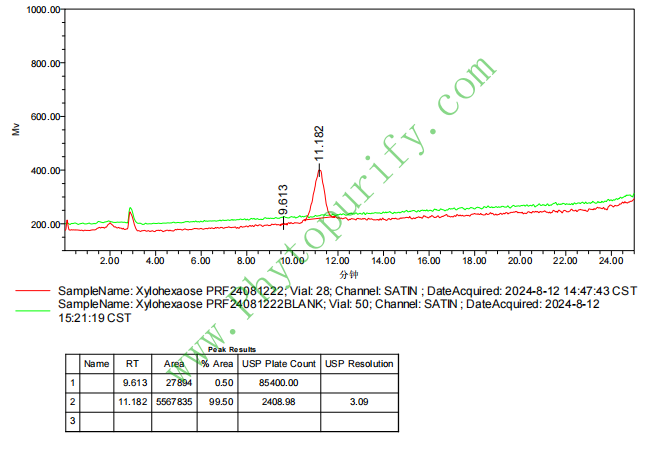
HPLC of Xylohexaose
Storage conditions:Short-term storage at 2~8℃, long-term storage at -20 ~ -80℃
392.5900
-3.7016
-3.7016
99.3179
.5146
.1579
Low
15.9430
6.1017
Yes
No
No
No
No
No
0.3
Yes
Yes
Yes
Yes
Xylohexaose is an oligomeric xylose formed by connecting six xylose residues through β -1,4-glycosidic bonds, and is an important member of the hydrolysis products of xylan. As a representative of natural polysaccharides, xylooligosaccharides have received widespread attention in the fields of natural product pharmacology and functional foods in recent years due to their unique structure and biological activity. Xylose is not only a standard substrate for determining the hydrolysis performance of xylan, but also a potential active substance for regulating intestinal microbiota, improving intestinal barrier function, and immune regulation due to its excellent prebiotic properties.
With the in-depth study of the relationship between gut microbiota and host health, prebiotics, as an important factor in regulating gut microbiota balance, have gradually clarified their mechanisms of action and molecular targets. Xylose exerts multi-level regulatory functions by activating gut associated pattern recognition receptors (such as TLR2, TLR4), regulating the expression of mucosal barrier proteins (such as MUC2, OCLN, ZO1, CLDN1), and promoting short chain fatty acid receptor (GPR41, GPR43) signaling pathways. In addition, the promoting effect of xylooligosaccharides on probiotic communities such as Bifidobacterium provides a theoretical basis for its use as a functional food ingredient and adjuvant therapy for intestinal diseases.
This article provides a systematic review of the chemical structure and physicochemical properties, plant sources, and extraction methods of xylooligosaccharides. It focuses on analyzing their pharmacological activity and mechanism of action, evaluating their pharmacological properties and pharmacokinetic characteristics, and exploring their potential and future development directions in clinical applications. The aim is to provide scientific basis and reference for the pharmacological research of natural products and the development of functional foods.
Xylose molecules are linearly connected by six xylose units through β -1,4-glycosidic bonds, with a molecular formula of C30H52O30 and a molecular weight of 810.7050. Its structural characteristics determine its high hydrophilicity and large polar surface area (TPSA of 392.5900 Å ²), making it highly soluble in water (99.3179 mg/mL), which facilitates intestinal absorption and bioavailability after oral administration.
The LogP value of xylooligosaccharides is -3.7016, indicating that their lipophilicity is extremely low, making it difficult to pass through lipid bilayer membranes, and their blood-brain barrier permeability is low, which limits their direct action in the central nervous system. Its molecular structure is stable and does not possess hERG channel inhibitory activity, demonstrating good cardiac safety. The Ames test result is 0.3, indicating no significant mutagenicity and high safety.
Xylose has stable chemical properties and good heat resistance, but it is easily hydrolyzed by intestinal specific enzyme systems (such as xylanase), releasing short chain xylose oligosaccharides and xylose monomers, thereby exerting its prebiotic effect. Its multi hydroxyl structure provides multiple binding sites for interaction with gut microbiota and host receptors, which is an important basis for its biological activity.
Xylose mainly comes from the polysaccharides in plant cell walls, especially abundant in grasses (such as corn, wheat, oats) and broad-leaved trees (such as birch and poplar). Xyloglycans, as one of the main components of plant cell walls, endow plants with mechanical strength and stress resistance. By enzymatic or acid hydrolysis of xylan, different degrees of polymerization of xylose oligosaccharides can be obtained, among which xylooligosaccharides are typical medium chain oligosaccharides.
Raw material pretreatment
Select plant raw materials rich in xylan, and undergo pretreatment steps such as crushing, degreasing, and protein removal to remove non polysaccharide impurities.
Enzymatic hydrolysis
Using specific xylanases (such as endoxylanase and exoxylanase) to hydrolyze xylan under mild conditions, controlling reaction time and enzyme dosage to obtain oligomers mainly composed of xylooligosaccharides. Enzymatic hydrolysis has the advantages of high selectivity, good product purity, and environmental friendliness.
Acid hydrolysis method
The hydrolysis of xylan using dilute acid (such as dilute hydrochloric acid) under high temperature conditions requires strict reaction conditions and a wide distribution of products, which require further purification.
Purification and Separation
Xylohexose was separated and purified by membrane separation technology (ultrafiltration, nanofiltration), ion exchange chromatography, gel permeation chromatography and other methods. High performance liquid chromatography (HPLC) and mass spectrometry (MS) techniques are used for product identification and purity analysis.
At present, enzymatic hydrolysis combined with modern separation technology is the mainstream method for industrial preparation of xylooligosaccharides, which can ensure the high purity and biological activity of the product.
As a functional oligosaccharide, xylooligosaccharides mainly exhibit significant prebiotic activity, which can regulate intestinal microbiota balance, enhance intestinal barrier function, regulate immune response, and thus have a positive impact on various intestinal related diseases.
Xylose can selectively promote the growth of probiotics such as Bifidobacterium, enhance their metabolic activity, and promote the production of short chain fatty acids (SCFAs) such as acetic acid, propionic acid, and butyric acid. SCFAs, as important regulatory factors of the intestinal microenvironment, participate in regulating intestinal pH, inhibiting pathogen growth, promoting energy metabolism of intestinal epithelial cells, and immune regulation.
Xylose enhances the thickness and integrity of the intestinal mucosal barrier by upregulating the expression of MUC2, a major component of the intestinal mucus layer. At the same time, xylooligosaccharides promote the expression of tight junction proteins OCTN (Occludin), ZO1 (Zonula Occludens-1), and CLDN1 (Claudin-1), repair and maintain tight junctions between intestinal epithelial cells, reduce intestinal permeability, and prevent harmful substances and inflammatory factors from penetrating the intestinal wall.
Xylose activates the pattern recognition receptors TLR2 and TLR4 on the surface of intestinal epithelial cells and immune cells, regulates downstream signaling pathways, promotes the secretion of anti-inflammatory factor IL-22, and enhances the intestinal mucosal immune barrier. IL-22 plays a crucial role in maintaining intestinal epithelial cell homeostasis, promoting tissue repair, and antimicrobial defense.
Xylose activates short chain fatty acid receptors GPR41 and GPR43, regulates lipid metabolism and energy balance, and has potential anti obesity and metabolic syndrome prevention and treatment effects. In addition, by regulating the gut microbiota, xylose indirectly affects the host's metabolic status and improves insulin sensitivity.
The biological effects of xylooligosaccharides depend on their interactions with various molecular targets, mainly involving intestinal microbiota regulation, immune signaling, and barrier function maintenance.
As pattern recognition receptors, TLR2 and TLR4 recognize xylose and its metabolites, activate the nuclear factor kappa B (NF - κ B) and MAPK signaling pathways, regulate inflammatory responses and immune tolerance. Moderate TLR activation induced by xylose helps maintain intestinal immune homeostasis and prevent excessive inflammation.
Xylose promotes the secretion of MUC2 by intestinal goblet cells, enhances the physical barrier function of the mucus layer, and prevents pathogen adhesion and invasion.
Xylose enhances the tight junctions between intestinal epithelial cells, reduces intestinal permeability, and prevents endotoxins and inflammatory factors from entering the bloodstream by regulating the expression and localization of these proteins.
IL-22 is an important cytokine for intestinal epithelial cell repair and antibacterial defense. Xylose regulates the secretion of IL-22 by immune cells, promotes the proliferation and repair of intestinal epithelial cells, and enhances barrier function.
These two G protein coupled receptors are receptors for short chain fatty acids. Xylose promotes the generation of SCFAs, activates GPR41/GPR43, regulates energy metabolism, inflammatory response, and intestinal hormone secretion.
Xylose, as a prebiotic, selectively promotes the growth of bifidobacteria communities, improves the structure of gut microbiota, and enhances microbial homeostasis.
In summary, xylooligosaccharides exert their prebiotic and intestinal protective functions through multi-target and multi pathway synergistic effects.
The molecular weight of xylooligosaccharides is 810.7050, which belongs to the category of medium molecular weight polysaccharides. Its LogP value is -3.7016, indicating its strong hydrophilicity. A high TPSA value (392.5900 Å ²) and high water solubility (99.3179 mg/mL) are beneficial for the dissolution and intestinal distribution of oral formulations, but limit their transmembrane absorption capacity.
Xylose does not have hERG channel inhibitory effect, indicating its good cardiac safety. The Ames test result is 0.3, indicating no significant mutagenic risk and high safety.
Due to its high hydrophilicity and macromolecular properties, xylooligosaccharides mainly exert their effects in the intestine after oral administration, and are difficult to be absorbed by intestinal epithelial cells into the systemic circulation. Its metabolism mainly relies on enzymatic hydrolysis by gut microbiota, producing short chain xylose and xylose monomers, which are further utilized by gut microbiota.
Xylose is difficult to cross the blood-brain barrier, limiting its direct action in the central nervous system. Its excretion pathway is mainly feces, with a short half-life in the body and low bioavailability.
In summary, xylooligosaccharides are suitable as prebiotic functional ingredients for intestinal targeting. Systemic pharmacokinetics limit their potential as systemic drugs, but their safety and targeting advantages are significant.
With the continuous revelation of the association between intestinal health and systemic diseases, xylooligosaccharides have broad clinical application prospects as a new type of prebiotic.
Xylose is expected to be used as an adjuvant therapy for inflammatory bowel disease (IBD), irritable bowel syndrome (IBS) and other diseases by regulating gut microbiota, enhancing intestinal barrier function and immune regulation, improving symptoms and promoting intestinal repair.
By activating the GPR41/GPR43 signaling pathway, xylose can regulate lipid metabolism and energy balance, and has potential anti obesity, insulin resistance improvement, and metabolic syndrome effects.
Xylose, as a natural oligosaccharide, has high safety and is suitable as a functional food additive to promote intestinal health, enhance immune function, and improve digestive system health.
Xylose regulates TLR signaling and IL-22 secretion, with the potential to enhance the body's immune defense, prevent intestinal infections and inflammatory reactions.
Xylose, as a structurally clear and functionally diverse oligosaccharides, has shown great research and application value in the fields of natural product pharmacology and functional foods. Its excellent probiotic activity, intestinal barrier protection, and immune regulatory function provide new ideas for the prevention and treatment of intestinal diseases. Despite its limited systemic absorption, it has significant advantages as an intestinal targeting agent and good safety.
In the future, with the deepening of molecular mechanisms and the advancement of clinical verification, xylooligosaccharides are expected to become an important natural product for intestinal health management and related disease adjuvant therapy, contributing new natural drug resources and functional food ingredients to human health.
