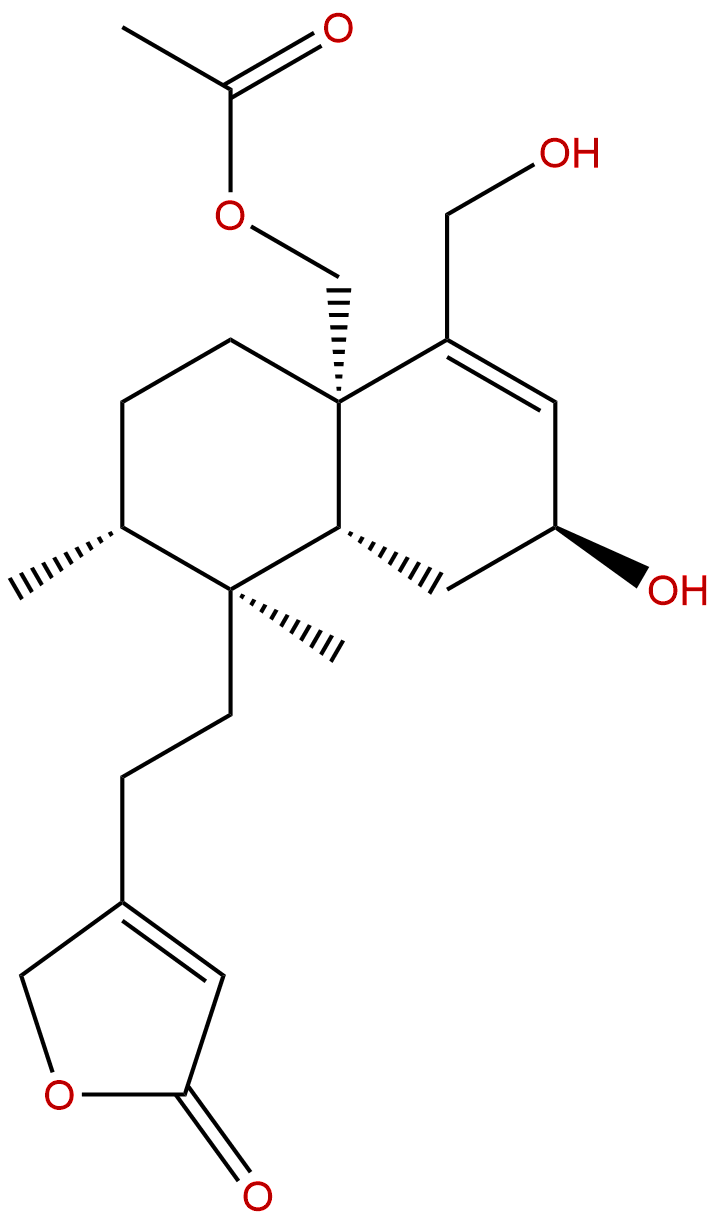
Artemisinin: an antimalarial diterpenoid lactone derived from Artemisia annua
1. Overview
Blinin is a natural diterpenoid lactone compound with significant biological activity. Its CAS number is 125675-09-4, molecular formula is C22H32O6, and molecular weight is approximately 392.49 g/mol. This compound was originally derived from Asteraceae plants Artemisia indica It was isolated from the middle and its English name Blinin comes from its early isolated plant Conyza blinii (now mostly classified in the genus Artemisia). In the fields of natural product chemistry and drug discovery, artemisinin has attracted attention due to its unique chemical structure and potential antimalarial activity. Malaria is a major global infectious disease caused by malaria parasite infection. Despite the great success of artemisinin based combination therapies (ACTs), the emergence of malaria parasite resistance has made the search for new antimalarial drugs urgent. In this context, exploring new antimalarial lead compounds from traditional medicinal plants has become an important strategy. As a compound isolated from Artemisia plants with traditional anti malaria properties, the study of artemisinin provides new candidate molecules and chemical frameworks for the development of anti malaria drugs, which has important scientific significance and application prospects.
2. Chemical structure and physicochemical properties
Artemisia annua belongs to the class of diterpenoid lactones, whose molecular skeleton consists of four isoprene units and contains a lactone ring structure. Its SMILES string (CC (=O) OC [C @ @] 12CC C@@HC@(CCC3=CC(=O)OC3)[C@H]1CC@H C=C2CO accurately describes its atomic connection sequence and stereochemical configuration, indicating that the molecule has multiple chiral centers and its biological activity is likely closely related to its specific spatial conformation.
From the analysis of medicinal parameters, the molecular weight (MW) of artemisinin is 392.49, slightly higher than the recommended upper limit of 500 Da in Lipinski's Rule of Five, but still within an acceptable range, especially for natural products. Its lipid water partition coefficient (LogP) is 2.20, indicating that the compound has moderate lipophilicity, which is beneficial for its penetration into cell membranes. The topological polar surface area (TPSA) is 93.06 Å ², and it is generally believed that compounds with TPSA less than 140 Å ² have good membrane permeability, which is consistent with artemisinin. Its water solubility parameter is 0.1319 (usually measured in mg/mL or mol/L, indicating low solubility), which is consistent with the moderate lipophilicity reflected by the LogP value. Combining LogP and TPSA, artemisinin exhibits a good membrane permeability foundation, which provides favorable physicochemical conditions for its intracellular anti malaria activity.
3. Plant sources and traditional applications
The main plant source of artemisinin is Artemisia indica Also known as Indian wormwood. Artemisia plants are widely distributed around the world, and many species have a long history of application in traditional medical systems. The most famous example is Artemisia annua Artemisinin extracted from it has saved the lives of millions of malaria patients and won the Nobel Prize in Physiology or Medicine.
Artemisia annua (A. indica) is also used in folk medicine in many regions of Asia to treat fever, malaria, inflammation, and digestive system diseases. Its application history suggests that the plant may contain multiple secondary metabolites with anti malarial and anti-inflammatory activities. The discovery of artemisinin is a typical example of modern pharmacy searching for active ingredients from traditional medicinal plants. Through biologically active directed separation, researchers identified a specific compound, artemisinin, from the extract of Artemisia annua and linked its activity to traditional plant uses. This research path from tradition to modernity not only validates the empirical wisdom of traditional medicine, but also provides valuable chemical entities for new drug development.
4. Pharmacological activity and mechanism of action
The most notable pharmacological activity of artemisinin is its against malaria Potential. According to database information, the action of artemisinin involves multiple malaria parasite targets, suggesting that it may have a multi-target mechanism of action that can help delay or overcome the development of drug resistance. The following is an analysis of known targets and their roles in the life activities of malaria parasites:
-
PFCRT(Plasmodium falciparum Chloroquine Resistance Transporter)This is an important drug transporter protein in Plasmodium falciparum, located on the digestive vacuole membrane of the parasite. The emergence of chloroquine resistance is related to specific mutations in the PFCRT protein, which cause the drug to be "pumped" out of the vacuole, reducing its concentration. If artemisinin can act on PFCRT, it may interfere with this resistance mechanism or affect the ion balance and function of vacuoles, thereby killing malaria parasites.
-
PFDHFR(Plasmodium falciparum Dihydrofolate Reductase)Dihydrofolate reductase is a key enzyme in the folate synthesis pathway, which is crucial for DNA synthesis and cell proliferation in malaria parasites. The classic antimalarial drugs ethambutol and sulfadoxine ethambutol compound preparations exert their effects by inhibiting this enzyme. If artemisinin is a PFDHFR inhibitor, it can exert anti proliferative effects by blocking the nucleic acid metabolism of malaria parasites.
-
PFK13(Kelch13 Protein)K13 protein is a key molecular marker of artemisinin resistance. The mutation is directly related to the decreased sensitivity of malaria parasites to artemisinin. K13 protein is involved in various cellular processes, including protein degradation and endoplasmic reticulum stress response. The action of artemisinin on PFK13 may indicate a certain correlation or difference in its mechanism of action with artemisinin, which has important research value for addressing artemisinin resistance.
-
PFATP6(Plasmodium falciparum Ca²⁺-ATPase 6)This is a calcium ion transport ATPase responsible for maintaining the homeostasis of calcium ions within cells. Some studies suggest that one of the main targets of artemisinin and its derivatives is PFATP6, which interferes with calcium ion signaling by inhibiting its activity, leading to parasite death. If artemisinin can also target PFATP6, it may have a pathway of action similar to artemisinin.
-
PFCYTBC (speculated to be a target related to cytochrome bc ₁ complex)Cytochrome bc ₁ complex is a key component of the mitochondrial electron transport chain in malaria parasites, involved in energy (ATP) generation. Atorvaquinone and other antimalarial drugs exert their effects by inhibiting this complex. Targeting this complex with artemisinin means that it may produce a killing effect by disrupting the energy metabolism of malaria parasites.
Hypothesis of mechanism of action Artemisia annua may be a Multi targeted antimalarial agents The lactone ring and multiple oxygen-containing functional groups in its molecular structure may enable it to interact with key sites of multiple target proteins mentioned above. For example, it may be activated by iron or heme in the parasite like artemisinin, producing free radicals that covalently bind to proteins such as PFATP6 and inhibit their function; Meanwhile, its molecules may also directly competitively inhibit the activity of PFDHFR or PFCRT. This multi pronged mode of action makes it difficult for malaria parasites to develop resistance through mutations in a single target, thus giving them a unique advantage in developing new antimalarial drugs. Of course, the above target information is mostly based on database predictions or preliminary research tips. The specific binding mode, inhibition constant (Ki), and contribution weight of each target in the overall efficacy still need to be verified through in-depth biochemical and cell biology experiments.
5. Evaluation of drug properties
Based on the provided pharmacokinetic parameters, we can conduct a preliminary evaluation of the development potential of artemisinin as an oral antimalarial drug, combined with the famous Lipinski's Five Rules Conduct analysis:
Comprehensive Assessment Artemisia annua has shown promising prospects in oral absorption, membrane permeability, and cardiac safety, and its high BBB penetration may be beneficial for the treatment of cerebral malaria. However, its potential hepatotoxic signals are one of the main obstacles to advancing its development. In addition, its synthesis accessibility (SyneAccess: 4.8567, a lower value may indicate greater synthesis difficulty) is also a challenge, which may depend on plant extraction or complex total synthesis.
6. Research Status and Application Prospects
At present, research on artemisinin is still mainly in progress Preclinical discovery and validation stage The existing data has clarified its source, chemical structure, preliminary in vitro antimalarial activity, and multi-target action characteristics. The basic physicochemical properties that comply with the rules of generic drugs have laid the foundation for its further development.
However, there is still a lot of work to be done urgently to push it into clinical applications:
1. Deep analysis of the mechanism of action Direct interactions and specific mechanisms with targets such as PFCRT and PFK13 need to be confirmed through techniques such as gene knockout, isothermal titration calorimetry (ITC), X-ray crystallography, or cryo electron microscopy.
2. Pharmacodynamic evaluation in vivo It is necessary to systematically evaluate the efficacy, optimal dosing regimen, and synergistic effect with existing drugs in malaria infected mouse or non-human primate models.
3. Comprehensive security evaluation It is necessary to conduct in-depth exploration of its suggested hepatotoxicity, determine the range of toxic doses, reversibility, and mechanisms. Simultaneously conduct preclinical toxicology studies on the system (acute toxicity, chronic toxicity, reproductive toxicity, etc.).
4. Drug metabolism and pharmacokinetics research Clarify its absorption, distribution, metabolism, and excretion processes in the body, identify the main metabolites, and evaluate whether there is a risk of drug drug interactions.
5. Chemical optimization and formulation development If natural artemisinin has defects (such as hepatotoxicity and difficult synthesis), structural modifications can be made to optimize its activity, reduce toxicity, and improve its pharmacokinetic properties. Simultaneously developing suitable formulations to enhance bioavailability.
Application Prospects If the above challenges are overcome, artemisinin is expected to be developed into a novel multi-target antimalarial drug. It can be used as a monotherapy for malaria resistant to existing drugs (including artemisinin), or as a new component in combination therapy. Its high BBB penetration may have unique value in the treatment of severe cerebral malaria. In addition, the study of the mechanism of action of artemisinin itself can enhance our understanding of the biology and drug resistance mechanisms of malaria parasites, bringing new scientific insights to the field of anti malaria.
In short, artemisinin, as a natural product excavated from traditional medicinal plants, demonstrates the strong vitality of combining modern drug development with traditional medical wisdom. Despite the long road ahead, it undoubtedly provides a hopeful new direction for the fight against malaria, an ancient and stubborn disease.