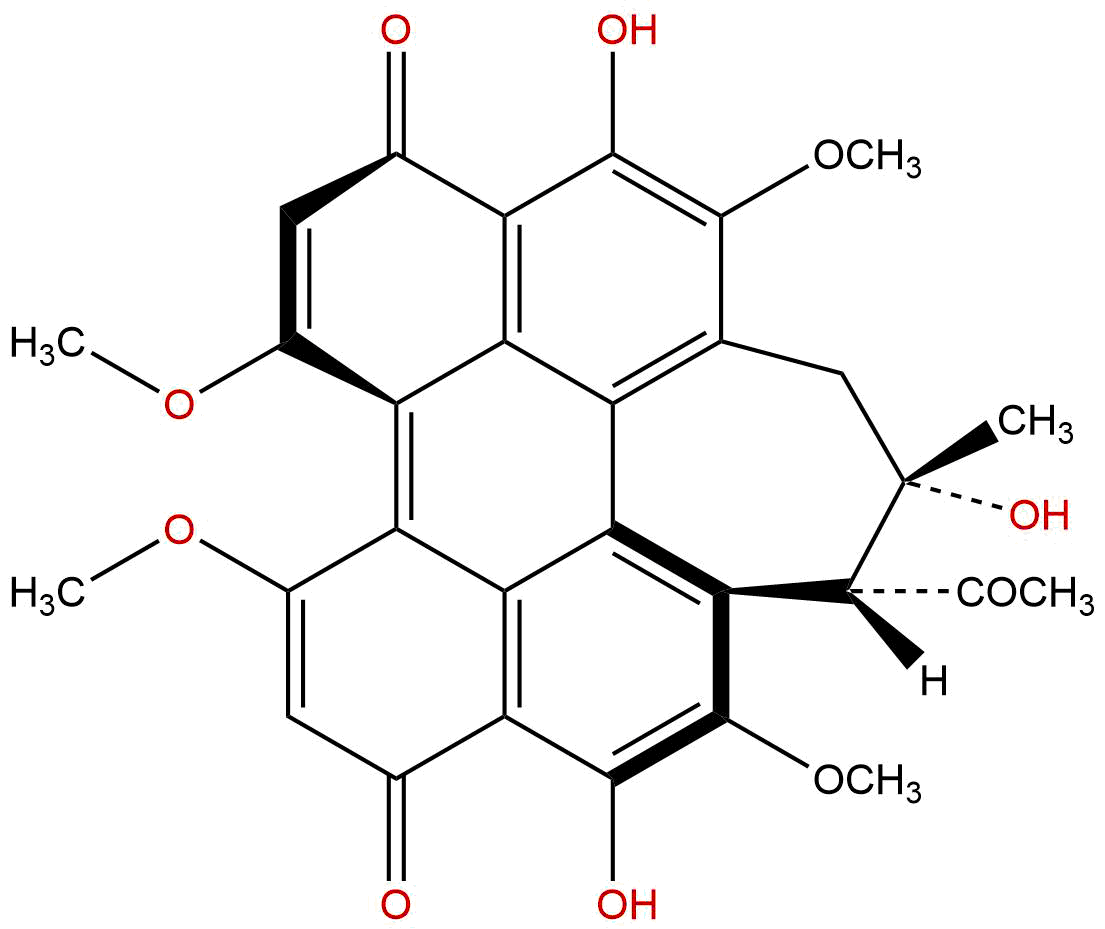


Product name: hypocrellin A
Synonym name:
Catalogue No.: BP0754
Cas No.: 77029-83-5
Formula: C30H26O10
Mol Weight: 546.528
Botanical Source: Hypocrella bambusae (Berk. et Br.) Sacc
Physical Description:
Type of Compound: Anthraquinones
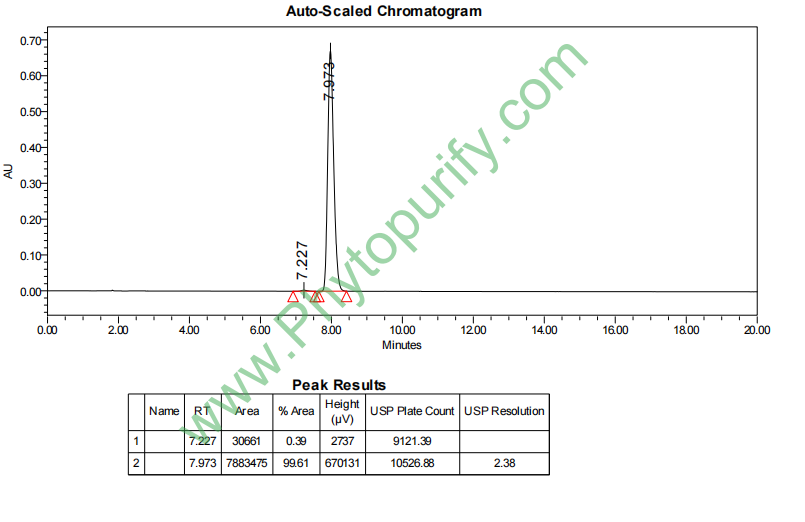
Purity: 95%~99%
Analysis Method: HPLC-DAD or/and HPLC-ELSD
Identification Method: Mass, NMR
Packing: Brown vial or HDPE plastic bottle
Storage: Store in a well closed container, protected from air and light. Put into refrigerate or freeze for long term storage.
Whenever possible, you should prepare and use solutions on the same day. However, if you need to make up stock solutions in advance, we recommend that you store the solution as aliquots in tightly sealed vials at -20℃. Generally, these will be useable for up to two weeks.
The product could be supplied from milligrams to grams
Inquire for bulk scale.
Description:
Hypocrellin A, an a natural perylene quinine photosensitizers (PSs), can chelate with heavy metal ions, including Au(III) and Pt(IV), to form a 1:2 complex. Hypocrellin A has light-induced antitumor,antifungal and antiviral activities, it also exerts immunomodulatory effects on MHC-restricted presentation of antigen.
References:
Bioorg Med Chem Lett. 2013 Oct 1;23(19):5317-24.
Internal heavy atom effect of Au(III) and Pt(IV) on hypocrellin A for enhanced in vitro photodynamic therapy of cancer.
METHODS AND RESULTS:
Hypocrellin A (HA), an a natural perylene quinine photosensitizers (PSs), can chelate with heavy metal ions, including Au(III) and Pt(IV), to form a 1:2 complex, which exhibits enhanced (1)O2 generation quantum yield through the increased intersystem crossing efficiency mediated by internal heavy atom effect. Besides, the chelate process greatly improved the water solubility of HA.
CONCLUSIONS:
Comparative studies with HA and complexes have demonstrated that the heavy-atom effect on HA molecules enhances the efficiency of in vitro photodynamic (PDT) efficacy.
Nanoscale. 2013 Dec 7;5(23):11910-8.
A new near infrared photosensitizing nanoplatform containing blue-emitting up-conversion nanoparticles and hypocrellin A for photodynamic therapy of cancer cells.
The utilization of up-conversion nanoparticles (UCNPs) for photodynamic therapy (PDT) has gained significant interest due to their unique ability to convert near infrared light to UV/visible light. Previous work mainly focused on the fabrication of green and red emitting UCNPs to load photosensitizers (PSs) for PDT.
METHODS AND RESULTS:
In this work, we firstly developed a new multifunctional nanoplatform combining blue-emitting UCNPs with blue-light excited PS (Hypocrellin A, HA) as a NIR photosensitizing nanoplatform for PDT of cancer cells. Tween 20 coated NaYbF4:Tm, Gd@NaGdF4 UCNPs (Tween 20-UCNPs) with strong blue up-conversion luminescence and good water dispersibility were prepared for use as PS carriers. The blue emission band matched well with the efficient absorption band of HA, thereby facilitating the resonance energy transfer from UCNPs to HA and then activating HA to produce singlet oxygen ((1)O2).
CONCLUSIONS:
The in vitro study showed that these Tween 20-UCNPs@HA complexes could efficiently produce (1)O2 to kill cancer cells under 980 nm NIR excitation. Moreover, these Gd(3+) and Yb(3+) containing nanoparticles also exhibited positive contrast effects in both T1 weighted magnetic resonance imaging (MRI) and computed tomography (CT) imaging, making them become a multifunctional platform for simultaneous PDT and bio-imaging.
Immune Netw. 2011 Dec;11(6):412-5.
Immunomodulatory Effects of Hypocrellin A on MHC-restricted Antigen Processing.
Hypocrellin A has gained much attention in recent years due to its light-induced antitumor, antifungal and antiviral activities.
METHODS AND RESULTS:
Here we report that Hypocrellin A exerts immunomodulatory effects on MHC-restricted presentation of antigen. Hypocrellin A inhibited class II-MHC restricted presentation of exogenous antigen, but not class I MHC-restricted presentation of exogenous antigen, in dendritic cells. Hypocrellin A also inhibited the cytosolic pathway of endogenous antigen presentation. However, Hypocrellin Adid not inhibit the expression of class I and class II MHC molecules on dendritic cells (DCs), the phagocytic activity of DCs, or the H-2K(b)-restricted presentation of a synthetic peptide, SIINFEKL.
CONCLUSIONS:
These results show that Hypocrellin A differentially modulates the MHC-restricted antigen presentation pathways.
HPLC of hypocrellin A
Storage conditions:Short-term storage at 2~8℃, long-term storage at -20 ~ -80℃
Hypocrellin A (CAS number: 77029-83-5) is a natural product derived from the genus Hypocrellin, which has attracted much attention due to its unique photosensitive activity and multiple pharmacological effects. As a typical photodynamic therapy (PDT) photosensitizer, Caryophyllin A exhibits significant biological activity in anti-cancer, antibacterial, antiviral (especially against human immunodeficiency virus, HIV) and other fields. In addition, recent studies have found that it has the potential to regulate glucose metabolism and fight diabetes, mainly by inhibiting protein kinase C (PKC) and reversing the expression of endothelin (ET-1) induced by high glucose. Bamboo red fungus A also showed strong inhibitory activity against Leishmania parasites (IC50=0.27 μ g/ml), indicating its potential application value in anti parasitic infections. This article provides a systematic review of the chemical structure and physicochemical properties, sources and extraction methods, pharmacological activity and mechanism of action, pharmacological evaluation, and clinical application prospects of Caryophyllin A. The aim is to provide a theoretical basis and research direction for its further drug development and clinical translation.
Zhuhongjunsu A is a natural naphthoquinone product with a molecular formula of C30H22O10 and a molecular weight of 546.5280. Its chemical structure consists of two naphthoquinone units connected by a divalent oxygen bridge, forming a polycyclic naphthoquinone derivative skeleton with abundant hydroxyl and ketone functional groups. This structure endows Rhododendron A with strong photosensitivity, which can generate singlet oxygen and other reactive oxygen species under specific wavelength light irradiation, leading to cellular oxidative damage.
In terms of physical and chemical properties, the LogP value of Caryophyllin A is 3.0339, indicating that it has moderate lipid solubility, which is beneficial for cell membrane penetration. However, its water solubility is poor (about 0.0018 mg/mL), which limits its solubility and bioavailability in aqueous phase. Its topological polar surface area (TPSA) is 148.82 Å ², indicating a high molecular polarity that may affect its transmembrane absorption. The low permeability of the blood-brain barrier suggests its limited distribution in the central nervous system. The hERG channel inhibition test was negative, indicating a low risk of cardiac toxicity from Caryophyllin A. The Ames test result is 0.9, indicating a low risk of genetic toxicity and meeting safety requirements.
Caryophyllin A mainly comes from fungi of the Caryophyllum genus, especially Hypocrella bambusae and Shiraia bambusicola. These fungi grow on the dead branches or leaves of bamboo plants and belong to parasitic or saprophytic fungi. The natural yield of Caryophyllin A is relatively low, which limits its large-scale application. Therefore, the development of efficient extraction and purification methods is crucial.
Traditional extraction methods typically use organic solvents such as ethanol, methanol, or ethyl acetate for extraction, combined with ultrasound assisted extraction or Soxhlet extraction techniques to improve extraction efficiency. The extraction solution was purified through multiple steps such as silica gel column chromatography and reverse phase high performance liquid chromatography (RP-HPLC) to obtain high-purity Caryophyllin A. In recent years, microbial fermentation technology and genetic engineering methods have been introduced to improve the yield and production stability of Caryophyllin A. In addition, chemical synthesis and semi synthesis methods are also being explored, but due to their complex structures, long synthetic routes, and high costs, industrial production has not yet been achieved.
As a protein kinase C (PKC) inhibitor, hypocrellin A shows potential value in the prevention and treatment of diabetes and its complications. Under high glucose conditions, the expression of endothelin (ET-1) is abnormally elevated, leading to vascular constriction, inflammatory response, and endothelial dysfunction. Hypocrellin A shows good anti diabetic activity by inhibiting PKC activity, reversing the expression of ET-1 induced by high glucose, improving endothelial function, alleviating diabetes related vascular diseases.
Hypocrellin A shows significant anti-cancer effects in many tumor models, especially in the field of breast cancer. Its anti-cancer mechanism involves multiple signaling pathways and molecular targets, including:
In addition, as a photosensitizer, Caryophyllin A induces oxidative damage and apoptosis of tumor cells in photodynamic therapy by generating reactive oxygen species through photoexcitation, thereby enhancing the therapeutic effect.
Bamboo red fungus A exhibits inhibitory effects on various bacteria, especially on Gram positive bacteria and some Gram negative bacteria. Its antibacterial mechanism mainly relies on the destruction of bacterial cell membranes and nucleic acids by reactive oxygen species generated by photodynamic therapy.
In terms of antiviral activity, Caryophyllin A exhibits significant photosensitive killing activity against human immunodeficiency virus (HIV). Through PDT, Caryophyllin A can destroy the viral envelope and inhibit viral replication, demonstrating its potential as an anti HIV photosensitizer.
Leishmania infection is an important parasitic disease worldwide, and Caryophyllin A exhibits potent inhibitory effects on Leishmania with an IC50 of only 0.27 μ g/ml. This activity provides new ideas for the development of novel antiparasitic drugs, especially in the context of increasingly severe drug resistance.
The multiple pharmacological activities of Zhuhongjunsu A are attributed to its complex mechanism of action and multi-target regulatory ability. Its core mechanism of action includes:
PKC inhibitory effect It can directly inhibit the activity of protein kinase C (PKC), regulate cell signal transduction, reverse the pathological state induced by high glucose, and improve endothelial function and diabetes related complications.
Photosensitive activity Under specific wavelength light irradiation, Caryophyllin A stimulates the production of singlet oxygen and free radicals, inducing cellular oxidative stress and disrupting the structure and function of tumor cells and pathogenic microorganisms.
Signal pathway regulation Regulating key molecules such as AMPK, STAT3, BCL2, etc., affecting cell metabolism, proliferation, and apoptosis processes, inhibiting tumor growth and drug resistance.
Multidrug resistance protein inhibition Inhibiting the functions of ABCB1 and ABCG2, reversing multidrug resistance in tumor cells, and improving the efficacy of chemotherapy drugs.
Inhibition of matrix degrading enzymes Inhibit MMP2 activity and reduce the invasion and metastasis ability of tumor cells.
immunomodulation By regulating immune related kinases such as LCK, it affects the function of immune cells in the tumor microenvironment and enhances anti-tumor immune response.
The pharmacological properties of Zhuhongjunsu A are challenging, mainly due to its extremely low water solubility (0.0018 mg/mL), which limits its bioavailability for oral and intravenous administration. Its LogP value is 3.0339, indicating good lipid solubility and facilitating membrane penetration, but high polarity (TPSA=148.82 Å ²) may affect its transmembrane absorption and distribution.
The low permeability of the blood-brain barrier suggests limited efficacy in the central nervous system, but it also reduces the risk of central nervous system toxicity. HERG channel inhibition is negative, indicating a low risk of cardiac toxicity and good safety. The Ames test results are close to negative, indicating a low risk of genetic toxicity.
In terms of pharmacokinetics, the metabolic pathway of Caryophyllin A in vivo has not been fully elucidated, but its phenolic hydroxyl and quinone groups may undergo redox reactions and binding metabolism through the liver enzyme system. Due to poor water solubility, drug carrier systems such as liposomes and nanoparticles have been widely studied to improve their in vivo distribution and stability.
Bamboo red fungus A, as a multifunctional natural product, has a wide range of clinical application potential:
Application of Photodynamic Therapy As a photosensitizer, hypocrellin A shows excellent effects in tumor treatment (such as breast cancer, skin cancer) and virus infection treatment. In the future, targeted delivery systems and novel light source technologies can be combined to enhance treatment selectivity and safety.
Development of anti diabetes drugs By regulating the expression of PKC and ET-1, hypocrellin A is expected to become a new therapeutic drug against diabetes and its vascular complications. Further in vivo efficacy evaluation and preclinical safety studies are needed.
Antiparasitic Agents The efficient inhibitory activity against Leishmania parasites provides new ideas for the treatment of parasitic diseases, especially in the face of increasingly severe drug resistance.
Antibacterial and antiviral drugs The photobactericidal and antiviral properties of hypocrellin A provide a new strategy for the treatment of infectious diseases, especially for refractory viruses such as HIV.
Future research should focus on addressing the drug delivery and bioavailability issues of Caryophyllin A, optimizing dosage form design, conducting systematic pharmacokinetic and toxicological evaluations, and verifying its safety and efficacy through multi center clinical trials. In addition, combining modern molecular biology and medicinal chemistry techniques to explore its structural modifications and derivative development will help enhance its clinical application value.
As a natural product with multiple pharmacological activities, hypocrellin A, with its unique chemical structure and photosensitive properties, shows broad application prospects in many fields such as anti-cancer, anti diabetes, antibacterial, anti-virus and anti parasite. Although there are certain limitations to its pharmacological properties, it is expected to overcome these obstacles and achieve clinical translation through modern drug formulation technology and molecular modification methods. In the future, in-depth exploration of its mechanism of action, optimization of drug delivery systems, and clinical research will promote the development of Caryophyllin as an important model for natural product drug development, providing new solutions for the treatment of related diseases.
