


Product name: D-Pinitol
Synonym name: 3-O-Methyl-D-chiro-inositol; Matezitol; Sennitol; Cathartomannitol
Catalogue No.: BP0515
Cas No.: 10284-63-6
Formula: C7H14O6
Mol Weight: 194.183
Botanical Source: Widely distributed in plants. Produced on a large scale from the heartwood of Pinus lambertiana
Physical Description: Powder
Type of Compound: Miscellaneous
Purity: 95%~99%
Analysis Method: HPLC-DAD or/and HPLC-ELSD
Identification Method: Mass, NMR
Packing: Brown vial or HDPE plastic bottle
Storage: Store in a well closed container, protected from air and light. Put into refrigerate or freeze for long term storage.
Whenever possible, you should prepare and use solutions on the same day. However, if you need to make up stock solutions in advance, we recommend that you store the solution as aliquots in tightly sealed vials at -20℃. Generally, these will be useable for up to two weeks.
The product could be supplied from milligrams to grams, up to kilograms
Inquire for bulk scale.
Descriptions:
D-Pinitol is azole nucleoside analogue, as potential antitumor agents; it reduces the migration and the invasion of prostate cancer cells (PC3 and DU145) at noncytotoxic concentrations, reduces mRNA and cell surface expression of αvβ3 integrin, exerts its inhibitory effects by reducing focal adhesion kinase (FAK) phosphorylation, c-Src kinase activity and NF-kB activation; thus, D-pinitol may be a novel anti-metastasis agent for the treatment of prostate cancer metastasis.[1,2]
D-Pinitol has hepatoprotective effects by attenuating hyperglycaemia-mediated pro-inflammatory cytokines and oxidative stress.[3]
D-Pinitol and myo-inositol stimulate translocation of glucose transporter 4 in skeletal muscle of C57BL/6 mice, they have the potential to prevent diabetes mellitus by reducing the postprandial blood glucose level and stimulating GLUT4 translocation in the skeletal muscle.[4]
D-Pinitol significantly inhibits the proliferation of MCF-7 cells in a concentration-dependent manner, while upregulating the expression of p53, Bax and down regulating Bcl-2 and NF-kB, thus, D-pinitol induces apotosis in MCF-7 cells through regulation of proteins of pro- and anti-apoptotic cascades.[5]
D-Pinitol efficiently attenuates the hazardous consequences of the environmental carcinogen 7,12-DMBA through modulating cell surface glycoproteins, membrane protective role both in lysosomal and ATPase compartment via its antioxidant nature which ultimately results in the findings of future innovative remedies for genotoxin mediated hazards.[6]
References:
[1] Tianrong Z, Hongxiang L. Carbohyd Res, 2007, 342(6):865-9.
[2] Lin T H, Tan T W, Tsai T H, et al. Int J Mol Sci, 2013, 14(5):9790-802.
[3] Sivakumar S, Palsamy P, Subramanian S P. Free Radical Res, 2010, 44(6):668-78.
[4] Dang N T, Mukai R, Yoshida K, et al. Biosci Biotech Biochem, 2010, 74(5):1062-7.
[5] Rengarajan T, Nandakumar N, Rajendran P, et al. Asian Pac J Cancer P, 2014, 15(4):1757-62.
[6] Rengarajan T, Nandakumar N, Balasubramanian M P. J Exp Ther Oncol, 2012, 10(1):39-49.
[7] Ling C, Jian H, Yang L V, et al. Chinese Journal of Experimental Traditional Medical Formulae, 2011, 17(5):80-2.
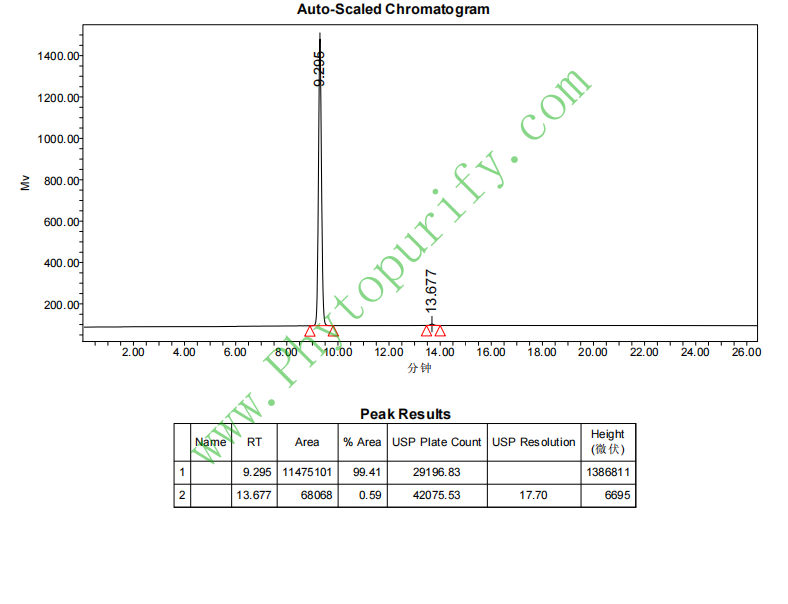
HPLC of D-Pinitol
Storage conditions:Short-term storage at 2~8℃, long-term storage at -20 ~ -80℃
D-Pinitol (CAS number: 10284-63-6), also known as 3-O-methyl-D-cloinositol, is a natural cyclic polyol compound widely found in pine and legume plants. As a natural product with multiple biological activities, D-sitol has attracted widespread attention in the field of natural product pharmacology in recent years due to its significant hypoglycemic and cardiovascular protective effects. In addition, D-sitol also exhibits antiviral and larval killing activities, demonstrating its potential multi-target pharmacological value. This article reviews the chemical structure and physicochemical properties, plant sources, and extraction methods of D-sitol. It systematically evaluates its pharmacological activity and mechanism of action, explores its pharmacological properties and pharmacokinetic characteristics, and looks forward to its clinical application prospects, providing theoretical basis and practical guidance for subsequent research and development.
The molecular formula of D-sitol is C7H14O6, with a molecular weight of 194.1830. Its structure is 3-O-methyl-D-chilositol, which is a cyclic hexahydroxy alcohol derivative with high polarity. Its LogP value is -2.0723, indicating that D-sitol has strong hydrophilicity and a water solubility of 391.0067 mg/mL, demonstrating good water solubility. The polar surface area (TPSA) is 110.38 Å ², indicating that the molecule has more hydrogen bond donors and acceptors, which is conducive to binding with biomolecules. The low permeability of the blood-brain barrier indicates its limited ability to penetrate the central nervous system. The hERG channel inhibition test was negative, indicating a low risk of cardiac toxicity. The Ames mutagenicity test result was 0.0, indicating good genetic toxicity safety.
From a chemical structure perspective, the 3-O-methylation modification of D-sitol endows it with different biological activities compared to other inositol isomers, particularly exhibiting unique functions in regulating glucose metabolism and signal transduction. The multiple hydroxyl groups in its molecule not only enhance its water solubility, but also provide abundant hydrogen bonding sites for its binding with target proteins.
D-sitol naturally exists in various plants, especially in the Pinaceae and Fabaceae families. Common plants with high content include pine trees (Pinus spp.), soybeans (Glycine max), red beans (Vigna angularis), and other leguminous plants. D-sitol in plants mainly exists in free or bound form and is distributed in tissues such as seeds, leaves, and bark.
The traditional methods for extracting D-sitol mainly include water extraction and alcohol extraction. Generally, hot water or 70% -80% ethanol is used as the solvent, and the extraction is carried out by heating reflux or ultrasound assisted extraction. After concentration, centrifugation, and filtration, the extract is purified by column chromatography (such as silica gel column, ion exchange column) or high performance liquid chromatography (HPLC). In recent years, supercritical CO2 extraction and membrane separation technologies have also been applied to improve extraction efficiency and purity.
The optimization of extraction process mainly focuses on improving the recovery rate and purity of D-sitol, while reducing the interference of other polysaccharides and impurities in plants. Some studies have also attempted to efficiently prepare D-sitol from plant polysaccharides or inositol derivatives through biotransformation and enzymatic hydrolysis techniques, promoting its large-scale production.
The most well-known pharmacological activity of D-sitol is its significant hypoglycemic effect. Multiple in vitro and in vivo studies have shown that D-sitol can improve insulin resistance, promote glucose uptake and metabolism, and lower blood sugar levels. In the animal model of diabetes, oral or injection of D-pine can significantly reduce fasting blood glucose and glucose tolerance, and improve the function of pancreatic β cells.
Its hypoglycemic effect is not only reflected in the regulation of glucose metabolism, but also includes the improvement of lipid metabolism and the reduction of antioxidant stress, so as to alleviate the development of diabetes and its complications as a whole. Compared with traditional hypoglycemic drugs, D-sitol has fewer side effects and higher safety, demonstrating good potential for application.
D-sitol has multiple protective effects on the cardiovascular system, including antioxidant, anti-inflammatory, improvement of endothelial function, and regulation of blood lipids. Experimental studies have found that D-pine can reduce dyslipidemia, alleviate atherosclerosis, inhibit cardiomyocyte apoptosis, and improve myocardial ischemia reperfusion injury.
It has potential value as an adjuvant therapy for cardiovascular diseases by regulating multiple signaling pathways, reducing oxidative stress and inflammatory reactions, and protecting cardiovascular tissues from damage.
D-sitol also exhibits certain antiviral activity, which can inhibit the replication and infection process of various viruses. Related in vitro experiments have shown that D-sitol has inhibitory effects on certain RNA viruses and DNA viruses, and the mechanism may involve interfering with virus entry into cells and replication processes.
In addition, D-sitol also has a killing effect on certain agricultural pest larvae, demonstrating its potential application value in pesticide development.
The pharmacological effects of D-terpineol involve multiple signaling pathways and key molecular targets, especially in the field of anti diabetes, and its mechanism is relatively clear.
AMPK (5 'AMP activated protein kinase) is a key regulatory factor in cellular energy metabolism. D-sitol can activate AMPK (PRKAA1 subunit), promote glucose uptake and fatty acid oxidation, and improve insulin sensitivity. The activation of AMPK also inhibits hepatic gluconeogenesis and reduces blood glucose production.
D-sitol affects multiple proteins related to glucose transport and metabolism, including:
D-sitol regulates the expression of PPARG (peroxisome proliferator activated receptor gamma), promoting lipid metabolism and insulin sensitivity. It activates AKT1 (protein kinase B), promotes downstream signaling, regulates cell metabolism and survival.
D-sitol has a certain inhibitory effect on DPP4 (dipeptidyl peptidase 4), prolongs the half-life of glucagon like peptide-1 (GLP-1), promotes insulin secretion, and lowers blood sugar.
To sum up, D-terpineol achieves its comprehensive anti diabetes and cardiovascular protective effects through multi target and multi pathway synergistic effects.
The pharmacological evaluation of D-sitol shows that it has good safety and pharmacokinetic characteristics:
Pharmacokinetic studies have shown that D-sitol is rapidly absorbed after oral administration, with a moderate plasma half-life and mainly excreted through the kidneys. Its bioavailability is influenced by intestinal transporters and metabolic enzymes, and some studies have shown that it has a high affinity for binding to targets related to glucose metabolism, supporting its potential for oral drug development.
At present, the preclinical safety evaluation and toxicology research of D-sitol are relatively sufficient, but further systematic pharmacokinetic and clinical pharmacological studies are still needed to clarify its dosage range and long-term safety.
With the high incidence of diabetes and cardiovascular disease, it is urgent to develop safe and effective natural hypoglycemic and cardiovascular protective drugs. D-terpineol has become a strong candidate for natural anti diabetes drugs due to its multi-target mechanism and good safety.
The future clinical application prospects are mainly reflected in:
However, the clinical promotion of D-sitol still faces some challenges:
Future research should focus on in-depth analysis of its molecular mechanism of action, optimization of extraction and synthesis processes, and multi center clinical studies to promote the clinical translation of D-sitol.
D-sitol, as a naturally occurring 3-O-methyl-D-cloinositol, has shown great potential for drug development due to its significant hypoglycemic and cardiovascular protective activities. Its multi target and multi pathway mechanism provides a new strategy for the treatment of diabetes and related metabolic diseases. The good medicinal properties and safety make it a hot topic in the pharmacological research of natural products. In the future, with the deepening of pharmacokinetics and clinical research, D-terpineol is expected to become an important natural drug in the field of diabetes and cardiovascular disease treatment, contributing new strength to human health.
