


Product name: Taxifolin
Synonym name: (+)-Dihydroquercetin;(+)-Taxifolin; (+)-trans-Taxifolin;Distylin
Catalogue No.: BP1367
Cas No.: 480-18-2
Formula: C15H12O7
Mol Weight: 304.254
Botanical Source: Polygoni Orientalis Fructus
Physical Description:
Type of Compound: Flavonoids
Purity: 80%,90%,95%,98%
Analysis Method: HPLC-DAD
Identification Method: Mass, NMR
Packing: As per customer requirements
The product could be supplied from milligrams to grams, up to kilogram.
Inquire for bulk scale.
Chengdu Biopurify Phytochemicals Ltd. is a leading company in the research, development, manufacture and marketing of High Quality Phytochemicals and Extracts(especially Active Ingredients from Traditional Chinese Medicine,TCM), Natural Active Pharmaceutical Ingredients worldwide.
The main services:
A. Supply active ingredients and reference standards of TCM, from mgs to kgs scale
B. Custom extraction and purification, target Herb Active Ingredients
C. Custom synthesis and semi-synthesis for Natural Active Ingredients
D. CR(contract research), CM(contract manufacture) and PD(process development) services from lab scale, pilot scale to commercial scale(GMP is also available)
E. TCM compounds library for drug screen,more than 3000 compounds available, many of them are rare and unique.
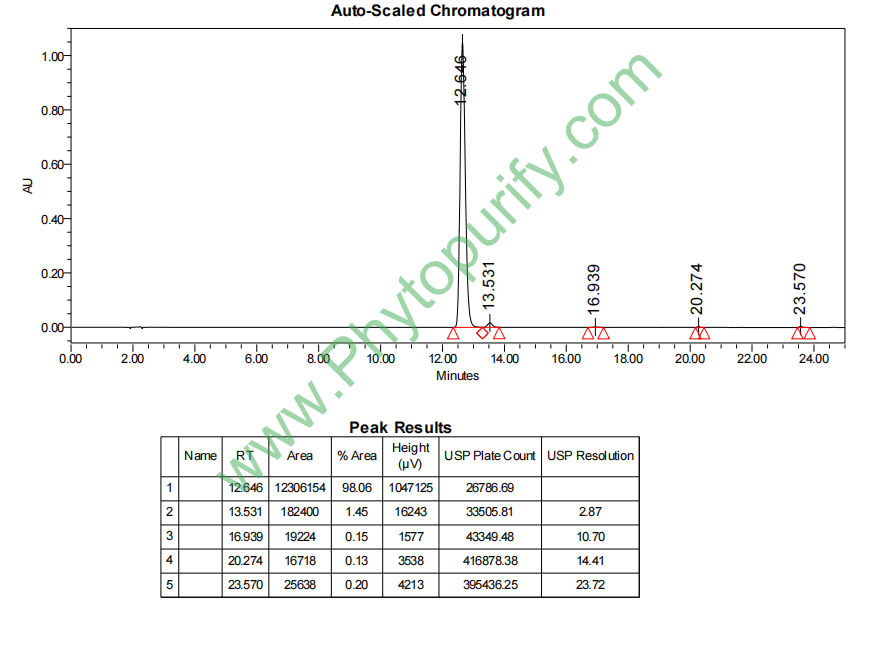
HPLC of Taxifolin
Storage conditions:Short-term storage at 2~8℃, long-term storage at -20 ~ -80℃
Taxifolin, also known as (+) - dihydroquercetin, is a natural flavonoid compound widely present in various plants, with significant biological activity and pharmacological potential. As an important natural product, anthocyanins have received widespread attention in the field of natural medicine research and development in recent years due to their excellent antioxidant, anti fibrotic, and anti tyrosinase activities. Its potential applications in anti-aging, anti-inflammatory, anti-tumor, and neuroprotection have made it a hot topic in pharmacological research. This article provides a systematic review of the chemical structure and physicochemical properties, plant sources and extraction methods, pharmacological activity and mechanism of action, pharmacological evaluation, and clinical application prospects of anthocyanins, aiming to provide theoretical basis and research direction for natural product pharmacology and related drug development.
The chemical name of anthocyanins is (+) - dihydroquercetin, with a molecular formula of C15H12O7, a molecular weight of 304.2540, and a CAS number of 480-18-2. Its structure belongs to the category of flavonols and has a typical tricyclic structure (C6-C3-C6), which includes two benzene rings (A and B rings) and one oxygen heterocyclic ring (C ring). Compared with quercetin, quercetin is saturated at the C2-C3 position and lacks double bonds, giving it stronger stability and unique biological activity.
In terms of physical and chemical properties, the LogP value of berberine is 1.0495, indicating its moderate lipid solubility, which is beneficial for membrane penetration. The topological polar surface area (TPSA) is 127.45 Å ², indicating high polarity and moderate water solubility (0.8136), which has a significant impact on its bioavailability and in vivo distribution. The low permeability of the blood-brain barrier suggests limited direct action in the central nervous system. The negative result of hERG channel inhibition experiment indicates a low risk of cardiac toxicity. The Ames test result is 1.2, indicating a low risk of genotoxicity and a good safety basis.
Anthocyanins are widely present in various plants, especially in the pine family (such as Pinus strobus), grapes (Vitis vinifera), onions (Allium cepa), and citrus fruits, where they are abundant. Its natural form of existence is mainly in the free or glycosidic bound state, and different plant sources and growth environments have a significant impact on its content.
The extraction methods mainly include solvent extraction, ultrasound assisted extraction, microwave-assisted extraction, and membrane separation technology. Traditional solvent extraction often uses ethanol, water, or their mixed solvents, and the extraction efficiency is greatly affected by temperature, time, and solvent polarity. Ultrasound assisted extraction has become one of the mainstream technologies due to its high efficiency and energy-saving characteristics, which can significantly improve the extraction rate of anthocyanins and shorten the time. In recent years, green extraction techniques such as supercritical CO2 extraction and enzyme assisted extraction have gradually been applied to the extraction of anthocyanins, improving the purity and stability of active ingredients.
After extraction, high performance liquid chromatography (HPLC), mass spectrometry (MS), and nuclear magnetic resonance (NMR) techniques are often used for purity identification and structural confirmation to ensure product quality and research accuracy.
As a natural free radical scavenger, anthocyanins have significant antioxidant capacity. The hydroxyl groups in its molecular structure can effectively capture reactive oxygen species (ROS) and free radicals, reducing oxidative stress damage to cells. Multiple in vitro and in vivo studies have shown that resveratrol can enhance the activity of endogenous antioxidant enzymes such as superoxide dismutase (SOD1) and catalase (CAT), activate the nuclear factor E2 related factor 2 (NRF2) signaling pathway, promote antioxidant gene expression, and protect cells from oxidative damage.
Flower flag pine extract has an important inhibitory effect on tyrosinase, which is a key enzyme in melanin synthesis. Inhibiting its activity helps to whiten and prevent pigmentation. In addition, berberine effectively inhibits collagenase with an IC50 of 193.3 μ M, which can slow down the degradation of collagen, protect the integrity of skin structure, and delay the process of skin aging.
Fibrosis is the pathological basis of various chronic diseases, such as liver fibrosis, pulmonary fibrosis, and renal fibrosis. Flower flag pine extract reduces tissue fibrosis by inhibiting the activation of fibroblasts and collagen deposition. Its mechanism of action involves regulating the transforming growth factor beta (TGF - β) signaling pathway, inhibiting the expression of fibrosis related genes, reducing inflammation and oxidative stress, and demonstrating good anti fibrotic potential.
The research on anthocyanins in the field of anti-aging is becoming increasingly in-depth. It activates key targets such as 5 'AMP activated protein kinase (AMPK), silencing information regulatory factor 1 (SIRT1), and telomerase reverse transcriptase (TERT) to regulate cellular energy metabolism, delay telomere shortening, promote autophagy, and delay the process of cellular aging. Meanwhile, resveratrol regulates tumor suppressor gene TP53, cell cycle regulator CDKN1A, and transcription factor FOXO1, promoting the maintenance of cellular homeostasis. In addition, it induces the expression of antioxidant enzyme HMOX1, enhances the cell's ability to resist oxidative damage, and comprehensively exerts anti-aging effects.
In addition to the above effects, resveratrol also exhibits various pharmacological activities such as anti-inflammatory, anti-tumor, neuroprotective, and cardiovascular protection. In the inflammatory model, berberine inhibits the NF - κ B signaling pathway, reduces the release of inflammatory factors, and alleviates tissue damage. It has the potential to inhibit proliferation and induce apoptosis in various tumor cells, demonstrating its anti-cancer value. In terms of neuroprotection, resveratrol reduces oxidative stress and inflammatory response, protects nerve cell survival, and improves cognitive function.
The multi-target mechanism of action of berberine is the basis for its broad pharmacological activity. Its main targets and signaling pathways include:
Overall, anthocyanins exhibit a wide range of biological effects through multi-target and multi pathway synergistic effects, regulating cell metabolism, antioxidation, preventing cell apoptosis and fibrosis.
The pharmacological parameters of anthocyanins indicate that they have good potential for drug development. The molecular weight of 304.2540 conforms to Lipinski's rule and is beneficial for oral absorption. A moderate LogP value (1.0495) indicates moderate lipid solubility, which is beneficial for in vivo distribution. The TPSA value of 127.45 is relatively high, indicating its strong polarity, which may limit cell membrane penetration and oral absorption rate, but also contribute to the balance between water solubility and bioavailability. Water solubility is 0.8136, supporting its dissolution and transport in the body.
The low permeability of the blood-brain barrier limits its direct action in the central nervous system, but also reduces the potential risk of central neurotoxicity. HERG channel inhibition is negative, reducing the risk of cardiac toxicity. The Ames test results showed a low risk of genotoxicity and good safety.
Pharmacokinetic studies have shown that berberine is absorbed quickly after oral administration, with a moderate plasma half-life. It is mainly metabolized through the liver, and the metabolites are mostly sulfate and gluconic acid complexes. Its bioavailability is limited by first pass effects and intestinal metabolism, and the development of novel drug delivery systems such as nanocarriers and liposomes is expected to improve its pharmacokinetic properties.
Huaqisongsu has broad clinical application prospects due to its multiple pharmacological activities, especially in the fields of antioxidant, anti fibrotic, and anti-aging potential. In the field of dermatology, as tyrosinase inhibitor and collagenase inhibitor, Douglas fir can be developed into whitening anti-aging skin care products and drugs for the treatment of pigmentation. In liver and lung fibrosis diseases, berberine is expected to become an adjuvant therapy drug by inhibiting the fibrosis process.
In addition, the protective effects of resveratrol in neurodegenerative diseases, cardiovascular diseases, and metabolic syndrome have made it a candidate drug for multi-target therapy. In the future, combining modern drug delivery technology and structural modification is expected to enhance its bioavailability and targeting, and promote clinical translation.
However, the clinical research on berberine is still relatively limited, and there is an urgent need for systematic clinical trials to verify its safety and effectiveness. Meanwhile, in-depth analysis of its mechanism of action and metabolic pathways will provide scientific basis for its drug development.
As an important natural flavonoid compound, anthocyanins have shown extensive pharmacological potential and good medicinal properties due to their excellent antioxidant, anti fibrotic, and anti-aging activities. Its multi-target and multi pathway mechanism of action provides new ideas for the prevention and treatment of various chronic diseases. In the future, combining modern medicinal chemistry and drug delivery technology, berberine is expected to become an important candidate for the development of natural product drugs. The clinical research and mechanism exploration of the system will be the key to promoting its clinical application. In summary, anthocyanins have important research value and application prospects in the field of natural product pharmacology.
