Introduction/Overview
Paclitaxel, as a star natural product isolated from Taxus plants, has profoundly changed the clinical treatment pattern of various malignant tumors since the late 20th century due to its excellent anti microtubule protein activity and broad-spectrum anti-tumor efficacy. It has become one of the cornerstone drugs in the field of tumor chemotherapy. However, the poor solubility, drug resistance, and certain toxic side effects of paclitaxel itself have prompted researchers to continuously explore its structural analogues in order to discover more advantageous candidate drugs. 2 '- Acetyl paclitaxel (CAS: 92950-40-8) is one of the important paclitaxel derivatives that has received attention in this context. This compound introduces an acetyl group on the C-2 'hydroxyl group of the paclitaxel core structure, which may seem like a minor modification but may have a significant impact on its physicochemical properties, biological activity, and pharmacokinetic behavior. This article aims to systematically review the chemical properties, plant sources, pharmacological activities, mechanisms of action, pharmacological evaluation, and clinical application potential of 2 '- acetyl paclitaxel, in order to provide comprehensive academic references for the in-depth research and development of this compound.
Chemical structure and physicochemical properties
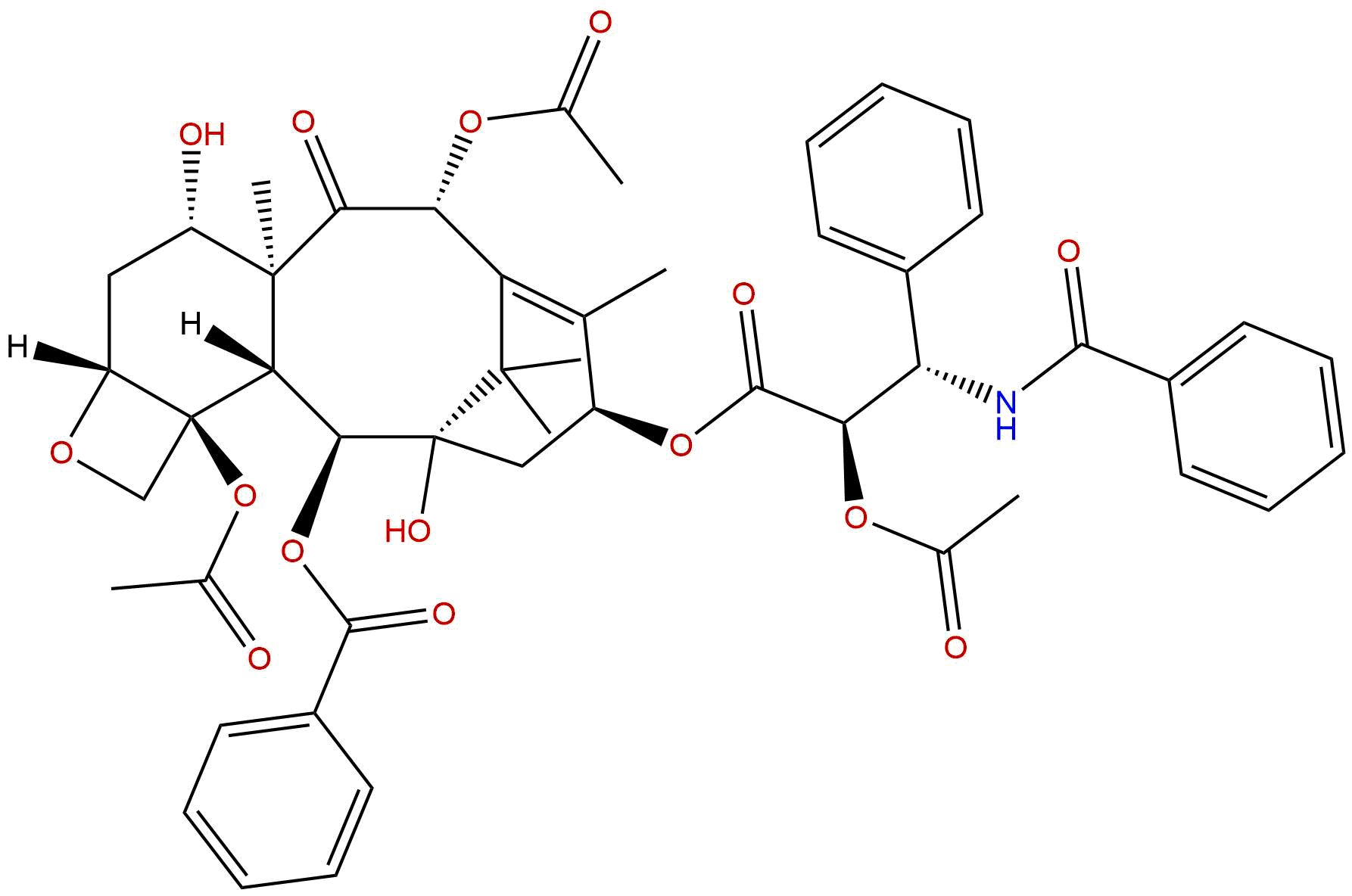
The molecular formula of 2 '- acetyl paclitaxel is C ₄₇ H ₅₁ NO ₁₅, with a molecular weight of 895.9550 Da. Its core structure is the same as paclitaxel, both of which are highly oxidized tetracyclic diterpenoid taxane skeletons, containing a unique [9.3.1.0 ³, ⁸] fifteen carbon tetracyclic system and a quaternary oxetane ring (D ring), which plays a crucial role in stabilizing microtubules. The difference between 2 '- acetyl paclitaxel and paclitaxel (with a free hydroxyl group at C-2') is that 2 '- acetyl paclitaxel forms an acetyl ester (- OCOCH ∝) on the hydroxyl group at C-2' on the side chain. This structural modification directly affects its physicochemical parameters.
According to the calculated or experimentally measured parameters related to drug properties, its lipid water partition coefficient (LogP) is about 3.4840, indicating moderate lipophilicity, slightly higher than paclitaxel (LogP of about 3.0), mainly due to the introduction of acetyl groups increasing the hydrophobicity of the molecule. The topologically polar surface area (TPSA) is 227.3600 Å ², reflecting the presence of multiple hydrogen bond acceptor and donor sites in the molecule with high polarity. Its predicted water solubility is extremely low, about 0.0019 mg/mL, similar to paclitaxel, indicating that it also faces solubility challenges in formulation development, usually requiring the use of surfactants (such as polyoxyethylene castor oil) or delivery systems such as albumin nanoparticles. The ability of this compound to penetrate the blood-brain barrier is predicted to be 'low', which is consistent with its larger molecular weight and higher polar surface area, suggesting that it may not be suitable for the treatment of primary brain tumors. In the early toxicity warning indicators, its hERG channel inhibition potential is "no", reducing the possibility of causing QT interval prolongation in the heart; The Ames test result is 0.0, indicating that there is no direct genetic toxicity risk, but further in vitro and in vivo experiments are needed for verification.
Plant sources and extraction methods
2 '- Acetyl paclitaxel is not the main component in Taxus chinensis plants, but exists as a trace component associated with paclitaxel. It is mainly isolated from the bark, branches, leaves, or cell cultures of plants such as Taxus brevifolia, Taxus yunnanensis, Taxus cuspidata, and cultivated Taxus media. Its content is usually much lower than paclitaxel, which increases the difficulty and economic cost of its direct natural extraction.
The extraction method usually follows the general process of taxane compounds. Firstly, extract or percolate the dried and crushed plant materials using methanol, ethanol, or a mixture of methanol and dichloromethane solvents. After the crude extract is concentrated under reduced pressure, it is preliminarily purified using liquid-liquid partitioning (usually between the aqueous phase and dichloromethane or ethyl acetate). Subsequently, the key step in obtaining the compound is to perform multiple separations and purifications using normal or reverse phase silica gel column chromatography. The commonly used elution systems include gradient elution of dichloromethane methanol, n-hexane ethyl acetate, etc. Due to the close polarity between 2 '- acetyl paclitaxel and paclitaxel and other structurally similar compounds (such as 10 deacetylpaclitaxel, sophocarpine, etc.), separation is difficult and often requires the combination of high-performance liquid chromatography (HPLC), especially preparative or semi preparative HPLC, using C18 reverse phase chromatography columns and methanol water or acetonitrile water as mobile phases for fine separation to obtain high-purity monomer compounds. In recent years, preparative chromatography techniques such as high-speed countercurrent chromatography have also been applied to the separation of structurally similar compounds. In addition, the selective C-2 'acetylation reaction using 10 deacetylbaccatin III (10-DAB III) or paclitaxel itself with relatively high content as starting materials through chemical semi synthesis is also an important pathway to obtain 2' - acetyl paclitaxel, providing a more reliable material basis for pharmacological research.
Pharmacological activity research
The core pharmacological activity of 2 '- acetyl paclitaxel is consistent with paclitaxel, which has strong anti proliferative and anti-tumor effects, but its activity intensity spectrum may vary due to structural modifications.
-
In vitro anti-tumor activity Numerous in vitro cytotoxicity tests have shown that 2 '- acetyl paclitaxel exhibits significant inhibitory activity against various human tumor cell lines. Its half inhibitory concentration (IC ≮₀) on ovarian cancer (such as A2780, SK-OV-3), breast cancer (such as MCF-7, MDA-MB-231), lung cancer (such as A549, NCI-H460), prostate cancer (such as PC-3), and drug-resistant cell lines (such as tumor cells overexpressing P-glycoprotein) is generally at the level of nM, which is equivalent to or slightly different from the activity of paclitaxel. Some studies have pointed out that in certain cell models, its activity may be slightly lower than paclitaxel, which may be related to the introduction of acetyl groups affecting the binding of drugs to cell membranes or intracellular transport efficiency. However, there are also studies reporting comparable or even superior activity in specific cell lines, which may be related to differences in cell types and drug metabolism enzyme expression profiles.
-
In vivo anti-tumor activity In animal models of transplanted tumor (such as mouse models of breast cancer, ovarian cancer and lung cancer), 2 '- acetylpaclitaxel can usually inhibit tumor growth in a dose-dependent manner and prolong the survival period of model animals. The comparison results of its efficacy with the paclitaxel control group are inconsistent. Some studies have shown that its anti-tumor efficacy is similar to paclitaxel, but its toxic side effects (such as weight loss and bone marrow suppression) may exhibit different characteristics or degrees. Due to its potential conversion to paclitaxel through deacetylation metabolism in the body, its active component may be attributed to itself and partially to its metabolites.
-
Other potential activities In addition to the classic anti microtubule effect, some preliminary studies suggest that taxane compounds may have anti angiogenic and immunogenic cell death inducing effects. As a derivative of paclitaxel, further research is needed to confirm whether 2 '- acetyl paclitaxel possesses these additional activities and its strength.
Mechanism of action and molecular targets
The mechanism of action of 2 '- acetyl paclitaxel is highly similar to paclitaxel, and its primary and clear molecular target is microtubule proteins in cells.
-
Microtubule stabilization effect Like paclitaxel, 2 '- acetyl paclitaxel can specifically bind to a site near the N-terminal 31st amino acid (arginine) of β - tubulin, located on the inner side of microtubules. After binding, it promotes the polymerization of microtubule protein dimers into microtubules through conformational effects, and abnormally stabilizes the formed microtubules, inhibiting their normal dynamic depolymerization process. This' excessive stability 'disrupts the normal functions of microtubule networks in cell mitosis, organelle transport, and cell morphology maintenance.
-
Cell cycle arrest and apoptosis induction The core function is to interfere with mitosis. Stable microtubules are unable to form functional spindles, leading to the inability of chromosomes to separate properly and causing the cell cycle to stagnate in the G2/M phase. This sustained M-phase blockade ultimately triggers multiple apoptotic signaling pathways, including mitochondrial pathways (cytochrome c release, caspase-9/3 activation) and death receptor pathways, leading to programmed cell death of tumor cells.
-
Possible effects of structural modifications on mechanisms The introduction of C-2 'acetyl group may have subtle effects on its mechanism of action from the following aspects:a) Affinity for binding to microtubule proteins The C-2 'side chain is an important region for the interaction between paclitaxel and microtubule binding pocket. Acetylation may slightly alter the conformation or hydrogen bonding ability of the side chain, which may affect its binding constant (Kd) with the target.b) Cell uptake and efflux The increase in lipophilicity may affect the efficiency of passive transmembrane diffusion. More importantly, this modification may alter its interaction with drug efflux pumps (such as P-glycoprotein, P-gp). Paclitaxel is a substrate of P-gp, and its resistance is often associated with this. Whether 2 '- acetyl paclitaxel is still a highly efficient substrate for P-gp and whether its efflux rate is different from paclitaxel are key factors in evaluating its potential to overcome multidrug resistance.c) Metabolic stability The C-2 'acetyl ester bond may be hydrolyzed by carboxylesterase in vivo to produce paclitaxel. Therefore, its in vivo effect may be the result of the joint contribution of the prototype drug and metabolites, and the duration of its efficacy may be related to the metabolic rate.
Evaluation of drug properties and pharmacokinetics
The pharmacological evaluation of 2 '- acetyl paclitaxel needs to be based on its physicochemical properties and preliminary pharmacokinetic (PK) studies.
-
Absorption and distribution The extremely low water solubility determines its extremely poor oral bioavailability and must be administered via intravenous route. In vivo, similar to paclitaxel, it may highly bind to plasma proteins (mainly albumin and alpha 1-acid glycoprotein). Its distribution volume may be large, but the specific tissue distribution characteristics, especially the accumulation in tumor tissue, are not fully studied. The predicted low blood-brain barrier permeability limits its application in central nervous system tumors.
-
Metabolism and excretion Metabolism is the core link of its PK behavior. The acetyl ester bond at C-2 'position is the main metabolic site, which may be hydrolyzed by carboxylesterases in the liver, plasma, and certain tissues to produce the active metabolite paclitaxel. In addition, it may also undergo hydroxylation metabolism mediated by the liver cytochrome P450 enzyme system (especially CYP2C8 and CYP3A4) like paclitaxel, generating multiple hydroxylated metabolites. Therefore, its internal exposure is the sum of the original drug and metabolites such as paclitaxel. The main excretion pathways may be through bile and feces, with a relatively small proportion excreted through the kidneys. Its metabolic clearance rate may be faster, and its half-life may be shorter than paclitaxel (paclitaxel has a longer terminal half-life, partly due to its nonlinear PK), but specific parameters need to be determined experimentally.
-
Formulation Challenge Compared to Taxol Injection ®) The development of 2 '- acetyl paclitaxel formulations also faces the same challenges as using polyoxyethylene castor oil and ethanol as solubilizers. Polyethylene castor oil may cause serious allergic reactions and requires pre-treatment. Therefore, developing new delivery systems such as albumin bound nanoparticles (similar to Abraxane) ®)、 Liposomes, polymer micelles, etc. are inevitable directions to improve their solubility, enhance tumor targeting, and reduce toxic side effects.
-
Preliminary Safety Assessment Based on its mechanism of action, the expected toxicity profile is similar to paclitaxel, including dose limiting bone marrow suppression (neutropenia), peripheral neurotoxicity, hair loss, muscle and joint pain, and possible allergic reactions. HERG inhibition of negative prediction reduces the risk of cardiac toxicity, but the specific maximum tolerated dose (MTD) and toxicological characteristics need to be elucidated through systematic preclinical toxicology studies (acute toxicity, long-term toxicity, reproductive toxicity, etc.).
Clinical application prospects and prospects
The clinical application prospects of 2 '- acetyl paclitaxel need to be viewed rationally, and its development value may be reflected in the following aspects:
-
As a prodrug of paclitaxel Given that it can be converted into paclitaxel in the body, it can be considered as a precursor drug of paclitaxel. The prodrug strategy may alter the PK behavior of the drug, for example, higher lipid solubility may alter its tissue distribution or affect its efficiency in being excreted by P-gp, which may demonstrate advantages in certain drug-resistant tumor models. However, whether it is more clinically beneficial than directly using paclitaxel requires rigorous head to head comparative studies.
-
Exploring the potential to overcome drug resistance One of the research focuses is its activity against paclitaxel resistant cells, especially P-gp overexpressing cells. If it is confirmed that it is not a highly efficient substrate for P-gp or has a low affinity for P-gp, it may become a new option to overcome paclitaxel resistance. This requires in-depth in vitro transporter experiments and validation of drug-resistant animal models.
-
Candidate molecules for the development of new formulations As a member of the taxane family, it is a potential candidate drug for developing novel nano formulations such as albumin bound and polymer micelle types. By overcoming the problem of poor solubility through formulation technology and targeting tumors using enhanced permeability and retention (EPR) effects, better therapeutic efficacy and safety may be achieved.
-
Components of combination therapy Combining with other chemotherapy drugs (such as platinum and anthracycline), targeted drugs, or immune checkpoint inhibitors to explore synergistic anti-tumor effects is one of its possible clinical application scenarios.
However, its development also faces significant challenges:a) Limited natural sources It relies on semi synthesis, and cost control is key.b) Compared with the marketed paclitaxel and its various improved formulations (such as albumin paclitaxel and docetaxel), it is necessary to demonstrate clear differentiation advantages Otherwise, it will be difficult to establish a foothold in the fierce market competition, such as better efficacy, lower toxicity, overcoming drug resistance, and more convenient administration.c) Requires significant investment of resources for complete preclinical development and clinical trials The risk is relatively high.
Therefore, future research should focus on elucidating its unique PK/PD characteristics; Validate its advantages in precise drug resistance models; Developing new dosage forms with clinical differentiation using modern formulation technology; And explore its potential new targets or signaling pathway regulatory mechanisms that are different from paclitaxel.
Conclusion
2 '- Acetyl paclitaxel, as a C-2' acetylated derivative of paclitaxel, inherits the anti microtubule mechanism of taxane compounds and exhibits significant in vitro and in vivo anti-tumor activity. Its subtle structural modifications have brought about changes in physicochemical properties and may potentially affect its pharmacokinetic behavior, interactions with resistance related proteins, and metabolic fate. At present, this compound is mainly used as an important tool molecule and candidate for studying the structure-activity relationship of paclitaxel, exploring strategies to overcome paclitaxel resistance, and developing novel paclitaxel prodrugs or formulations. Although it faces dual challenges from existing paclitaxel drugs and the need to prove its unique value on its direct path to clinical practice, through in-depth mechanism of action research, rational dosage form design, and precise clinical positioning exploration, 2 '- acetyl paclitaxel still has the potential to find a place in the field of anti-tumor drug development, providing new possibilities for enriching the arsenal of cancer treatments. The continuous and in-depth research on it not only helps to understand the scientific connotation of taxane drugs, but also reflects the unremitting pursuit of optimizing the structure of natural products to explore their maximum potential.