


Product name: Roburic Acid
Synonym name:
Catalogue No.: BP1218
Cas No.: 6812-81-3
Formula: C30H48O2
Mol Weight: 440.712
Botanical Source: oak galls produced by Cynips mayri and Gentiana macrophylla
Physical Description: White powder
Type of Compound: Triterpenoids
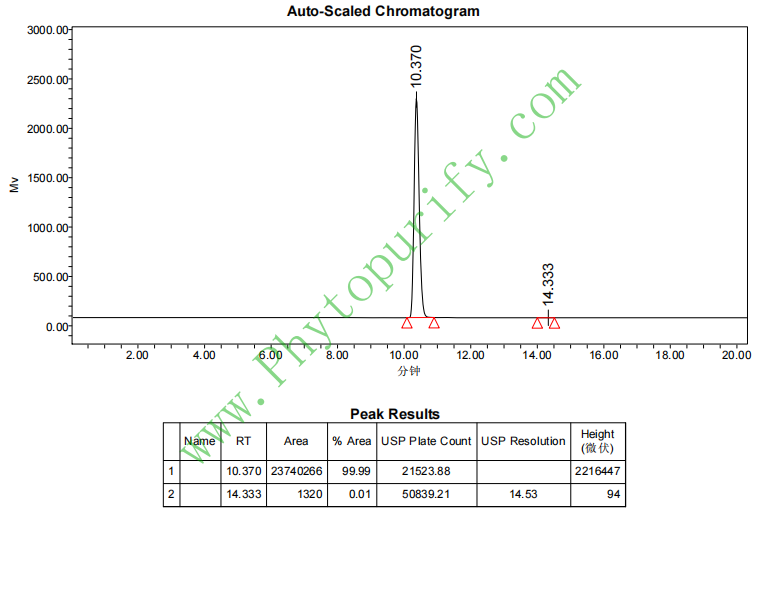
Purity: 95%~99%
Analysis Method: HPLC-DAD or/and HPLC-ELSD
Identification Method: Mass, NMR
Packing: Brown vial or HDPE plastic bottle
Storage: Store in a well closed container, protected from air and light. Put into refrigerate or freeze for long term storage.
Whenever possible, you should prepare and use solutions on the same day. However, if you need to make up stock solutions in advance, we recommend that you store the solution as aliquots in tightly sealed vials at -20℃. Generally, these will be useable for up to two weeks.
The product could be supplied from milligrams to grams, up to kilograms
Inquire for bulk scale.
Descriptions:
Roburic acid is a new triterpene 3,4-seco-acid from Section Cruciata of Gentiana.[1,2]
References:
[1] Wu L H, Bligh S W A, Leon C J, et al. Biochem Syst Ecol, 2012, 43(8):152–5.
[2] Mangoni L, Belardini M. Tetrahedron Lett, 1963, 4(14):921-4.
[3] Wang Y Y, Zhao Z L, Wu RJ, et al. Identification of traditional Chinese medicine Chinese Medical Association Conference, 2008.
HPLC of Roburic Acid
Storage conditions:Short-term storage at 2~8℃, long-term storage at -20 ~ -80℃
37.3000
7.8839
5.7861
.0016
6.8941
6.9672
High
94.4766
4.8184
No
No
No
No
No
No
0.0
No
No
Yes
No
In the broad field of natural product chemistry and pharmacology research, triterpenoids have attracted much attention due to their structural diversity and extensive biological activities. Roburic acid (CAS number: 6812-81-3), as a pentacyclic triterpenoid acid with significant biological activity, is gradually emerging from numerous natural products and becoming an emerging focus in the research fields of inflammation, tumors, and bone metabolism diseases. It was initially isolated from the bark or galls of various Quercus plants, and traditionally these plant extracts are commonly used in folk medicine for anti-inflammatory and astringent purposes. Modern pharmacological research has revealed that quercetin not only exhibits clear anti-inflammatory and anti-tumor activities, but also specifically inhibits osteoclastogenesis, providing a solid scientific basis for its treatment of chronic inflammatory diseases, cancer, osteoporosis and other bone resorption diseases. Its multi-target action characteristics, especially its ability to regulate key inflammatory mediators such as tumor necrosis factor (TNF) and cyclooxygenase (COX), make its mechanism of action research profound and inspiring. This article aims to provide a systematic review of the chemical properties, plant sources, pharmacological activities, molecular mechanisms of action, pharmacological potential, and clinical application prospects of quercetin, in order to provide comprehensive references for the in-depth research and development of this compound.
Quercetin acid is a Lupane type pentacyclic triterpenoid compound. Its basic skeleton is composed of five fused rings (four hexagonal rings and one pentagonal ring), with a molecular formula of C30H48O3 and a molecular weight of 440.7120. Its structural feature is that it is usually connected to a hydroxyl or carbonyl group at the C-3 position (the specific configuration depends on the isomer), and to a carboxyl group at the C-17 position, which is why it exhibits acidity and is named "acid". The common oak gall acid usually refers to 3-hydroxylupine-20 (29) - ene-28-oic acid or its analogues.
Based on its provided pharmacological parameters, oak gall acid exhibits typical lipophilic natural product characteristics. Its calculated lipid water partition coefficient (LogP) is as high as 7.8839, indicating that the compound has strong lipophilicity and tends to be distributed in a lipid environment. Consistent with this, its water solubility is extremely low, only 0.0016 mg/mL, which poses the primary challenge for its formulation development. The topologically polar surface area (TPSA) is 37.3 Å ², which is a relatively small value, further confirming its low molecular polarity. These physicochemical properties determine the distribution behavior of quercetin in organisms: it is predicted to have a high blood-brain barrier permeability, which provides potential for the treatment of central nervous system related inflammation or tumors. In terms of preliminary safety evaluation, the data shows that it has no hERG potassium channel inhibitory activity (hERG inhibition: No), indicating a low risk of causing QT interval prolongation in the heart; The Ames test result is 0.0, which preliminarily indicates that there is no mutagenicity under the testing conditions, providing a favorable safety starting point for its further development.
Quercus gallic acid is widely present in various plants of the Quercus genus in the Fagaceae family, especially in the bark, leaves, and galls formed by insect parasitism of Quercus acutissima, Quercus variabilis, and Quercus robur. Galls are abnormal proliferative structures produced by plant tissues stimulated by specific insects, often rich in defensive secondary metabolites, making them an important resource for obtaining quercetin. In addition, there have been isolated reports in certain plants of the Rosaceae family, such as the European Sichuan pepper (Sorbus aucuparia).
The extraction of quercetin from plant materials mainly depends on its lipophilicity and acidity. The conventional extraction process is as follows:
1. Raw material pretreatment and extraction Crush the dried plant bark or galls, and use organic solvents for extraction or reflux extraction. Common solvents include methanol, ethanol, acetone, or their mixed solvents with water to maximize the extraction range of triterpenoid components. Modern technologies such as ultrasound assisted extraction and microwave-assisted extraction can effectively improve extraction efficiency and shorten time.
2. Coarse separation and enrichment The extract is concentrated under reduced pressure to obtain a paste. Due to the carboxyl group of oak gall acid, it can be preliminarily enriched by alkali soluble acid precipitation method: disperse the extract in water, adjust the pH to alkaline with dilute alkali (such as sodium hydroxide or sodium bicarbonate solution), dissolve the acidic components into salts, filter out insoluble impurities, and then acidify with dilute acid (such as hydrochloric acid) to make oak gall acid and other acidic components precipitate again, collect by centrifugation or filtration.
3. Fine separation and purification The obtained acidic sites are further separated and purified by column chromatography technology. Silica gel column chromatography is commonly used to gradually separate using gradient elution systems such as petroleum ether ethyl acetate or chloroform methanol. Reverse phase silica gel (such as C18) column chromatography and preparative high-performance liquid chromatography (HPLC) are key steps for obtaining high-purity quercetin. Its purity can be identified by thin-layer chromatography (TLC), high-performance liquid chromatography ultraviolet detection (HPLC-UV), and mass spectrometry (MS).
4. Structural Identification The purified compound was structurally confirmed by techniques such as nuclear magnetic resonance (NMR, including 1H NMR, 13C NMR, 2D NMR), mass spectrometry (MS), infrared spectroscopy (IR), and X-ray single crystal diffraction.
Numerous in vitro and in vivo pharmacological studies have shown that quercetin has multiple biological activities, mainly focused on anti-inflammatory, anti-tumor, and bone resorption inhibition.
anti-inflammatory activity Quercetin acid is a core anti-inflammatory agent. In the lipopolysaccharide (LPS) - stimulated macrophage model (such as RAW 264.7 cells), it can dose dependently inhibit the production of key inflammatory mediators such as nitric oxide (NO), prostaglandin E2 (PGE2), interleukin-6 (IL-6), and tumor necrosis factor alpha (TNF - α). Its anti-inflammatory effect has also been validated in animal models, for example, in acute or chronic inflammation models such as ear swelling and paw swelling in mice, administration of quercetin can significantly reduce tissue edema and inflammatory cell infiltration.
Antitumor activity Quercus gall acid showed growth inhibition and apoptosis promoting effects on many cancer cell lines, especially in colorectal cancer, breast cancer, liver cancer and lung cancer cells. It can induce cancer cell cycle arrest (such as G0/G1 phase or G2/M phase arrest) and activate the caspase cascade reaction, leading to cell apoptosis. Animal experiments have shown that quercetin can inhibit tumor growth and metastasis in mouse models of transplanted tumors, and may have a synergistic effect when combined with certain chemotherapy drugs.
Inhibition of osteoclastogenesis and bone protective activity This is a highly distinctive pharmacological effect of oak gall acid. In the osteoclast differentiation system induced by receptor activator of nuclear factor kappa B ligand (RANKL), quercetin can significantly inhibit the formation of multinucleated osteoclasts and reduce their ability to form bone resorption cavities. In mouse models of osteoporosis induced by ovariectomy (OVX) or titanium particle induced bone resorption, quercetin treatment can effectively reduce the number of osteoclasts, maintain the microstructure of bone trabeculae, and increase bone density, demonstrating the potential for preventing and treating bone resorption diseases such as osteoporosis.
Antibacterial activity In addition to the main activities mentioned above, research also suggests that quercetin may have broad-spectrum antibacterial potential. Its function may involve multiple bacterial targets, including but not limited to: DNA gyrase (GYRA), cell division protein (FTSZ), acyl carrier protein reductase (FABI), dihydrofolate reductase (DHFR), etc. These targets are closely related to nucleic acid synthesis, cell division, and metabolism. In addition, the potential inhibitory effect on fungal targets such as lanosterol 14 α - demethylase (ERG11/CYP51A1) suggests its potential antifungal activity. However, there is relatively little in-depth research in this area, and its specific antibacterial spectrum and efficacy need further clarification.
The multiple pharmacological activities of quercetin stem from its precise intervention in multiple key signaling pathways within cells, and its mechanism of action has been extensively studied at the molecular and pathway levels.
Anti inflammatory mechanism:
Mechanism of anti-tumor action:
The mechanism of inhibiting osteoclastogenesis:
Although oak gall acid exhibits excellent pharmacological activity, its drug like evaluation reveals the challenges that must be faced in the development process.
Drug Challenge:
Current Status of Pharmacokinetic (PK) Research At present, there are relatively limited research reports on the pharmacokinetics of quercetin system. Limited animal pharmacokinetic data suggests that its oral absorption may be poor, with widespread distribution in the body (due to its high lipophilicity, predicted to cross the blood-brain barrier), and parameters such as elimination half-life need to be clarified. Its binding rate with plasma proteins may be high, which can affect its free drug concentration and efficacy. Comprehensive ADME (absorption, distribution, metabolism, excretion) research is a key step in advancing it towards preclinical and clinical development.
Preliminary Safety Assessment The existing data provides positive signals: the absence of hERG inhibition suggests a lower risk of cardiac toxicity, while a negative Ames test suggests a controllable risk of genetic toxicity. However, a comprehensive preclinical toxicology evaluation is still needed, including acute toxicity, subchronic toxicity, reproductive toxicity, and more in-depth organ specific toxicity studies, to determine its safety window.
The multi-target and multifunctional properties of oak gall acid have depicted broad prospects for its application in various disease fields, but also pointed out the direction of future research.
Potential therapeutic areas:
Future research directions and challenges:
Quercetin acid, as a plant derived pentacyclic triterpenoid acid, has become a highlight in the development of natural product drugs due to its unique multiple pharmacological activities of anti-inflammatory, anti-tumor, and inhibition of osteoclastogenesis. The study of its mechanism of action has reached the molecular level of exerting therapeutic effects by competitively inhibiting TNF and regulating key signaling pathways such as NF - κ B/MAPK/NFATc1, demonstrating the advantages of multi-target intervention. Although its extremely low solubility and incomplete pharmacokinetic properties constitute the main bottleneck for its drug conversion, this also provides opportunities for innovation in the fields of medicinal chemistry and pharmacy. Through structural modification, development of novel delivery systems, and preclinical studies of the system, it is expected to overcome these obstacles. Looking ahead to the future, quercetin and its derivatives have shown promising application prospects in areas such as osteoporosis, chronic inflammatory diseases, and adjuvant therapy for tumors. Continuous and in-depth research on it not only helps to reveal the medicinal value of natural triterpenoids, but also provides important lead compounds and scientific basis for the development of new therapeutic drugs with independent intellectual property rights.
