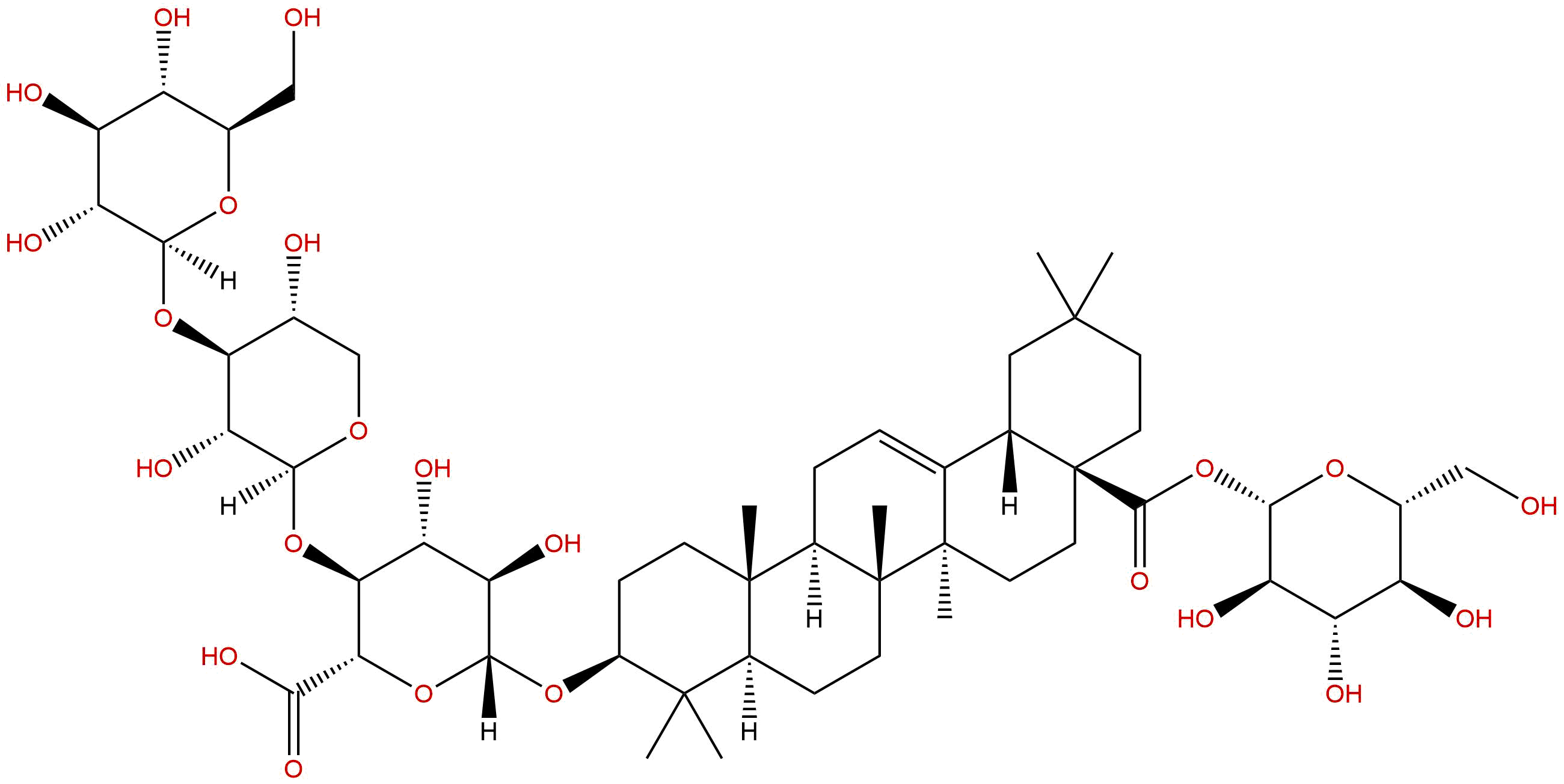
Introduction/Overview
Araloside C, CAS number 55446-15-6, is a compound derived from the Araliaceae plant Araliaceae(Aralia elata)Natural triterpenoid saponins isolated from the middle. As one of the important active ingredients in Aralia elata, saponins C from Aralia elata have received widespread attention in recent years due to their significant biological activities, especially their potential in anti-inflammatory, immune regulation, and cardiovascular protection. Myocardial ischemia/reperfusion injury (MI/R) is a key pathological process in cardiovascular disease, and Aralia elata saponin C has shown good protective effects in this field, demonstrating its value as a potential therapeutic agent.
This article will provide a systematic review of the chemical structure and physicochemical properties, plant sources, and extraction methods of Aralia elata saponin C. The focus will be on its pharmacological activity and mechanism of action, and pharmacokinetic analysis will be conducted based on its pharmacological parameters to explore its clinical application prospects and future research directions. The aim is to provide theoretical basis and research references for the field of natural product pharmacology and new drug development.
Chemical structure and physicochemical properties
Aralia elata saponin C belongs to the triterpenoid saponin class, with a molecular formula of C54H86O23 and a molecular weight of 1089.2320. Its structural feature is centered around a pentacyclic triterpenoid skeleton, connecting multiple sugar residues to form a typical saponin structure. The LogP value of Aralia elata saponin C is 1.7397, indicating that it has moderate lipid solubility and is beneficial for membrane penetration. The polar surface area (TPSA) is as high as 370.97 Å ², reflecting its strong molecular polarity and water solubility of 0.3376, indicating a certain degree of water solubility but not high. The low blood-brain barrier permeability of Aralia elata saponin C suggests its limited distribution in the central nervous system. In addition, the hERG channel inhibition experiment results were negative, indicating a low risk of cardiac toxicity. The Ames test result is 0, indicating no significant mutagenicity and good safety.
The complex glycosylation modification and triterpenoid skeleton of Aralia elata saponin C endow it with unique biological activity, while also affecting its pharmacokinetic properties, especially in its absorption, distribution, and metabolic processes, which require further in-depth research.
Plant sources and extraction methods
Araliaceae saponin C mainly comes from the Araliaceae plant Araliaceae in the Araliaceae family(Aralia elata)This plant is widely distributed in East Asia, especially in China, Japan, and the Korean Peninsula. As a traditional Chinese medicinal herb, Aralia elata has always been used to treat rheumatism, arthritis, and cardiovascular diseases. Aralia saponin C is a representative active ingredient in the roots, stems, and leaves of Aralia elata.
The common methods for extracting saponins C from Aralia elata include:
- Solvent extraction Using ethanol or methanol as extraction solvents, saponin components can be effectively extracted through reflux or ultrasound assisted extraction.
- Separation and purification The crude extract was separated and purified through multiple steps such as liquid-liquid distribution, silica gel column chromatography, and reverse phase high performance liquid chromatography (RP-HPLC), ultimately obtaining high-purity Aralia elata saponin C.
- Structural Identification Confirm its structure using modern analytical techniques such as nuclear magnetic resonance (NMR), mass spectrometry (MS), and infrared spectroscopy (IR).
In recent years, emerging technologies such as supercritical fluid extraction and microwave-assisted extraction have gradually been applied to the extraction of saponins C from Aralia elata, improving extraction efficiency and purity while reducing the use of organic solvents, in line with the concept of green chemistry.
Pharmacological activity research
The pharmacological activity research of Aralia elata saponin C mainly focuses on three fields: anti-inflammatory, immune regulation, and cardiovascular protection.
anti-inflammatory effect
Aralia elata saponin C significantly inhibits inflammatory response by regulating the expression of various inflammatory mediators. In vitro cell experiments have shown that Aralia elata saponins C can inhibit the production of pro-inflammatory factors such as tumor necrosis factor alpha (TNF - α), interleukin-6 (IL-6), and nitric oxide (NO) in macrophages, reducing inflammatory damage. In animal models, saponins C from Aralia elata have shown good relief effects on inflammatory diseases such as arthritis and pneumonia.
Cardioprotective effect
Myocardial ischemia/reperfusion injury is the main cause of myocardial cell death and cardiac dysfunction. Aralia elata saponin C exerts protective effects through multiple targets and pathways, including antioxidant, anti-inflammatory, inhibition of cell apoptosis, and regulation of energy metabolism. Experimental studies have shown that saponins C from Aralia elata can reduce oxidative stress levels in myocardial tissue, alleviate inflammatory reactions, reduce myocardial cell apoptosis rates, and thus improve myocardial function recovery.
Immune enhancement effect
Aralia elata saponins C exhibit significant enhancing effects in immune regulation. Its target involves various immune related molecules, including interleukin-2 (IL2), signal transduction and transcription activator 4 (STAT4), interferon gamma (IFNG), helper T cell marker molecule CD4, and cytotoxic T cell marker molecule CD8A. Aralia elata saponin C can promote T cell proliferation and activation, enhance cellular immune function, and improve the body's resistance to pathogens.
Mechanism of action and molecular targets
The mechanism of action of Aralia elata saponin C is complex, involving multiple signaling pathways and molecular targets, mainly including:
-
Immune regulatory pathway
Aralia elata saponin C promotes the proliferation and differentiation of T lymphocytes and enhances the immune response of the body by regulating key immune factors such as IL2, STAT4, and IFNG. IL2, as a T cell growth factor, upregulates its expression and promotes T cell activation; STAT4, as a signaling molecule, regulates Th1 cell differentiation; IFNG, as an important antiviral and immune regulatory factor, enhances cellular immune function. The activation of CD4+helper T cells and CD8+cytotoxic T cells by Aralia elata saponin C further enhances the overall efficacy of the immune system.
-
Anti inflammatory signaling pathway
Aralia elata saponin C can inhibit the activation of the nuclear factor kappa B (NF - κ B) signaling pathway, reduce the expression of pro-inflammatory factors, and alleviate inflammatory reactions. In addition, it also exerts anti-inflammatory effects by regulating the MAPK pathway, reducing the release of inflammatory mediators.
-
Antioxidant and Cellular Protection Mechanisms
Aralia elata saponins C enhance intracellular antioxidant enzyme activity, eliminate excess reactive oxygen species (ROS), and prevent cell damage caused by oxidative stress. By regulating mitochondrial function, myocardial cells are protected from ischemia/reperfusion injury.
-
Regulation of cell apoptosis
By regulating the expression of Bcl-2 family proteins, Aralia elata saponin C inhibits cell apoptosis signals and promotes the survival of cardiomyocytes.
In summary, Aralia elata saponins C achieve a wide range of pharmacological effects through multi-target and multi pathway synergistic effects.
Evaluation of drug properties and pharmacokinetics
The pharmacological parameters of Aralia elata saponin C show that it has certain potential for drug development:
-
Molecular weight and polarity
The molecular weight of 1089.2320 is relatively large, with a TPSA of up to 370.97 Å ², indicating strong molecular polarity that may affect oral absorption and cell membrane permeability.
-
Fat solubility and water solubility
LogP is 1.7397, which belongs to moderate lipophilicity and is conducive to cell membrane penetration; The water solubility is 0.3376, indicating that there may be certain solubility limitations in its distribution in vivo.
-
Blood-brain barrier penetrability
Low blood-brain barrier permeability limits its application in central nervous system diseases, but reduces the risk of central side effects.
-
safety
The hERG channel inhibition experiment was negative, indicating a low risk of cardiac toxicity; The Ames test was 0, indicating no mutagenicity and good safety.
-
pharmacokinetics
At present, there is limited data on the in vivo absorption, distribution, metabolism, and excretion (ADME) of saponins C from Aralia elata. Due to its high molecular weight and polarity, oral bioavailability may be low, and strategies such as nanocarriers or structural modifications are needed to improve it. The metabolic pathway may involve the liver cytochrome P450 enzyme system, and future research should focus on the activity and toxicity of its metabolites.
Clinical application prospects and prospects
Aralia elata saponin C, with its multiple pharmacological activities, especially significant effects in anti-inflammatory, immune enhancement, and myocardial protection, has demonstrated good clinical application potential:
-
Cardiovascular disease treatment
The protective effect of Aralia elata saponin C in myocardial ischemia/reperfusion injury provides a new approach for the adjuvant treatment of myocardial infarction and related cardiovascular diseases. In the future, clinical trials can be conducted to evaluate its efficacy and safety in acute coronary syndrome and heart failure.
-
Immune regulation and anti-inflammatory diseases
Its immune enhancement and anti-inflammatory properties make it potentially useful in autoimmune diseases, chronic inflammatory diseases such as rheumatoid arthritis, inflammatory bowel disease, and other areas.
-
Drug development strategy
Due to the large molecular weight and strong polarity of Aralia elata saponin C, its bioavailability and targeting should be improved in the future through structural optimization, dosage form improvement, and innovative administration routes (such as nano formulations and liposome encapsulation).
-
Safety and Toxicological Assessment
Long term toxicology studies need to be conducted systematically to clarify the safe dosage range and potential side effects, ensuring the safety of clinical applications.
-
Multi target drug development
The multi-target mechanism of action of Aralia elata saponin C meets the needs of modern multifactorial disease treatment and is expected to be developed into a multifunctional drug to meet the treatment needs of complex diseases.
Conclusion
Aralia saponin C, as a source from Aralia elata Natural triterpenoid saponins, with their unique chemical structure and diverse pharmacological activities, have shown broad application prospects, especially in the fields of anti-inflammatory, immune regulation, and myocardial protection. Its mechanism of action involves multiple signaling pathways and key molecular targets, reflecting the advantages of natural product multi-target therapy. Although its medicinal properties face certain challenges, with the assistance of modern drug design and formulation technology, Aralia elata saponin C is expected to become an important candidate for the treatment of new cardiovascular and immune related diseases.
Future research should focus on the pharmacokinetic characteristics, structural optimization, and preclinical safety evaluation of Aralia elata saponin C, in order to promote its clinical translation. At the same time, by combining systems biology and pharmacogenomics methods, we can deeply analyze its action network, provide a model for natural product pharmacology research, and promote innovation and breakthroughs in natural product drug development.