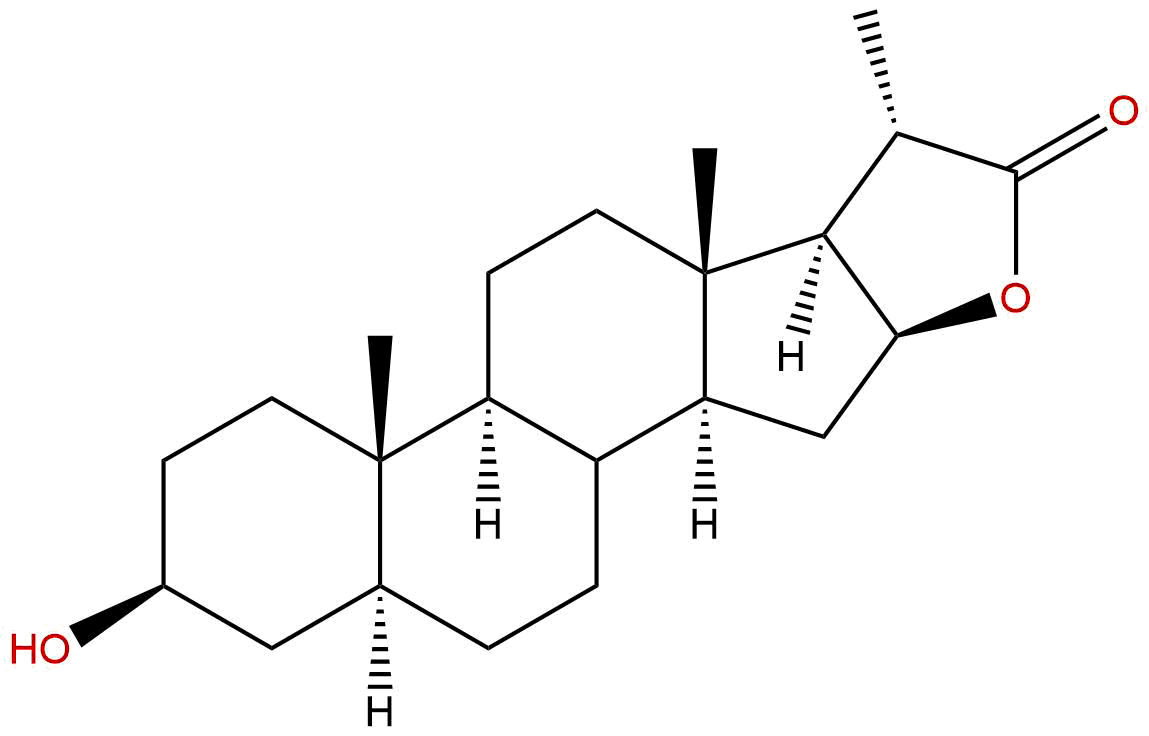


Product name: Tigogenin lactone
Synonym name:
Catalogue No.: BP5139
Cas No.: 514-33-0
Formula: C22H34O3
Mol Weight: 346.511
Botanical Source:
Type of Compound: Triterpenoids
Purity: 95%~99%
Analysis Method: HPLC-DAD or/and HPLC-ELSD
Identification Method: Mass, NMR
Packing: Brown vial or HDPE plastic bottle
Storage: Store in a well closed container, protected from air and light. Put into refrigerate or freeze for long term storage.
Whenever possible, you should prepare and use solutions on the same day. However, if you need to make up stock solutions in advance, we recommend that you store the solution as aliquots in tightly sealed vials at -20℃. Generally, these will be useable for up to two weeks.
The product could be supplied from milligrams to grams
Inquire for bulk scale.
For Reference Standard and R&D, Not for Human Use Directly.
Storage conditions:Short-term storage at 2~8℃, long-term storage at -20 ~ -80℃
Tigogen lactone (CAS number: 514-33-0) is an important steroidal saponin, which has attracted widespread attention in the field of natural product pharmacology in recent years due to its unique chemical structure and diverse biological activities. As one of the representative compounds of steroidal saponins, sisal saponin lactone not only exhibits significant anti-tumor, anti-inflammatory, immune regulatory, and metabolic regulatory effects, but also shows potential therapeutic value in bone metabolism and cardiovascular disease research. It can effectively inhibit the adipocyte differentiation of mouse bone marrow stromal cells and promote osteoblast differentiation, demonstrating potential applications in bone metabolism diseases such as osteoporosis. In addition, the inhibitory effect of sisal saponin lactone on cell proliferation and the induction of apoptosis lay the foundation for further exploration of its anti-cancer mechanism.
This article aims to systematically review the chemical structure and physicochemical properties, plant sources and extraction methods, pharmacological activity and mechanism of action, pharmacological evaluation and pharmacokinetic characteristics of sisal saponin lactone. Combined with current research progress, it explores its clinical application prospects and future development directions, providing theoretical basis and research references for the drug development of this natural product.
Jianma saponin lactone belongs to the class of steroidal saponin compounds, with a molecular formula of C21H34O4 and a molecular weight of 346.5110. Its structural core is a typical steroid skeleton, containing a four ring steroid structure and a lactone ring at the C-3 position, endowing it with unique biological activity. The LogP value is 4.1376, indicating that it has good lipid solubility, which is beneficial for membrane penetration and in vivo distribution. The polar surface area (TPSA) is 46.53 Å ², indicating that its molecular polarity is moderate and facilitates binding to biological targets. Low water solubility (0.0088 mg/mL) suggests limited solubility in vivo, which may affect oral bioavailability. It is worth noting that sisal saponin lactone has a high blood-brain barrier penetration ability, indicating its potential application value in central nervous system related diseases. The hERG channel inhibition test result was negative, indicating a low risk of cardiac toxicity. The Ames mutagenicity test showed 0.0, indicating a low risk of genotoxicity and good safety.
Jianma saponin lactones are mainly found in plants of the genus Agave spp., especially in Agave sisalana and its related species. Jianma plants are widely distributed in tropical and subtropical regions, and due to their strong drought tolerance and abundant saponin components, they have become an important source of natural steroidal saponins. Traditionally, sisal saponin lactones are obtained by extracting and isolating the roots, stems, or leaves of sisal plants.
The extraction method usually uses organic solvent extraction combined with liquid chromatography technology. Common extraction solvents include methanol, ethanol, and their aqueous solutions. Ultrasonic assisted extraction or reflux extraction can be used to improve extraction efficiency. The extraction solution was concentrated, liquid-liquid separated, and purified by silica gel column chromatography. The purity and structure were finally confirmed by techniques such as high-performance liquid chromatography (HPLC) and mass spectrometry (MS). In recent years, the application of supercritical CO2 extraction technology and molecular imprinting technology has provided new ideas for the efficient extraction and purification of sisal saponin lactones, improving the selectivity and environmental friendliness of extraction.
Jianma saponin lactone exhibits significant anti proliferative and pro apoptotic effects in various tumor cell lines. Research shows that it can inhibit the growth and metastasis of tumor cells by regulating a variety of signal pathways, especially in breast cancer cells. Its anti-tumor mechanism involves regulating cell cycle arrest, inducing mitochondrial dependent apoptosis, and inhibiting tumor related gene expression.
Jianma saponin lactone can inhibit the release of inflammatory mediators and alleviate inflammatory reactions. It exhibits immunomodulatory effects in autoimmune disease models such as rheumatoid arthritis, regulating the activity of immune cells and the expression of inflammatory factors, and reducing tissue damage.
Jianma saponin lactone significantly inhibits the differentiation of mouse bone marrow stromal cells into adipocytes, while promoting the differentiation and mineralization of osteoblasts, suggesting its potential therapeutic value in bone metabolism diseases such as osteoporosis. This effect may be achieved by regulating signaling pathways related to bone metabolism, promoting bone formation, and inhibiting bone resorption.
Sisal saponin lactones show anti-inflammatory and antioxidant effects in atherosclerosis models, can improve vascular endothelial function, inhibit the proliferation of vascular smooth muscle cells, slow down the process of atherosclerosis, and show the potential of cardiovascular disease prevention and treatment.
The multi-target mechanism of action of sisal saponin lactone is the basis for its broad pharmacological activity. Research has found that its main targets involve various proteins related to cell apoptosis, proliferation, and metabolism:
In addition, sisal saponin lactone promotes bone formation and inhibits bone resorption by regulating bone metabolism related signaling pathways such as Wnt/β - catenin, BMP, and RANKL/OPG systems, exerting bone protective effects.
The pharmacological parameters of sisal saponin lactone indicate that it has certain potential for drug development. A higher LogP value suggests good lipid solubility, which facilitates membrane penetration, but low water solubility may limit oral absorption. Its low polar surface area and high blood-brain barrier penetration ability indicate its potential application in central nervous system diseases. The negative and non mutagenic results of hERG channel inhibition indicate its high safety.
At present, there is limited research on the pharmacokinetics of sisal saponin lactone. Preliminary data indicate that it is widely distributed in the body, metabolically stable, and mainly excreted through the liver metabolic pathway. In the future, further systematic research is needed to investigate its absorption, distribution, metabolism, and excretion (ADME) characteristics, optimize dosing regimens, and improve bioavailability.
Jianma saponin lactone, with its multi-target and multi mechanism pharmacological activities, has shown broad application prospects in the fields of anti-tumor, anti-inflammatory, immune regulation, and bone metabolism diseases. Especially in the treatment of breast cancer, rheumatoid arthritis, osteoporosis, atherosclerosis and other diseases, sisal saponin lactone provides a new treatment idea.
In the future, combining modern medicinal chemistry and molecular biology techniques, optimizing the structural modification of sisal saponin lactones, improving their water solubility and bioavailability, is expected to promote their clinical translation. At the same time, in-depth analysis of its mechanism of action and target network, and systematic pharmacological and toxicological studies will lay the foundation for its safe and effective application. Multi center, randomized, controlled clinical trials are a key step in verifying their clinical value.
In addition, utilizing novel drug delivery systems such as nanocarriers and liposomes to improve their pharmacokinetic properties, enhance targeting and efficacy, is also an important direction for future research. Through the comprehensive use of interdisciplinary approaches, sisal saponin lactone is expected to become an important candidate molecule in the development of natural product drugs.
As a natural steroidal sapogenin with multiple biological activities, sisal saponin lactone has shown extensive potential in anti-tumor, anti-inflammatory, immune regulation, and bone metabolism fields due to its unique chemical structure and multi-target mechanism of action. Its good safety and pharmacological parameters provide favorable conditions for drug development. In the future, by deepening pharmacological mechanism research, optimizing drug design, and improving clinical evaluation, sisal saponin lactone is expected to become a new natural medicine for treating various major diseases, contributing important forces to the development of natural product pharmacology and modern medicine.
