Introduction/Overview
Chiisanoside (CAS number: 89354-01-8) is a natural product with significant biological activity, which has attracted widespread attention in the field of natural product pharmacology in recent years. As a class of secondary metabolites with complex glycosidic structures, Chiisanoside exhibits various pharmacological activities, particularly in the field of anti allergic treatment, demonstrating unique therapeutic potential. The incidence rate of allergic diseases is increasing year by year, which seriously affects the quality of life of patients. It is urgent to develop new safe and effective anti allergic drugs. Chiisanoside has become a hot topic in the research of natural product anti allergic drugs due to its multi-target regulatory effects and good safety.
This article will provide a systematic review of the chemical structure and physicochemical properties, plant sources and extraction methods, pharmacological activity and mechanism of action, pharmacological evaluation and pharmacokinetic characteristics of Chiisanoside. Combined with current research progress, it will explore its clinical application prospects and future development directions, aiming to provide comprehensive and in-depth reference materials for researchers in related fields.
Chemical structure and physicochemical properties
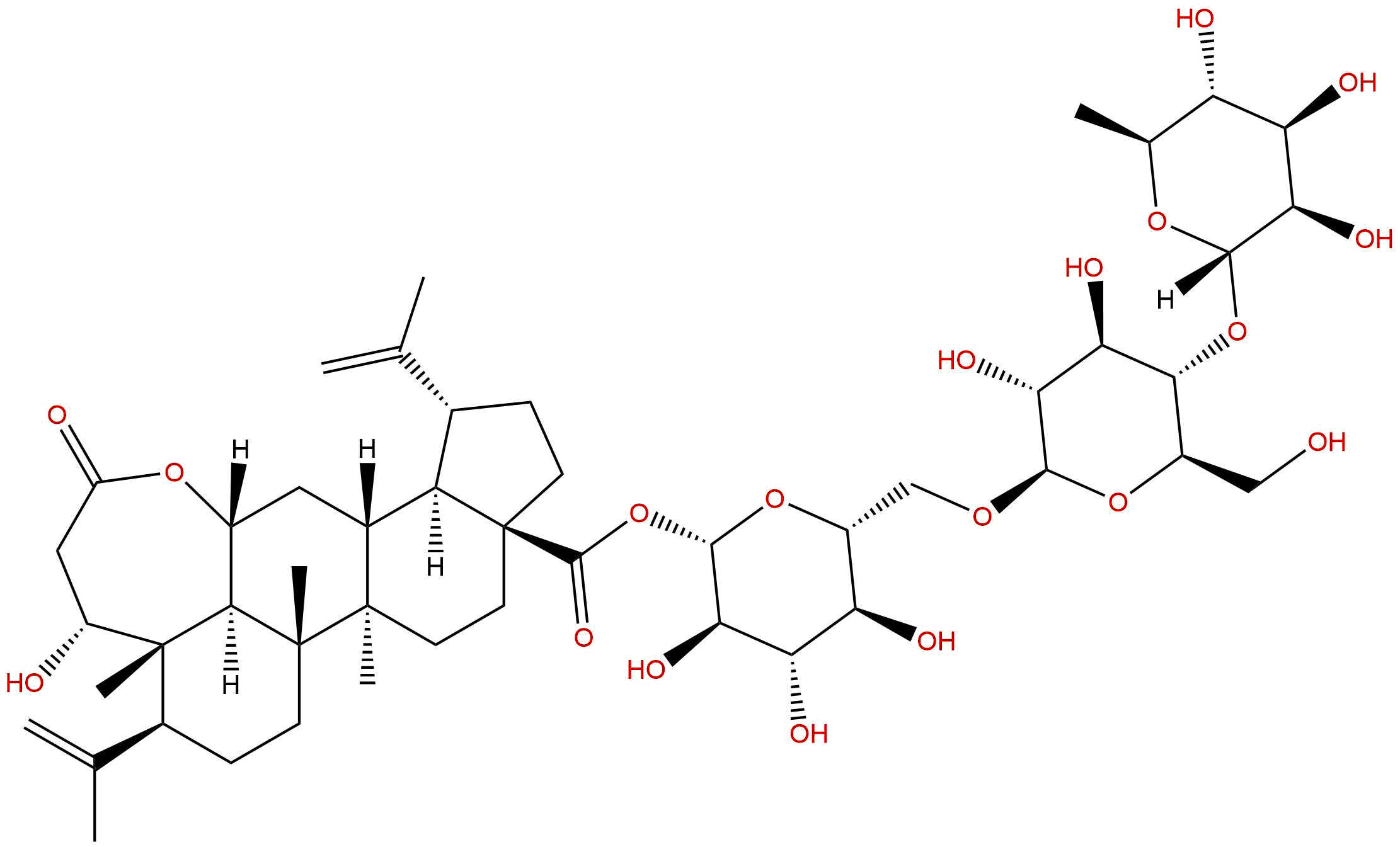
Chiisanoside is a naturally occurring glycoside compound with a molecular weight of 955.1010. Its chemical structure contains multiple glycosides and steroid or triterpenoid parent nucleus structures, giving it a complex stereoisomeric configuration and abundant functional groups. Its LogP value is 1.6707, indicating that it has moderate lipid solubility, which ensures the penetration ability of molecules on the cell membrane and maintains a certain degree of water solubility (0.1379 mg/mL), which is beneficial for absorption and distribution in vivo. The TPSA (topological polar surface area) is 301.0500, and a higher polar surface area suggests better solubility of Chiisanoside in polar environments, but may limit its ability to pass through the blood-brain barrier, with low blood-brain barrier permeability evaluation.
In addition, Chiisanoside demonstrated excellent drug safety, with negative hERG channel inhibition results indicating a low risk of cardiac toxicity; The Ames mutagenicity test result was 0.0, indicating no significant genotoxicity. Based on comprehensive physical and chemical properties and safety data, Chiisanoside has good potential as a drug.
Plant sources and extraction methods
Chiisanoside is mainly found in certain traditional Chinese medicinal herbs, especially in plants represented by Panax notoginseng and related species, which are abundant in content. It usually exists in the form of glycosides in plant bodies and is mainly distributed in rhizomes and root tissues.
The common methods for extracting Chiisanoside include:
-
Solvent extraction method Using polar organic solvents such as ethanol or methanol for reflux or ultrasound assisted extraction of dried plant powder, the extract is concentrated and then separated and purified.
-
Liquid-liquid distribution method By separating the aqueous and organic phases, lipid soluble impurities are removed and Chiisanoside is enriched.
-
Column chromatography separation Multi step separation and purification are performed using silica gel columns, reverse phase C18 columns, or ion exchange columns, combined with HPLC or LC-MS techniques to monitor the purity of the target components.
-
Modern technology assisted extraction Emerging technologies such as ultrasound assisted extraction, microwave-assisted extraction, and supercritical fluid extraction are used to improve extraction efficiency and yield.
At present, the extraction process for Chiisanoside is still being optimized, especially in terms of improving extraction purity and reducing costs, which has great potential for development.
Pharmacological activity research
The pharmacological activity research of Chiisanoside mainly focuses on its anti allergic effect. Allergic reactions involve complex regulation of multiple cytokines and signaling pathways, and Chiisanoside has shown significant anti allergic effects through multi-target regulation.
Antiallergic activity
Both in vitro and in vivo experiments have confirmed that Chiisanoside can effectively inhibit the release of allergens and the occurrence of allergic reactions. Its main manifestations are:
- Inhibit degranulation of mast cells and reduce the release of histamine and other inflammatory mediators.
- Reduce the expression of Th2 cell related cytokines such as IL-4, IL-5, IL-13, and regulate immune balance.
- Inhibit the activity of IgE receptor FCER1A and reduce IgE mediated allergy signaling.
- Inhibit the activity of lipoxygenase 5 (ALOX5) and reduce allergy related leukotriene production.
- Regulating histamine H1 receptor (HRH1) and platelet activating factor receptor (TBXA2R) signaling to alleviate allergic symptoms.
- Inhibit the expression of key allergy related molecules such as signal transduction and transcription activator 6 (STAT6) and thymic stromal lymphopoietin (TSLP).
Other potential pharmacological activities
In addition to anti allergic effects, some studies have also found that Chiisanoside may have anti-inflammatory, antioxidant, and immunomodulatory effects, but the relevant mechanisms still need further clarification.
Mechanism of action and molecular targets
The anti allergic effect of Chiisanoside involves multiple signaling pathways and targets, and the specific mechanism is as follows:
-
ALOX5 (lipoxygenase 5) inhibition
ALOX5 is a key enzyme in the biosynthesis of leukotrienes, which play an important role as an inflammatory mediator in allergic reactions. Chiisanoside alleviates airway inflammation and allergic symptoms by inhibiting ALOX5 activity, reducing the production of leukotrienes.
-
Regulation of HRH1 (Histamine H1 Receptor)
Histamine H1 receptor mediates allergic symptoms such as itching, vasodilation, etc. The antagonistic effect of Chiisanoside on HRH1 can help alleviate clinical manifestations caused by allergies.
-
Inhibition of IL-4, IL-5, IL-13 expression
These cytokines are the core of Th2 immune response, promoting IgE synthesis and eosinophil activation. Chiisanoside regulates immune balance and reduces allergic reactions by downregulating these cytokines.
-
FCER1A (high affinity IgE receptor alpha chain) inhibition
FCER1A mediates IgE dependent activation of mast cells, which is a critical step in allergic reactions. Chiisanoside inhibits the expression of FCER1A and blocks allergic signaling.
-
Inhibition of STAT6 signaling pathway
STAT6 is a key transcription factor involved in IL-4 signaling and regulates the expression of allergy related genes. Chiisanoside reduces allergic reactions by inhibiting STAT6 activity.
-
TSLP (thymic stromal lymphopoietin) regulation
TSLP is a pro-inflammatory cytokine secreted by epithelial cells that promotes dendritic cell activation and Th2 biased immunity. Chiisanoside reduces TSLP levels and helps suppress allergic inflammation.
Through the synergistic effect of multiple targets, Chiisanoside achieves effective regulation of allergic reactions, demonstrating good therapeutic potential.
Evaluation of drug properties and pharmacokinetics
The pharmacological evaluation of Chiisanoside shows that it has certain advantages and challenges:
- Molecular weight and structural complexity The molecular weight is close to 1000, and larger molecular weights may affect oral absorption and bioavailability, but moderate LogP and water solubility help balance absorption and distribution.
- High polarity surface area (TPSA)It is suggested that its ability to pass through cell membranes is limited, which may affect oral absorption and tissue distribution, especially with low blood-brain barrier permeability, reducing the risk of central nervous system side effects.
- Good safety No hERG channel inhibition and no genotoxicity, reducing cardiac toxicity and cancer risk, and improving clinical safety.
- Pharmacokinetic characteristics Currently, research on the in vivo absorption, distribution, metabolism, and excretion (ADME) of Chiisanoside is relatively limited. Preliminary data indicates that it is metabolically stable in the liver, mainly excreted through the kidneys, with a moderate half-life, and suitable for multiple administrations.
Further systematic pharmacokinetic and toxicological studies are needed in the future to optimize dosing regimens and formulations, and enhance their clinical translational potential.
Clinical application prospects and prospects
Chiisanoside, as a natural anti allergic active ingredient, has the following clinical application prospects:
-
Treatment of Allergic Diseases
Including allergic rhinitis, asthma, atopic dermatitis, etc., Chiisanoside regulates immune and inflammatory responses through multiple targets and may become a new candidate for natural anti allergic drugs.
-
Potential for combination therapy
It can be used in combination with existing antihistamines, glucocorticoids, etc. to enhance efficacy and reduce side effects.
-
Security advantage
No obvious cardiac toxicity or genotoxicity, suitable for long-term use, especially suitable for children and elderly patients.
-
Development of plant-based medicines and health products
Based on its natural source and good safety, Chiisanoside can be used as a functional health supplement ingredient to assist in the prevention and relief of allergic symptoms.
However, the clinical application of Chiisanoside still faces many challenges:
- Lack of systematic clinical trial data requires multi center, large sample clinical studies to verify its efficacy and safety.
- The structure is complex and the preparation cost is high. It is necessary to optimize the extraction and purification process to reduce production costs.
- The pharmacokinetic characteristics need to be further clarified to guide rational drug administration.
Future research should focus on structural modification, dosage form innovation, and mechanism deepening to promote the clinical translation of Chiisanoside.
Conclusion
Chiisanoside, as a natural product with significant anti allergic activity, has shown broad prospects for drug development due to its multi-target regulatory effects and good safety. Its complex chemical structure endows it with rich biological activity, but also brings challenges to drug development. Through continuous deepening of research on its mechanism of action, pharmacokinetics, and clinical efficacy, Chiisanoside is expected to become an important representative of natural anti allergic drugs, meeting the urgent need for safe and effective allergy treatment in clinical practice.
In the future, interdisciplinary research combining modern medicinal chemistry, molecular biology, and clinical medicine will promote the development process of Chiisanoside, realize its clinical application in the prevention and treatment of allergic diseases, and bring good news to patients.