
| Catalog No | Package | Original Price | Price | Inventory | Quantity | Operating |
|---|---|---|---|---|---|---|
| BP0529-20mg | 20mg | $30.00 | Sign in |
|


Product name: Ellagic Acid
Synonym name: Benzoaric acid; Elagostasine; Lagistase
Catalogue No.: BP0529
Cas No.: 476-66-4
Formula: C14H6O8
Mol Weight: 302.194
Botanical Source: Widely distributed in higher plants; found by Bate-Smith in 75 genera of dicotyledons and in only one monocotyledonous sp., Hypoxis filiformis
Physical Description: Powder
Type of Compound: Phenols
Purity: 95%~99%
Analysis Method: HPLC-DAD or/and HPLC-ELSD
Identification Method: Mass, NMR
Packing: Brown vial or HDPE plastic bottle
Storage: Store in a well closed container, protected from air and light. Put into refrigerate or freeze for long term storage.
Whenever possible, you should prepare and use solutions on the same day. However, if you need to make up stock solutions in advance, we recommend that you store the solution as aliquots in tightly sealed vials at -20℃. Generally, these will be useable for up to two weeks.
The product could be supplied from milligrams to grams, up to kilograms
Inquire for bulk scale.
Descriptions:
Ellagic acid, a naturally occurring plant phenol, inhibits the activity of the direct-acting mutagen N-methyl-N-nitrosourea (MeNU) in Salmonella typhimurium TA100, is due to specific inhibition of methylation at the O6 position of guanine through an ellagic acid-duplex DNA affinity-binding mechanism.[1]
Ellagic acid has anti-oxidant and anti-inflammatory properties, can inhibit key cell functions and activation of PSCs, including platelet-derived growth factor (PDGF)-BB, interleukin (IL)-1beta, tumor necrosis factor (TNF)-alpha, alpha-smooth muscle actin and collagen genes. [2]
Ellagic acid has antioxidant and apoptosis-inducing activities, shows high DPPH radical scavenging and peroxidation inhibition activities, significantly reduces HOS cell proliferation, and induces apoptosis evidenced by chromosomal DNA degradation and apoptotic body appearance.[3]
References:
[1] Dixit R, Gold B. P Natl Acad Sci USA, 1986, 83(21):8039-43.
[2] Masamune A, Satoh M, Kikuta K, et al. Biochem Pharmacol, 2005, 70(6):869-78.
[3] Han D H, Lee M J, Kim J H. Anticancer Res, 2006, 26(5A):3601-6.
[4] Ou L M, Seken A, Li K A, et al. Int J Pharm Res, 2015, 42(05):637-41.
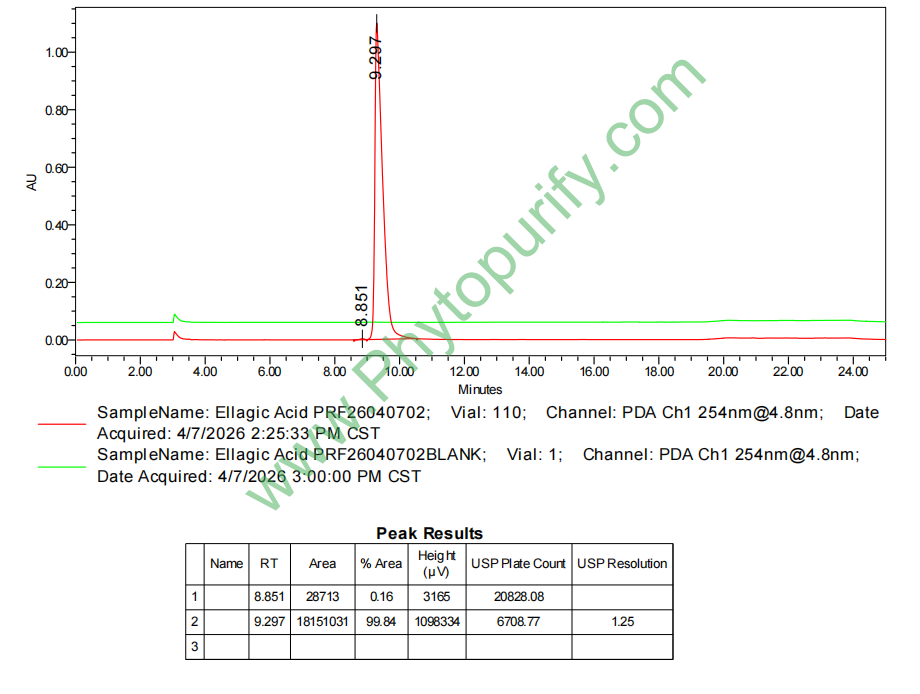
HPLC of Ellagic Acid
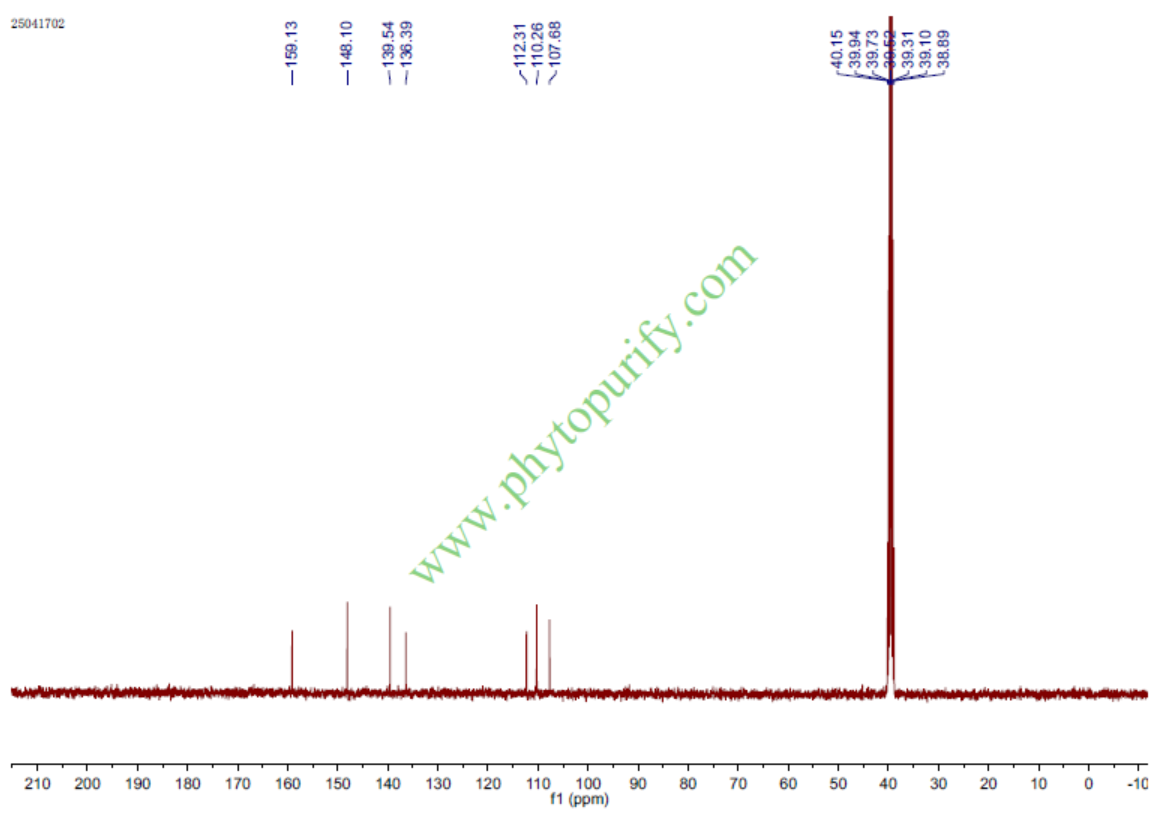
NMR of Ellagic Acid
Storage conditions:Short-term storage at 2~8℃, long-term storage at -20 ~ -80℃
141.3400
1.5319
.3671
.0032
1.6623
6.7417
Low
84.7599
2.9801
Yes
Yes
No
No
Yes
Yes
0.9
Yes
Yes
Yes
No
Natural products, as an important treasure trove for drug discovery and development, play an irreplaceable role in the long history of human fight against diseases. Among them, ellagic acid (EA), as a polyphenolic lactone widely present in various fruits, nuts, and medicinal plants, has attracted much attention due to its excellent antioxidant activity. With the deepening of modern pharmacological research, tannic acid has evolved from a simple antioxidant to a lead compound with multi-target and multi pathway regulatory potential. Its CAS number is 476-66-4, and its molecular formula is C14H6O8. Recent studies have revealed that tannic acid is not only an effective ATP competitive casein kinase 2 (CK2) and Src homologous domain protein tyrosine phosphatase 2 (SHP2) inhibitor (IC50 of 40 nM and Ki of 20 nM, respectively), but also exhibits a complex regulatory network in the prevention and treatment of various major diseases such as colon cancer, involving key targets such as AMPK, STAT3, BCL-2 family, etc. Although its medicinal properties face challenges such as poor water solubility, tannic acid is showing broad prospects in translational medicine through structural modification and the development of novel drug delivery systems. This article aims to systematically review the chemical properties, plant sources, pharmacological activities, molecular mechanisms, pharmacological evaluation, and clinical application potential of tannic acid, in order to provide scientific references for the deep development of this natural product.
Tannic acid is a tetrahydroxybiphenyldicarboxylic acid lactone, with the chemical name 2,3,7,8-tetrahydroxy [1] benzopyrano [5,4,3-cde] [1] benzopyran-5,10-dione. Its molecular structure consists of two fused hexagonal lactone rings (one coumarin and one chromone) connected by a carbon carbon bond, forming a highly conjugated planar rigid system. This unique structure is the material basis for its strong antioxidant capacity, and the four phenolic hydroxyl groups on its molecule easily provide hydrogen atoms or electrons, neutralize free radicals, and stabilize reactive oxygen species (ROS) and reactive nitrogen species (RNS).
From the analysis of physical and chemical properties, the molecular weight of tannic acid is 302.1940, and the theoretical lipid water partition coefficient (LogP) is 1.53, indicating that it has a certain lipophilicity. However, its topological polar surface area (TPSA) is as high as 141.34 Å ², mainly attributed to multiple hydroxyl and carbonyl oxygen atoms, which result in its strong ability to form strong hydrogen bonds between molecules and with water molecules. This characteristic directly results in the extremely low water solubility of tannic acid (about 0.0032 mg/mL), which is the main limiting factor for its low oral bioavailability (usually less than 5%). Under physiological pH conditions, tannic acid can undergo partial dissociation, but its solubility improvement is limited. In addition, its planar rigid structure may affect membrane permeability. In the preliminary safety screening, tannic acid showed no significant inhibitory effect on hERG potassium channels, indicating a low risk of cardiac toxicity; The Ames test result is 0.9 (usually considered positive if>1.5), indicating that there is no significant mutagenicity, but a more comprehensive genetic toxicity assessment is still needed.
Tannic acid is not present in large quantities in plants in its free form. It is mainly distributed as a precursor of ellagitannins in pomegranate peels, seeds, strawberries, raspberries, blackberries, walnuts, walnuts, wolfberries, and various medicinal plants such as eucalyptus and storks. When plant cells are damaged (such as chewing, processing) or tannic acid is hydrolyzed and lactonized under the action of gut microbiota, its hexahydroxybiphenyldicarboxylic acid (HHDP) group can release free tannic acid.
There are various methods for extracting tannic acid from plant materials, including traditional methods such as solvent extraction (commonly using methanol, ethanol, acetone and their aqueous solutions), and hot water extraction. To improve extraction efficiency and selectivity, modern technology has been widely applied, such as:
1. Ultrasound assisted extraction (UAE) and microwave-assisted extraction (MAE): Using physical fields to destroy cell walls significantly shortens extraction time and improves yield.
2. Supercritical fluid extraction (SFE): CO2 is commonly used as a solvent to achieve selective extraction by adjusting temperature and pressure. The process is green and solvent free, especially suitable for thermosensitive components.
3. Enzyme assisted extraction (EAE): Utilizing cellulases, pectinases, and other enzymes to disrupt the structure of plant cell walls and promote the release of tannic acid under mild conditions.
4. Solid phase extraction (SPE) and preparative high-performance liquid chromatography (Prep HPLC): Mainly used for further separation and purification of crude extracts to obtain high-purity tannic acid standards or pharmaceutical raw materials.
The optimization of extraction process requires comprehensive consideration of raw material characteristics, target product form (free state or tannic acid), cost, and environmental requirements.
Tannic acid exhibits a wide and powerful pharmacological activity, with its core being antioxidant activity, which extends to multiple effects such as anti-inflammatory, anticancer, cardiovascular protection, and neuroprotection.
Antioxidant and anti-inflammatory activities: Tannic acid is one of the strongest known natural antioxidants, which can directly remove superoxide anions, hydroxyl radicals, hydrogen peroxide, and chelate metal ions (such as Fe2+, Cu2+) to inhibit the Fenton reaction. By inhibiting the activation of inflammatory signaling pathways such as nuclear factor kappa B (NF - κ B, whose key subunit is RELA/p65) and mitogen activated protein kinase (MAPK, such as MAPK1/ERK2), downregulating the expression of cyclooxygenase-2 (COX-2), inducible nitric oxide synthase (iNOS), and various pro-inflammatory cytokines (such as TNF - α, IL-6), significant anti-inflammatory effects are achieved.
Antitumor activity: Tannic acid has the effects of inhibiting proliferation, inducing apoptosis, blocking cell cycle, inhibiting invasion, metastasis, and angiogenesis in various cancer cell lines. Especially in-depth in colon cancer research. It can activate the AMPK (PRKAA1) pathway, inhibit mTOR signaling, induce autophagy and apoptosis; Downregulate the expression of anti apoptotic proteins Bcl-2 and Mcl-1, disrupt mitochondrial membrane potential, and promote cytochrome C release; Inhibit the phosphorylation and nuclear translocation of transcription activator 3 (STAT3), thereby affecting the transcription of downstream genes related to proliferation and survival. In addition, tannic acid can also inhibit the activity of 5-lipoxygenase (ALOX5) and reduce the production of leukotrienes that promote inflammation and cancer; Inhibit the activity of DNA topoisomerase I (TOP1) and interfere with DNA replication; And it can reverse tumor multidrug resistance by inhibiting the function of P-glycoprotein (ABCB1/MDR1).
Cardiovascular protective effect: It is mainly achieved through antioxidant stress, improving endothelial function, inhibiting abnormal proliferation of vascular smooth muscle cells, regulating lipid metabolism (such as reducing oxidized low-density lipoprotein), and anti platelet aggregation, which has potential prevention and treatment value for atherosclerosis, hypertension and other diseases.
Neuroprotective effect: Tannic acid can penetrate the blood-brain barrier (although with low efficiency), and has shown protective effects in neurodegenerative disease models such as Alzheimer's disease and Parkinson's disease by clearing free radicals in the nervous system, inhibiting neuroinflammation, reducing β - amyloid aggregation, and tau protein hyperphosphorylation.
Other activities: It also includes antibacterial, antiviral, anti liver fibrosis, skin photoprotection (through absorption of ultraviolet light), and regulation of gut microbiota (whose microbial metabolites, uroliths, may contribute the main activity).
The mechanism of action of tannic acid is complex and has multi-target characteristics. Its core mechanism can be attributed to direct enzyme inhibition and indirect signal pathway regulation.
Direct target inhibition:
Regulation of key signaling pathways:
These targets and pathways are not isolated, but form an interwoven network. For example, inhibition of CK2 can indirectly affect the activity of STAT3 and NF - κ B; Activation of AMPK and inhibition of mTOR can synergistically promote autophagic death. The multi-target properties of tannic acid enable it to simultaneously attack multiple weaknesses of tumor cells, which may help overcome the resistance problem of single target drugs.
Although tannic acid has significant pharmacological activity, its pharmacological properties, especially pharmacokinetic properties, have obvious shortcomings, which limit its direct application as a drug.
Absorption: After oral administration, the absorption rate of free tannic acid in the gastrointestinal tract is extremely low (<5%), mainly due to its low solubility and high polarity. Most of the ingested ellagic tannins are metabolized by gut microbiota in the colon into better absorbable uroliths (Urolithins A, B, etc.), which are considered the main active forms of their systemic effects in the body.
Distribution: Limited pharmacokinetic data shows that the absorbed tannic acid has a low concentration in plasma and is eliminated quickly. Its high TPSA and polarity result in limited transmembrane diffusion ability and low blood-brain barrier permeability, but it is not completely unable to enter the central nervous system.
Metabolism and excretion: Tannic acid mainly undergoes phase II metabolic reactions in the body, such as glucuronidation and sulfation, forming complexes. The prototype drug and its metabolites are mainly excreted through the kidneys and urine.
Optimization strategy for drug properties:
The transformation of tannic acid from an antioxidant on the dining table to a clinical therapeutic drug is full of opportunities and challenges.
Disease prevention and control field:
Formulation development: Based on its physical and chemical defects, the development of advanced dosage forms such as oral nano formulations, enteric coated capsules, and injectable liposomes is a necessary path towards clinical practice. Topical preparations (such as gel and creams for skin photoprotection, acne and oral mucositis) may be transformed faster because of their direct administration and avoidance of first pass effects.
Future research directions:
Tannic acid, as a polyphenolic compound originating from nature, has risen from a simple phytochemical to a lead compound with significant development potential due to its powerful antioxidant core and increasingly clear multi-target pharmacological mechanism of action. Its multiple anti-tumor and anti-inflammatory effects demonstrated in major disease models such as colon cancer by regulating key targets such as AMPK, STAT3, BCL-2 family, CK2, SHP2, etc., reveal its unique advantages as a multi-target therapeutic agent. However, its inherent poor water solubility and low oral bioavailability pose pharmaceutical bottlenecks, requiring us to utilize modern pharmaceutical chemistry and pharmacology methods for optimization and modification. Through structural modification, especially the development of novel drug delivery systems based on nanotechnology, it is expected to break through its in vivo delivery barriers and unleash its full therapeutic potential. In the future, with the continuous deepening of basic research and the acceleration of clinical translation, tannic acid and its derivatives or metabolites are expected to achieve a leap from "laboratory to clinical" in the fields of tumor adjuvant therapy, chronic disease prevention and control, and contribute to human health with the wisdom and power from plants.
