| Catalog No | Package | Original Price | Price | Inventory | Quantity | Operating |
|---|---|---|---|---|---|---|
| BP5078-5mg | 5mg | $590.00 | Sign in |
|


Storage conditions:Short-term storage at 2~8℃, long-term storage at -20 ~ -80℃
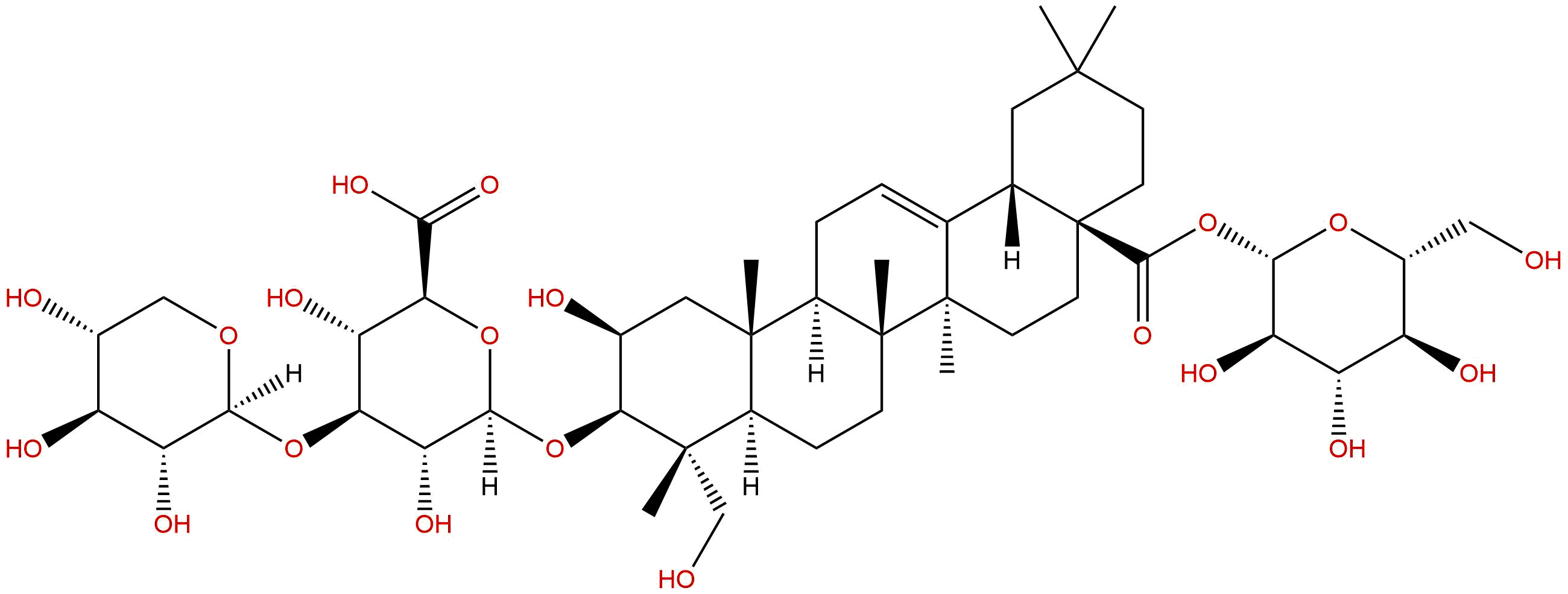
Celosin L is an emerging triterpenoid saponin natural product that has received widespread attention in recent years due to its significant hepatoprotective activity and potential anti malarial effects. Triterpenoid saponins, as an important natural product, occupy a significant position in pharmacology and drug development due to their structural diversity and rich biological activity. Celosidine L was initially isolated from plants of the Celosia genus and showed significant protective effects against acetaminophen (APAP) induced liver toxicity in HepG2 cells, indicating its potential application value in the prevention and treatment of liver diseases. In addition, Celosidine L has also shown certain activity in the field of anti malaria, with related targets covering multiple key proteins of malaria parasites, indicating its potential as a candidate molecule for novel anti malaria drugs. This article provides a systematic review of the chemical structure and physicochemical properties, plant sources and extraction methods, pharmacological activity and mechanism of action, pharmacological evaluation and pharmacokinetic characteristics of Celosidine L, and looks forward to its clinical application prospects, aiming to provide scientific basis and reference for the in-depth research and development of this natural product.
Celosidine L is a triterpenoid saponin with a molecular weight of 959.0890. It is structurally composed of a triterpenoid skeleton and multiple glycosides connected by glycosidic bonds, exhibiting typical saponin molecular characteristics. Its LogP value is 1.2099, indicating that the molecule has moderate lipid solubility, which is beneficial for cell membrane penetration but not excessively hydrophobic, and conducive to in vivo distribution. The extremely high topological polar surface area (TPSA) is 332.2800, indicating that its molecular surface is rich in polar groups, which may affect its ability to penetrate biofilms and bind to target proteins. The water solubility index is 0.3273, indicating that Celosidine L has a certain degree of water solubility, which is conducive to absorption and distribution in the body. The low permeability of the blood-brain barrier suggests its limited role in the central nervous system, reducing the risk of central nervous system toxicity and side effects. The hERG channel inhibition experiment result was negative, indicating that the risk of cardiac toxicity of Celosidine L is relatively low. The Ames test showed 0.0, indicating no significant mutagenicity and high safety.
From a chemical structure perspective, the triterpenoid skeleton of Celosidine L endows it with a strong biological activity basis, while the modification of polysaccharide chains may affect its pharmacokinetic properties and targeting selectivity. The complexity and polarity of the overall structure determine its metabolic pathways and pharmacological performance in the body.
Celosia L is mainly derived from plants of the Celosia genus (Celosia spp.), which are widely distributed in tropical and subtropical regions and have traditionally been used to treat various diseases. The plants of the genus Celosia contain abundant triterpenoid saponins, and Celosidine L is one of the representative active ingredients.
The common methods for extracting Celosidine L include organic solvent extraction, liquid-liquid distribution, and column chromatography purification. Generally, ethanol or methanol is used as the extraction solvent to obtain crude extract through reflux extraction, and then separation and purification are carried out using techniques such as silica gel column chromatography and reverse phase high performance liquid chromatography (RP-HPLC). During the identification process, the structural characteristics were confirmed by combining mass spectrometry (MS), nuclear magnetic resonance (NMR), and infrared spectroscopy (IR). In recent years, the application of ultrasound assisted extraction and microwave-assisted extraction technologies has improved the extraction efficiency and purity of Celosidine L, reduced solvent usage, and is in line with the concept of green chemistry.
In addition, the diversity of plant sources and growth environment have a significant impact on the content of Celosidine L. The establishment of standardized planting and extraction processes is crucial to ensure its quality stability.
The most well-known pharmacological effect of Celosidine L is its significant hepatoprotective effect. Multiple in vitro studies have shown that Celosidine L has a significant protective effect against APAP induced liver toxicity in HepG2 cells. Excessive APAP is one of the main causes of acute liver injury, and its metabolite N-acetylbenzoquinone imine (NAPQI) can cause oxidative stress and cell apoptosis. Celosidine L significantly improves cell survival rate and reduces cell damage by reducing oxidative stress, inhibiting inflammatory response, and regulating cell apoptosis signaling pathways.
In vivo experiments have also confirmed that Celosidine L can reduce the levels of liver injury markers such as ALT and AST, improve the pathological structure of liver tissue, and demonstrate good liver protective effects. Its antioxidant capacity is mainly reflected in clearing free radicals, enhancing endogenous antioxidant enzyme activity (such as SOD, GSH Px), inhibiting lipid peroxidation, and reducing liver cell membrane damage.
The research on the anti malaria effect of Celosidine L is relatively preliminary, but its potential role in targeting multiple key targets of malaria parasites has attracted high attention from researchers. The relevant targets include PFCRT (Plasmodium chloroquine resistance transporter), PFMDR1 (multidrug resistance protein 1), PFDHFR (dihydrofolate reductase), PFK13 (ketokinase 13), PFATP6 (calcium ATPase), PFCYTBC (cytochrome bc1 complex), PFPK (phosphate kinase), PFCYT (cytochrome), PFCYTb (cytochrome b), and PfATG8 (autophagy related protein 8). These targets play a crucial role in the survival and drug resistance mechanisms of malaria parasites. Through interactions with these proteins, Celosidine L is expected to interfere with the metabolism and physiological processes of malaria parasites, thereby exerting anti malarial effects.
Molecular docking and in vitro pharmacological experiments have shown that Celosidine L has a certain binding affinity and inhibitory activity towards these targets, suggesting that it can be a potential candidate molecule for the development of anti malaria drugs.
In addition to liver protection and anti malaria effects, Celosidine L also exhibits certain activities in anti-inflammatory, antioxidant, and immune regulation. Some studies suggest that it can regulate the expression of inflammatory factors, inhibit the activation of the NF - κ B signaling pathway, and alleviate inflammatory responses. In addition, the regulation of apoptosis and autophagy processes by Celosidine L provides theoretical support for its multi-target pharmacological effects.
The pharmacological activity of Celosidine L is mainly achieved through multi-target and multi pathway synergistic effects. The mechanism of its hepatoprotective effect involves three core links: antioxidant, anti-inflammatory, and anti apoptotic
Antioxidant mechanism Celosidine L can significantly enhance intracellular antioxidant enzyme activity, eliminate excess reactive oxygen species (ROS), and reduce oxidative stress damage. By regulating the Nrf2/ARE signaling pathway, we promote the expression of antioxidant genes and enhance the ability of cells to resist oxidative damage.
Anti inflammatory mechanism Celosidine L inhibits the release of pro-inflammatory cytokines (such as TNF - α, IL-6, IL-1 β), blocks the activation of the NF - κ B signaling pathway, alleviates liver inflammation, and protects liver cells from inflammation mediated damage.
Anti apoptotic mechanism Celosidine L regulates the expression of Bcl-2 family proteins, inhibits mitochondrial mediated apoptosis, reduces cell death, and promotes liver cell survival and repair.
In terms of anti malaria, Celosidine L interferes with the metabolism and function of malaria parasites by binding to key protein targets, blocking their life cycle. Especially the effects on PFCRT and PFMDR1 can help overcome the resistance of malaria parasites and enhance the efficacy of antimalarial drugs. In addition, the inhibitory effect on PFDHFR can block the folate metabolism of malaria parasites, further inhibiting their reproduction.
Molecular dynamics simulations and protein binding experiments support the high affinity binding of Celosidine L to the aforementioned targets, revealing its multi-target synergistic inhibition mechanism.
The pharmacological parameters of Celosidine L indicate that it has good potential for drug development. The molecular weight is close to 1000, although relatively large, a moderate LogP value (1.2099) and a certain degree of water solubility (0.3273) are beneficial for its in vivo absorption and distribution. A high TPSA value indicates strong polarity and may limit oral absorption, but its bioavailability can be improved through structural modification or nanocarrier delivery technology.
The blood-brain barrier has low permeability and reduces the risk of adverse reactions in the central nervous system, making it suitable for liver and peripheral target therapy. HERG channel inhibition is negative, indicating low risk of cardiac toxicity and high safety. The Ames test was negative, further supporting its genotoxic safety.
In terms of pharmacokinetics, the in vivo metabolism of Celosidine L is mainly carried out through the liver enzyme system, involving glycoside hydrolysis and oxidative modification of the triterpenoid skeleton. Its half-life is moderate and its plasma protein binding rate is high, indicating that it has good stability and sustained action time in vivo. The main excretion pathways are bile and urine, and the safety of metabolites is good.
However, the oral bioavailability of Celosidine L is limited by its molecular size and polarity. In the future, pharmaceutical improvements such as liposomes, nanoparticles, and other delivery systems will be needed to enhance its in vivo utilization and therapeutic efficacy.
Celosidine L, as a natural product with significant hepatoprotective activity and potential anti malaria effects, has shown broad clinical application prospects. In the field of liver disease, especially in the adjuvant treatment of drug-induced liver injury (such as acute liver injury caused by APAP overdose) and chronic hepatitis, Celosidine L is expected to become a safe and effective hepatoprotective drug. Its multi-target and multi mechanism mode of action helps to comprehensively regulate liver pathological processes, reduce liver cell damage, and promote liver function recovery.
In terms of anti malaria, facing the increasingly severe challenge of malaria parasite resistance, Celosidine L provides a new drug design approach by acting on multiple resistance related targets. In the future, through structural optimization and combination therapy strategies, it is expected to develop new antimalarial drugs to improve the effectiveness of malaria treatment.
In addition, the potential of Celosidine L in anti-inflammatory and immune regulation is also worth further exploration, which may expand its indications.
Future research should focus on the following directions:
Celosidine L, as a structurally unique and biologically active triterpenoid saponin, has become a hot topic in natural product pharmacology research due to its excellent hepatoprotective effects and potential anti malaria activity. Its multi-target and multi mechanism pharmacological properties provide valuable resources for the development of new liver disease treatment drugs and anti malaria drugs. Although there are still some challenges in pharmacokinetics and clinical applications, with the optimization of modern medicinal chemistry and pharmacy methods, it is expected that Celosidine L can be transformed from laboratory to clinical use. In the future, in-depth research on its mechanism of action and systematic safety evaluation will further promote its drug development process, contributing new theoretical and practical achievements to the field of natural product pharmacology.
