
| Catalog No | Package | Original Price | Price | Inventory | Quantity | Operating |
|---|---|---|---|---|---|---|
| BP0566-20mg | 20mg | $30.00 | Sign in |
|


Synonym name: Aesculin; Crataegin; Bicolorin; Polychrom; Vitamin C2; Esculoside; Schillerstoff
Catalogue No.: BP0566
Cas No.: 531-75-9
Formula: C15H16O9
Mol Weight: 340.284
Botanical Source: Obt. from bark of Fraxinus ornus, flowers of Solanum pinnatisectum, from Fraxinus japonica, Olea africana, Olea capensis, Aesculus hippocastanum and other plants
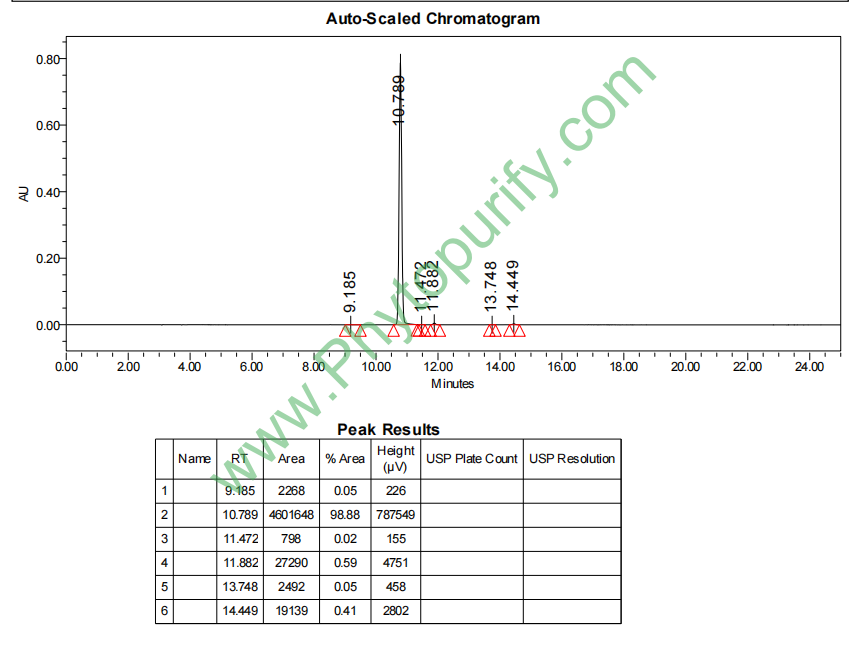
Purity: 95%~99%
Analysis Method: HPLC-DAD or/and HPLC-ELSD
Identification Method: Mass, NMR
Packing: Brown vial or HDPE plastic bottle
Can be supplied from milligrams to grams.
For Reference Standard and R&D, Not for Human Use Directly.
Inquire for bulk scale.
HPLC of Esculin
Storage conditions:Short-term storage at 2~8℃, long-term storage at -20 ~ -80℃
Esculin, CAS number 531-75-9, is a typical fluorescent coumarin glucoside mainly found in Fraxinus spp. As a natural product, aesculin has attracted much attention due to its diverse pharmacological activities, especially in the fields of anti diabetes, anti-inflammatory, antioxidant, antibacterial and neuroprotective. In recent years, with the increasing incidence rate of diabetes nephropathy (DN) and its related cognitive impairment, the study of aesculin improving DN cognitive impairment by regulating MAPK signaling pathway has attracted extensive attention. In addition, its potential applications in anti-cancer, antiviral, antithrombotic, and ocular disease treatment are gradually being revealed. This article aims to systematically review the chemical structure and physicochemical properties, plant sources and extraction methods, pharmacological activity and mechanism of action, pharmacological evaluation and pharmacokinetic characteristics of Qinpi Jia Su, and explore its clinical application prospects and future development directions based on current research progress.
The chemical structure of Qinpi Jia Su is 7-hydroxy-6-methoxycoumarin-6- β - D-glucoside, with a molecular formula of C15H16O9 and a molecular weight of 340.2840. Its structure consists of a coumarin core connected to a β - D-glucoside bond, endowing it with good water solubility and biological activity. Qinpi Jia Su has fluorescent properties, and its UV visible spectrum shows a characteristic absorption peak at 320-340 nm.
In terms of physical and chemical properties, the LogP value of Qinpi Jia Su is -0.4753, indicating its strong hydrophilicity, with a water solubility of 9.5094 mg/mL, and a TPSA (topological polar surface area) of 149.82 Å ², suggesting its high polarity. The blood-brain barrier has low permeability, which limits the direct function of the central nervous system. The negative result of hERG channel inhibition experiment indicates a low risk of cardiac toxicity. The Ames test score is 0.9, indicating a low risk of genotoxicity and good safety.
Qinpi Jia Su mainly exists in the gray bark (Fraxinus excelsior L.) and its closely related species, especially in the bark with the highest content. The traditional Chinese medicinal herb "Qin Pi" is derived from the bark of gray trees and has always been used for clearing heat, detoxifying, reducing swelling, and relieving pain. Modern extraction processes often use water extraction and alcohol precipitation combined with column chromatography purification, with specific steps including:
In addition, new technologies such as ultrasound assisted extraction and microwave-assisted extraction have also been applied to improve the extraction efficiency and purity of quercetin.
In the experimental diabetes model, aesculin showed significant hypoglycemic and renal function improvement effects. It alleviates cognitive impairment related to diabetes nephropathy (DN) and improves neurological impairment by regulating MAPK signaling pathway. Qinpi Jia Su can inhibit oxidative stress response under high glucose environment, reduce the expression of inflammatory factors such as TNF - α and IL-6, alleviate glomerular basement membrane thickening and renal tubular damage.
Qinpi Jia Su has significant free radical scavenging ability, can inhibit lipid peroxidation, and enhance the activity of antioxidant enzymes such as superoxide dismutase (SOD) and glutathione peroxidase (GPx). Its anti-inflammatory mechanism mainly involves downregulating the NF - κ B signaling pathway, reducing the release of inflammatory mediators, and protecting tissues from chronic inflammatory damage.
Qinpi Jia Su exhibits inhibitory activity against various bacterial strains, with related targets including bacterial DNA gyrase GYRA, cell wall synthase FABI, dihydrofolate reductase DHFR, etc. In addition, it has an inhibitory effect on fungal ERG11 (CYP51A1) enzyme and blocks fungal cell membrane synthesis. Its antiviral activity involves blocking virus replication and enhancing host immune response, especially showing potential inhibitory effects on influenza virus and certain coronavirus strains.
Qinpi Jia Su exerts anti-tumor effects by inducing apoptosis of cancer cells, blocking the cell cycle, and inhibiting tumor angiogenesis. Its mechanism of action includes regulating the PI3K/Akt, MAPK, and p53 signaling pathways, inhibiting tumor cell proliferation and metastasis. A number of in vitro and in vivo experiments have shown that aesculin has an inhibitory effect on breast cancer, liver cancer and colon cancer cells.
Qinpi Jia Su has shown neuroprotective effects on neurons in neurodegenerative disease models, mainly through antioxidant, anti-inflammatory, and regulation of neurotransmitter balance. It has potential intervention value in the pathological processes related to Alzheimer's disease and Parkinson's disease.
Qinpi Jia Su exhibits antithrombotic activity by inhibiting platelet aggregation and regulating coagulation factors. In addition, its antioxidant and anti-inflammatory properties help to alleviate the pathological progress of eye diseases such as diabetes retinopathy and macular degeneration.
The pharmacological effects of Qinpi Jia Su involve multiple signaling pathways and molecular targets:
In addition, the antioxidant effect of Qinpi Jia Su is mainly achieved by enhancing endogenous antioxidant enzyme activity, clearing ROS, and protecting cells from oxidative damage.
The pharmacological parameters of Qinpi Jia Su show that it has good safety and low toxicity risk. It has good water solubility, which is beneficial for oral absorption, but its low LogP value and high TPSA limit its ability to pass through the blood-brain barrier, which may affect the direct action of the central nervous system. The negative inhibition of hERG channel reduces the risk of cardiac toxicity, and Ames test shows low genotoxicity.
Pharmacokinetic studies have shown that berberine is absorbed rapidly after oral administration, with a moderate plasma half-life. However, its bioavailability is limited by the hydrolysis and metabolism of the glucoside structure. Its main metabolic pathway includes hydrolysis of glucosidic bonds by gut microbiota, release of coumarin mother nucleus, and further metabolism through liver metabolic enzymes. The kidneys are the main excretion pathway. Improving its bioavailability and targeting through structural modification or nanocarrier technology in the future is the key to enhancing its clinical application potential.
With its multi target and multi mechanism pharmacological activity, aesculin has broad clinical application prospects in metabolic diseases, infectious diseases, tumors, neurodegenerative diseases and other fields. Especially in the adjuvant treatment of diabetes nephropathy and cognitive impairment, aesculin shows good therapeutic potential. In addition, its antibacterial and antiviral effects provide new ideas for the development of anti infective drugs.
Future research should focus on:
Qinpi Jia Su, as a natural coumarin glucoside, has shown the potential to become a multidisciplinary therapeutic drug due to its rich pharmacological activity and good safety. Its multi target mechanism of action in anti diabetes nephropathy, anti-bacterial, anti-virus, anti-cancer and neuroprotection provides an important example for natural product pharmacology research. In the future, through in-depth mechanism research and clinical translation, Qinpi Jia Su is expected to become an important candidate molecule in the development of natural medicines, promoting the application and development of natural products in modern medicine.
