


Synonym name: Fraxetol
Catalogue No.: BP0598
Cas No.: 574-84-5
Formula: C10H8O5
Mol Weight: 208.169
Botanical Source: Present in the flowers of Fraxinus, Diervilla and Aesculus and in Echites hirsuta. Occurs widely in Peltogyne and Hydrangea spp. Aglycone obtained by hydrol. of Fraxin
Purity: 95%~99%
Analysis Method: HPLC-DAD or/and HPLC-ELSD
Identification Method: Mass, NMR
Packing: Brown vial or HDPE plastic bottle
Can be supplied from milligrams to grams.
For Reference Standard and R&D, Not for Human Use Directly.
Inquire for bulk scale.
HPLC of Fraxetin
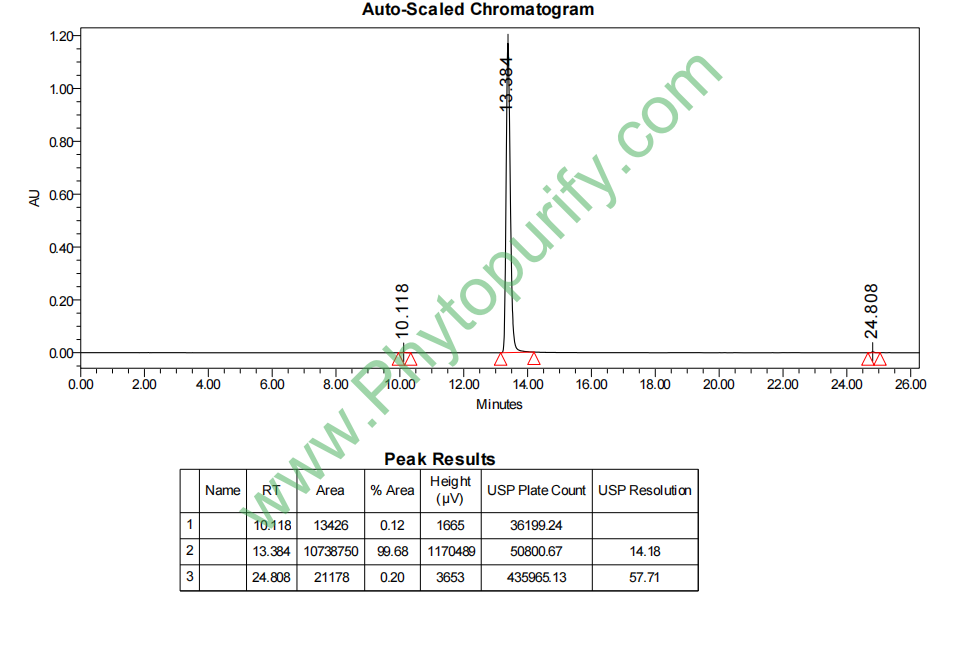
Storage conditions:Short-term storage at 2~8℃, long-term storage at -20 ~ -80℃
Fraxetin (CAS number: 574-84-5) is a natural product isolated from the Fraxinus rhynchophylla Hance plant in the Oleaceae family, belonging to the coumarin class. As a natural small molecule with oral activity, quercetin has attracted widespread attention in pharmacology and natural product drug development in recent years due to its diverse biological activities, especially anti-tumor, antibacterial, antioxidant, and anti-inflammatory pharmacological effects. Qinpi Su not only effectively induces apoptosis in various tumor cells, but also demonstrates significant anti-inflammatory and antioxidant capabilities by regulating multiple cell signaling pathways. In addition, Qinpi Su exhibits excellent antibacterial activity against key targets of various microorganisms, demonstrating its potential application value in anti infective therapy.
This article provides a systematic review of the chemical structure and physicochemical properties, plant sources and extraction methods, pharmacological activity and mechanism of action, pharmacological evaluation and pharmacokinetic characteristics of quercetin, and prospects its clinical application prospects, aiming to provide theoretical basis and reference for further research and development of quercetin.
The chemical name of quercetin is 7,8-dihydroxycoumarin, with a molecular formula of C10H8O4 and a molecular weight of 208.1690. Its structural core is a coumarin skeleton, with hydroxyl substituents at positions 7 and 8, endowing it with strong polarity and biological activity. The LogP value of Qinpi Su is 1.3956, indicating its moderate lipid solubility, which facilitates cell membrane penetration and in vivo distribution. The polar surface area (TPSA) is 79.9 Å ², indicating that it has a certain polarity, which contributes to its water solubility and binding ability with biomolecules.
In terms of water solubility, the solubility of quercetin is about 0.5883 mg/mL, indicating that it has certain solubility properties in aqueous phase, which is convenient for the development of oral administration formulations. Its blood-brain barrier permeability is high, indicating that quercetin may have potential therapeutic effects on central nervous system diseases. It is worth noting that quercetin does not exhibit hERG channel inhibitory activity, reducing its risk of cardiac toxicity. The Ames test result is 0.6, indicating a low risk of genotoxicity and good safety.
Qin Pi Su mainly comes from the bark and leaves of Fraxinus rhynchophylla Hance, a plant in the family Rhinoceros. Qin Pi is widely used in traditional Chinese medicine and has the effects of clearing heat, detoxifying, dispelling wind, and relieving pain. Qin Pi Su, as one of its main active ingredients, has undertaken some pharmacological effects.
The common methods for extracting quercetin include solvent extraction, ultrasound assisted extraction, and high-performance liquid chromatography (HPLC) separation and purification. Generally, ethanol or methanol is used as the extraction solvent, and by optimizing the extraction temperature, time, and solvent concentration, a higher extraction rate can be obtained. Subsequently, the extract was separated and purified using techniques such as silica gel column chromatography and reverse phase HPLC, ultimately obtaining high-purity quercetin.
In recent years, green extraction techniques such as supercritical fluid extraction and microwave-assisted extraction have also been applied in the extraction research of quercetin, aiming to improve extraction efficiency, reduce solvent usage and environmental pollution, and provide technical support for industrial production.
Qinpi Su exhibits significant anti proliferative and pro apoptotic effects in various tumor cell lines. In vitro experiments have shown that quercetin can induce tumor cell apoptosis by activating the mitochondrial pathway, regulate the expression of Bcl-2 family proteins, promote cytochrome C release, and activate the caspase cascade reaction. In addition, quercetin can also inhibit the migration and invasion of tumor cells, blocking the process of tumor metastasis.
In vivo model studies have shown that quercetin has inhibitory effects on tumor growth and low toxicity, demonstrating good therapeutic potential. Its anti-tumor mechanism involves multiple signaling pathways, including PI3K/Akt, MAPK, and NF - κ B, which regulate cell proliferation, apoptosis, and inflammatory response.
Qinpi Su exhibits broad-spectrum antibacterial activity against various bacteria and fungi. Its targets include key enzymes such as bacterial DNA gyrase GYRA, cell wall synthase FABI, dihydrofolate reductase DHFR, as well as fungal enzymes ERG11 and CYP51A1, which block the growth and reproduction of pathogens. Qinpi Su can also inhibit the CDR1 efflux pump of fungi and enhance the sensitivity of antifungal drugs.
In addition, quercetin has inhibitory effects on both Gram positive and Gram negative bacteria, and shows a synergistic effect in combination therapy, indicating its broad application prospects in anti infective therapy.
Qinpi Su exhibits significant antioxidant capacity by scavenging free radicals, inhibiting lipid peroxidation, and regulating the antioxidant enzyme system. It can activate the Nrf2 signaling pathway, enhance intracellular antioxidant defense, and alleviate oxidative stress damage.
In terms of anti-inflammatory effects, quercetin inhibits the expression of inflammatory factors such as TNF - α, IL-6, and IL-1 β, suppresses the activation of the NF - κ B signaling pathway, and alleviates inflammatory responses. It has shown good anti-inflammatory effects in various inflammation models, providing a potential pharmacological basis for the treatment of inflammation related diseases.
The multi-target mechanism of action of Qinpi Su is the basis of its multiple pharmacological activities. In terms of anti-tumor effects, quercetin induces tumor cell apoptosis and inhibits proliferation by regulating cell cycle related proteins, pro apoptotic proteins, and signaling pathways. Specific targets include Bcl-2, Bax, caspase-3, and caspase-9.
The antibacterial mechanism mainly involves the inhibition of key enzymes in bacteria and fungi, such as DNA gyrase GYRA and cell wall synthase FABI, which block pathogen DNA replication and cell wall synthesis. Inhibition of fungal ERG11 and CYP51A1 interferes with sterol biosynthesis and disrupts fungal cell membrane structure.
The antioxidant and anti-inflammatory effects are achieved by activating the Nrf2/ARE pathway, promoting the expression of antioxidant enzymes, inhibiting the NF - κ B and MAPK signaling pathways, reducing the release of inflammatory mediators, and protecting tissues from oxidative and inflammatory damage.
In addition, the regulatory effect of quercetin on cell membrane permeability and signal transduction molecules enables it to exert protective effects in various pathological states.
The pharmacological parameters of Qinpi Su indicate that it has good potential for drug development. The molecular weight of 208.1690 conforms to Lipinski's rule, and the LogP value of 1.3956 shows moderate lipid solubility, which is beneficial for oral absorption. The TPSA is 79.9 Å ², indicating that it has suitable polarity for binding to targets and in vivo distribution.
Moderate water solubility (0.5883 mg/mL), convenient for formulation development. The high permeability of the blood-brain barrier suggests its potential use in the treatment of central nervous system diseases. No hERG channel inhibitory effect, reducing the risk of cardiac toxicity. The Ames test result is 0.6, indicating a low risk of genotoxicity and good safety.
Pharmacokinetic studies have shown that quercetin is well absorbed after oral administration, with high bioavailability and widespread distribution in the body. Its metabolism is mainly through the liver enzyme system, and its excretion pathway is mainly through the kidneys. Its half-life is moderate and suitable for daily administration. Further research is needed on the activity and safety of the metabolites of quercetin.
Qinpi Su has shown broad clinical application prospects due to its multiple pharmacological activities and good medicinal properties. In the field of anti-tumor, quercetin can be used as an adjuvant or combination therapy to improve treatment efficacy and reduce chemotherapy toxicity and side effects. In the treatment of infections, quercetin exhibits inhibitory effects on multiple drug-resistant strains and is expected to become a candidate molecule for novel antibacterial or antifungal drugs.
In addition, the antioxidant and anti-inflammatory properties of quercetin make it potentially valuable in the fields of chronic inflammatory diseases, neurodegenerative diseases, and cardiovascular diseases. Its excellent blood-brain barrier permeability is particularly suitable for drug development in central nervous system diseases.
Future research should focus on preclinical safety evaluation, pharmacokinetic optimization, and formulation development of quercetin. Meanwhile, based on its multi-target mechanism and modern drug design technology, structural optimization and derivative synthesis are carried out to enhance its activity and selectivity. The development of multicenter clinical trials will provide solid evidence for the clinical application of quercetin.
Qinpi Su, as a natural coumarin compound derived from Qinpi, has become a hot topic in natural product pharmacology research due to its diverse pharmacological activities and good medicinal properties. Its multiple mechanisms of action, including anti-tumor, antibacterial, antioxidant, and anti-inflammatory effects, provide new ideas and candidate drug molecules for the treatment of various diseases. Although significant progress has been made in current research, the clinical application of quercetin still faces many challenges and requires further in-depth pharmacological mechanisms, pharmacokinetics, and safety studies.
Overall, Qinpi Su has significant potential to become a new type of natural medicine, and in the future, through interdisciplinary cooperation and technological innovation, it is expected to promote its transition from laboratory to clinical use, benefiting patients.
