| Catalog No | Package | Original Price | Price | Inventory | Quantity | Operating |
|---|---|---|---|---|---|---|
| BP3054-100mg | 100mg | $30.00 | Sign in |
|


Product name: Adenosine
Synonym name:
Catalogue No.: BP3054
Cas No.: 58-61-7
Formula: C10H13N5O4
Mol Weight: 267.245
Botanical Source:
Physical Description: Powder
Type of Compound: Alkaloids
Purity: 95%~99%
Analysis Method: HPLC-DAD or/and HPLC-ELSD
Identification Method: Mass, NMR
Packing: Brown vial or HDPE plastic bottle
The product could be supplied from milligrams to grams. Inquire for bulk scale.
We provide solution to improve the water-solubility of compounds, thereby facilitating the variety of activity tests and clinic uses.
For Reference Standard and R&D, Not for Human Use Directly.
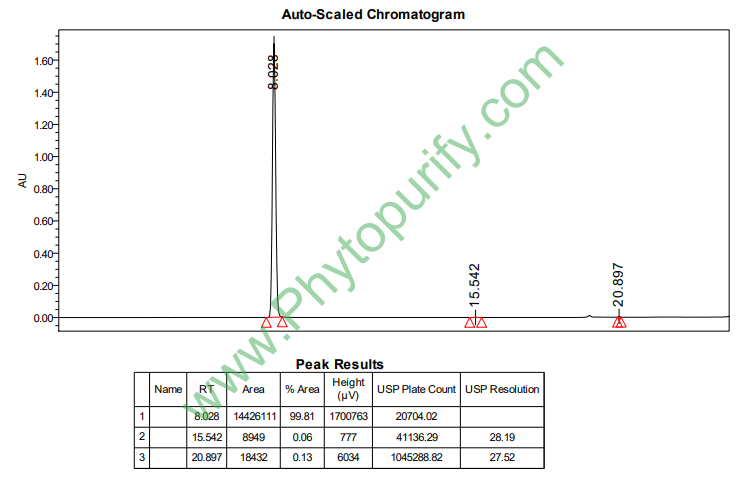
HPLC of Adenosine
Storage conditions:Short-term storage at 2~8℃, long-term storage at -20 ~ -80℃
139.5400
-1.0491
-1.0498
12.0312
.4621
.3058
High
26.4195
3.5313
Yes
Yes
No
No
Yes
No
1.2
Yes
No
Yes
Yes
Adenosine (CAS number: 58-61-7), as an endogenous nucleoside compound, is widely present in the human body and various organisms, playing important physiological and pathological regulatory roles. Its structure is composed of adenine bases and ribose connected by β - N9 glycosidic bonds, and it is a key molecule in cellular energy metabolism and signal transduction. Adenosine nucleotides not only act as precursors for nucleic acid synthesis, but also regulate neuronal excitability, vascular tone, platelet aggregation, and immune cell function by binding to four G protein coupled receptors (A1, A2A, A2B, and A3), involving multiple physiological processes. In recent years, the pharmacological effects of adenosine have attracted widespread attention in the fields of cardiovascular disease, neurodegenerative diseases, inflammation, and tumors, especially showing significant protective effects in pathological states such as myocardial ischemia.
This article will provide a systematic review of the chemical structure and physicochemical properties, plant sources and extraction methods, pharmacological activity, mechanism of action and molecular targets, pharmacological evaluation and pharmacokinetic characteristics of adenine nucleoside, combined with its potential and challenges in clinical applications, aiming to provide comprehensive references for research in natural product pharmacology and related fields.
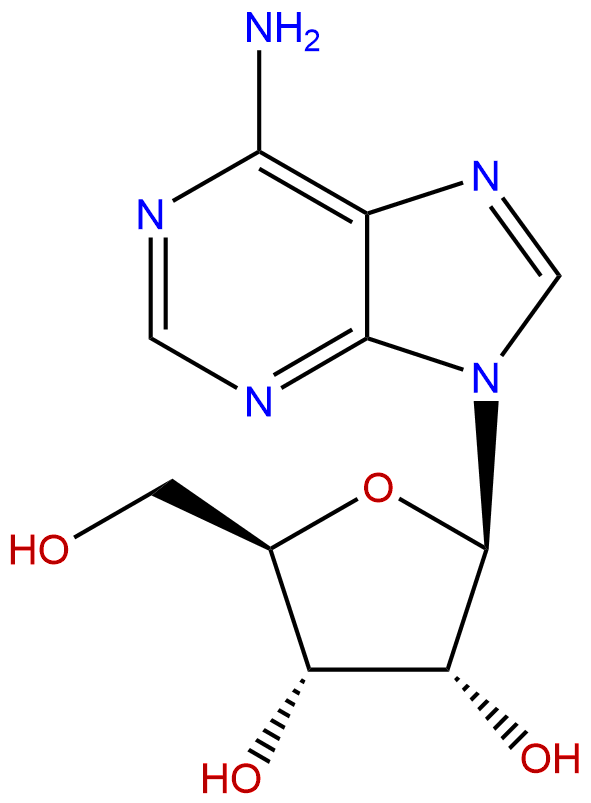
The chemical name of adenine nucleoside is 9- β - D-ribosyl adenine, with a molecular formula of C10H13N5O4 and a molecular weight of 267.2450. Its structural feature is that a purine base (adenine) is connected to D-ribose through a β - N9 glycosidic bond, forming a nucleoside molecule. The purine ring in the structure has multiple nitrogen atoms, giving it strong alkalinity and hydrophilicity.
In terms of physical and chemical properties, adenine nucleoside exhibits high polarity, with a calculated topological polar surface area (TPSA) of 139.54 Å ², indicating good water solubility (approximately 12.03 mg/mL), and a LogP value of -1.0491, indicating strong hydrophilicity and difficulty in passing through lipid membranes. However, adenosine can efficiently cross the blood-brain barrier (BBB), which may be related to its specific transport mechanism. In addition, adenosine does not exhibit hERG channel inhibitory activity, indicating a lower risk of cardiac toxicity. The Ames test value is 1.2, indicating a low risk of genotoxicity.
The stability of adenine nucleoside is greatly affected by pH and enzymatic hydrolysis, and it is easily metabolized by adenosine deaminase and nucleosidase in the body, forming metabolites such as hypoxanthine nucleotides, which have an important impact on its pharmacokinetic properties.
Adenosine nucleoside, as a widely present nucleoside compound, has been found in various plant, microbial, and animal tissues. Adenosine nucleotides are mainly present in the nuclei and cytoplasm of tea leaves, ginkgo leaves, ginseng, and various medicinal plants in plants. Its content is greatly affected by plant species, growth environment, and harvesting time.
Traditional extraction methods mainly include water extraction, alcohol extraction, and their combinations. Due to the strong polarity of adenosine nucleotides, water extraction method is commonly used, usually combining hot water extraction with ultrasound assisted extraction to improve efficiency. The extract is purified by concentration, decolorization, ion exchange, and column chromatography, and finally separated and quantitatively analyzed by high performance liquid chromatography (HPLC).
Modern extraction techniques such as supercritical fluid extraction, membrane separation, and molecular imprinting have gradually been applied to the purification of adenine nucleotides, significantly improving purity and recovery rates. Adenosine nucleotides derived from plants have become an important resource for the development of natural medicines due to their naturalness and biological activity.
Adenosine plays a crucial role in various physiological and pathological processes, and its pharmacological activities cover multiple aspects such as cardiovascular regulation, neuroprotection, immune regulation, and anti-inflammatory effects.
Cardiovascular protective effect
Adenosine nucleotides regulate the energy metabolism and calcium homeostasis of myocardial cells by activating A1 and A3 receptors, reducing myocardial ischemia-reperfusion injury. It can reduce myocardial oxygen consumption, inhibit arrhythmia, and improve functional impairment caused by myocardial ischemia. In addition, adenine nucleotides dilate coronary arteries through A2A and A2B receptors, promote blood flow perfusion, and alleviate hypoxia in ischemic areas.
Neuroprotective effect
Adenosine, as a neurotransmitter and regulatory factor, regulates neuronal excitability and synaptic transmission. It inhibits neuronal overexcitation through A1 receptors, reduces glutamate release, lowers excitotoxicity, and protects neurons from damage. The A2A receptor-mediated signaling pathway is involved in the regulation of neuroinflammation and alleviates the pathological process of neurodegenerative diseases.
Immune regulation and anti-inflammatory effects
Adenosine nucleotides regulate the activity of immune cells, inhibit the release of inflammatory factors such as IL-6 and TNF - α, and alleviate inflammatory responses. Its activation of A2A and A2B receptors promotes the production of anti-inflammatory cytokines, regulates macrophage and lymphocyte function, and helps maintain immune homeostasis.
Blood system regulation
Adenosine nucleoside inhibits platelet aggregation, prevents thrombosis, and improves microcirculation. It regulates endothelial function, promotes nitric oxide (NO) synthesis, enhances vasodilation response, and lowers blood pressure.
The biological effects of adenosine nucleotides are mainly achieved by binding to four adenosine receptors (A1, A2A, A2B, A3), all of which are G protein coupled receptors (GPCRs) with significant differences in expression in different tissues, mediating diverse signal transduction pathways.
In myocardial ischemia pathology, adenosine exerts protective effects by regulating multiple key molecular targets:
The synergistic effect of these targets constitutes a complex regulatory network of adenosine nucleotides in myocardial protection and other pathological states.
The pharmacological evaluation of adenine nucleoside shows that it has good safety and biological activity potential. Its molecular weight is moderate (267.2450), polarity is high (TPSA 139.54), and it has good water solubility (12.03 mg/mL), which is beneficial for in vivo distribution and absorption. Although the LogP value is low, indicating strong hydrophilicity, it can effectively penetrate the blood-brain barrier, supporting its application in central nervous system diseases.
Adenosine does not exhibit hERG channel inhibition, reducing the risk of cardiac toxicity. The Ames test results show that its genotoxicity risk is low and meets drug safety requirements.
In terms of pharmacokinetics, adenine nucleoside is rapidly absorbed after oral administration, but its metabolism rate in the body is fast, mainly through adenosine deaminase and nucleosidase metabolism, producing metabolites such as hypoxanthine nucleotides. Its short half-life limits its sustained clinical efficacy. To this end, researchers have attempted to improve its pharmacokinetic properties through strategies such as structural modification, sustained-release formulations, and receptor agonist development.
Adenosine nucleoside, as a natural endogenous molecule, has shown broad prospects in clinical applications due to its multi-target and multi pathway pharmacological effects. Its potential is particularly prominent in the fields of myocardial ischemia, neuroprotection, immune regulation, and anti-inflammatory.
cardiovascular disease
The protective effect of adenosine in myocardial ischemia and ischemia-reperfusion injury has been extensively validated through animal experiments and some clinical trials. In the future, cardiovascular drugs based on adenosine receptor regulation can be developed to improve myocardial function and reduce the incidence of arrhythmia.
Neurological disorders
The regulatory effect of adenosine on neuronal excitability and neuroinflammation provides a new therapeutic approach for neurodegenerative diseases such as Alzheimer's disease, Parkinson's disease, and stroke. Its efficient penetration of the blood-brain barrier makes it an ideal candidate for central nervous system drug development.
Immune and inflammatory diseases
Adenosine nucleotides have shown potential in treating autoimmune diseases, chronic inflammation, and tumor microenvironment regulation by regulating immune cell function and inflammatory cytokine expression. In the future, the combination of targeted delivery technology is expected to improve its therapeutic effect.
Drug development challenges
The rapid metabolism and short half-life of adenosine limit its clinical application, and it is necessary to improve its stability and bioavailability through chemical modification, drug delivery system optimization, and other means. In addition, in-depth research on receptor subtype specific regulation will help reduce side effects and improve treatment selectivity.
Adenosine nucleoside, as an important endogenous nucleoside natural product, occupies a core position in the field of natural product pharmacology due to its extensive biological functions and multi-target regulatory ability. Its multiple mechanisms of action in cardiovascular protection, neuroprotection, and immune regulation provide a rich theoretical basis and practical direction for the development of new drugs. In the future, combining modern medicinal chemistry, molecular biology, and pharmacokinetic techniques, adenine nucleoside and its derivatives are expected to become effective drugs for treating various complex diseases. Continuous in-depth mechanism research and clinical translation exploration will promote its transition from laboratory to clinical application, benefiting the vast number of patients.
