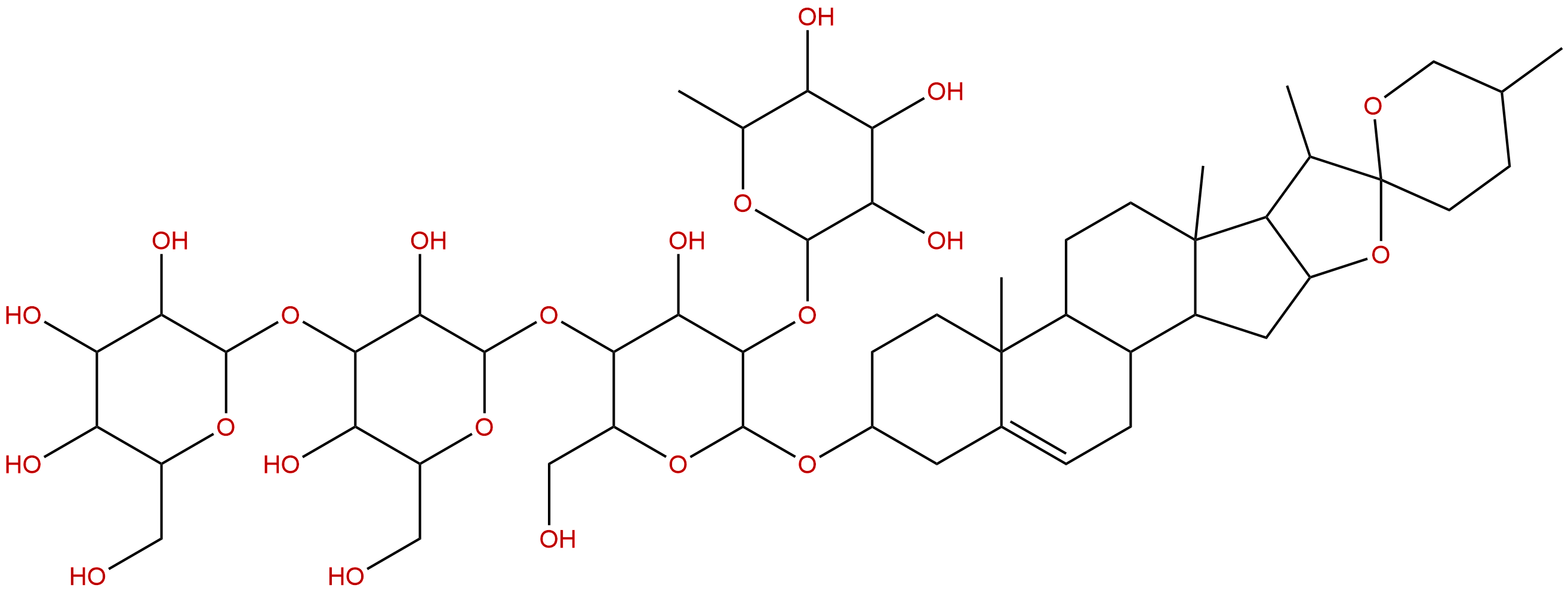


Product name: Zingiberensis saponin I
Synonym name:
Catalogue No.: BP3407
Cas No.: 91653-50-8
Formula: C51H82O22
Mol Weight: 1047.2
Botanical Source:
Physical Description:
Type of Compound: Triterpenoids
Purity: 95%~99%
Analysis Method: HPLC-DAD or/and HPLC-ELSD
Identification Method: Mass, NMR
Packing: Brown vial or HDPE plastic bottle
The product could be supplied from milligrams to grams. Inquire for bulk scale.
We provide solution to improve the water-solubility of compounds, thereby facilitating the variety of activity tests and clinic uses.
For Reference Standard and R&D, Not for Human Use Directly.
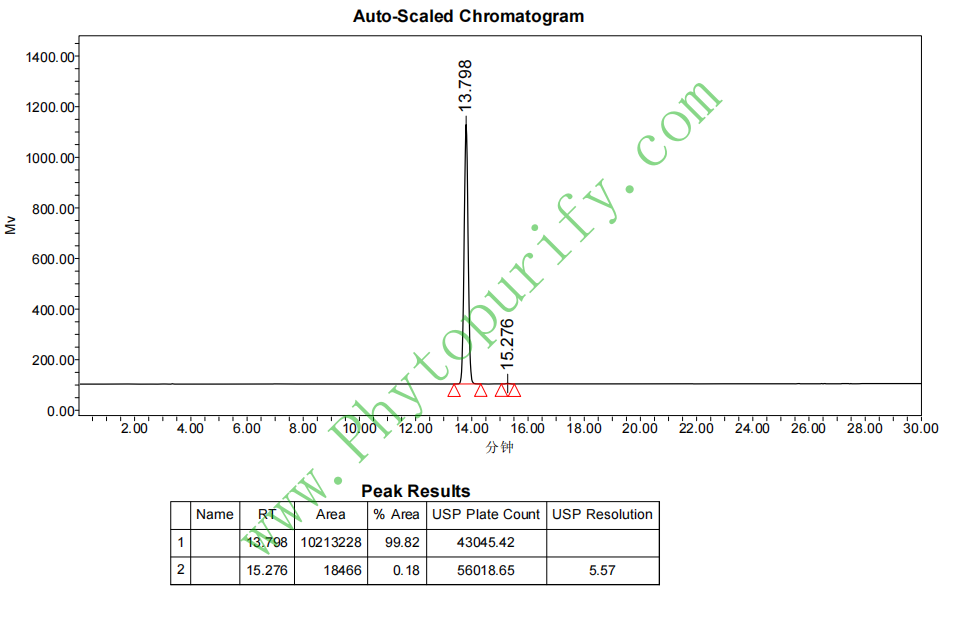
HPLC of Zingiberensis saponin I
Storage conditions:Short-term storage at 2~8℃, long-term storage at -20 ~ -80℃
335.0600
1.3896
1.3894
.2269
.4379
.4241
Low
62.6340
7.1746
No
No
No
No
No
No
0.3
Yes
No
Yes
No
Zingiberensis saponin I is a natural steroidal saponin isolated from the traditional medicinal plant Dioscorea zingiberensis. Its CAS number is 91653-50-8, the molecular formula is C51H82O22, and the molecular weight is as high as 1047.2000 g/mol. It belongs to the complex structure of large molecule natural products. In the fields of natural product chemistry and drug discovery, steroidal saponins have attracted much attention due to their wide range of biological activities. As one of them, the research value of Dunye Xin Gan mainly focuses on its significant anti-inflammatory activity. Existing pharmacological studies have shown that it can intervene in the inflammatory signaling pathway by acting on multiple key inflammation related targets, such as TNF, PTGS2, NFKB1, IL6, and IL1B. Although the plant derived Dioscorea nipponica has long been used in traditional medicine, the systematic study of new saponins from Dioscorea nipponica as a single active ingredient, especially their precise molecular mechanisms and potential for medicinal development, remains a cutting-edge topic in modern natural medicine chemistry and pharmacology research. This article will provide a systematic professional interpretation of this compound from its chemical nature, origin, pharmacological mechanism, drug properties, and prospects.
The molecular formula of Shield Leaf Glycoside is C51H82O22, with a molecular weight of 1047.2000 g/mol, and it is a typical steroid saponin compound. From its SMILES structural formula, it can be inferred that the core of its structure is the steroid mother nucleus (cyclopentane and phenanthrene structure), which is connected to multiple sugar groups (such as glucose) through glycosidic bonds, forming a complex sugar chain structure. The structural characteristics of these polyhydroxy and polysaccharide groups directly determine their physical and chemical properties.
According to the provided pharmacokinetic parameters, the logarithm of the lipid water partition coefficient (LogP) is 1.3896 and the LogD is 1.3894, indicating that the compound has a certain degree of lipophilicity under physiological pH conditions, but not highly lipophilic. Its topological polar surface area (TPSA) is as high as 335.0600 Å ², which is closely related to the presence of a large number of polar groups such as hydroxyl and ether bonds in its molecules. A high TPSA value usually indicates high molecular polarity and good water solubility, but limited transmembrane permeability. The calculated water solubility is 0.2269 mg/mL, belonging to the category of slight solubility, which is consistent with the expected portion of highly polar molecules. However, the complex structure may also lead to high crystal stacking energy, affecting the actual solubility.
The molecular weight far exceeds the limit of conventional small molecule drugs (500 Da), which poses the primary challenge for their oral absorption and bioavailability. Overall, Shield Leaf Glycoside is a highly polar and high molecular weight steroidal saponin, and its physicochemical properties lay the foundation for its subsequent biological activity and pharmacokinetic behavior.
The plant source of Dioscorea zingiberensis is Dioscorea zingiberensis C.H. Wright, commonly known as "yellow ginger", "fire vine root", etc. It is a perennial winding herbaceous plant of the Dioscoreaceae family and the Dioscorea genus. This plant is mainly distributed in the Yangtze River Basin and southern regions of China, such as Hubei, Sichuan, Shaanxi, and other places.
In traditional Chinese medicine practice, the rhizome of Dioscorea opposita (often referred to as "yellow ginger") has a long history of application. It is warm in nature, bitter and pungent in taste, and belongs to the liver and spleen meridians. Traditionally used for dispelling wind and dampness, promoting blood circulation and unblocking collaterals, reducing swelling and relieving pain. Commonly used for the treatment of rheumatism, joint discomfort, injuries from falls, abscesses, and other conditions. These efficacy descriptions are often related to "inflammation" and "pain", implying that they contain a substance basis for anti-inflammatory activity. Modern plant chemistry research has confirmed that Dioscorea opposita is rich in various steroidal saponins, which are considered the main carriers of its pharmacological activity. Dunyexin glycoside is one of the many active saponins isolated and identified from this plant. The traditional application experience has pointed out the direction for modern research, which is to search for effective anti-inflammatory and analgesic ingredients from this plant, and the discovery of shiitabine is the result of this approach.
The core pharmacological activity of Shield Leaf Glycoside is concentrated in anti-inflammatory Function. Its mechanism of action is not through a single target, but through the intervention of multiple targets and pathways in the complex inflammatory network. The existing target information suggests that it mainly acts on five key inflammatory mediators and signaling molecules: TNF, PTGS2, NFKB1, IL6, and IL1B.
Regulation of pro-inflammatory cytokines (TNF, IL6, IL1B):
Intervention on key inflammatory enzymes and signaling pathways (PTGS2, NFKB1):
Integrated explanation of mechanism of action Shield leaf glycoside may inhibit the overactivation of the NF - κ B signaling pathway directly or indirectly. The downregulation of NF - κ B activity leads to a decrease in the expression of downstream target genes such as TNF - α, IL-6, IL-1 β, and COX-2. Meanwhile, it may also independently inhibit the activity of COX-2 enzyme. In this way, from the transmission of inflammatory signals (NF - κ B pathway), the production of inflammatory mediators (TNF - α, ILs) to the synthesis of final effector molecules (prostaglandins), Shield Leaf Glycosides achieve multi-level and multi-target synergistic inhibition, thereby exerting strong anti-inflammatory effects. This multi-target characteristic makes it potentially advantageous in the treatment of complex chronic inflammatory diseases such as rheumatoid arthritis, osteoarthritis, and inflammatory bowel disease.
Based on the provided pharmacological parameters and in combination with classic standards such as the Lipinski Rule of Five (Ro5), a preliminary evaluation of the pharmacological potential of Shield Leaf Glycoside can be conducted. The Lipinski rule is commonly used to predict the absorption and permeability of small molecule oral drugs, with core criteria being: molecular weight MW<500, LogP<5, number of hydrogen bond donors HBD<5, and number of hydrogen bond acceptors HBA<10.
Comprehensive evaluation conclusion As a lead compound, Shield Leaf Glycoside Advantage It lies in a clear, multi-target anti-inflammatory pharmacological mechanism and relatively low initial genetic toxicity and cardiac toxicity risk. However, it Significant pharmaceutical defects Due to its excessive molecular weight (violating Ro5) and extremely high polar surface area, its expected oral bioavailability is extremely low, making it difficult to administer through conventional oral routes. This determines that it is unlikely to be directly developed as a traditional small molecule oral drug.
Future development strategies may need to shift towards:
1. New drug delivery system Such as nano formulations (liposomes, polymer nanoparticles), prodrug strategies, or transdermal delivery systems to improve their absorption and delivery.
2. Injection administration Develop intravenous or local injection formulations to bypass absorption barriers and directly exert systemic or local anti-inflammatory effects.
3. Research on the mechanism of action It can serve as an excellent molecular probe for in-depth research on the anti-inflammatory signaling network of steroidal saponins, or as a structural template for rational analysis Simplification or modification of structure While retaining the pharmacophore, reduce molecular weight and polarity, and optimize the properties of the drug.
At present, research on the new glycoside of shield leaves is still in progress Preclinical stage Mainly focused on plant chemistry (extraction, isolation, structural identification), in vitro pharmacological activity screening, and preliminary mechanism of action exploration. Previous studies have confirmed its anti-inflammatory activity and effects on multiple inflammatory targets, but further details on signaling pathways, in vivo pharmacological validation (in animal disease models), comprehensive pharmacokinetics (absorption, distribution, metabolism, excretion), and toxicological evaluation are still insufficient.
Application Prospects Mainly reflected in the following aspects:
Future research directions It should include: ① Using gene knockout/knockdown techniques, reporter gene systems, etc., to accurately elucidate the specific molecular links involved in their intervention in pathways such as NF - κ B at the cellular level; ② Establish a suitable animal model of inflammation and evaluate its in vivo efficacy and dose-response relationship; ③ Conduct systematic ADMET (absorption, distribution, metabolism, excretion, and toxicity) research to identify development bottlenecks and solutions; ④ Conduct in-depth structure-activity relationship research and obtain derivatives with better activity and drug properties through chemical synthesis or semi synthesis methods.
In summary, Shield Leaf Glycoside is a natural steroidal saponin with clear anti-inflammatory activity, and its multi-target mechanism of action endows it with unique value. Despite facing significant challenges in drug formulation, it is still expected to occupy a place in the prevention and treatment of inflammatory diseases in the future through innovative drug chemistry strategies and dosage form design, or at least provide valuable structural insights and biological understanding for the design of new generation anti-inflammatory drugs.
