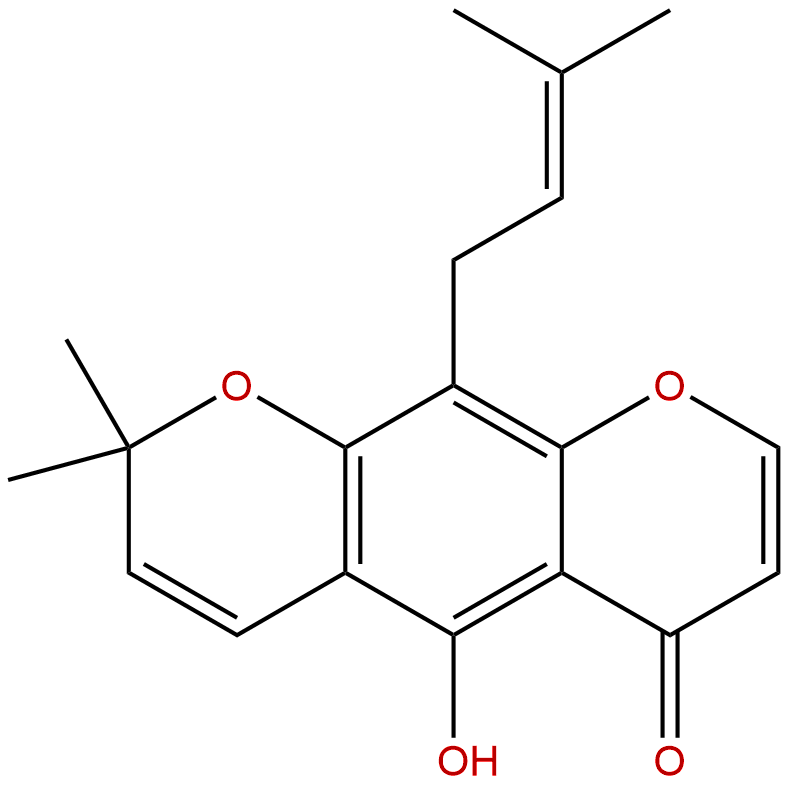
Eriosematin: Natural products from Jijinba and their potential in the treatment of diabetes nephropathy
1. Overview
Eriosematin (CAS number: 168010-17-1) is a natural organic compound with the molecular formula C19H20O4 and a molecular weight of approximately 312.37 g/mol. It was initially isolated from the roots of the leguminous plant Flemingia philippinensis, and subsequent studies have also found its presence in the same family plant Millettia speciosa. This compound has attracted attention in the field of natural product pharmacy due to its unique chemical structure and significant biological activity. Preliminary studies have revealed that Eriosematin has Anti proliferative activity and Inducing cell apoptosis The characteristics suggest that it may have application value in the field of anti-tumor. However, more in-depth research has found that its target is highly related to the key pathological links of diabetes nephropathy (DN), including TGFB1, NOS3, COL4A1, RAGE and AGER1, which makes its research focus gradually shift to the prevention and treatment of chronic kidney diseases, especially diabetes nephropathy. Diabetes nephropathy is one of the most serious and common microvascular complications of diabetes and the main cause of end-stage renal disease. As a natural lead compound with multi-target intervention potential, Eriosematin provides new ideas and candidate molecules for the development of new therapeutic drugs for diabetes nephropathy. This article will systematically elaborate on its chemical structure, plant origin, pharmacological mechanism, evaluation of medicinal properties, and research prospects.
2. Chemical structure and physicochemical properties
The molecular formula of Eriosematin is C19H20O4, which is a natural product with medium molecular weight. The SMILES string is "CC (C)=CCc1c2c (c (O) c3c (=O) ccoc13) C=CC (C) (C) O2", depicting a complex fused ring system. Structurally, it is likely to contain the basic skeleton of benzofuran or chromane, and is connected with hydrophobic groups such as isopentenyl. This structure is commonly found in plant secondary metabolites and is often associated with various biological activities.
Its pharmacological parameters provide a quantitative basis for us to understand its physical and chemical properties and behavior:
- Molecular weight (MW)312.37, far below 500, meets the requirements of Lipinski's five rules for the molecular weight of oral drugs.
- Lipid water partition coefficient (LogP/LogD)LogP is 4.17 and LogD is 4.13, indicating that the compound has Strong lipophilicity This is beneficial for its penetration through the cell membrane, but it may also lead to poor water solubility. Its water solubility parameter is 0.0202 (unit may be mg/mL or mol/L, usually indicating low solubility), which confirms this.
- Topological Polarity Surface Area (TPSA)59.67 Å ², which is relatively low and usually associated with good membrane permeability. TPSA less than 140 Å ² and moderate molecular weight are positive indicators of good oral bioavailability of compounds.
- Permeability and Distribution The permeability of Caco-2 cells is 17.76 (high values indicate good permeability), and the predicted human effective permeability (Peff) is 4.64 cm/s × 10 ⁻⁴, both indicating that it has Good intestinal absorption potential More importantly, its blood brain barrier (BBB) penetration is predicted to be "high", which means that Eriosematin may be able to enter the central nervous system, which may be an additional advantage in the treatment of diabetes complications with neuropathy, but it is also necessary to be alert to potential neurotoxicity risks.
- Protein binding rate (PPB)As high as 90.18%, it indicates that it mainly binds to plasma proteins (such as albumin) in the blood. High protein binding rate can affect the free concentration, distribution volume, and clearance rate of drugs, which need to be comprehensively considered in drug design.
From a chemical perspective, the structural characteristics of Eriosematin determine its basic properties of strong hydrophobicity and good membrane permeability, which lays the foundation for its intracellular pharmacological effects.
3. Plant sources and traditional applications
The main plant source of Eriosematin is Millettia speciosa Champ Also known as Beautiful Cliff Bean Vine or Niu Dali. It belongs to the Fabaceae family and is a perennial shrub mainly distributed in southern China, such as Guangdong, Guangxi, Hainan, etc. The dried root of Qianjin Ba is a famous folk medicinal herb with a long history of application in the Lingnan region.
In traditional medicine, the root of a thousand catties is often used for Tonifying deficiency and moistening the lungs, strengthening tendons and activating collaterals, and nourishing the kidneys It is commonly used to treat symptoms such as lung deficiency cough, rheumatoid arthritis, lumbar muscle strain, chronic hepatitis, and post disease body deficiency. Its usage is mostly for decoction or soaking in wine, reflecting the folk recognition of its nourishing and strong effects. Although the traditional application does not clearly point to diabetes nephropathy, its effect of "tonifying the kidney" has some similarities with the concept of improving kidney function in modern medicine. Plant chemistry studies have shown that Qianjin Ba contains abundant flavonoids, alkaloids, steroids, and isopentenyl phenolic compounds such as Eriosematin, which together form the material basis of its pharmacological activity. The discovery of Eriosematin, which has anti diabetes nephropathy targeting activity, from the traditional medicinal materials used for "tonifying the kidney and strengthening the body", is a typical case of "new use of old drugs" in the modernization research of traditional Chinese medicine, and also provides some modern scientific basis for explaining the traditional efficacy of this medicinal material.
4. Pharmacological activity and mechanism of action
Erioseatin was initially discovered for its anti proliferative and pro apoptotic activities, but existing target information strongly suggests its potential in Diabetes nephropathy (DN) It has more specific potential in prevention and treatment. The main pathological features of diabetes nephropathy include glomerular hypertrophy, basement membrane thickening, excessive accumulation of extracellular matrix (ECM) (glomerulosclerosis/renal interstitial fibrosis) and progressive proteinuria. The five targets associated with Eriosematin happen to be deeply involved in these pathological processes:
-
TGF - β 1 (transforming growth factor - β 1)This is the pathogenesis of DN Core pro fibrotic factors A high glucose environment can activate the TGF - β 1 signaling pathway in the kidneys, leading to mesangial cell proliferation, increased synthesis of ECM (such as type IV collagen), inhibition of degradation, and ultimately causing renal fibrosis. Inhibiting the TGF - β 1 signaling pathway is an important strategy for treating diabetic nephropathy. If Eriosematin can act on TGFB1, it may inhibit the fibrosis process upstream.
-
COL4A1 (type IV collagen alpha 1 chain)Type IV collagen is the main structural component of the glomerular basement membrane (GBM). In the early stage of diabetic nephropathy, GBM thickens and changes permeability due to abnormal synthesis of components such as COL4, leading to microalbuminuria. Directly or indirectly (such as by inhibiting TGF - β 1) regulating the expression of COL4A1 helps maintain the normal structure and function of GBM.
-
RAGE (receptor for advanced glycation end products) and AGER1 (negative regulatory receptor/detoxifying receptor of RAGE)This is a pair of key receptors with opposite effects. Persistent hyperglycemia leads to the accumulation of advanced glycation end products (AGEs).RAGE is the main signaling receptor for AGEs Its activation triggers oxidative stress, inflammatory responses (such as the NF - κ B pathway), and further upregulates TGF - β 1, forming a vicious cycle and accelerating kidney damage. But AGER1 is believed to have the ability to clear AGEs and antagonize RAGE signaling It has a protective effect on the kidneys. An ideal intervention strategy is to simultaneously inhibit RAGE and promote AGER1 function. Eriosematin simultaneously associates these two targets, suggesting that it may possess the unique ability of "bidirectional regulation" by blocking the damage axis of AGEs RAGE while enhancing the body's endogenous protective mechanisms.
-
NOS3 (endothelial nitric oxide synthase)In the kidneys, the NO produced by NOS3 is crucial for maintaining renal vasodilation, renal blood flow, inhibiting platelet aggregation, and leukocyte adhesion. In the state of diabetes, oxidative stress and other factors often lead to dysfunction or "uncoupling" of NOS3, which reduces the bioavailability of NO, while the production of superoxide anion increases, exacerbating endothelial dysfunction and renal ischemic injury. Protecting or enhancing NOS3 function can help improve renal microcirculation.
Mechanism of action integration speculation Based on the above target analysis, we can outline the possible network of Eriosematin: in the environment of diabetes nephropathy, Eriosematin may Antagonistic RAGE signaling and Enhance AGER1 functionality To alleviate the oxidative stress and inflammatory response induced by AGEs; Furthermore, it may Inhibiting the core pro fibrotic factor TGF - β 1 Excessive activation; The downregulation of TGF - β 1 directly leads to Reduced synthesis of key extracellular matrix components such as COL4A1 Relieve glomerulosclerosis and basement membrane thickening; Meanwhile, by reducing oxidative stress and improving the microenvironment, it may help Protect NOS3 function Increase the production of renal protective NO and improve renal blood flow. This multi target and multi link intervention mode just aims at the complex and network pathogenesis of diabetes nephropathy, showing its potential as a multi target therapeutic molecule.
Its original "anti proliferation" and "induction of apoptosis" activities may also act on abnormally proliferating renal mesangial cells or fibroblasts in the context of diabetic nephropathy, inhibiting their excessive growth and delaying the fibrosis process.
5. Evaluation of drug properties
Drug efficacy assessment aims to predict the likelihood of a compound developing into a successful drug. We combined Lipinski's Rule of Five (Ro5) and other key parameters to analyze Eriosematin:
-
Lipinski Five Rule Compliance:
- Molecular weight<500 Da:Comply with(312.37)。
- LogP < 5:Comply with(4.17, although close but not exceeding).
- Number of hydrogen bond donors (HBD): Based on the molecular formula and structure, it should be less than 5 (- OH, etc.).Comply with。
- Number of hydrogen bond acceptors (HBA): Inferred from the molecular formula O4, not exceeding 10.Comply with。
Eriosematin fully complies with Lipinski's five rules, indicating its good performance Oral absorption potential。
-
Permeability and Distribution As mentioned earlier, its TPSA value is low (59.67 Å ²), Caco-2 permeability is high, and the Peff prediction value is ideal, all of which support its good intestinal absorption and membrane permeability. High BBB penetration is a double-edged sword, and its advantages and disadvantages need to be validated in specific disease models.
-
Metabolism and Toxicity (ADMET):
- Toxicity Warning The database indicates multiple potential toxicity risks that require high vigilance
- Genotoxicity Ames test (0.6, usually<0.8 is negative, caution should be exercised when approaching the critical value) and chromosomal aberration ("present") show positive signals, which are commonly used in drug development Red Alert It must be thoroughly validated through more comprehensive experiments such as in vitro micronucleus assay, in vivo comet assay, etc.
- Organ toxicity Serum biomarkers suggest that they may have an impact on the liver (elevation of ALT, AST, GGT) and muscles (elevation of ALK). Positive results for "skin sensitization" and "respiratory sensitization" also require attention.
- Phototoxicity This compound may cause skin toxicity under light exposure.
- protein binding High PPB (90.18%) may affect drug efficacy and drug interactions.
- HERG inhibition Predicted as' no ', this is a positive signal that reduces the risk of causing QT interval prolongation and apical torsion ventricular tachycardia in the heart.
Comprehensive Assessment Eriosematin is here Pharmacodynamics (PK) Excellent performance in various aspects, with a good drug like basis and oral absorption prospects. However, it is Toxicology of Drugs (Tox) The data in this area has raised multiple red lights, especially regarding potential genetic toxicity and organ toxicity, which are on the path towards drug development Main obstacles Whether these toxicities are caused by the parent nucleus structure of the compound or specific metabolites, they need to be optimized and avoided through structural modifications (such as synthesizing derivatives). Optimization of lead compounds is a common and necessary step in natural product research.
6. Research Status and Application Prospects
At present, there is relatively limited public research literature on Eriosematin, and its biological activity data mainly comes from preliminary screening and computational predictions during plant chemical isolation and identification. It has changed from a natural molecule with anti-tumor potential to a very attractive one due to the high correspondence between the target information and the pathology of diabetes nephropathy Natural lead compounds for anti diabetes nephropathy。
Research status:
1. Basic research stage Most of the work focuses on isolating and identifying the compound from plants such as Qianjin Ba. Its activity against targets related to diabetes nephropathy is mostly based on database correlation and calculation prediction, which is urgently needed Empirical evidence of in vitro and in vivo experiments It is necessary to use high glucose induced mesangial cells, podocyte models, and STZ induced or db/db and other diabetes nephropathy animal models to systematically verify their regulatory effects on the above targets (TGF - β 1, RAGE/AGER1, COL4A1, NOS3), and confirm their efficacy in improving proteinuria, renal fibrosis and other pathological phenotypes.
2. Initial exploration of medicinal properties The clear chemical structure and preliminary ADMET parameters laid the foundation for subsequent research, but prominent toxicity prediction is a core issue that must be addressed and solved.
Application prospects and future directions:
1. As a lead compound for structural optimization This is the most likely development path. Pharmaceutical chemists can use it as a template to systematically analyze it through semi synthetic or total synthetic methods Structural modification The goal is to maintain or enhance its multi-target anti diabetes nephropathy activity,Significantly reduce its genetic toxicity and organ toxicity For example, introducing hydrophilic groups to improve solubility, modifying sites that may produce toxic metabolites, etc.
2. Deep analysis of the mechanism of action It is necessary to clarify whether Eriosematin directly binds to these target proteins or indirectly affects them by regulating upstream signaling pathways. Utilize surface plasmon resonance (SPR), cellular thermal shift analysis (CETSA) and other techniques to identify its direct target and create a detailed signaling pathway map.
3. Exploring the potential of combination therapy Given its multi-target nature, it may be considered to combine it with existing DN treatment drugs (such as SGLT2 inhibitors and RAS system inhibitors) in the future to investigate whether there is a synergistic effect.
4. Expand other indications Its association with targets such as RAGE and TGF - β 1 suggests that it may have research value in other fibrotic diseases (such as liver fibrosis, pulmonary fibrosis) or chronic inflammatory diseases.
In conclusion, Eriosematin is a natural lead compound that conforms to the drug like rules, has a novel mechanism of action, and is closely related to the major disease diabetes nephropathy. Despite the severe challenge of toxicity, it provides a valuable starting point for the development of anti diabetes nephropathy drugs with a new mechanism of action. Future research needs to focus on overcoming its toxicity problems on the basis of confirming its efficacy, and transform it into a safe and effective candidate drug through reasonable drug design, ultimately benefiting the majority of diabetes patients.