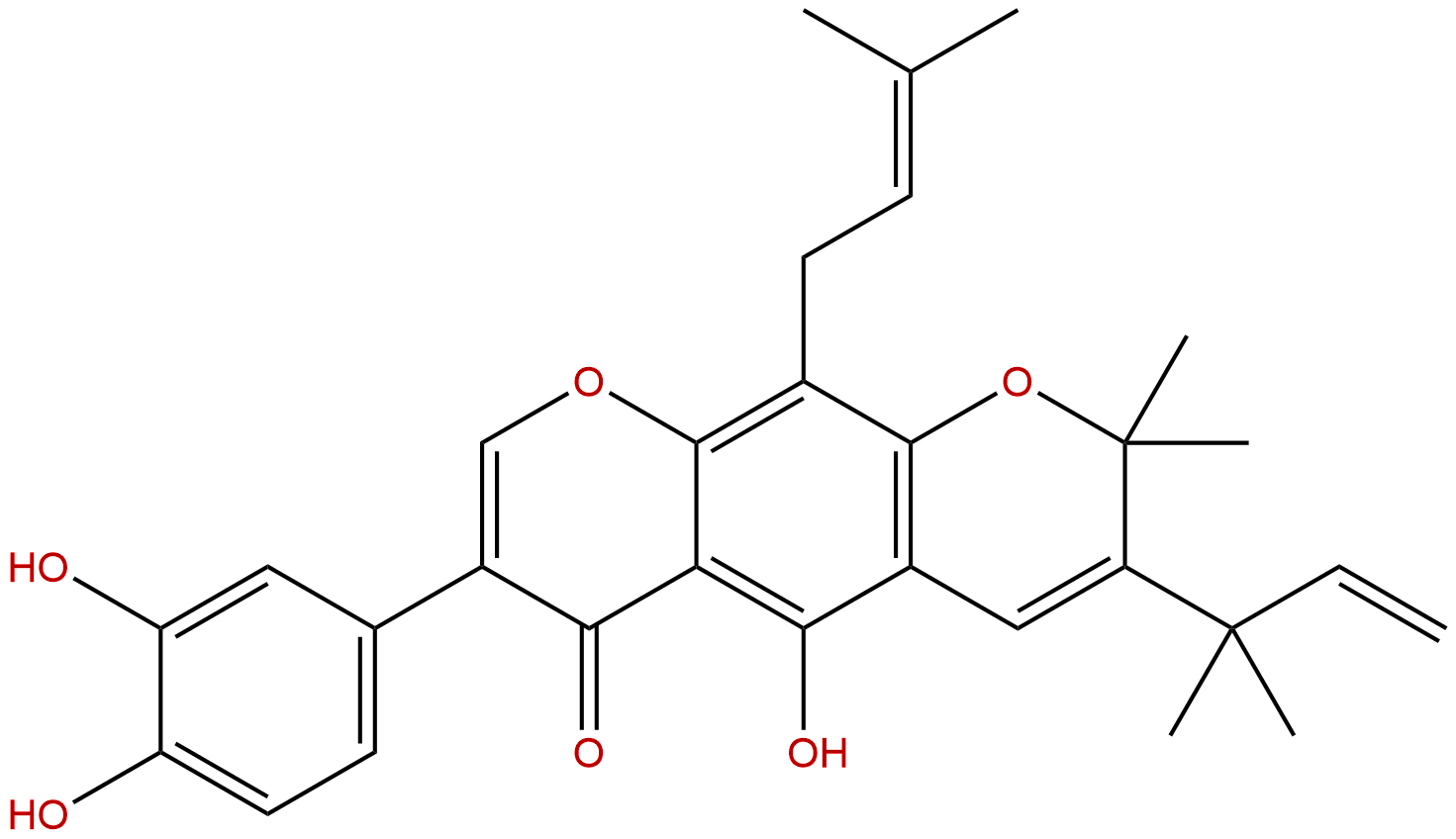


Product name: Flemiphilippinin A
Synonym name:
Catalogue No.: BP1844
Cas No.: 140366-64-9
Formula: C30H32O6
Mol Weight: 488.58
Botanical Source: Flemingia philippinensis
Physical Description:
Type of Compound: Xanthones
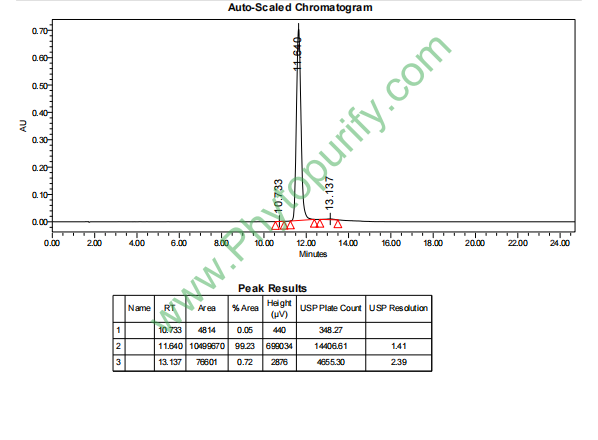
Purity: 95%~99%
Analysis Method: HPLC-DAD or/and HPLC-ELSD
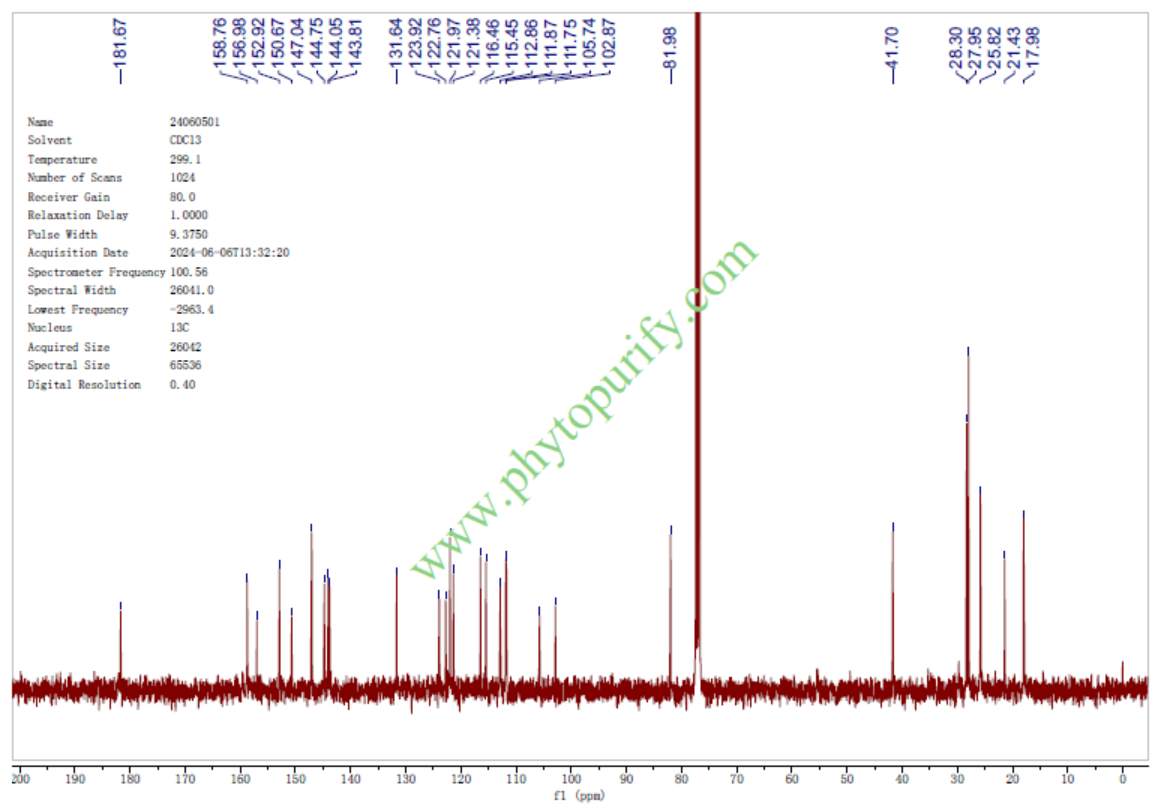
Identification Method: Mass, NMR
Packing: Brown vial or HDPE plastic bottle
The product could be supplied from milligrams to grams. Inquire for bulk scale.
We provide solution to improve the water-solubility of compounds, thereby facilitating the variety of activity tests and clinic uses.
For Reference Standard and R&D, Not for Human Use Directly.
Description:
Flemiphilippin A has antioxidant activity, it shows DPPH radical scavenging activity with effective half maximal concentration (EC50) of 18.36 ug/mL. Flemiphilippinin A (5 ug/mL) exhibits some level of antitumor activity against human hepatocellular carcinoma cell (BEL-7402), human lung epithelial (A-549) and human ileocecal adenocarcinoma cell (HCT-8).
References:
Tropical Journal of Pharmaceutical Research, 2015, 14(8):1365.
Ultrasonic-Assisted Extraction and Evaluation of Biological Activities of Flavonoids from Flemingia philippinensis Merr et Rolfe.
To develop a simple and rapid method for extracting total flavonoids from the roots of Flemingia philippinensis and to investigate the antioxidant and anti-tumor activities of the extracts of the materials from various locations in China.
METHODS AND RESULTS:
The total flavonoids in F. philippinensis were obtained by ultrasonic-assisted conventional solvent extraction method, and the extraction conditions were optimized by single factor and orthogonal test. 1,1-diphenyl-2-picrylhydrazyl (DPPH) radical scavenging and anti-tumor activities, using 3-(4,5- dimethylthiazol-2-yl)-2,5-diphenyltetrazolium bromide (MTT) assay, of the extract were evaluated. The contents of Flemiphilippinin A, auriculasin, 5,7,3′,4′-tetrahydroxy-6,8 -diprenylisoflavone and dorsmanins I were also determined. Optimal extraction conditions were as follows: extraction time, 40 min; methanol concentration, 85 %; and solvent to solid ratio, 40 mL/g; and number of extraction, once. Total flavonoid content varied greatly (3.7 - 14.35 %) among the 19 samples collected from different origins in China. Flemiphilippin A, 5,7,3′,4′- tetrahydroxy-6,8 -diprenylisoflavone, auriculasin and dorsmanins I showed varying DPPH radical scavenging activities with effective half maximal concentration (EC50) of 18.36, 23.59, 57.25 and 63.54 μg/mL, respectively. Flemiphilippinin A (5 μg/mL) also exhibited some level of antitumor activity against human hepatocellular carcinoma cell (BEL-7402), human lung epithelial (A-549) and human ileocecal adenocarcinoma cell (HCT-8) with inhibition of 91.13 ± 1.6, 91.22 ± 3.23, and 79.77 ± 3.57 %, respectively.
CONCLUSIONS:
Total flavonoids can be extracted efficiently from F. philippinensis by ultrasonic-assisted extraction method. Flemiphilippinin A has a potential for use in medicine as an antioxidant and antitumor drug.
HPLC of Flemiphilippinin A
NMR of Flemiphilippinin A
Storage conditions:Short-term storage at 2~8℃, long-term storage at -20 ~ -80℃
100.1300
6.1926
6.1283
.0039
4.8541
11.9824
Low
92.5573
3.7010
No
Yes
Yes
No
Yes
Yes
0.6
Yes
Yes
Yes
Yes
Flemiphilinin A, with a CAS number of 140366-64-9, is a type of plant derived from the legume plant Flemiphilinin A(Millettia speciosa It is also often associated with Flemingia philippinensis)Natural organic compounds obtained through separation. Its chemical classification belongs to Isopentenyl Isoflavones This is a type of flavonoid derivative with relatively limited distribution in the plant kingdom, but it has attracted much attention due to its significant biological activity. The molecular formula of this compound is C30H32O6, with a molecular weight of 488.58 g/mol. Preliminary biological studies indicate that cranberry extract A exhibits antioxidant and antitumor Dual activity. In terms of antioxidant activity, its half maximal effect concentration (EC50) for DPPH free radicals is 18.36 μ g/mL, indicating a certain degree of free radical scavenging ability. In the screening of anti-tumor activity, even at lower concentrations (5 μ g/mL), it can produce certain inhibitory effects on human liver cancer cells (BEL-7402), human lung cancer cells (A-549), and human ileocecal adenocarcinoma cells (HCT-8). More noteworthy is that based on database information, this compound has potential interactions with multiple key inflammatory and immune regulatory targets (such as TNF, PTGS2, NF - κ B, etc.) and is associated with Rheumatoid arthritis This autoimmune disease suggests its value for in-depth research in the fields of anti-inflammatory and immune regulation. This article will provide a systematic professional science popularization interpretation of this natural product from its chemical essence, sources, pharmacological mechanisms, medicinal properties, and prospects.
The chemical structure of cranberry extract A is the material basis for its biological activity. The SMILES expression (C=CC (C) (C) C1=Cc2c (c (CC=C (C) C) c3acc (- c4ccc (O) c (O) c4) c (=O) c3c2O) OC1 (C) C) depicts a complex isoflavone skeleton with isopentenyl (- C5H9) substituents attached to it. The introduction of isopentenyl groups significantly alters the physicochemical properties and biological activity of parent isoflavones, typically enhancing their lipid solubility and affinity for certain biological targets.
From the perspective of pharmacological parameters, its physicochemical properties exhibit typical characteristics of highly active natural products, but also face some challenges:
- Molecular weight (MW)488.58, slightly higher than the empirical rule of "less than 500" typically followed by conventional oral medications (one of Lipinski's Five Rules).
- Lipid water partition coefficient (LogP/LogD)LogP is 6.19 and LogD is 6.13. This value is much higher than the ideal range (LogP is generally considered to be better between 1-5), indicating that the compound Very strong fat solubility, extremely poor water solubility Its theoretical water solubility is only 0.0039 mg/mL, which will become the primary obstacle to its oral absorption and in vivo delivery.
- Topological Polarity Surface Area (TPSA): 100.13 Å ². This value is at a moderately high level and is usually associated with poor membrane permeability, but not absolute.
- Penetration prediction The predicted values of Caco-2 cell permeability (11.98 × 10 ⁻⁶ cm/s) and effective permeability (Peff, 4.85 × 10 ⁻⁴ cm/s) suggest that it may have Moderate to good intestinal permeability potential This is consistent with its high lipid solubility. However, it The blood-brain barrier (BBB) penetration is predicted to be 'low'This means that it may not easily enter the central nervous system, which may avoid central side effects for peripheral inflammatory diseases such as rheumatoid arthritis, but also limits its potential for treating central nervous system related diseases.
- Plasma protein binding rate (PPB)As high as 92.56%, it indicates that after entering the bloodstream, the vast majority of compounds will bind to plasma proteins (mainly albumin), with only a small amount of free drugs exerting pharmacological effects, which may affect their efficacy and metabolic kinetics.
In summary, cranberry extract A is a medium-sized, strongly hydrophobic, and high protein binding molecule, and its good membrane permeability potential is limited by poor water solubility.
Manxing Qianjin extract A is mainly derived from leguminous plants Thousand pound pull(Millettia speciosa)Separated from the middle. Plants of the genus Trichoderma have a long history of folk medicinal use in East Asia and Southeast Asia, especially in China's Guangdong and Guangxi provinces and Yunnan. In traditional medicine, Qianjin Ba (often referring to its roots or whole plant) is often used for Dispelling wind and dampness, relaxing muscles and activating collaterals, strengthening muscles and bones It is commonly used to treat symptoms such as rheumatoid arthritis, lumbar muscle strain, traumatic injury, and limb weakness. These traditional efficacy descriptions are highly consistent with the anti-inflammatory and antioxidant activities discovered in modern research.
Rheumatoid arthritis is mostly classified as a "bi syndrome" in traditional Chinese medicine theory, and its pathogenesis is closely related to the invasion of wind cold dampness pathogens and poor circulation of qi and blood. Qianjin Ba, as a commonly used herb for dispelling wind dampness and strengthening muscles and bones, provides direct clues and basis for searching for active ingredients against rheumatoid arthritis from this plant based on its experience in treating "bi syndrome". The discovery of cranberry extract A is a typical example of modern plant chemistry research scientifically interpreting traditional medicinal wisdom - by isolating and identifying its specific active chemical components, and using modern pharmacological methods to verify its effects, traditional experience is elevated to the molecular mechanism level.
The pharmacological activity research of cranberry extract A is currently in its early stages, but existing data points to its potential in Antioxidant, anti-tumor, and anti-inflammatory properties Potential in multiple aspects. Its mechanism of action is closely related to its regulation of multiple key signaling molecules and pathways.
4.1 Antioxidant activity
Its DPPH radical scavenging ability (EC50=18.36 μ g/mL) indicates that it can directly neutralize free radicals and alleviate oxidative stress. Oxidative stress is an important driving factor in the occurrence and development of many chronic diseases, including inflammation and cancer. The isoflavone skeleton itself has phenolic hydroxyl groups, which are natural antioxidant groups. The modification of isopentenyl groups may affect its electron distribution, thereby regulating its antioxidant efficacy.
4.2 Antitumor activity
The inhibitory activity against cancer cell lines such as BEL-7402, A-549, HCT-8 suggests its broad-spectrum anti proliferative potential. The anticancer mechanisms of natural isoflavones and their derivatives are diverse, which may include inducing cell apoptosis, blocking the cell cycle, inhibiting angiogenesis, and so on. The specific mechanism needs further research, but high lipid solubility may facilitate its penetration into cancer cell membranes.
4.3 Anti inflammatory and immune regulatory activity (core mechanism analysis)
This is the pharmacological direction that deserves the most attention for cranberry extract A, especially in relation to Rheumatoid arthritis (RA)The database information suggests that its function involves five key targets: TNF, PTGS2, NFKB1, IL6, and IL1B. These targets form a closely related pro-inflammatory signaling network:
- TNF (tumor necrosis factor - α)The core pro-inflammatory cytokines in RA pathology can activate various downstream inflammatory pathways, leading to synovial inflammation, cartilage destruction, and bone erosion. Directly inhibiting TNF is one of the most successful strategies for treating RA in clinical practice (such as using Infliximab, Adalimumab, etc.).
- IL6 (interleukin-6) and IL1B (interleukin-1 β)Two other key pro-inflammatory cytokines play important roles in acute and chronic inflammation, fever, anemia, and osteoclast activation in RA. Tozumab (anti-IL-6R antibody) and anakinra (IL-1 receptor antagonist) are drugs targeting these targets.
- NFKB1 (nuclear factor kappa B)A key transcription factor that can be activated by various signals such as TNF and IL-1. Once activated, it enters the nucleus and initiates the transcription of a large number of inflammation related genes, including TNF, IL6, IL1B, and PTGS2, serving as the "master switch" of the inflammatory response.
- PTGS2 (prostaglandin endoperoxide synthase 2, also known as COX-2)An inducible enzyme that is highly expressed at the site of inflammation and is responsible for catalyzing the synthesis of inflammatory mediators such as prostaglandin E2, causing pain, fever, and swelling. Non steroidal anti-inflammatory drugs (NSAIDs) such as celecoxib are selective COX-2 inhibitors.
Hypothesis of mechanism of action Manxing Qianjin Ba Su A may intervene in the above targets directly or indirectly. For example, it may inhibit the activation of NF - κ B, thereby blocking the production of downstream inflammatory mediators such as TNF, IL6, IL1B, COX-2 from upstream, forming a "multi-point inhibition" anti-inflammatory effect. This multi-target mode of action may have advantages over single target drugs for diseases such as RA driven by complex cytokine networks, as it can more comprehensively control inflammation. Its antioxidant activity may also synergistically exert anti-inflammatory effects by reducing the activation of pathways such as NF - κ B by reactive oxygen species (ROS).
Therefore, cranberry extract A exhibits an attractive multi-target intervention potential in the treatment of rheumatoid arthritis, which may simultaneously alleviate inflammation, pain, and delay joint destruction.
Although cranberry extract A shows promising biological activity, it must undergo rigorous pharmacological evaluation in order to become a candidate drug. We combine Lipinski's Rule of Five (Ro5) and other key parameters for analysis:
Lipinski Five Rule Compliance:
Absorption, distribution, metabolism, excretion (ADME) characteristics:
Comprehensive Assessment:
Manxing Qianjin Ba Su A is a Lead compounds with high activity but significant challenges in drug formation and potential toxicity risks Its outstanding multi-target anti-inflammatory properties make it uniquely valuable in the treatment of diseases such as rheumatoid arthritis. However, its poor water solubility, violation of Ro5 characteristics, and especially potential genotoxicity and hepatotoxicity are major obstacles that it must overcome on the road to drug conversion. It is not suitable for direct drug development, but Extremely valuable as a lead compound, carry out systematic structural optimization(such as simplifying the structure, reducing LogP, introducing ionizable groups, removing toxic groups) to improve its physicochemical properties, pharmacokinetic characteristics, and reduce toxicity while maintaining activity.
At present, research on cranberry extract A is still ongoing Basic research stage The existing literature mainly focuses on its phytochemical isolation, identification, and preliminary in vitro activity screening (antioxidant, anti-tumor). The association between it and inflammatory targets is mostly based on database prediction or limited molecular docking research, which is in-depth There is still a lack of in vitro and in vivo pharmacological validation, specific pathway validation, and comprehensive ADMET (absorption, distribution, metabolism, excretion, toxicity) research。
Future research directions:
1. Deepening mechanism research The primary task is to use cell models (such as RA related fibroblast like synovial cells and macrophages) and molecular biology techniques to empirically verify the inhibitory ability of cranberry extract A on targets such as TNF, IL-6, NF - κ B, COX-2, and elucidate its upstream action nodes.
2. In vivo efficacy evaluation Establishing an animal model of rheumatoid arthritis (such as collagen induced arthritis mice) and evaluating its anti-inflammatory and anti joint destruction effects after oral or local administration is a key step in demonstrating its therapeutic potential.
3. Optimization of drug properties Based on its chemical structure, carry out Reasonable drug chemical modification For example, cutting or cyclizing the isopentenyl chain, methylating or glycosidizing the phenolic hydroxyl group to regulate solubility and metabolic stability, or synthesizing a series of similar compounds for structure-activity relationship studies, aiming to find candidate molecules with comparable or better activity but reduced LogP, increased water solubility, and eliminated toxicity.
4. Security system assessment For optimized lead compounds, a comprehensive toxicological evaluation that complies with drug registration standards must be conducted, especially for warned genotoxicity and hepatotoxicity.
Application Prospects:
Despite the numerous challenges ahead, the research model of active ingredients in traditional Chinese medicine represented by cranberry extract A has broad prospects. It's not just about discovering New multi-target small molecule drugs for rheumatoid arthritis The valuable starting point of this research process can also deepen the scientific understanding of the traditional medicinal effects of Qianjin Ba. Ultimately, it is possible to transform it into an innovative drug with independent intellectual property rights, precise efficacy, and high safety through modern medicinal chemistry and pharmaceutical methods. Even if it fails to become a drug on its own, its unique isopentenyl isoflavone skeleton provides a novel molecular template for medicinal chemists to design and discover novel mechanisms of action for immunomodulators.
In short, Manxing Qianjin Ba Su A is a "key" contained in traditional herbs, which opens the door for us to explore multi-target anti-inflammatory treatments. However, to turn this "key" into a "precision tool" suitable for modern disease treatment, researchers still need to adhere to the spirit of rigor and practicality, and conduct unremitting exploration and verification at the molecular, cellular, animal, and even future clinical levels.
