


Synonym name: Myricitroside; Myricetin 3- rhamnoside
Catalogue No.: BP0971
Cas No.: 17912-87-7
Formula: C21H20O12
Mol Weight: 464.379
Botanical Source: Occurs in Mimusops elongi, Rhus spp. and Elaeocarpus floribundus and numerous other plants
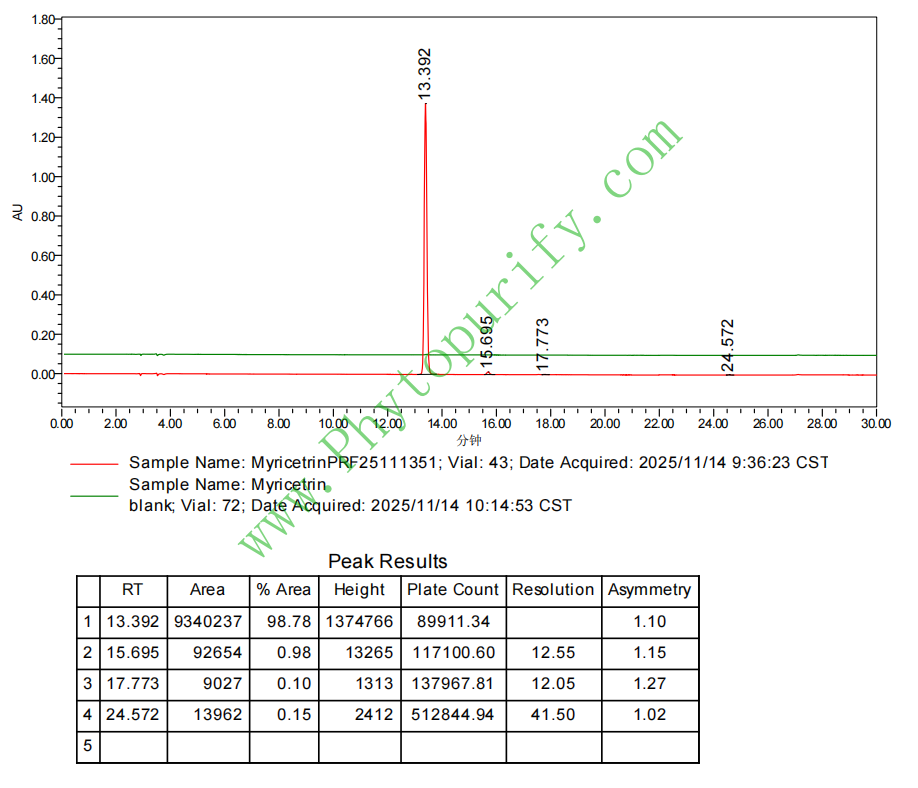
Purity: 95%~99%
Analysis Method: HPLC-DAD or/and HPLC-ELSD
Identification Method: Mass, NMR
Packing: Brown vial or HDPE plastic bottle
Can be supplied from milligrams to grams.
For Reference Standard and R&D, Not for Human Use Directly.
Inquire for bulk scale.
Description:
Myricitrin exhibits hepatoprotective, anti-inflammatory,antioxidant, anti-allergic, antinociception, anxiolytic-like, and antipsychotic-like effects. Myricitrin can be used as a drug candidate for the treatment of cardiovascular diseases, by effectively protecting cells from ox-LDL-induced endothelial cell apoptosis and reducing atherosclerotic plaque formation. Myricitrin is also a nitric oxide (NO) and protein kinase C (PKC) inhibitor that has central nervous system activity.
References:
Nat Prod Commun. 2015 Jan;10(1):83-8.
Phytochemical profile of the aerial parts of Sedum sediforme and anti-inflammatory activity of myricitrin.
The aim of this study was to investigate the phytochemical profile of the methanol extract of the aerial parts of Sedum sediforme and to identify its secondary metabolites.
METHODS AND RESULTS:
By means of chromatographic separation and enrichment of compounds, HPLC-ESI-MS, HRMS, 1D-, 2D- NMR and/or comparison with reference compounds, three triterpenes, two sterols, ten flavonoids and twelve phenolic compounds were identified, together with two new compounds, i.e. (2R*, 3R*)-5,7-dihydroxy-2,3-dimethyl-4-chromanone-7-O-β-D-glucoside (27) and butan-2-O-rutinoside (28). Out of the 29 identified secondary metabolites, 18 are described as ingredients of S. sediforme herein for the first time. Furthermore, Myricitrin, one of the major constituents, was tested for its ability to inhibit different enzymes within the arachidonic acid cascade in order to determine its anti-inflammatory properties.
CONCLUSIONS:
Whereas there was only either weak or no inhibition of the microsomal prostaglandin E2 synthase-1 (mPGES-1) and the soluble epoxide hydrolase (sEH), Myricitrin showed strong inhibition of 5-lipoxygenase (5-LO), with an IC50 of 7.8 ± 0.2 μM.
Biochem Biophys Res Commun. 2015 Mar 6;458(2):227-33.
Myricitrin alleviates MPP⁺-induced mitochondrial dysfunction in a DJ-1-dependent manner in SN4741 cells.
Oxidative stress and mitochondrial dysfunction have been linked to Parkinson's disease. DJ-1 is a recessive familial PD gene involved in antioxidative function and mitochondrial maintenance. Myricitrin, a flavanoid isolated from the root bark of Myrica cerifera, has potent antioxidative properties.
METHODS AND RESULTS:
In the present study, we investigated the protective effects of Myricitrin against MPP(+)-induced mitochondrial dysfunction in SN4741 cells and attempted to elucidate the mechanisms underlying this protection. The results showed that incubating SN4741 cells with Myricitrin significantly reduced cell death induced by the neurotoxin MPP(+). Furthermore, Myricitrin protected cells from MPP(+)-induced effects on mitochondrial morphology and function. However, these protective effects were lost under DJ-1-deficient conditions.
CONCLUSIONS:
Thus, our results suggest that Myricitrin alleviates MPP(+)-induced mitochondrial dysfunction and increases cell viability via DJ-1, indicating that Myricitrin is a potential beneficial agent for age-related neurodegenerative diseases, particularly Parkinson's disease.
Vascul Pharmacol. 2015 Apr 4.
Myricitrin attenuates endothelial cell apoptosis to prevent atherosclerosis: An insight into PI3K/Akt activation and STAT3 signaling pathways.
Blood vessel endothelial dysfunction induced by oxidized low-density lipoprotein (ox-LDL) has been implicated in the pathogenesis of atherosclerosis and vasculopathy. The ox-LDL-elicited reactive oxygen species (ROS) release has been assumed to serve a critical function in endothelial damage. Myricitrin (from Myrica cerifera) is a natural antioxidant that has strong anti-oxidative, anti-inflammatory, and anti-nociceptive activities. However, the protective effect of Myricitrin on ROS-induced endothelial cell injury and its related molecular mechanisms have never been investigated.
METHODS AND RESULTS:
This study demonstrates that Myricitrin can inhibit ox-LDL-induced endothelial apoptosis and prevent plaque formation at an early stage in an atherosclerotic mouse model. The administration of Myricitrin in vivo decreases the thickness of the vascular wall in the aortic arch of ApoE-/- mice. In vitro study shows that ox-LDL-induced human umbilical vein endothelial cell apoptosis can be reduced upon receiving Myricitrin pre-treatment. Treatment with Myricitrin significantly attenuated ox-LDL-induced endothelial cell apoptosis by inhibiting LOX-1 expression and by increasing the activation of the STAT3 and PI3K/Akt/eNOS signaling pathways. At the same time, our result demonstrates that Myricitrin treatment optimizes the balance of pro/anti-apoptosis proteins, including Bax, Bad, XIAP, cIAP-2, and survivin.
CONCLUSIONS:
Our study suggests that Myricitrin treatment can effectively protect cells from ox-LDL-induced endothelial cell apoptosis, which results in reduced atherosclerotic plaque formation. This result indicates that Myricitrin can be used as a drug candidate for the treatment of cardiovascular diseases. Nat Prod Res. 2011 Feb;25(4):374-80.
Anti-allergic effect of the flavonoid myricitrin from Myrica rubra leaf extracts in vitro and in vivo.
Flavonoids are ingested by the general population as anti-oxidant and anti-inflammatory agents.
METHODS AND RESULTS:
In this study, we investigated the effects of Myricitrin, a flavonoid rich in Myrica rubra leaf, upon anti-inflammatory action. Myrica rubra leaf extracts inhibited pro-inflammatory TNFα production in a macrophage cell line, Raw264.7 cells. We observed that the serum IgE levels in the leaf extract-treated DO11.10, a mouse allergy model, were down-regulated. HPLC was performed to demonstrate that M. rubra leaf extracts contain a large amount of Myricitrin. We observed an inhibitory effect of HPLC-purified Myricitrin on TNFα production in Raw264.7 cells.
CONCLUSIONS:
Thus, Myricitrin may be of potential interest in the management of inflammatory conditions.
HPLC of Myricetrin
Storage conditions:Short-term storage at 2~8℃, long-term storage at -20 ~ -80℃
Myricetrin, CAS number 17912-87-7, is a typical natural product of glycosylated flavonoids, mainly formed by the glycosidic linkage of myricetin to the 3-position α - L-pyranose rhamnose residue. As an important active ingredient in Myrica rubra, myricetin has received widespread attention in the field of natural product pharmacology in recent years due to its diverse biological activities and potential medicinal value. Its multiple pharmacological effects, such as anti allergy, antioxidant, anti-inflammatory and metabolic regulation, make it show unique advantages in the prevention and treatment of diabetes and related metabolic diseases. In addition, the inhibitory effect of yangmei glycoside on key enzymes such as protein kinase C (PKC) and nitric oxide synthase (NOS) provides important clues for a deeper understanding of its molecular mechanism.
This article aims to systematically review the chemical structure and physicochemical properties, plant sources, and extraction methods of yangmei glycoside, explore its pharmacological activity and mechanism of action, evaluate its pharmacological properties and pharmacokinetic characteristics, and prospect its clinical application potential, providing scientific basis for subsequent basic and translational research.
The chemical structure of yangmei glycoside is based on the five hydroxyflavone skeleton of myricetin, with a molecular formula of C21H20O12 and a molecular weight of 464.3790. Its structural feature is that the 3-hydroxyl group of myricetin is connected to the α - L-pyranose rhamnose residue through a glycosidic bond, forming a stable glycosyl oxyflavonoid. Yangmei glycoside is a monosaccharide derivative that combines the polyphenolic properties of flavonoids with the hydrophilicity of glycosides.
In terms of physicochemical properties, the LogP value of yangmei glycoside is about 0.6680, indicating a moderate balance between lipophilicity and hydrophilicity. Its topological polar surface area (TPSA) is as high as 210.51 Å ², indicating strong molecular polarity and good water solubility (about 0.9142), which is beneficial for its dissolution and bioavailability in aqueous environments. However, a higher TPSA value also suggests a lower ability to pass through the blood-brain barrier, which is consistent with the prediction of low blood-brain barrier permeability. The hERG channel inhibition experiment showed a negative result, indicating that myricetin has a high safety profile in terms of cardiac toxicity. The Ames mutagenicity test score is 1.2, indicating a low risk of genotoxicity.
In summary, the chemical structure of yangmei glycoside endows it with good water solubility and safety, providing a favorable physicochemical basis for its use as a drug candidate molecule.
Yangmei glycoside is mainly found in plants of the Yangmei genus, with the fruit of Myrica rubra being the main source. Yangmei, as an important economic fruit in southern China, contains abundant yangmei glycosides and related flavonoids in its fruit, leaves, and bark. In addition to Yangmei, some other plants such as Yangmei and Momordiaceae have also been reported to contain Yangmei glycosides, but at lower levels.
The traditional method for extracting yangmei glycoside often uses solvent extraction technology, commonly using ethanol water mixed solvents (such as 70% ethanol) for reflux or ultrasound assisted extraction. The extraction conditions have a significant impact on yield and purity, and temperature, time, and solvent polarity need to be optimized to maximize the recovery rate of yangmei glycoside. After concentration, separation, and purification steps, the extraction solution is often analyzed qualitatively and quantitatively using high-performance liquid chromatography (HPLC) combined with mass spectrometry (MS) technology.
In recent years, green and efficient extraction technologies such as supercritical CO2 extraction, microwave-assisted extraction, and membrane separation have gradually been applied to the extraction of yangmei glycoside, significantly improving extraction efficiency and purity, reducing the use of organic solvents, and in line with the sustainable development concept of modern natural product development.
The pharmacological activity research of yangmei glycoside covers multiple fields such as anti allergy, anti-inflammatory, antioxidant, metabolic regulation, and neuroprotection, reflecting its multi-target and multi pathway biological effects.
Yangmei glycoside exhibits significant anti allergic effects by inhibiting degranulation of mast cells and suppressing histamine release. In vitro experiments have shown that myricetin can reduce IgE mediated mast cell activation and alleviate the inflammatory cascade of allergic reactions. In animal models, yangmei glycoside effectively alleviates symptoms of allergic dermatitis and asthma, indicating its potential therapeutic value in allergic diseases.
As a polyhydroxyflavonoid, myricetin has strong free radical scavenging ability and can significantly reduce oxidative stress levels. It activates the Nrf2 signaling pathway, enhances the expression of endogenous antioxidant enzymes (such as SOD, CAT, GPx), and protects cells from oxidative damage. At the same time, yangmei glycoside inhibits the NF - κ B signaling pathway, reduces the release of pro-inflammatory factors (such as TNF - α, IL-6, IL-1 β), and exhibits good anti-inflammatory effects.
Myricetin can significantly reduce blood glucose and improve insulin resistance in diabetes and metabolic syndrome models. Its mechanism of action is closely related to the activation of AMPK (5 'AMP activated protein kinase), which promotes glucose metabolism and lipid oxidation, and improves energy metabolism balance. In addition, yangmei glycoside can inhibit SGLT2 (sodium glucose cotransporter 2), reduce renal reabsorption of glucose, and assist in blood glucose control. Its regulation on the key enzymes of insulin signaling pathway GCK (glucokinase) and PTPN1 (protein tyrosine phosphatase 1B) also provides a molecular basis for its anti diabetes effect.
Although yangmei glycoside has low blood-brain barrier permeability, it indirectly exerts neuroprotective effects by regulating peripheral inflammatory responses and oxidative stress. Some studies have shown that yangmei glycoside can inhibit MAOA (monoamine oxidase A) activity, regulate neurotransmitter metabolism, and may have the potential to assist in the treatment of neurological and psychiatric disorders such as depression. In addition, the regulatory effect of yangmei glycoside on estrogen receptor ESR2 suggests its potential application in hormone related diseases.
The multiple pharmacological effects of yangmei glycoside are attributed to its regulation of multiple key enzymes and signaling pathways, involving multiple targets such as protein kinase C (PKC), nitric oxide synthase (NOS), AMPK, SGLT2, GCK, PTPN1, etc.
PKC plays an important role in cell signal transduction, inflammatory response, and metabolic regulation. Yangmei glycoside, as an EC 2.7.11.13 class PKC inhibitor, can block downstream signal transduction mediated by PKC, alleviate inflammation and cell damage, and promote cell homeostasis recovery.
Yangmei glycoside has an inhibitory effect on EC 1.14.13.39 nitric oxide synthase, regulates NO production, affects vasodilation, immune response, and nerve conduction. By regulating NOS activity, myricetin plays an important role in anti-inflammatory and vascular protection.
AMPK serves as an "energy sensor" for cellular energy metabolism, and its activation promotes glucose uptake, fatty acid oxidation, and mitochondrial biosynthesis. Myricetin can improve energy metabolism disorder and reduce insulin resistance by activating AMPK, which is the core mechanism of its anti diabetes and metabolic syndrome effect.
Yangmei glycoside inhibits renal SGLT2 function, reduces glucose reabsorption, promotes urinary glucose excretion, and helps with blood glucose control. Meanwhile, by regulating GCK activity, it promotes glucose metabolism in the liver and pancreas, and enhances insulin sensitivity.
PTPN1, as an enzyme that negatively regulates insulin signaling, is inhibited by myricetin, which helps enhance insulin signaling. MAOA regulates neurotransmitter metabolism, and inhibition of it by myricetin may improve neurological dysfunction.
The pharmacological evaluation of yangmei glycoside shows that it has good safety and pharmacokinetic characteristics. The molecular weight of 464.3790 is moderate, and the LogP value of 0.6680 indicates that it has a lipophilic hydrophilic balance suitable for in vivo distribution. Although high TPSA values limit their blood-brain barrier penetration, they reduce the risk of central nervous system toxicity.
The negative inhibition of hERG ion channels and low mutagenicity in Ames test suggest a low risk of cardiac toxicity and genotoxicity, which meets drug safety requirements. Good water solubility, conducive to the development of oral preparations.
Pharmacokinetic studies have shown that yangmei glycoside is absorbed quickly after oral administration, but its bioavailability is limited by the hydrolysis of glycoside structure and intestinal metabolism. The metabolism in the body is mainly carried out through the liver enzyme system, and the metabolites are mostly myricetin and its derivatives, which have certain biological activities. Yangmei glycoside has a moderate half-life and is suitable for daily administration.
In the future, through structural modification or nanocarrier delivery technology, its pharmacokinetic performance can be further optimized to improve in vivo stability and targeting.
Based on the multi target pharmacological activity of myricetin, it has broad application prospects in the adjuvant treatment of diabetes and metabolic syndrome. By regulating AMPK, SGLT2 and insulin signaling pathways, myricetin is expected to become a candidate molecule for new natural anti diabetes drugs. In addition, its anti allergic and anti-inflammatory effects provide new treatment ideas for allergic and chronic inflammatory diseases.
Although clinical research on yangmei glycoside is still in its early stages, its good safety and diverse biological activities have laid the foundation for subsequent clinical trials. In the future, it is necessary to conduct systematic pharmacokinetic, toxicological, and clinical efficacy evaluations to clarify their dosage, safety range, and indications.
At the same time, combining modern drug design and delivery technology, the development of myricetin derivatives or compound preparations is expected to improve its efficacy and bioavailability, and expand its application in the fields of diabetes, cardiovascular disease, neurodegenerative disease and immune regulation.
Yangmei glycoside, as a typical glycosylated flavonoid, exhibits a wide range of biological functions and good potential for pharmaceutical development due to its unique chemical structure and multiple pharmacological activities. Its mechanism of action in antiallergic, anti-inflammatory, antioxidant and metabolic regulation is increasingly clear, especially in the treatment of diabetes and metabolic diseases.
In the future, by combining modern pharmacology, molecular biology, and medicinal chemistry techniques, we will deeply explore the targets and signaling pathways of yangmei glycoside, optimize its pharmacokinetic properties, and provide a solid foundation for its clinical translation. With the continuous advancement of related research, yangmei glycoside is expected to become an important representative of natural product drug development, contributing new natural drug resources to human health.
