


Product name: Jatrorrhizine chloride
Synonym name: Neprotine chloride; Deleted Cas No.: 960383-96-4
Catalogue No.: BP0809
Cas No.: 6681-15-8
Formula: C20H20ClNO4
Mol Weight: 373.833
Botanical Source:
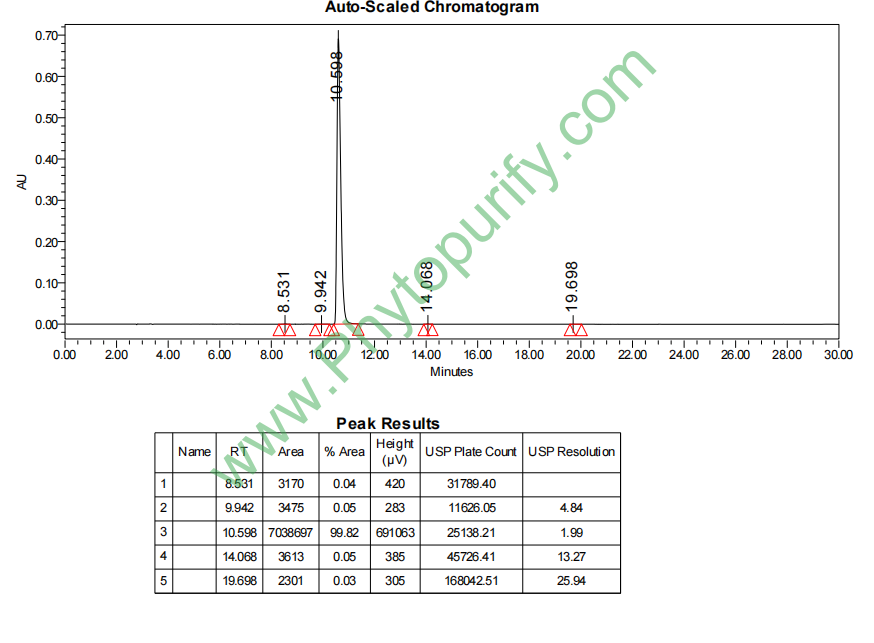
Purity: 95%~99%
Analysis Method: HPLC-DAD or/and HPLC-ELSD
Identification Method: Mass, NMR
Packing: Brown vial or HDPE plastic bottle
Can be supplied from milligrams to grams.
For Reference Standard and R&D, Not for Human Use Directly.
Inquire for bulk scale.
Description:
Jatrorrhizine hydrochloride has lipid lowering effects, it can ameliorate hyperlipidemia via the suppression of lipogenesis and the enhancement of lipid oxidation in the liver. It exhibits a potent inhibitory effect toward neuraminidase of the H7N9 (N9) avian influenza virus, it also can potentiate the neuraminidase inhibitory effect of oseltamivir towards H7N9 influenza. Jatrorrhizine hydrochloride is a potential new antimelanoma drug candidate, can inhibit the proliferation and neovascularization of C8161 metastatic melanoma cells with low toxicity.
References:
Anticancer Drugs. 2013 Aug;24(7):667-76.
Jatrorrhizine hydrochloride inhibits the proliferation and neovascularization of C8161 metastatic melanoma cells.
Malignant melanoma is the most aggressive form of skin cancer. Although various antimelanoma approaches have been used in the clinics to treat the disease over the last three decades, none of the drugs significantly prolonged the survival of metastatic melanoma patients; hence, effective drugs against metastatic melanoma are highly desired.
METHODS AND RESULTS:
In this study, we explored an antimetastatic melanoma agent derived from traditional Chinese medicinal herbs and found that Jatrorrhizine Hydrochloride (JH), an active component of the traditional Chinese medicinal herb Coptis chinensis, inhibited the proliferation and neovascularization of C8161 human metastatic melanoma cells. JH suppressed C8161 cell proliferation in a dose-dependent manner, with a half-maximal inhibitory concentration of 47.4±1.6 μmol/l; however, it did not induce significant cellular apoptosis at doses up to 320 μmol/l. Mechanistic studies showed that JH-induced C8161 cell cycle arrest at the G0/G1 transition, which was accompanied by overexpression of the cell cycle-suppressive genes p21 and p27 at higher doses. Moreover, JH reduced C8161 cell-mediated neovascularization in vitro and in vivo and impeded the expression of the gene for VE-cadherin, a key protein in tumor vasculogenic mimicry and angiogenesis.
CONCLUSIONS:
Taken together, the effective inhibitory effects of JH on metastatic melanoma cell proliferation and neovascularization with low toxicity suggest that JH is a potential new antimelanoma drug candidate.
Mol Med Rep. 2016 Oct;14(4):3277-84.
Jatrorrhizine hydrochloride attenuates hyperlipidemia in a high-fat diet-induced obesity mouse model. Jatrorrhizine Hydrochloride (JH) is an active component of the traditional Chinese herb Coptis chinensis, which has been used to prevent and treat metabolic disorders. Hyperlipidemia is one of the principal factors underlying numerous metabolic diseases, including diabetes and obesity. Therefore, the aim of the present study was to investigate the lipid lowering effects of JH treatment in vivo in an obesity mouse model. JH-treated hyperlipidemic mice exhibited a reduction in body weight, as well as improved glucose tolerance and insulin sensitivity. In addition, JH‑treated hyperlipidemic mice exhibited reduced serum triglyceride, total cholesterol and low‑density lipoprotein cholesterol levels, as well as increased high‑density lipoprotein cholesterol levels compared with untreated mice fed a high‑fat diet. Notably, JH treatment ameliorated the pathophysiological changes observed in the livers of hyperlipidemic mice. At the molecular level, JH downregulated the hepatic mRNA expression levels of SREBP‑1c and FAS, and induced PPAR‑α and CPT1A mRNA expression in hyperlipidemic mice. These findings suggest that JH ameliorates hyperlipidemia via the suppression of lipogenesis and the enhancement of lipid oxidation in the liver.
HPLC of Jatrorrhizine chloride
Storage conditions:Short-term storage at 2~8℃, long-term storage at -20 ~ -80℃
Jatrorrhizine chloride (CAS number: 6681-15-8) is a natural alkaloid isolated from the traditional Chinese medicine Coptis chinensis Franch. It belongs to the family of isoquinoline alkaloids. As a multifunctional natural product, berberine hydrochloride has attracted widespread attention due to its significant neuroprotective, antibacterial, anti malaria, and antioxidant activities. In recent years, with the increasing demand for the treatment of neurodegenerative diseases, antimicrobial resistance, and mental and neurological disorders, the pharmacological effects and mechanisms of action of berberine hydrochloride have gradually been deeply studied, demonstrating its potential application value in the treatment of various diseases.
This review aims to systematically summarize the chemical structure and physicochemical properties, plant sources and extraction processes, pharmacological activity and mechanism of action, pharmacological evaluation and pharmacokinetic characteristics of berberine hydrochloride, and explore its clinical application prospects. It is expected to provide theoretical basis and research direction for further drug development and clinical translation of berberine hydrochloride.
Hydrochloric acid alkaloids are isoquinoline alkaloids with the molecular formula C20H20ClNO4 and a molecular weight of 338.3830. Its chemical structure contains a typical tetracyclic isoquinoline skeleton with methoxy and hydroxyl substituents, endowing it with strong biological activity. The presence of polar groups in the structure gives it moderate water solubility, with a LogP value of 0.5732, indicating low hydrophobicity and favorable in vivo distribution.
In terms of physical and chemical properties, the topological polar surface area (TPSA) of berberine hydrochloride is 51.8 Å ², indicating that it has a certain polarity and is conducive to binding with biomolecule targets. Its water solubility is 0.4907, which is a compound with moderate solubility and suitable for oral administration. The low permeability of the blood-brain barrier (BBB) suggests that its direct action in the central nervous system may be limited, but this also reduces the potential risk of central toxicity. The negative result of hERG channel inhibition experiment indicates that berberine hydrochloride has good safety in terms of cardiac toxicity. The Ames test result is 0.9, indicating a low risk of genotoxicity.
In summary, the physicochemical properties of berberine hydrochloride support its potential for development as an oral medication and have a good safety foundation.
Hydrochloric acid alkaloids mainly come from the Chinese medicinal herb Coptis chinensis Franch., which belongs to the Ranunculaceae family. Huanglian, as a traditional Chinese medicine, is widely used in clinical treatments such as clearing heat and dampness, purging fire and detoxifying. Its main active ingredients are various isoquinoline alkaloids, including berberine hydrochloride, berberine, etc.
The extraction of hydrochloric acid alkaloids is usually carried out by leaching with acidic aqueous solutions or organic solvents. Common processes include:
After extraction, identification and purity testing are usually carried out through techniques such as high-performance liquid chromatography (HPLC), mass spectrometry (MS), and nuclear magnetic resonance (NMR).
Hydrochloric acid alkaloids exhibit multiple pharmacological activities, covering neuroprotection, antibacterial, anti malaria, and antioxidant aspects, as follows:
Sodium hydroxide, as an acetylcholinesterase (AChE) inhibitor, has an IC50 of approximately 872 nM, demonstrating excellent enzyme inhibitory activity. Its selectivity for inhibiting butyrylcholinesterase (BuChE) is as high as 115 times, indicating that it mainly acts on AChE, reduces the degradation of acetylcholine, enhances the function of neurotransmitters, and has potential therapeutic value for neurodegenerative diseases such as Alzheimer's disease (AD).
In addition, berberine hydrochloride can reduce the uptake of serotonin (5-HT) and norepinephrine (NE) by inhibiting the uptake-2 transporter, regulate neurotransmitter balance, and may have an adjuvant therapeutic effect on mental disorders such as depression and anxiety.
Hydrochloric acid alkaloids exhibit inhibitory effects on various bacteria, involving targets such as DNA gyrase (GYRA), cell wall synthase (FABI), dihydrofolate reductase (DHFR), etc. In addition, they also act on fungal ERG11 (cytochrome P450 14 α - demethylase) and CDR1 (multidrug resistance associated transporter), demonstrating their broad-spectrum antibacterial and antifungal potential.
Hydrochloric acid alkaloids exhibit certain inhibitory effects on malaria parasites, and the mechanism may be related to their interference with malaria parasite metabolic enzymes and redox balance. The specific target of action remains to be further elucidated.
Sodium hydroxide has the ability to scavenge free radicals, inhibit lipid peroxidation, alleviate oxidative stress damage, protect cells from oxidative damage, and enhance cell survival rate.
The multiple pharmacological effects of berberine hydrochloride depend on its interactions with various biomolecule targets, mainly including:
Hydrochloric acid alkaloids bind to the active site of AChE, block the hydrolysis of acetylcholine, prolong the action time of neurotransmitters, and improve cognitive function. It has a high selectivity for inhibiting BuChE, reducing the side effects caused by non-specific enzyme inhibition.
Hydrochloric acid alkaloids inhibit the uptake-2 transporter of serotonin and norepinephrine, reduce the reuptake of neurotransmitters, enhance their concentration in synaptic cleft, regulate emotions and neural excitability.
Hydrochloric acid alkaloids exert antibacterial effects by inhibiting the activity of key enzymes such as bacterial DNA gyrase (GYRA), cell wall synthase (FABI), and dihydrofolate reductase (DHFR), blocking bacterial DNA replication, cell wall synthesis, and nucleic acid metabolism. Inhibition of fungal ERG11 and CDR1 interferes with fungal membrane synthesis and multidrug resistance mechanisms.
Hydrochloric acid root alkaloids can clear reactive oxygen species (ROS), inhibit lipid peroxidation, protect mitochondrial function, reduce cell apoptosis, and exert antioxidant protection.
The pharmacological parameters of berberine hydrochloride show that it has good potential for drug development:
In terms of pharmacokinetics, berberine hydrochloride exhibits good oral absorption characteristics and is widely distributed in the body. However, due to the low permeability of the blood-brain barrier, its concentration in the central nervous system is low, which may limit its direct therapeutic effect on neurological diseases. The metabolic pathway mainly involves the liver enzyme system, and excretion is mainly through the kidneys and bile.
Further research is needed in the future to investigate the activity and safety of its metabolites in vivo, in order to optimize dosage forms and administration regimens.
As a multi-target and multifunctional natural product, berberine hydrochloride has broad clinical application potential
Treatment of neurodegenerative diseases Its AChE inhibitory activity provides a new therapeutic approach for cognitive disorders such as Alzheimer's disease. In the future, structural modifications can be used to improve the permeability of the blood-brain barrier and enhance the activity of the central nervous system.
Antimicrobial drug development Faced with the increasingly severe problem of antimicrobial resistance, the multi-target antibacterial mechanism of berberine hydrochloride provides a foundation for the development of new antibacterial agents. Combining modern drug design techniques, it is expected to develop effective drugs against drug-resistant strains.
Assistive treatment for mental and neurological disorders By regulating the uptake of 5-HT and NE, berberine hydrochloride may exert auxiliary therapeutic effects in diseases such as depression and anxiety, and is worthy of further clinical verification.
Application of antioxidant and anti-inflammatory drugs Its antioxidant effect helps to alleviate the progression of chronic inflammation and related diseases, and expand its application fields.
Future research should focus on the pharmacological optimization, formulation improvement, and safety evaluation of berberine hydrochloride, combined with clinical trials to verify its efficacy and safety, and promote its transition from laboratory to clinical application.
Hydrochloric acid alkaloids, as an important active ingredient in Huanglian, have shown broad prospects for drug development due to their diverse pharmacological activities and good medicinal properties. Its mechanism of action in neuroprotection, antibacterial, antimalarial, and antioxidant aspects is becoming increasingly clear, providing new candidate drugs for the treatment of related diseases. Although there are still limitations such as low blood-brain barrier permeability, it is expected to further enhance its clinical application value through structural optimization and improved drug delivery strategies.
In the future, combining modern medicinal chemistry, pharmacology, and clinical research, berberine hydrochloride is expected to become an important natural medicine in the treatment of various diseases, contributing new strength to the development of natural product pharmacology.
