


Product name: Liquidambaric acid
Synonym name: Betulonic acid
Catalogue No.: BP0871
Cas No.: 4481-62-3
Formula: C30H46O3
Mol Weight: 454.695
Botanical Source: Liquidambar formosana Hance
Physical Description:
Type of Compound: Triterpenoids
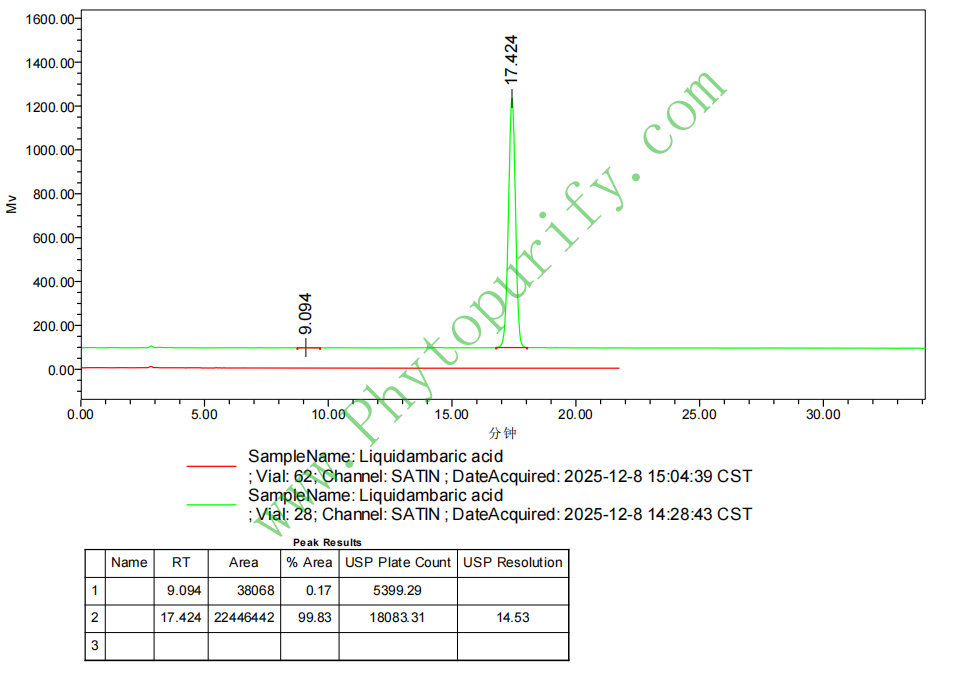
Purity: 95%~99%
Analysis Method: HPLC-DAD or/and HPLC-ELSD
Identification Method: Mass, NMR
Packing: Brown vial or HDPE plastic bottle
Storage: Store in a well closed container, protected from air and light. Put into refrigerate or freeze for long term storage.
The product could be supplied from milligrams to grams
Inquire for bulk scale.
Description:
Betulonic acid has anti-cancer , anti-HIV,hepatoprotective and anti-inflammatory activities, it has antiviral activity against herpes simplex virus, it also suppresses ECHO 6 virus reproduction. Betulonic acid derivatives have a promising cytostatic activity in vitro and could be used as potential leads for the development of new type of anti-cancer agents.
References:
Bioorg Med Chem. 2014 Jul 1;22(13):3292-300.
Synthesis of triterpenoid triazine derivatives from allobetulone and betulonic acid with biological activities.
The synthetic transformation and modification of natural products with the aim to improve the biological properties is an area of current interest. The triterpenoids betulin and betulinic acid are very abundant in nature and now are commercially available.
METHODS AND RESULTS:
In our study, starting from betulin and betulinic acid, we obtained allobetulone and Betulonic acid in a few synthetic steps. The ketone function at the A-ring was used as the starting point for the synthesis of a series of 1,2,4-triazine-fused triterpenoids. The alkylation and Liebeskind-Srogl coupling were used for further substitution of 1,2,4-triazines, and the intramolecular hetero Diels-Alder reaction leads to interesting fused thienopyridine derivatives. All new compounds were tested for their cytostatic activities against murine leukemia L1210, human cervix carcinoma HeLa and human lymphoblast CEM tumor cells.
CONCLUSIONS:
The results show that some triterpenoid triazine Betulonic acid derivatives have a promising cytostatic activity in vitro and could be used as potential leads for the development of new type of anti-cancer agents. Several compounds were also endowed with anti-HCMV activity in the low micromolar range.
Fitoterapia. 2003 Jul;74(5):489-92.
Antiviral activity of betulin, betulinic and betulonic acids against some enveloped and non-enveloped viruses.
METHODS AND RESULTS:
Antiviral properties of betulin, betulinic and Betulonic acids were investigated in cell cultures infected with herpes simplex type I, influenza FPV/Rostock and ECHO 6 viruses.
CONCLUSIONS:
All studied triterpenes were active against herpes simplex virus. Betulin and especially betulinic acid also suppressed ECHO 6 virus reproduction.
Bioorg Med Chem. 2009 Jul 15;17(14):5164-9.Efficient synthesis of the first betulonic acid-acetylene hybrids and their hepatoprotective and anti-inflammatory activity.
The Sonogashira reaction can be applied for the preparation of acetylenic derivatives of Betulonic acid where the triterpenoid moiety can serve as either the halo- or the acetylenic component. This reaction opened access to the first derivatives of Betulonic acid containing either the arylethynyl (C[triple bond]C-Ar(Het) or the ethynyl (C[triple bond]CH) moieties. From the fundamental perspective, this work illustrates the possibility of selective Pd-catalyzed cross-coupling at terminal acetylenes in the presence of a terminal alkene.
METHODS AND RESULTS:
Hepatoprotective and anti-inflammatory properties of selected acetylenic derivatives of Betulonic acid were investigated using the CCl4-induced hepatitis and carrageenan-induced edema models, respectively.
HPLC of Liquidambaric acid
Storage conditions:Short-term storage at 2~8℃, long-term storage at -20 ~ -80℃
54.3700
6.1759
4.4443
.0010
7.1236
9.0186
High
92.0908
4.6674
No
No
No
No
No
No
0.0
No
No
No
No
Natural products, as an important source of drug discovery, play an irreplaceable role in the long history of human struggle against diseases. Triterpenes, as a class of structurally diverse and biologically active natural secondary metabolites, have always been a hot topic in medicinal chemistry and pharmacology research. Among them, Liquidabaric acid, also known as Betulonic acid, is a typical pentacyclic triterpenoid acid that has attracted much attention due to its significant biological activity, especially its enormous potential in anti-inflammatory and antiviral fields in recent years.
Lulutonic acid, CAS number 4481-62-3, is commonly known as 3-oxo-20 (29) - lupen-28-oic acid. Structurally, it belongs to the pentacyclic triterpenoid of the lupine type and is a 3-carbonyl derivative of Betulinic acid. This slight structural difference endows Lulutonic acid with unique physicochemical properties and biological activity spectrum. Early research focused on its anti-tumor activity, but in recent years, with a deeper understanding of signaling pathways related to inflammation and viral infections, the role of lulutonic acid in anti-inflammatory and anti coronavirus effects has gradually been revealed, making it a highly promising natural lead compound.
Inflammation is a defensive response of the body to harmful stimuli, but excessive or sustained inflammatory response is a core link in the pathological process of various chronic diseases (such as rheumatoid arthritis, inflammatory bowel disease, neurodegenerative diseases) and acute infections (such as COVID-19). Viral infections, especially coronavirus infections, often trigger a "cytokine storm", which refers to the excessive release of pro-inflammatory cytokines (such as IL-6, TNF - α) in the body, leading to multi organ damage and even death. Therefore, finding compounds that can effectively inhibit key inflammatory pathways and viral replication has important clinical significance. Lulutonic acid, with its multi-target properties, especially its activity in regulating key inflammatory signaling pathways such as IL-6/STAT3 and NF - κ B, as well as its potential anti coronavirus ability, provides new ideas for the development of novel anti-inflammatory and antiviral drugs.
This article aims to provide a comprehensive and in-depth review of the research status of lulutonic acid, covering its chemical structure, plant sources, extraction process, pharmacological activity, mechanism of action, drug evaluation, and clinical application prospects, in order to provide a systematic reference for further research and development of this natural product.
The chemical structure of lulutonic acid is the basis of its biological activity. Its core skeleton is a pentacyclic triterpenoid of the lupine type, consisting of five fused rings (A, B, C, D, E). Compared with betulinic acid, the most significant structural feature of Lulutonic acid is that the C-3 position of the A ring is a ketone carbonyl group (=O), rather than a hydroxyl group (- OH). In addition, it has an isopropylidene side chain (C-20, C-29) on its E-ring, as well as a carboxyl group at position C-28. Its system names are usually: (1R, 3aS, 5aR, 5bR, 7aR, 9S, 11aR, 11bR, 13aR, 13bR) -9-isopropenyl-3a, 5a, 5b, 8,8,11a-hectamethyl-1-propan-1-en-2-yl-1,2,3,4,5,6,7,7a, 9,10,11,11b, 12,13,13a, 13b-hexahydrocyclopentane-3-a-carboxylic acid.
From the perspective of physical and chemical properties, Lulutonic acid (molecular formula C ∝₀ H ₄₆ O3, molecular weight 454.69 Da) exhibits typical lipophilic characteristics. Its calculated LogP value is as high as 6.1759, indicating that it has strong lipid solubility and is easily soluble in organic solvents such as chloroform, methanol, ethanol, and dimethyl sulfoxide, while its solubility in water is extremely low (about 0.0010 mg/mL). This high lipophilicity has a significant impact on its absorption, distribution, metabolism, and excretion (ADME) processes in organisms. Its topological polar surface area (TPSA) is 54.37 Å ², mainly contributed by one carboxyl group and one ketone group, which is at a moderate level, indicating that it may have a certain degree of cell membrane permeability. It is worth noting that its blood-brain barrier (BBB) penetration is predicted to be "high", which provides the possibility for its application in central nervous system diseases such as neuroinflammation. In addition, preliminary pharmacological evaluation showed that the inhibitory risk of lulutonic acid on hERG potassium channels was low (hERG inhibition: no), and the result in Ames test was negative (0.0), indicating that it does not have significant genetic toxicity, which provides initial assurance for its safety as a candidate drug.
Lulutonic acid is not a rare natural product, it is widely distributed in nature and mainly exists in the Hamamelidaceae family of maple trees(Liquidambar)In plants, this is also the origin of its Chinese name "Lulutong Acid". In addition, it is also in the Betulaceae family, Betulaceae, genus Betulaceae(Betula)Found in various plants.
Main plant sources:
Extraction and Separation Purification Methods:
Due to the lipophilicity of lulutonic acid, its extraction is usually carried out using organic solvent extraction method. Common extraction solvents include ethanol, methanol, or chloroform methanol mixed solvents. In order to improve extraction efficiency and purity, modern separation techniques are widely used.
The pharmacological activity research of lulutonic acid has expanded from early anti-tumor to anti-inflammatory, antiviral, neuroprotective and other fields, demonstrating multiple pharmacological effects.
anti-inflammatory activity:
Inflammation is one of the most in-depth areas of research in the field of rosuvastatin. Numerous in vitro and in vivo experiments have confirmed its significant anti-inflammatory effect.
Antiviral activity:
In recent years, the antiviral activity of lulutonic acid, especially its anti coronavirus activity, has become a research hotspot.
Antitumor activity:
As an analog of betulinic acid, lulutonic acid also inherits its anti-tumor activity. Studies have shown that it has cytotoxicity to a variety of cancer cell lines (such as melanoma, lung cancer, breast cancer, liver cancer, etc.), can induce apoptosis and autophagy, and inhibit tumor cell migration and invasion. The mechanism may be related to the regulation of signaling pathways such as STAT3 and NF - κ B.
Neuroprotective effect:
Given its excellent blood-brain barrier penetration, lulutonic acid has also shown protective effects in neurodegenerative disease models. It can inhibit neuroinflammation mediated by microglia, reduce neurotoxicity induced by β - amyloid protein (A β), and alleviate oxidative stress damage by activating antioxidant pathways such as Nrf2.
Other activities:
Lulutonic acid has also been reported to have various biological activities such as antibacterial, antiparasitic (such as Plasmodium and Leishmania parasites), hepatoprotective, and hypoglycemic effects, but its specific mechanism and in vivo effectiveness still need further verification.
The pharmacological activity of lulutonic acid is the result of the combined action of multiple targets and pathways. Its core mechanism mainly revolves around the regulation of inflammatory signaling pathways and viral life cycle.
Anti inflammatory mechanism:
Mechanism of action against coronavirus:
Mechanism of anti-tumor action:
Lulutonic acid exerts anti-tumor effects through various mechanisms such as inducing apoptosis (activating Caspase family proteins), inducing autophagy, blocking the cell cycle (such as G1/S phase arrest), inhibiting angiogenesis (downregulating VEGF), and reversing epithelial mesenchymal transition (EMT). Among them, inhibition of the STAT3 and NF - κ B pathways also played a key role.
Despite the multifaceted pharmacological activities of lulutonic acid, its development as an oral drug still faces significant challenges, mainly focused on pharmacokinetic (PK) properties.
Analysis of drug properties parameters:
Pharmacokinetic characteristics:
Strategies for improving drug properties:
Given its extremely poor water solubility, structural modification or adoption of novel drug delivery systems is key to enhancing the pharmacological properties of lulutonic acid.
Lulutonic acid, as a natural triterpenoid acid with multiple pharmacological activities, has broad clinical application prospects, but also faces many challenges.
Potential application areas:
Future research directions:
Lulutong acid, as a natural triterpenoid acid derived from traditional Chinese medicine "Lulutong" and "Baihua", has shown important research value and development potential in multiple fields such as anti-inflammatory, antiviral, and anti-tumor due to its unique lupine structure and multi-target pharmacological activity. Especially its role in regulating key inflammatory pathways such as IL-6/STAT3 and NF - κ B, as well as inhibiting coronaviruses, makes it a potential candidate molecule for addressing current global health challenges such as the COVID-19 pandemic and chronic inflammatory diseases.
However, its extremely low water solubility and oral bioavailability are the biggest obstacles to its transition from laboratory to clinical application. Future research should focus on overcoming this bottleneck through structural modification, prodrug design, or advanced drug delivery systems. Meanwhile, in-depth analysis of its mechanism of action and comprehensive safety evaluation are also essential steps. It can be foreseen that with the continuous deepening of research and technological progress, lulutonic acid and its derivatives are expected to contribute to human health in the near future, becoming a new star originating from the treasure trove of natural products.
