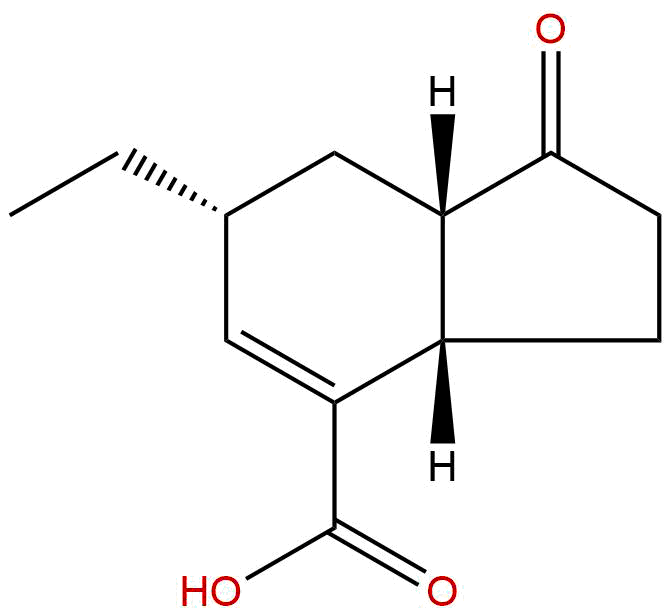


Product name: Coronafacic acid
Synonym name: (+)-Coronafacic acid
Catalogue No.: BP5188
Cas No.: 62251-98-3
Formula: C12H16O3
Mol Weight: 208.257
Botanical Source:
Type of Compound: Miscellaneous
Purity: 95%~99%
Analysis Method: HPLC-DAD or/and HPLC-ELSD
Identification Method: Mass, NMR
Packing: Brown vial or HDPE plastic bottle
Storage: Store in a well closed container, protected from air and light. Put into refrigerate or freeze for long term storage.
Whenever possible, you should prepare and use solutions on the same day. However, if you need to make up stock solutions in advance, we recommend that you store the solution as aliquots in tightly sealed vials at -20℃. Generally, these will be useable for up to two weeks.
The product could be supplied from milligrams to grams
Inquire for bulk scale.
For Reference Standard and R&D, Not for Human Use Directly.
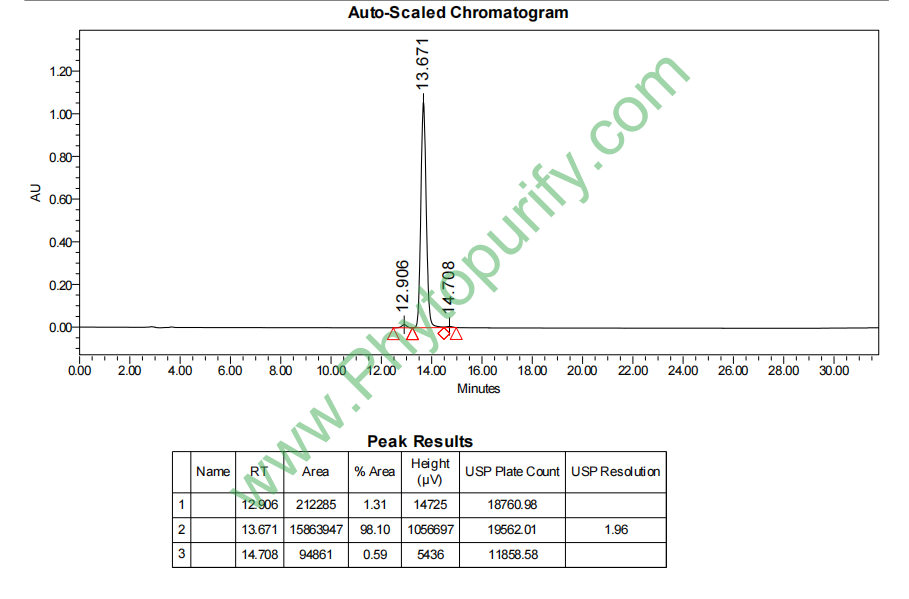
HPLC of Coronafacic acid
Storage conditions:Short-term storage at 2~8℃, long-term storage at -20 ~ -80℃
54.3700
Coronafacic acid (CAS number: 62251-98-3) is a natural product with significant biological activity, originally derived from the plant pathogenic bacterium Pseudomonas(Pseudomonas syringae)Separated from metabolic products. As a key biosynthetic intermediate, coronoid acid has attracted widespread attention in the fields of plant pathology and natural product chemistry. Its unique structure and diverse biological activities make it an important molecule for studying plant pathogen interactions, natural product pharmacology, and the development of new pesticides.
Coronary acid is an important component of the molecule Coronatine, a bacterial toxin that mimics the plant hormone Jasmonic acid (JA) and can regulate plant defense responses and growth and development. Coronary acid, as the structural core of coronamycin, has the ability to regulate plant hormone signaling pathways, and therefore occupies a key position in plant pathology and natural product pharmacology. In recent years, with the in-depth study of the pharmacological activity of coronoid acid and its derivatives, its potential in drug development and agricultural applications has gradually emerged.
This article will provide a systematic review of the chemical structure and physicochemical properties, plant sources and extraction methods, pharmacological activity research, mechanism of action and molecular targets, pharmacological evaluation and pharmacokinetics, as well as clinical application prospects and prospects of coronoid acid. The aim is to provide comprehensive and systematic reference materials for researchers in related fields and promote the in-depth development of research related to coronoid acid.
The chemical formula of coronaic acid is C ₁₁ H ₁₆ O ₄, with a molecular weight of 208.25. The molecular structure contains a cyclohexene ring and multiple carboxyl and hydroxyl functional groups. Its topological polar surface area (TPSA) is 54.37 Å ², with 3 hydrogen bond acceptors, exhibiting moderate polarity and good solubility characteristics.
Structurally, coronaic acid belongs to epoxy fatty acid compounds and contains an alpha, beta unsaturated carboxylic acid structure, which endows it with strong biological activity. Its molecular skeleton is similar in structure to the plant hormone jasmonic acid, thus it can simulate or interfere with hormone signaling in plants. The stereochemical characteristics of coronaic acid have a significant impact on its biological activity. Naturally occurring coronaic acid is typically a specific stereoisomer, exhibiting high conformational selectivity.
In terms of physical and chemical properties, coronaic acid exhibits good chemical stability and moderate polarity, and is easily soluble in polar organic solvents such as methanol and ethanol, but its solubility in water is limited. Its UV absorption peak is mainly concentrated in the range of 200-220 nm, which is suitable for qualitative and quantitative analysis using high-performance liquid chromatography (HPLC) and mass spectrometry techniques.
Coronary acid is not directly derived from higher plants, but is a secondary metabolite produced by the plant pathogen Pseudomonas. Specifically,Pseudomonas syringae Through complex biosynthetic pathways, it and its related strains synthesize coronaic acid, which participates in the pathogenic process of plant pathogens as a component of coronamycin molecules.
The process of extracting coronoid acid usually relies on microbial fermentation technology. Firstly, by cultivating a strain of bacteria that produces coronaic acid in a specific culture medium, it is induced to produce coronaic acid and related metabolites. Subsequently, organic solvents such as ethyl acetate or methanol were used for liquid-liquid extraction, combined with separation and purification techniques such as column chromatography, thin layer chromatography (TLC), and high performance liquid chromatography (HPLC) to obtain high-purity coronaic acid.
In recent years, with the development of molecular biology and metabolic engineering technology, gene cloning and expression regulation have been used to manipulate the biosynthetic gene cluster of coronaic acid, further optimizing its yield and purity. In addition, chemical synthesis methods have also been developed for the preparation of citric acid, especially in the field of stereoselective synthesis, which has made significant progress and provided technical support for its large-scale preparation and structural modification.
Coronary acid exhibits various pharmacological activities due to its unique structure and biological functions, mainly focused on plant hormone simulation, antibacterial activity, and immune regulation.
Plant hormone mimicking activity
Coronary acid, as a component of coronamycin, can simulate the biological activity of jasmonic acid, regulate plant defense responses and growth and development. It activates the jasmonic acid signaling pathway in plants, induces the production of defense related genes, and enhances resistance to pathogens. In addition, coronaic acid also affects the opening and closing of stomata, leaf aging, and root growth of plants, demonstrating the potential to regulate plant physiological processes.
Antibacterial and antiviral activity
Although coronaic acid itself mainly serves as a structural unit of bacterial toxins, its derivatives and synthetic analogues have shown certain potential in antibacterial activity research. Some studies have shown that the modification of the structure of coronoid acid can endow it with inhibitory effects on certain plant pathogens and fungi, and it is expected to be developed as a new type of plant protective agent.
Immune regulatory effect
In animal models, coronaic acid and its analogues have been found to have certain immunomodulatory effects, which can affect inflammation related signaling pathways and exhibit potential anti-inflammatory activity. This provides a new direction for the expansion of coronoid acid in the field of natural product pharmacology.
Other biological activities
Some studies have also explored the role of coronary acid in neuroprotection, antioxidant, and cell signaling regulation. Although the relevant evidence is currently limited, it lays the foundation for further exploration of the multifunctionality of coronary acid in the future.
The mechanism of action of coronaic acid is mainly based on its function of simulating the plant hormone jasmonic acid, by binding to jasmonic acid receptors in the plant and regulating downstream signaling pathways.
Regulation of jasmonic acid signaling pathway
Coronary acid can bind to plant jasmonic acid receptor complexes (such as COI1-JAZ complex), induce JAZ protein degradation, release transcription factors, and activate defense gene expression. This mechanism enables plants to quickly respond to pathogen infection and enhance their immune defense capabilities.
Molecular target specificity
The structure of coronaic acid is highly similar to jasmonic acid, thus exhibiting high specificity in receptor binding affinity and selectivity. Research has shown that coronaic acid forms covalent or non covalent interactions with key amino acid residues of receptor proteins through its alpha, beta unsaturated carboxylic acid groups, stabilizing receptor ligand complexes.
Cross regulation of signal network
Coronary acid not only affects the jasmonic acid pathway, but may also regulate plant physiological responses and defense strategies through cross regulation with other plant hormone signaling pathways such as ethylene and abscisic acid. This multi-level regulatory mechanism enhances the adaptability of plants to environmental stress.
Potential targets in animal cells
The specific molecular targets of coronaic acid in animal cells are not yet fully understood, but preliminary studies suggest that it may exert immunomodulatory effects by regulating inflammation related signaling pathways such as NF - κ B and MAPK. In the future, further elucidation of its targets and mechanisms is needed.
The pharmacological evaluation of COVID-19 is mainly based on its physicochemical properties, pharmacological characteristics, and in vivo metabolic behavior.
Physical and chemical properties and drug compatibility
Coronary acid has a moderate molecular weight (208.25 Da), a TPSA of 54.37, and a hydrogen bond receptor number of 3, which conforms to the physicochemical parameters of most drugs in Lipinski's rules and demonstrates good drug compatibility. Its moderate polarity contributes to membrane permeability and facilitates in vivo absorption.
Pharmacokinetic characteristics
At present, there is limited in vivo pharmacokinetic data on coronaic acid. In vitro studies have shown that coronaic acid can be enzymatically metabolized in liver microsomes, mainly through hydroxylation and carboxylation reactions to convert it into polar metabolites. Its bioavailability, half-life, and tissue distribution still require systematic research.
toxicological evaluation
Preliminary in vitro cytotoxicity tests showed that coronaic acid has low toxicity and good tolerance to mammalian cells. However, long-term toxicity and safety assessments have not yet been systematically conducted, and further animal experiments and preclinical studies are needed to validate them.
Drug delivery and formulation development
Given the physicochemical properties of coronaic acid, developing a water-soluble and stable formulation form is a future research focus. New drug delivery systems such as nanocarriers, liposomes, and sustained-release formulations are expected to enhance their in vivo stability and targeting.
Coronary acid, as a natural product, has shown broad application prospects in agriculture and medicine due to its unique biological activity and structural advantages.
Applications in the field of agriculture
Coronary acid and its derivatives, as plant hormone mimetics, can be used to regulate crop growth and development and enhance disease resistance, with the potential to develop green pesticides and plant growth regulators. Optimizing the biosynthetic pathway of coronoid acid through genetic engineering is expected to achieve efficient and low-cost industrial production.
Potential value in the field of medicine
The preliminary research results on the immunomodulatory and anti-inflammatory effects of COVID-19 suggest that it may become a lead compound for novel anti-inflammatory drugs. In the future, through structural optimization and pharmacokinetic improvements, it is expected to develop new drugs targeting inflammatory diseases, autoimmune diseases, and neurodegenerative diseases.
Challenges and Opportunities
At present, the research on COVID-19 still faces challenges such as unclear pharmacokinetics in vivo and complex target mechanisms. Multidisciplinary cross fusion, advanced molecular simulation, and high-throughput screening techniques will accelerate the development process of drugs related to COVID-19.
Future research directions
It is suggested that in the future, systematic research should focus on the structural modification, target validation, pharmacokinetics, and safety evaluation of coronaic acid, combined with metabolic engineering and nanotechnology, to promote its translational applications in agriculture and medicine.
Coronary acid, as a natural product derived from plant pathogens, has become an important research object in the field of natural product pharmacology due to its unique chemical structure and diverse biological activities. Its mechanism of action in plant hormone simulation, immune regulation, and disease resistance defense provides a new perspective for understanding plant microbe interactions, and also lays the foundation for the development of new pesticides and drugs.
Although the in vivo pharmacokinetics and clinical application research of COVID-19 is still in its early stages, with the development of molecular biology, chemical synthesis, and drug delivery technology, the potential and application prospects of COVID-19 as a drug are becoming increasingly clear. In the future, in-depth multi-level research by the system will promote the clinical and industrial development of COVID-19 from the laboratory, and assist in the innovative development of natural product pharmacology and green agriculture.
