


Synonym name: Chinensioside B; Pulsatilloside E
Catalogue No.: BP0344
Cas No.: 366814-43-9
Formula: C65H106O31
Mol Weight: 1383.53
Botanical Source: roots of Pulsatilla chinensis
Purity: 95%~99%
Analysis Method: HPLC-DAD or/and HPLC-ELSD
Identification Method: Mass, NMR
Packing: Brown vial or HDPE plastic bottle
Can be supplied from milligrams to grams.
For Reference Standard and R&D, Not for Human Use Directly.
Inquire for bulk scale.
HPLC of Pulsatilloside E
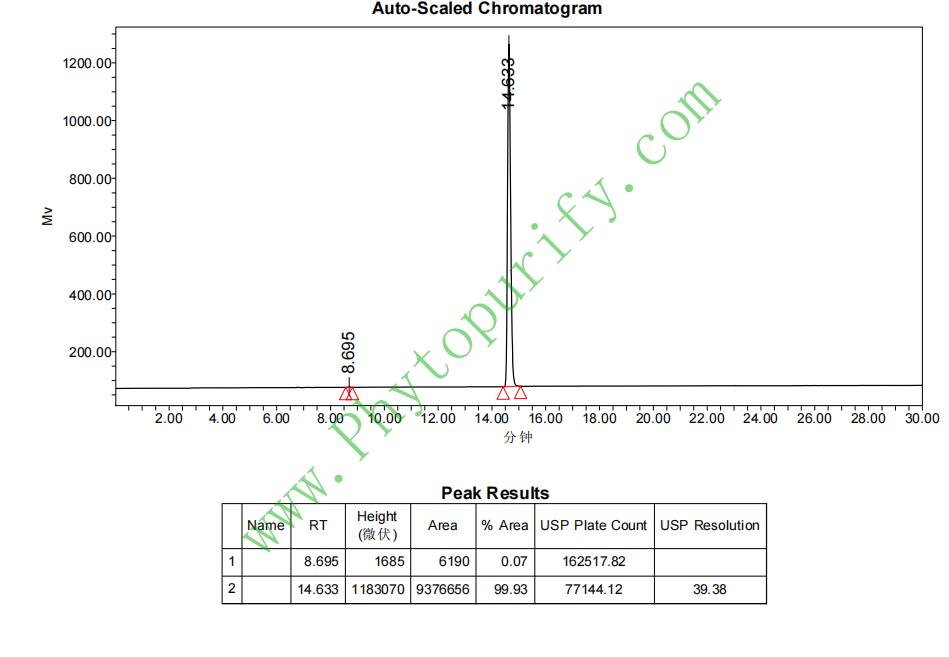
Storage conditions:Short-term storage at 2~8℃, long-term storage at -20 ~ -80℃
550.0000
-2.0000
-1.5000
No
Unknown
Unknown
Unknown
Unknown
No
Unknown
Pulsatilloside E (CAS number: 366814-43-9), also known as Chinenside B, is a natural triterpenoid saponin isolated from the roots of Pulsatilla chinensis, a plant in the Ranunculaceae family. As a traditional Chinese medicinal herb, Bai Tou Weng has always been used for clearing heat, detoxifying, reducing swelling, and relieving pain. Modern pharmacological studies have shown that its components have significant anti-inflammatory, anti-tumor, and immune regulatory activities. Baitouweng saponin E, as one of the important active ingredients in this plant, has gradually received attention in the field of anti-tumor research, especially in prostate cancer research in recent years.
Prostate cancer, as one of the common malignant tumors in men, has a complex pathogenesis involving multiple signaling pathways and molecular targets. Baitouweng saponin E exhibits potential multi-target synergistic regulatory ability against multiple key oncogenic targets such as BCL2, STAT3, AR, etc. This article will systematically review the chemical structure and physicochemical properties, plant sources and extraction methods, pharmacological activity and mechanism of action, pharmacological evaluation and pharmacokinetic characteristics of Baitouweng saponin E, and explore its clinical application prospects and development directions in the treatment of prostate cancer.
Baitouweng saponin E belongs to the triterpenoid saponin class, with a molecular weight of 1299.53 and a complex chemical structure. It is mainly composed of a triterpenoid skeleton connected to multiple sugar groups through glycosidic bonds. Its LogP value is -2.0, indicating that the compound has strong hydrophilicity and good water solubility. The topological polar surface area (TPSA) is as high as 550, and the number of hydrogen bond acceptors is as high as 31, indicating its high molecular polarity, which may affect its cell membrane penetration ability.
Structurally, the triterpenoid skeleton of Paeonia lactiflora saponin E is a typical five ring structure, with diverse and widely distributed sugar groups, forming complex glycosidic chains. This structural feature endows it with various biological activities, but also brings certain challenges in drug formulation, such as low oral absorption rate and poor membrane permeability.
In terms of physical and chemical properties, Baitouweng saponin E is a white or off white powder that is difficult to dissolve in organic solvents but easily soluble in water or polar solvents. It has good stability and is not easily decomposed at room temperature and pressure, but is sensitive to strong acid or alkali environments, and glycosidic bonds are easily hydrolyzed.
The main source of Baitouweng saponin E is from the roots of the plant Pulsatilla chinensis in the Ranunculaceae family. White headed Weng is widely distributed in northern and northeastern China, and is an important traditional Chinese medicine for clearing heat and detoxifying. Its roots contain abundant active ingredients such as triterpenoid saponins, flavonoids, and polysaccharides.
The common methods for extracting saponins E from Paeonia lactiflora include:
Solvent extraction
Dry white haired Weng root powder is subjected to reflux extraction using ethanol or methanol aqueous solution (usually 70%), and the extract is concentrated to obtain a crude extract.
Liquid-liquid distribution
The crude extract is separated by water and ethyl acetate or n-hexane to remove lipophilic impurities and enrich saponin components.
Column chromatography separation
Separate and purify using silica gel, reverse phase C18 column, or resin column. By gradient elution combined with high-performance liquid chromatography (HPLC) monitoring, high-purity saponins E from Paeonia lactiflora were obtained.
Crystallization purification
Further purification through recrystallization or preparative HPLC ensures the purity and structural determination of the compound.
In recent years, ultrasound assisted extraction and microwave-assisted extraction techniques have also been applied to the extraction of saponins E from Paeonia lactiflora, significantly improving extraction efficiency and purity.
The pharmacological activity research of Baitouweng saponin E mainly focuses on its anti-tumor, anti-inflammatory, and immune regulatory effects, especially showing significant inhibitory effects in vitro and in vivo models of prostate cancer.
Multiple studies have shown that saponins E from Paeonia lactiflora have significant inhibitory effects on cell proliferation in prostate cancer cell lines such as PC-3 and LNCaP. Its function is manifested as:
In addition, saponins E from Paeonia lactiflora significantly delayed tumor growth, reduced tumor volume, and had low toxic side effects in an in vivo prostate cancer xenograft model.
Baitouweng saponin E can inhibit the release of inflammatory mediators such as TNF - α, IL-6, IL-1 β, etc., and alleviate inflammatory reactions. It exerts anti-inflammatory effects by regulating the NF - κ B and MAPK signaling pathways. Meanwhile, saponins E from Paeonia lactiflora can regulate immune cell function and enhance the body's anti-tumor immune response.
Some studies have also found that saponins E from Paeonia lactiflora have antioxidant activity, which can clear free radicals and protect cells from oxidative damage. In addition, its research on liver protection and neuroprotective effects is still in its preliminary stage, and the relevant mechanisms need to be further explored.
The mechanism of action of Baitouweng saponin E in the treatment of prostate cancer involves multiple molecular targets and signaling pathways, reflecting its multi-target synergistic regulation characteristics.
BCL2
BCL2 is an anti apoptotic protein, and Baitouweng saponin E promotes cell apoptosis by downregulating BCL2 expression, thereby relieving the blockade of apoptosis in cancer cells.
PTPN1
Protein tyrosine phosphatase 1 (PTPN1) is involved in regulating multiple signaling pathways, and paeoniflorin E may affect cell proliferation and metabolism by regulating PTPN1 activity.
STAT3
Signal transducer and activator of transcription factor 3 (STAT3) plays a crucial role in tumor cell proliferation, survival, and immune escape. Baitouweng saponin E inhibits the phosphorylation and activation of STAT3, blocking its downstream oncogenic signals.
ESR2 (estrogen receptor beta)
ESR2 has an inhibitory effect in the regulation of prostate cancer, and paeoniflorin E may affect hormone dependent tumor growth by regulating ESR2 expression.
MAPK1
Baitouweng saponin E affects cell proliferation and apoptosis by regulating the MAPK1 signaling pathway.
CYP19A1 (aromatase)
Regulating estrogen synthesis and affecting the endocrine environment of hormone related tumors.
AR (androgen receptor)
AR is the core driving factor of prostate cancer, and paeoniflorin E inhibits the AR signaling pathway, blocking hormone dependent proliferation of tumor cells.
PIK3CA
Participate in the PI3K/Akt signaling pathway to regulate cell growth and survival. Baitouweng saponin E may inhibit PIK3CA and block the abnormal activation of this pathway.
LGALS3 (galectin 3)
Affects cell adhesion, migration, and immune regulation, and Paeonia lactiflora saponin E inhibits tumor metastasis by regulating LGALS3.
EGFR (epidermal growth factor receptor)
By inhibiting EGFR signaling, Paeonia lactiflora saponin E blocks the proliferation and survival signals of tumor cells.
Baitouweng saponin E regulates multiple key tumor related signaling pathways through multi-target action, including:
PI3K/Akt/mTOR pathway
Inhibit cell proliferation and promote apoptosis.
JAK/STAT pathway
Block the immune escape and proliferation signals of tumor cells.
MAPK/ERK pathway
Regulating cell cycle and apoptosis.
NF - κ B pathway
Inhibiting inflammatory response and supporting tumor microenvironment.
In summary, Baitouweng saponin E exerts its pharmacological effects against prostate cancer through multi-target and multi pathway synergistic effects.
The pharmacological parameters of Baitouweng saponin E show that it has certain challenges:
At present, the hepatotoxicity, cardiotoxicity, hERG channel inhibition, and mutagenicity (Ames test) data of saponins E from Paeonia lactiflora are not clear and require further systematic evaluation.
In terms of pharmacokinetics, preliminary in vivo studies have shown that the oral absorption rate of Paeonia lactiflora saponin E is low, the plasma half-life is short, and it is mainly metabolized by the liver and excreted through bile. Its high polarity and large molecular weight limit its distribution in the body, making it difficult to achieve high target tissue concentrations. To overcome these limitations, the development of drug delivery systems such as nanocarriers and liposome encapsulation has become an important direction.
Paeonia lactiflora saponin E, as a natural product with multi-target anti-tumor activity, has shown great potential in the treatment of prostate cancer. Its multi pathway synergistic regulation mechanism helps overcome the resistance problem of single target drugs and provides new treatment strategies.
The future clinical application prospects are mainly reflected in:
New drug development
Through structural optimization and drug design, its oral bioavailability and in vivo stability are improved, and it is developed into an oral or injectable anti-tumor drug.
combination therapy
Combined use with existing prostate cancer treatment drugs (such as androgen receptor antagonists and chemotherapy drugs) to enhance efficacy and reduce the risk of drug resistance.
Drug delivery technology
Using nanotechnology, liposomes, microspheres and other carriers to improve their targeting and in vivo circulation time, and reduce side effects.
Development of biomarkers
Based on its target, screen suitable patient populations and achieve personalized and precise treatment.
safety evaluation
Strengthen toxicological research on saponins E from Paeonia lactiflora to ensure their safety and efficacy in clinical applications.
Although Paeonia lactiflora saponin E has not yet entered the clinical trial stage, its positive results in basic research have laid a solid foundation for subsequent translational studies.
Baitouweng saponin E, as an important triterpenoid saponin in the family Ranunculaceae, has become a hot topic in natural product pharmacology research due to its complex chemical structure and multi-target anti-tumor activity. Its mechanism of action in prostate cancer involves multiple key molecular targets and signaling pathways, reflecting the advantages of natural product multi-target and multi mechanism synergistic regulation.
However, the high polarity, high molecular weight, and pharmacological properties of Paeonia lactiflora saponins E limit their direct conversion for clinical applications and urgently need to be overcome through structural modification and advanced drug delivery systems. In the future, the cross fusion of modern medicinal chemistry, molecular biology, and nanotechnology is expected to promote the clinical application of Paeonia lactiflora saponin E and provide new treatment options for prostate cancer patients.
In summary, Baitouweng saponin E not only enriches the pharmacological research of natural triterpenoid saponins, but also provides valuable molecular templates and theoretical basis for the development of natural anti-tumor drugs. We look forward to more systematic and in-depth research in the future to reveal its comprehensive pharmacological properties and safety, and promote its clinical translation process.
