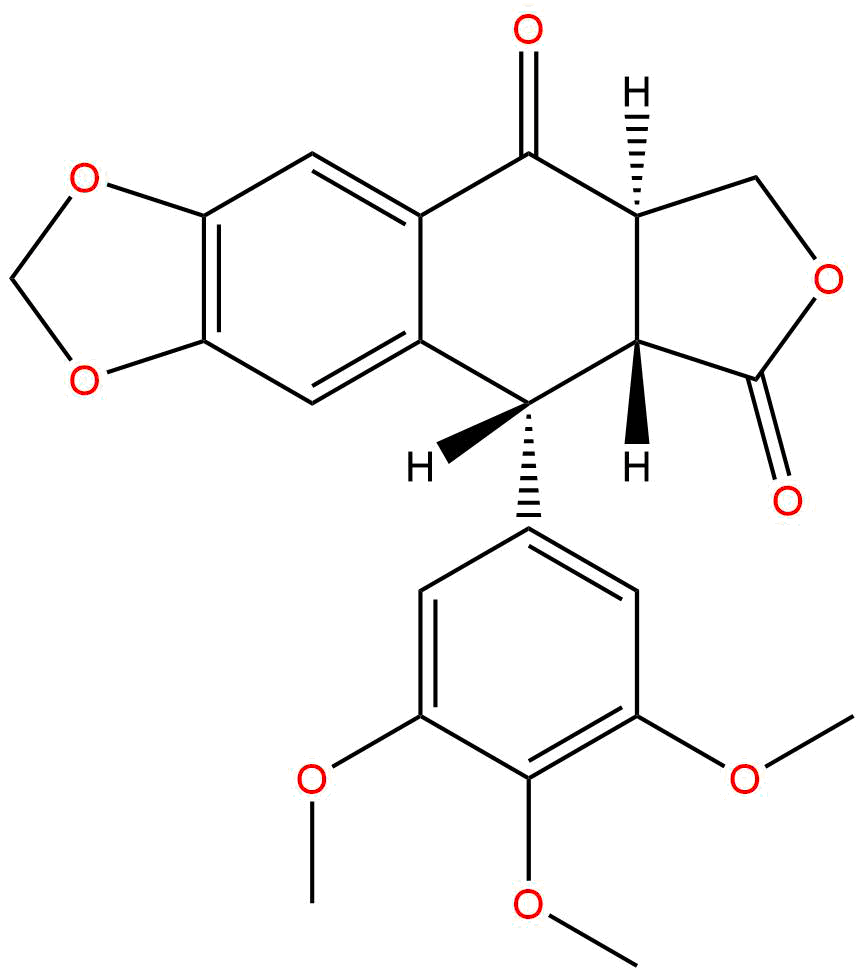


Product name: Podophyllotoxone
Synonym name: Podophyllotoxinone
Catalogue No.: BP4524
Cas No.: 477-49-6
Formula: C22H20O8
Mol Weight: 412.394
Botanical Source:
Type of Compound:
Purity: 95%~99%
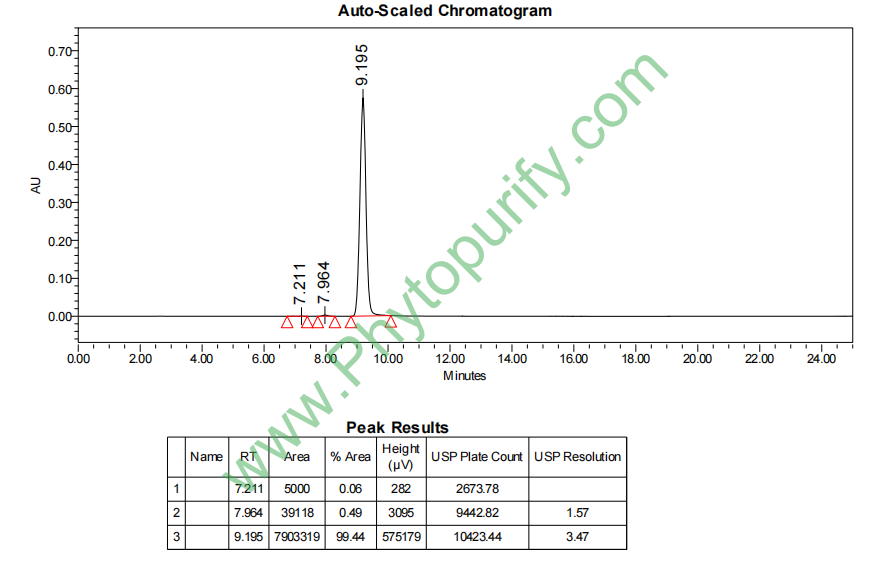
Analysis Method: HPLC-DAD or/and HPLC-ELSD
Identification Method: Mass, NMR
Packing: Brown vial or HDPE plastic bottle
Storage: Store in a well closed container, protected from air and light. Put into refrigerate or freeze for long term storage.
Whenever possible, you should prepare and use solutions on the same day. However, if you need to make up stock solutions in advance, we recommend that you store the solution as aliquots in tightly sealed vials at -20℃. Generally, these will be useable for up to two weeks.
The product could be supplied from milligrams to grams
Inquire for bulk scale.
For Reference Standard and R&D, Not for Human Use Directly.
HPLC of Podophyllotoxone
Storage conditions:Short-term storage at 2~8℃, long-term storage at -20 ~ -80℃
89.5200
2.2597
2.2596
.0356
4.7700
20.2093
High
82.9738
3.6224
Yes
No
Yes
No
Yes
No
0.0
Yes
Yes
No
Yes
Natural products have long been an important treasure trove for innovative drug discovery, among which lignans have attracted much attention due to their significant biological activity. Podophyllotoxin (CAS number: 477-49-6), as a natural lignan product with a tetrahydronaphthofuranone core structure, is an important structural analogue and biotransformation precursor of the traditional anti-tumor drug lead compound Podophyllotoxin. Since its isolation and identification from plants such as the genus Podophyllum, its unique chemical structure and diverse pharmacological activities, especially its mechanism of action that differs from classical podophyllotoxin drugs, have attracted sustained research interest in the fields of pharmacology and medicinal chemistry. Guijiu toxin ketone not only exhibits direct anti-tumor activity on its own, but also plays a key role in understanding the in vivo metabolism and mechanism of action of Guijiu toxin compounds (such as etoposide and tiniposide) as a key intermediate. The purpose of this article is to systematically review the chemical properties, plant sources, pharmacological activities, multi-target mechanisms of action, pharmacological characteristics, and clinical translational potential of podophyllotoxin, in order to provide a comprehensive academic perspective for the in-depth research and development of this compound.
The molecular formula of Guijiudu ketone is C22H20O8, with a molecular weight of 412.3940. Its core structure is tetrahydronaphtho [2,3-c] furan-1 (3H) - one, which belongs to the aromatic tetrahydronaphtho lignin class. Compared with podophyllotoxin, the most significant structural difference of podophyllotoxin ketone lies in the oxidation state of its C-ring (lactone ring): the C-ring of podophyllotoxin is a gamma lactone ring, while the C-ring of podophyllotoxin ketone is oxidized to a ketone group (C=O), forming an alpha, beta unsaturated ketone structure (enone). This structural change profoundly affects its chemical reactivity, spatial conformation, and interaction patterns with biomolecules.
In terms of physical and chemical properties, the lipid water partition coefficient (LogP) of podophyllotoxin is 2.2597, indicating its moderate lipophilicity and favorable transmembrane transport. Its topological polar surface area (TPSA) is 89.5200 Å ², reflecting the polarity brought by multiple oxygen atoms in the molecule. The water solubility is relatively low, about 0.0356 mg/mL, which to some extent limits its direct development in aqueous formulations, but also suggests that it may be more suitable for new drug delivery systems such as liposomes and nanoparticles. In terms of spectroscopic characteristics, it has a characteristic absorption peak near 290-300 nm in ultraviolet absorption, and its unique ketene structure and aromatic proton signal can be clearly distinguished by nuclear magnetic resonance hydrogen spectrum and carbon spectrum.
Guijiu toxin mainly comes from various plants such as Podophyllum and Diphylleia in the Berberidaceae family, among which the roots and rhizomes of Podophyllum pleianthum are the main natural sources. In addition, it can also be found in Sinopodophyllum hexandrum and Podophyllum peltatum, often present as a companion component or biosynthetic/oxidative metabolite of podophyllotoxin.
Its extraction and separation usually follow the conventional process of natural product chemistry. Firstly, the dried plant rhizome material is crushed and subjected to cold soaking or reflux extraction using organic solvents such as methanol, ethanol, or acetone. After vacuum concentration, the crude extract was subjected to segmented extraction using different polar solvents such as petroleum ether, chloroform, and ethyl acetate. Podocarpine was mainly enriched in the moderately polar ethyl acetate fraction. Further purification depends on a variety of chromatographic techniques, including silica gel column chromatography (elution with chloroform methanol gradient), Sephadex gel (LH-20) column chromatography, and high performance liquid chromatography (HPLC) preparation. In modern separation analysis, thin-layer chromatography (TLC) and high-performance liquid chromatography-mass spectrometry (HPLC-MS) are often combined for rapid identification and tracking. It is worth noting that podophyllotoxin can also be semi synthesized through chemical or biological transformation (such as microbial oxidation) of podophyllotoxin, providing a feasible pathway for obtaining sufficient samples for further research.
The pharmacological activity research of Guijiudu ketone mainly focuses on the field of anti-tumor and exhibits various biological effects.
The anti-tumor mechanism of Guijiudu ketone is complex and exhibits multi-target characteristics, which is closely related to its unique enone structure. Its main mechanism of action and molecular targets include:
In summary, the anti-tumor effect of podophyllotoxin is exerted through a mode of "microtubule inhibition as the core and multi-target synergy", and this multi-target characteristic may help overcome the problem of drug resistance that is prone to occur with single target drugs.
Based on the provided parameters and existing research, the preliminary evaluation of the pharmacological properties of podophyllotoxin is as follows:
The clinical application prospects of Guijiudu ketone are broad, but there are both challenges and opportunities on the road.
Direct drug development Developing it into a new type of anti-tumor drug is the main direction. Given its water solubility and potential toxicity, current research should focus on:
As a tool molecule and lead compound Podophylline is an important tool molecule for studying the structure-activity relationship of microtubule inhibitors, as well as the in vivo metabolism and activation mechanisms of podophyllotoxin compounds. Its unique ketene structure also provides valuable lead compound templates for designing novel multi-target anti-tumor drugs.
Exploration for specific indications Its high blood-brain barrier permeability suggests its special value in the treatment of brain tumors such as glioblastoma. The potential effect on ESR1 and CYP19A1 is also worth further verification in hormone receptor positive breast cancer models.
challenges faced Future research needs to systematically complete its preclinical pharmacological, pharmacokinetic, and toxicological evaluations, clarify its in vivo metabolic fate, therapeutic indices, and major toxic target organs. The precise mapping of its multi-target mechanism and how to balance the relationship between multi-target effects and selectivity are core scientific issues that need to be addressed in basic research.
Guijiu toxin ketone, as a natural lignan compound derived from traditional medicinal plants, occupies an important position in the fields of natural product pharmacology and anti-tumor drug development due to its unique enone chemical structure and multi-target anti-tumor mechanism. It not only continues the strong anti proliferative activity of the podophyllotoxin family, but also expands the multidimensional pharmacological network including apoptosis regulation, signal pathway interference, invasion and metastasis inhibition, with its inhibition of microtubule polymerization as the core. Although its poor solubility and potential toxicity pose major obstacles on the path to becoming a drug, the development of modern medicinal chemistry, pharmacy, and molecular pharmacology provides powerful tools to overcome these challenges. Through in-depth structure-activity relationship research, rational drug design, and advanced delivery technology, it is expected that podophyllotoxin will be successfully transformed from a potential natural active molecule into a clinically available anti-cancer drug, or provide key insights for the development of a new generation of multi-target anti-tumor agents. Continuous and in-depth research on it will further enrich our understanding of the anti-cancer mechanisms of natural products and promote the discovery process of related innovative drugs.
