
| Catalog No | Package | Original Price | Price | Inventory | Quantity | Operating |
|---|---|---|---|---|---|---|
| BP0276-20mg | 20mg | $20.00 | Sign in |
|


Product name: Biochanin A
Synonym name: Genistein 4′-methyl ether; Pratensol; Olmelin
Catalogue No.: BP0276
Cas No.: 491-80-5
Formula: C16H12O5
Mol Weight: 284.267
Botanical Source: Trifolium pratense L.
Physical Description:
Type of Compound: Flavonoids
Purity: 95%~99%
Analysis Method: HPLC-DAD or/and HPLC-ELSD
Identification Method: Mass, NMR
Packing: Brown vial or HDPE plastic bottle
Storage: Store in a well closed container, protected from air and light. Put into refrigerate or freeze for long term storage.
Whenever possible, you should prepare and use solutions on the same day. However, if you need to make up stock solutions in advance, we recommend that you store the solution as aliquots in tightly sealed vials at -20℃. Generally, these will be useable for up to two weeks.
The product could be supplied from milligrams to grams
Inquire for bulk scale.
Chengdu Biopurify Phytochemicals Ltd. is a leading company in the research, development, manufacture and marketing of High Quality Phytochemicals and Extracts(especially Active Ingredients from Traditional Chinese Medicine,TCM), Natural Active Pharmaceutical Ingredients worldwide.
The main services:
A. Supply active ingredients and reference standards of TCM, from mgs to kgs scale
B. Custom extraction and purification, target Herb Active Ingredients
C. Custom synthesis and semi-synthesis for Natural Active Ingredients
D. CR(contract research), CM(contract manufacture) and PD(process development) services from lab scale, pilot scale to commercial scale(GMP is also available)
E. TCM compounds library for drug screen,more than 3000 compounds available, many of them are rare and unique.
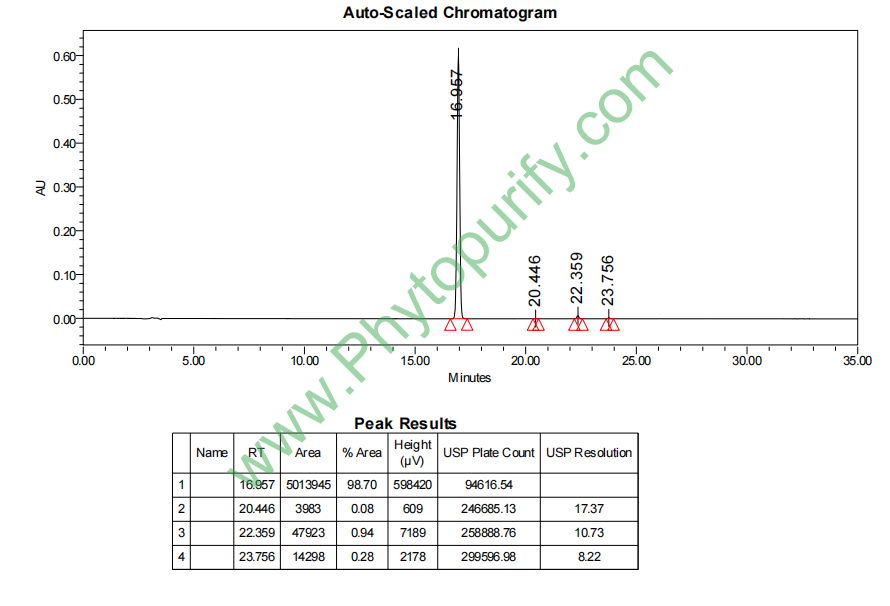
HPLC of Biochanin A
Storage conditions:Short-term storage at 2~8℃, long-term storage at -20 ~ -80℃
79.9000
2.4266
2.1574
.0638
3.3774
65.6060
Low
91.7842
2.1728
Yes
No
Yes
No
Yes
Yes
2.1
No
No
No
No
As an important treasure trove for drug discovery and development, natural products continue to provide modern medicine with lead compounds with novel structures and diverse activities. Isoflavones, as a class of secondary metabolites widely present in leguminous plants, have attracted much attention due to their diverse biological activities. Biochanin A (BCA), chemical name 5,7-dihydroxy-4 '- methoxyflavone, CAS number 491-80-5, is one of the representative active ingredients. Early research mainly focused on its phytoestrogenic effects, but in recent years, with the deepening of molecular pharmacology research, BCA has demonstrated multiple pharmacological activities beyond hormone regulation, especially in the fields of anti-tumor, neuroprotection, metabolic regulation, and anti-inflammatory potential. Of particular note is that BCA has been identified as a natural fatty acid amide hydrolase (FAAH) inhibitor, with half maximal inhibitory concentrations (IC50) of 1.8, 1.4, and 2.4 μ M for mouse, rat, and human FAAH, respectively. FAAH is a key degradation enzyme in the endocannabinoid system (ECS), and its inhibition can enhance the activity of endocannabinoids such as arachidonic ethanolamine (AEA), thereby regulating physiological and pathological processes such as pain, inflammation, emotion, and energy metabolism. This discovery has opened up a new dimension for the medicinal value of BCA. This article aims to systematically review the chemical properties, plant sources, pharmacological activities, multi-target mechanisms of action, pharmacological evaluation, and clinical application prospects of chickpea sprout extract A, in order to provide comprehensive scientific references for the in-depth research and development of this natural product.
The molecular formula of chickpea sprout extract A is C ₁₆ H ₁₂ O ₅, with a molecular weight of 284.2670 g/mol. Its core structure is the isoflavone mother nucleus, which is the 3-phenylchromenone structure. Specifically, the A ring has one phenolic hydroxyl group at positions 5 and 7, while the B ring has one methoxy group at position 4 '. This specific hydroxyl and methoxy substitution pattern is the structural basis of its biological activity, affecting its antioxidant capacity, receptor binding affinity, and metabolic stability.
In terms of physicochemical properties, the lipid water partition coefficient (LogP) of BCA is 2.4266, indicating its moderate lipophilicity and favorable transmembrane transport. Its topological polar surface area (TPSA) is 79.9000 Å ², reflecting the surface area of polar atoms (such as hydroxyl oxygen) in the molecule. The water solubility data is 0.0638 (usually measured in mg/mL or mol/L, indicating poor water solubility), which is a difficult to dissolve compound, posing challenges for its oral absorption and formulation development. Under physiological pH conditions, its phenolic hydroxyl group can partially dissociate, but the overall molecule still exists mainly in a neutral form. The conjugated system in its structure gives it characteristic absorption in the ultraviolet region, which can be used for qualitative and quantitative analysis. In addition, BCA is relatively stable under light and alkaline conditions, but may degrade in strong acid or strong oxidizing environments.
Chickpea sprout extract A is mainly found in leguminous plants, especially in the buds, leaves, and seeds of chickpeas (Cicer arietinum), where its content is relatively high, hence its name. In addition, Trifolium pratense, soybean (Glycine max), alfalfa (Medicago sativa), and some traditional medicinal plants such as Pueraria lobata also contain a certain amount of BCA or its glycoside form (such as olecranon bean sprouts A-7-O-glucoside). In plants, BCA is often stored in the form of glycosides, and after processing or in vivo metabolism, it is hydrolyzed into aglycone form to exert its activity.
Organic solvent extraction is commonly used to extract BCA from plant materials. Common solvents include methanol, ethanol, acetone, and their aqueous solutions. In order to improve extraction efficiency, modern extraction techniques such as ultrasound assisted extraction (UAE), microwave-assisted extraction (MAE), and supercritical fluid extraction (SFE, commonly CO ₂) have been widely used. These methods can shorten extraction time, reduce solvent usage, and potentially improve the yield of target compounds. The crude extract after extraction is usually subjected to a series of separation and purification steps, such as macroporous adsorption resin chromatography, silica gel column chromatography, preparative high-performance liquid chromatography (HPLC), etc., to obtain high-purity BCA monomers. The optimization of extraction process needs to comprehensively consider the types of raw materials, target purity, cost, and environmental requirements.
A large number of in vitro and in vivo studies have shown that chickpea sprout extract A has a wide range of pharmacological activities, and its effects go far beyond the initial phytoestrogenic effects.
The pharmacological effects of chickpea sprout extract A are achieved by acting on multiple molecular targets and signaling pathways, reflecting the multi-target nature of natural products.
Core target: FAAH inhibition BCA directly inhibits FAAH enzyme activity, leading to an increase in endogenous cannabinoid AEA levels. AEA exerts analgesic, anti-inflammatory, anti anxiety, and neuroprotective effects by activating cannabinoid CB1 and CB2 receptors, as well as transient receptor potential vanillic acid subtype 1 (TRPV1). This is one of the core mechanisms by which BCA participates in regulating the functions of the nervous and immune systems.
Anti breast cancer related target network:
Other pathways BCA can also activate the Nrf2/ARE antioxidant pathway, inhibit the NF - κ B and MAPK inflammatory pathways, and regulate the PI3K/Akt survival pathway, which together form the pharmacological basis of its pleiotropy.
Based on the provided pharmacological parameters, a preliminary evaluation of chickpea sprout extract A is conducted
* Molecular weight (284.27)Compliant with the five rules for generic drugs (<500 Da).
* LogP(2.43)Being within the ideal range (1-3) indicates good membrane permeability.
* TPSA(79.9 Ų)Below the commonly considered critical value of membrane permeability (~140 Å ²), it is beneficial for oral absorption.
* Water solubility (poor)This is its main pharmacological defect, which may lead to low oral bioavailability and requires improvement through formulation techniques such as nanocrystals, solid dispersions, cyclodextrin inclusion complexes, etc.
* Blood brain barrier permeability (low)Although its LogP is moderate, it is predicted to have lower BBB permeability due to molecular polarity or interactions with transporters. This is an unfavorable factor for the treatment of central nervous system diseases, but may be beneficial for reducing central side effects.
* HERG inhibition (No)The potential risk of cardiac toxicity is low, which is a favorable safety indicator.
* Ames test (2.1)The Ames test is used to evaluate mutagenicity, and the value is usually positive or negative. Here, "2.1" may refer to the ratio of the number of revertant mutant colonies of a specific strain. It is generally believed that a ratio<2 is negative and>2 is positive. This value is slightly higher than 2, indicating that there may be weak mutagenic signals under specific experimental conditions, and more genetic toxicity tests (such as micronucleus test and chromosome aberration test) need to be combined for comprehensive evaluation. This may be a safety issue that needs attention in its development.
In terms of pharmacokinetics, BCA is rapidly but incompletely absorbed after oral administration, with significant first pass effects. It mainly undergoes extensive metabolism in the body, including demethylation to generate more active genistein, glucuronidation, and sulfation binding reactions. Demethylation is mainly catalyzed by cytochrome P450 enzymes (such as CYP1A2). Its metabolites are mainly excreted through urine and feces. The absolute bioavailability and half-life of BCA are relatively low, which limits its therapeutic efficacy due to its pharmacokinetic properties. Therefore, developing new drug delivery systems (such as long circulating liposomes and polymer micelles) to improve their solubility, prolong circulation time, and enhance targeting is the key to promoting their clinical application.
Chickpea sprout extract A, as a natural active molecule with multiple targets and functions, has shown broad application prospects in various disease fields.
However, its clinical translation still faces challenges: ① poor water solubility and low bioavailability are the primary bottlenecks; ② The multi-target characteristic is both advantageous and may bring unforeseen side effects, requiring systematic preclinical safety evaluation; ③ The potential warning signals of Ames test need to be thoroughly clarified; ④ Its metabolism in the body is complex, and the contribution of active metabolites such as genistein needs to be clarified.
Future research directions should include: optimizing its pharmacokinetic properties through structural modification or prodrug strategies; Develop advanced targeted delivery systems; Conduct more high-quality preclinical pharmacological and toxicological studies; Explore its synergistic effects with other drugs or natural products; Ultimately driving the design of rigorous clinical trials to validate their effectiveness and safety in specific indications.
Chickpea sprout extract A is a multifunctional isoflavone compound derived from plants, and its unique chemical structure endows it with abundant pharmacological activity. The research process of BCA reflects the continuous deepening of understanding of natural products, from the initial plant estrogen to being revealed as a natural FAAH inhibitor, and then acting on multiple tumor related signaling pathways such as AMPK, STAT3, Bcl-2, etc. It demonstrates enormous potential in anti-tumor, neuroprotection, metabolic regulation, and other areas through a sophisticated multi-target network. Despite challenges such as low water solubility and poor bioavailability in drug development, as well as the need for further clarification of safety details, these have not obscured its value as a lead compound. With the progress of modern pharmaceutics, pharmaceutical chemistry and molecular biology technology, through reasonable structure optimization, preparation innovation and in-depth mechanism exploration, chickpea sprout A is expected to gradually develop from a promising natural molecule to an innovative drug or functional supplement for the treatment of breast cancer, neuropsychiatric diseases, metabolic syndrome and other major diseases, and contribute its unique value to human health.
