


Synonym name: Padmakastein; Prunusetin
Catalogue No.: BP1163
Cas No.: 552-59-0
Formula: C16H12O5
Mol Weight: 284.267
Botanical Source: Trifolium pratense L.
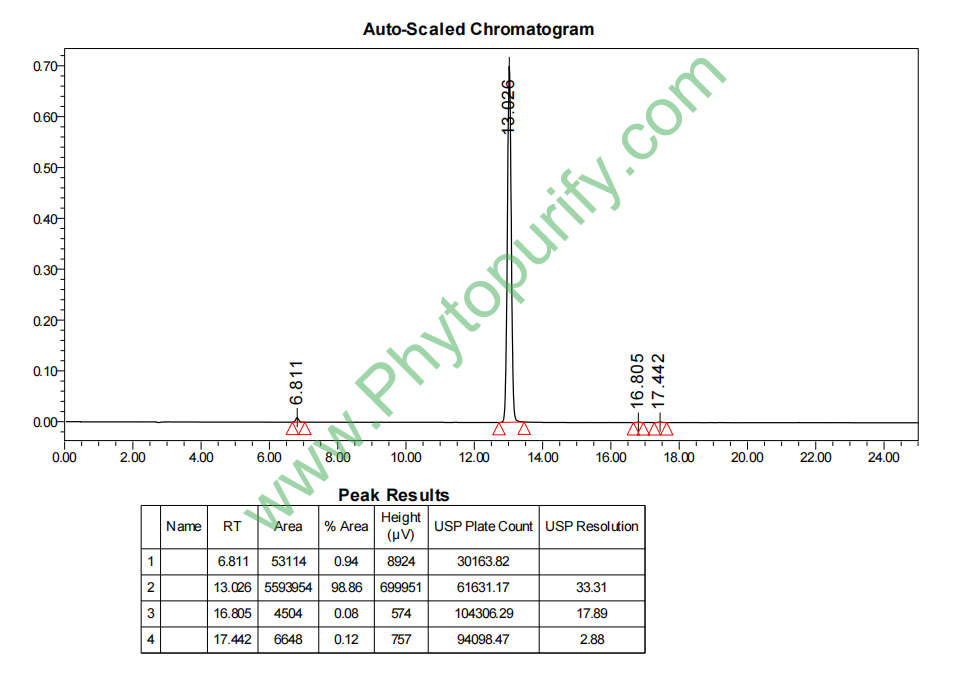
Purity: 95%~99%
Analysis Method: HPLC-DAD or/and HPLC-ELSD
Identification Method: Mass, NMR
Packing: Brown vial or HDPE plastic bottle
Can be supplied from milligrams to grams.
For Reference Standard and R&D, Not for Human Use Directly.
Inquire for bulk scale.
HPLC of Prunetin
Storage conditions:Short-term storage at 2~8℃, long-term storage at -20 ~ -80℃
79.9000
2.3724
2.3488
.0676
3.8696
67.4191
Low
92.1308
2.2094
Yes
No
No
No
Yes
Yes
2.1
No
Yes
No
No
Natural products have always been an important source of innovative drug discovery, among which isoflavone compounds have attracted much attention due to their wide range of biological activities. Prunetin, also known as 5,4 '- dihydroxy-7-methoxyflavone, is an O-methylated isoflavone with a CAS number of 552-59-0. As a structural analogue of genistein, its hydroxyl group at position 7 is replaced by a methoxy group, which significantly affects its physicochemical properties and biological activity spectrum. Sakuraflavin is widely present in various leguminous plants and fruits, and was initially recognized for its phytoestrogenic activity. With the deepening of research, its multiple pharmacological effects such as anti-inflammatory, antioxidant, and anti-tumor have gradually been revealed, especially its characteristics as a human aldehyde dehydrogenase (ALDH) inhibitor, providing new ideas for the treatment of related diseases. In recent years, research on the anti-tumor activity of quercetin has been particularly active, and it has shown potential therapeutic value in various tumor models by regulating multiple key targets such as MCL1, STAT3, and HIF1A. This article aims to provide a systematic review of the chemical properties, plant sources, pharmacological activities, mechanisms of action, pharmacological evaluation, and clinical application prospects of Sakuraflavins, in order to provide comprehensive scientific references for the deep development and utilization of this natural product.
Sakuraflavin belongs to the flavonoid class of compounds, and its basic parent nucleus is 3-phenylchromenone. The specific structure is: A ring is connected to a methoxy group (- OCH3) at position 7, B ring is connected to a hydroxyl group (- OH) at position 4 ', and there is another hydroxyl group (- OH) at position 5. Its molecular formula is C16H12O5 and its molecular weight is 284.2670. Compared with the prototype compound genistein (7,4 '- dihydroxyflavone), the methoxylation at position 7 increases its lipophilicity, with a LogP value of 2.3724, indicating a moderate lipophilic compound. This structural change also affects its molecular polarity, with a topological polar surface area (TPSA) of 79.9000 Å ².
In terms of physicochemical properties, the water solubility of Sakuraflavin is relatively low, about 0.0676 mg/mL, which is consistent with its high LogP value, suggesting that solubilization strategies may need to be considered in formulation development. The crystal morphology is usually light yellow needle shaped crystals. The phenolic hydroxyl groups in its structure give it a certain acidity and antioxidant potential. In terms of spectroscopic characteristics, there are characteristic absorption peaks in the 260-270 nm and 300-330 nm regions for its ultraviolet absorption. Nuclear magnetic resonance hydrogen spectrum (1H NMR) can clearly distinguish the signal of the 7-position methoxy group in the A ring (δ~3.8 ppm) and the proton signal of the 4 '- position hydroxyl group in the B ring. Sakuraflavin is relatively stable under alkaline conditions, but may degrade under strong acid, strong light, or high temperature. As a methylated derivative of genistein, it may exist in the body as one of the metabolites of the latter, and also has unique biological functions.
Sakuraflavin is relatively widely distributed in nature, mainly found in Leguminosae plants, especially in Prunus plants, which is also the source of its name "Sakuraflavin". Its main plant sources include:
1. Rosaceae plants Such as the bark, root bark, or fruit of cherries (Prunus avium), peaches (Prunus persica), and plums (Prunus salicina).
2. Leguminous plants Trace amounts are also present in certain varieties of the Glycyrrhiza genus, Dalbergia wood, and common legumes such as soybean (Glycine max).
3. Other sources It has also been reported in some traditional medicinal plants such as Psoralea corylifolia.
The extraction and separation of lutein usually follow the conventional process of natural product chemistry. Firstly, the dried plant materials (such as bark and roots) are crushed and subjected to extraction or reflux extraction using polar organic solvents (such as methanol, ethanol, or acetone). After the crude extract is concentrated under reduced pressure, its solubility difference is used for preliminary separation, such as defatting with petroleum ether, and then extracting and enriching isoflavone fractions with ethyl acetate or n-butanol.
Further purification relies on various chromatographic techniques:
- column chromatography Silica gel column chromatography is commonly used, with chloroform methanol or petroleum ether ethyl acetate gradient elution.
- High performance liquid chromatography Preparation type HPLC is a key step in obtaining high-purity sakurin, usually using a reverse phase C18 column with methanol water or acetonitrile water system as the mobile phase for separation.
-In addition, modern separation techniques such as high-speed counter current chromatography (HSCCC) have also been applied to the preparation of sakurin due to their high efficiency and avoidance of adsorption losses.
The optimization of extraction process focuses on improving yield and purity, involving solvent selection, extraction temperature, time, and the application of new auxiliary technologies such as ultrasound and microwave-assisted extraction. Research on the biosynthetic pathway suggests that sakurin may be generated from genistein through specific O-methyltransferase catalysis, laying the foundation for future large-scale production through synthetic biology strategies.
Numerous in vitro and in vivo studies have confirmed that lutein has diverse pharmacological activities, and its core functions can be summarized as follows:
Anti inflammatory and immune regulatory activity Sakuraflavin is a clear anti-inflammatory agent. In the macrophage inflammation model induced by lipopolysaccharide (LPS), it can significantly inhibit the production of nitric oxide (NO), prostaglandin E2 (PGE2), and pro-inflammatory cytokines such as TNF - α, IL-6, IL-1 β. Its anti-inflammatory effect is closely related to the inhibition of the activation of nuclear factor kappa B (NF - κ B) and mitogen activated protein kinase (MAPK) signaling pathways. In addition, it also has an inhibitory effect on the expression of inflammation related enzymes such as cyclooxygenase-2 (COX-2) and inducible nitric oxide synthase (iNOS).
Antitumor activity This is currently the most concerned pharmacological activity of Sakuraflavin. Studies have shown that it can inhibit proliferation and promote apoptosis of many human cancer cell lines, including breast cancer, prostate cancer, lung cancer, liver cancer, colon cancer, etc. Its anti-tumor effect is multifaceted:
Enzyme inhibitory activity:
Antioxidant and neuroprotective activities By virtue of its phenolic hydroxyl structure, Sakuraflavin has the ability to scavenge free radicals and inhibit lipid peroxidation. In some neurodegenerative disease models, it has shown a protective effect against oxidative stress-induced neuronal damage.
Estrogen like/anti estrogenic activity As an isoflavone, quercetin can weakly interact with the estrogen receptor (ESR1) and exhibit selective estrogen receptor modulator (SERM) like properties, which may exhibit excitatory or antagonistic effects in different tissues. This provides a basis for its application in menopausal syndrome, osteoporosis, and hormone related tumors.
The multiple pharmacological activities of Sakuraflavin stem from its regulation of multiple key signaling pathways and molecular targets within cells, forming a multi-target, networked mode of action. The core mechanism and key targets of its anti-tumor activity are as follows:
Regulating the apoptotic pathway (targeting MCL1 and BCL2)Sakuraxanthin can directly or indirectly affect the balance of the Bcl-2 protein family. It downregulates the expression of anti apoptotic proteins MCL1 and BCL2, while possibly upregulating pro apoptotic proteins such as Bax, leading to a decrease in mitochondrial membrane potential, release of cytochrome C, and ultimately activation of Caspase-3, triggering cell apoptosis.
Inhibition of STAT3 signaling pathway Signal transduction and transcription activator 3 (STAT3) is an important oncogenic transcription factor. Sakuraxanthin can inhibit the phosphorylation (activation) of STAT3, prevent its nuclear translocation and binding to DNA, thereby downregulating the expression of downstream target genes (such as Cyclin D1, Bcl-2, Survivor, VEGF), achieving inhibition of proliferation, promotion of apoptosis, and anti angiogenesis.
Intervention in MAPK/ERK pathway Sakuraflavin has an inhibitory effect on the activation of MAPK1 (i.e. ERK2). The ERK pathway typically promotes cell proliferation and survival, and inhibiting this pathway contributes to its cell cycle arrest and growth inhibition effects.
Inhibition of hypoxia inducible factor HIF1A In the hypoxic microenvironment of tumors, quercetin can inhibit the stability and transcriptional activity of HIF1 α protein. The downregulation of HIF1 α leads to a decrease in the expression of downstream genes related to angiogenesis (VEGF) and glucose metabolism (GLUT1), inhibiting tumor adaptation to hypoxia and angiogenesis.
Affects extracellular matrix degradation (targeting MMP2)Sakura yellow pigment can significantly reduce the expression and activity of matrix metalloproteinase 2 (MMP2). MMP2 is a key enzyme that degrades type IV collagen and promotes tumor invasion and metastasis. Inhibiting MMP2 is an important mechanism by which quercetin inhibits metastasis.
Interference with DNA Topoisomerase (TOP1/TOP2A)Research has shown that lutein may exert cytotoxic effects by interfering with the activity of TOP1 and TOP2A, affecting DNA replication, transcription, and repair, leading to DNA damage.
Inhibition of estrogen synthesis and signaling (targeting CYP19A1, ESR1)By inhibiting aromatase (CYP19A1), the conversion of androgens to estrogens is reduced. At the same time, as a weak ligand of ESR1, it may competitively antagonize the role of endogenous estrogen, which has therapeutic significance for estrogen receptor positive breast cancer.
Targeting tumor stem cells (by inhibiting ALDH)As an ALDH inhibitor, quercetin can reduce the highly active tumor stem cell population of ALDH, weaken its self-renewal and drug resistance ability, which is a potential key mechanism for overcoming traditional chemotherapy resistance and preventing tumor recurrence.
These targets and pathways are not isolated, but intertwined with each other. For example, inhibition of STAT3 can simultaneously affect the expression of BCL2 and Cyclin D1; The inhibition of HIF1 α is associated with the downregulation of VEGF. Sakuraxanthin achieves effective intervention in multiple stages of tumor occurrence and development through this multi-target synergistic effect.
Although Sakuraflavin has significant pharmacological activity, its ability to become a drug still requires systematic pharmacological evaluation.
Analysis of drug properties parameters based on calculations and preliminary experiments:
- Solubility and permeability A moderate LogP value (2.37) and low water solubility (0.0676 mg/mL) conform to the characteristics of Class II (low solubility, high permeability) or Class IV (low solubility, low permeability) biopharmaceutical classification system (BCS), suggesting that oral absorption may be limited by dissolution rate.
- Blood-brain barrier permeability The prediction shows that its blood-brain barrier permeability is "low", which is an unfavorable factor for the treatment of central nervous system diseases, but may also reduce the risk of central nervous system side effects.
- Preliminary safety warning The hERG inhibition test was negative, indicating a low risk of potential cardiac toxicity (causing long QT syndrome), which is a favorable safety feature. However, the Ames test result is 2.1 (usually indicated by a mutation rate ratio MR ≥ 2), which suggests that under the experimental conditions used, Sakuraflavin may exhibit potential mutagenic signals. This requires further in vivo genotoxicity testing (such as micronucleus testing) to confirm its risk, which is a safety issue that must be highly concerned in future development.
- drug-likeness Its molecular weight (284) and TPSA (79.9) conform to Lipinski's "five rules" and have a good drug like basis.
Current status of pharmacokinetic research:
At present, pharmacokinetic studies on the Sakuraflavin system are relatively limited and mostly focused on the animal level.
- absorb After oral administration, lutein can be absorbed in the gastrointestinal tract, but its absolute bioavailability may not be high due to first pass effects and solubility limitations. The methoxy group in the structure may make it more metabolically stable than genistein.
- distribution After absorption, it can be distributed to multiple tissues, but due to its high plasma protein binding rate (isoflavone properties) and low BBB permeability, its effective concentration in target tissues needs to be evaluated.
- Metabolism As an isoflavone, its main metabolic pathways may include phase I metabolism in the liver (such as demethylation to regenerate genistein and hydroxylation) and phase II binding reactions (glucuronidation and sulfation). The CYP450 enzyme system, especially CYP1A2, CYP2C9, etc., may be involved in its metabolism. As an inhibitor of CYP19A1 and ALDH, it may also affect the metabolism of other co administered drugs.
- excretion Metabolites are mainly excreted through urine and bile.
Prospects for Formulation Strategy To improve its bioavailability, advanced formulation technologies such as nanocrystals, solid dispersions, liposomes, and cyclodextrin inclusion complexes can be explored in the future. Structural modification (prodrug design) is also a potential direction for improving its water solubility and pharmacokinetic properties.
Sakuraflavin, as a multi-target natural active molecule, has shown broad clinical application potential in various disease fields, but also faces many challenges.
Potential application directions:
1. Tumor adjuvant therapy and drug resistance reversal Based on its multi-target anti-tumor properties and ALDH inhibitory activity, Sakuraflavin has the most promising application in the field of cancer. It can be used as an adjuvant drug in combination with conventional chemotherapy, radiotherapy, or targeted therapy to enhance efficacy, reduce dosage, minimize toxic side effects, and is particularly effective in reversing chemotherapy resistance mediated by tumor stem cells. It may have unique advantages for hormone related tumors such as breast cancer and prostate cancer.
2. Chronic inflammatory diseases Such as arthritis, colitis, atherosclerosis, etc. Its anti-inflammatory mechanism provides a theoretical basis for its application in such diseases.
3. Metabolic diseases: Preliminary studies suggest that it has a regulatory effect on glucose and lipid metabolism, which may be beneficial to diabetes and its complications, but more research is needed to confirm.
4. As a lead compound for structural optimization Using it as the parent nucleus, chemical modification is carried out with the aim of improving activity, selectivity, water solubility, and metabolic stability, and developing new small molecule drugs with independent intellectual property rights.
challenges faced:
1. Efficacy and selectivity It is necessary to verify its exact efficacy in more complex in vivo models and disease environments, and clarify its treatment window to avoid off target effects.
2. Pharmacokinetic optimization The low solubility and bioavailability are the key bottlenecks that restrict its drug development, and it urgently needs to be solved through pharmaceutical or chemical methods.
3. In depth security assessment The potential positive signal of Ames test is a "red light" that must be taken seriously, and a complete preclinical safety evaluation (including long-term toxicity, reproductive toxicity, etc.) needs to be completed to clarify its risk benefit ratio.
4. The mechanism of action network still needs to be refined Its multi-target nature is both advantageous and complex, requiring more precise elucidation of the dominant pathways and targets under different pathological conditions.
Future research prospects:
Future research should focus on: ① conducting systematic preclinical pharmacological, pharmacokinetic, and toxicological studies to provide solid data for clinical trial applications; ② Utilizing modern technologies such as network pharmacology, proteomics, organoid models, etc., to deeply reveal the precise network of multi-target synergistic effects; ③ Strengthen the development and structural modification research of innovative formulations based on Sakuraflavin; ④ Explore the synergistic effects and strategies of its combination with other drugs. Ultimately, promoting the translation of high-quality basic research into clinical practice is the key to tapping into the true medical value of Sakuraflavin.
Sakuraflavin, as a natural O-methylated isoflavone, exhibits various pharmacological activities such as anti-inflammatory, anti-tumor, and enzyme inhibition due to its unique chemical structure. Its mechanism of action involves the regulation of multiple key disease targets such as MCL1, STAT3, HIF1 α, MMP2, ALDH, etc., showing a synergistic characteristic of multiple pathways, especially in combating tumor stem cells and overcoming drug resistance, demonstrating potential advantages. Although it faces challenges in terms of solubility, bioavailability, and genetic toxicity signals that require further clarification in drug development, its compliance with class drug rules and negative hERG inhibition have laid the foundation for its further development. In the future, through in-depth mechanism research, rational structural optimization, advanced formulation strategies, and systematic safety evaluation, Sakuraflavin is expected to develop from a potential natural active molecule into an innovative drug or lead compound for the treatment of major diseases such as tumors, continuing to demonstrate the immortal value of natural products in drug discovery.
