


Product name: 2''-O-beta-L-galactopyranosylorientin
Synonym name: Orientin-2''-O-β-L-galactoside
Catalogue No.: BP0035
Cas No.: 861691-37-4
Formula: C27H30O16
Mol Weight: 610.521
Botanical Source: Lophatherum gracile Brongn.
Physical Description:
Type of Compound: Flavonoids
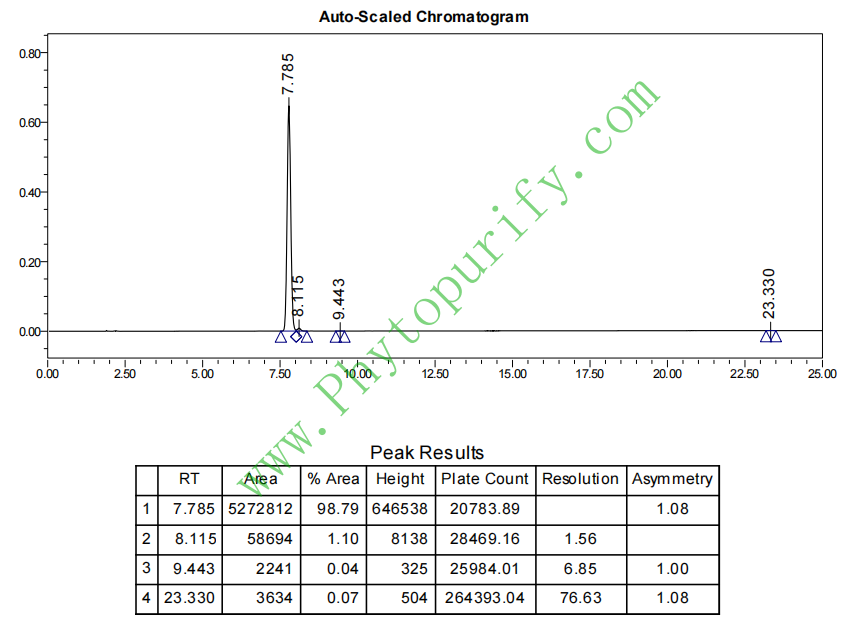
Purity: 95%~99%
Analysis Method: HPLC-DAD or/and HPLC-ELSD
Identification Method: Mass, NMR
Packing: Brown vial or HDPE plastic bottle
Storage: Store in a well closed container, protected from air and light. Put into refrigerate or freeze for long term storage.
Whenever possible, you should prepare and use solutions on the same day. However, if you need to make up stock solutions in advance, we recommend that you store the solution as aliquots in tightly sealed vials at -20℃. Generally, these will be useable for up to two weeks.
The product could be supplied from milligrams to grams
Inquire for bulk scale.
Chengdu Biopurify Phytochemicals Ltd. is a leading company in the research, development, manufacture and marketing of High Quality Phytochemicals and Extracts(especially Active Ingredients from Traditional Chinese Medicine,TCM), Natural Active Pharmaceutical Ingredients worldwide.
The main services:
A. Supply active ingredients and reference standards of TCM, from mgs to kgs scale
B. Custom extraction and purification, target Herb Active Ingredients
C. Custom synthesis and semi-synthesis for Natural Active Ingredients
D. CR(contract research), CM(contract manufacture) and PD(process development) services from lab scale, pilot scale to commercial scale(GMP is also available)
E. TCM compounds library for drug screen,more than 3000 compounds available, many of them are rare and unique.
HPLC of 2"-O-beta-L-galactopyranosylorientin
Storage conditions:Short-term storage at 2~8℃, long-term storage at -20 ~ -80℃
298.5000
-2.5000
-2.5000
No
No
No
No
No
No
No
Laocao-2 '' - O - β - L-galactoside (2 '' - O-beta-L-galactopyranosylorien, hereinafter referred to as' Laocao-2 '' - O - β - L-galactoside ') is a flavonoid glycoside derived from natural plants, which has significant biological activity and potential medicinal value. With the continuous development of pharmacology of natural products, coumarin-2 '' - O - β - L-galactoside has become a hot research topic in recent years due to its unique chemical structure and good safety. This article aims to systematically review the chemical structure and physicochemical properties, plant sources and extraction methods, pharmacological activity, mechanism of action, pharmacological evaluation, and clinical application prospects of this compound, in order to provide theoretical basis and research direction for its further drug development and clinical translation.
The molecular formula of icari-2 '' - O - β - L-galactoside is C27H30O16, with a molecular weight of 626.5, and it belongs to the glycoside derivatives of flavonoid aglycones. Its structural feature is that the 2 '' hydroxyl group on the origin molecule is connected to a galactose unit through a β - L-galactoside bond, forming a diglycoside structure. This structure endows it with strong hydrophilicity, manifested by a LogP value of -2.5, indicating low hydrophobicity and good water solubility. Its topological polar surface area (TPSA) is as high as 298.5 Å ², with 16 hydrogen bond acceptors, exhibiting strong polarity and a multi hydroxyl structure, which facilitates multi-point binding with biomolecules.
In terms of physical and chemical properties, coumarin-2 '' - O - β - L-galactoside exhibits good chemical stability, especially under acidic and neutral conditions, but may undergo hydrolysis in strongly alkaline environments. Its UV visible spectrum displays typical flavonoid absorption peaks, which facilitates qualitative and quantitative analysis. Mass spectrometry and nuclear magnetic resonance (NMR) techniques have been widely used for structural identification and purity detection.
Laocao Su-2 '' - O '- β - L-Galactoside is mainly found in certain traditional Chinese medicinal materials and wild plants, especially in grasses and some leguminous plants with medicinal value, where its content is relatively high. Common plant sources include Setaria italica and its related species, as well as some medicinal plants such as kudzu root and cassia seed.
The extraction process usually uses water or water alcohol mixed solvents for extraction, combined with ultrasonic assisted extraction or hot reflux extraction to improve yield. The extraction solution was purified by multi-stage solvent separation, column chromatography (such as silica gel column, C18 reverse phase column), and high performance liquid chromatography (HPLC) to obtain high-purity coumarin-2 '' - O - β - L-galactoside. In recent years, supercritical CO2 extraction and membrane separation techniques have also been attempted to be applied to the efficient extraction and purification of this compound, improving extraction efficiency and purity.
Laocao Su-2 '' - O - β - L-Galactoside exhibits a wide range of pharmacological activities in various in vitro and in vivo models, covering antioxidant, anti-inflammatory, anti-tumor, neuroprotective, and immune regulatory aspects.
antioxidant activity
This compound has significant free radical scavenging ability and can effectively inhibit the oxidative reactions of free radicals such as DPPH and ABTS, reducing cellular oxidative damage. Its multi hydroxyl structure provides excellent electron donor ability and enhances the antioxidant defense system.
anti-inflammatory effect
Research has shown that coumarin-2 '' - O - β - L-galactoside can inhibit the release of inflammatory mediators such as TNF - α, IL-6, and IL-1 β, and alleviate inflammatory reactions. It showed significant anti-inflammatory effects in mouse inflammation models, indicating its potential application value in inflammatory diseases.
Antitumor activity
In vitro cell experiments showed that the compound could inhibit the proliferation and induce apoptosis of many tumor cell lines (such as liver cancer, breast cancer, colon cancer). Its anti-tumor mechanism involves cell cycle arrest, activation of mitochondrial pathways, and inhibition of tumor related signaling pathways.
Neuroprotective effect
Although coumarin-2 '' - O - β - L-galactoside is not easily able to pass through the blood-brain barrier, it has potential neuroprotective effects in neural cell models by reducing nerve damage through antioxidant and anti-inflammatory mechanisms.
immunomodulation
This compound can regulate immune cell function, promote macrophage phagocytic activity, regulate T cell subpopulation balance, and enhance the body's immune defense ability.
The biological activity of coumarin-2 '' - O - β - L-galactoside mainly depends on its interactions with multiple molecular targets. The research reveals that its main mechanism of action includes:
Antioxidant mechanism
By directly clearing reactive oxygen species (ROS) and reactive nitrogen species (RNS), lipid peroxidation is inhibited, protecting cell membranes and DNA from oxidative damage. Simultaneously activate the Nrf2/ARE signaling pathway and promote the expression of endogenous antioxidant enzymes such as SOD, CAT, and GPx.
Anti inflammatory mechanism
Inhibiting the activation of the NF - κ B signaling pathway, reducing the transcription and release of pro-inflammatory cytokines, and lowering the inflammatory response. Hericin-2 '' - O - β - L-galactoside can also regulate the MAPK pathway and inhibit the phosphorylation of p38, JNK, and ERK.
Antitumor mechanism
Cell cycle arrest and apoptosis induction are achieved by regulating cell cycle proteins and apoptosis related proteins (such as Bcl-2, Bax, Caspase-3). It can also inhibit the PI3K/Akt/mTOR signaling pathway, block tumor cell proliferation and migration.
Immune regulatory mechanism
Regulating the secretion of immune cytokines, promoting macrophage polarization towards M1 type, and enhancing anti infective ability. By adjusting the proportion of T cell subsets, maintain immune homeostasis.
In summary, coumarin-2 '' - O - β - L-galactoside exerts its diverse pharmacological effects through multi-target and multi pathway synergistic effects.
The pharmacological parameters of coumarin-2 '' - O - β - L-galactoside show that it has good safety and tolerability. Its LogP value is -2.5, indicating good water solubility but low lipid solubility, which may limit its oral bioavailability. The TPSA value is as high as 298.5 Å ², far higher than the ideal range for general oral medications, indicating a weak passive diffusion ability through the cell membrane.
Toxicological evaluation shows that the compound has no significant hepatotoxicity, cardiotoxicity, or hERG channel inhibition, and the Ames mutagenicity test is negative, indicating high safety. In addition, the poor penetration ability of the blood-brain barrier limits its application in central nervous system diseases, but also reduces the risk of central toxic side effects.
Pharmacokinetic studies have shown that after oral administration, the absorption of coumarin-2 '' - O - β - L-galactoside is slow, the plasma half-life is moderate, and it is mainly excreted through the kidneys and bile. Its metabolic pathway involves glycoside hydrolysis and corresponding flavonoid glycoside metabolism, and the metabolites also have certain biological activities.
To improve its pharmacokinetic properties, researchers have attempted to use strategies such as nanocarriers, liposome encapsulation, and structural modification to enhance its bioavailability and targeting.
Laocao Su-2 '' - O - β - L-Galactoside, with its multi-target and multifunctional pharmacological activities, has shown broad clinical application potential in fields such as anti-inflammatory, anti-tumor, antioxidant, and immune regulation. Especially in the adjuvant treatment of chronic inflammatory diseases, autoimmune diseases, and certain tumors, it has good application prospects.
However, currently the compound is still in the stage of basic research and early pharmacological evaluation, lacking systematic clinical trial data. Future research should focus on:
Pharmacokinetic and Formulation Optimization
By improving the administration method and dosage form design, enhancing its bioavailability and targeting, and overcoming the limitations of poor blood-brain barrier penetration ability.
In depth exploration of mechanisms
Using modern molecular biology and systems biology techniques, further clarify its molecular targets and signaling pathways, and reveal the molecular basis behind its pleiotropy.
Safety and Toxicology Research
Conduct long-term toxicology and pharmacodynamics research to ensure the safety of its clinical application.
Preclinical and clinical trials
Promote the preclinical research and gradually carry out clinical trials to verify the efficacy and safety of Laocao Su-2 '' - O - β - L-Galactoside.
In addition, combining modern drug design concepts, the structural modification and derivative development of coumarin-2 '' - O - β - L-galactoside will also provide new ideas for its medicinal chemistry optimization.
Laocao Su-2 '' - O - β - L-Galactoside, as a natural flavonoid glycoside with multiple biological activities, exhibits good pharmacological potential and safety. Its unique chemical structure endows it with multi-target activity, making it widely applicable in antioxidant, anti-inflammatory, anti-tumor, and immune regulation fields. Although there are still challenges in terms of bioavailability and pharmacokinetics, with the assistance of modern drug development technology, coumarin-2 '' - O - β - L-galactoside is expected to become an important candidate for new natural medicines. In the future, the mechanism research and clinical validation of the system will be the key to promoting its translation into clinical applications. The field of natural product pharmacology should continue to pay attention to and deepen research on this compound, in order to achieve its widespread application in disease prevention and treatment.
