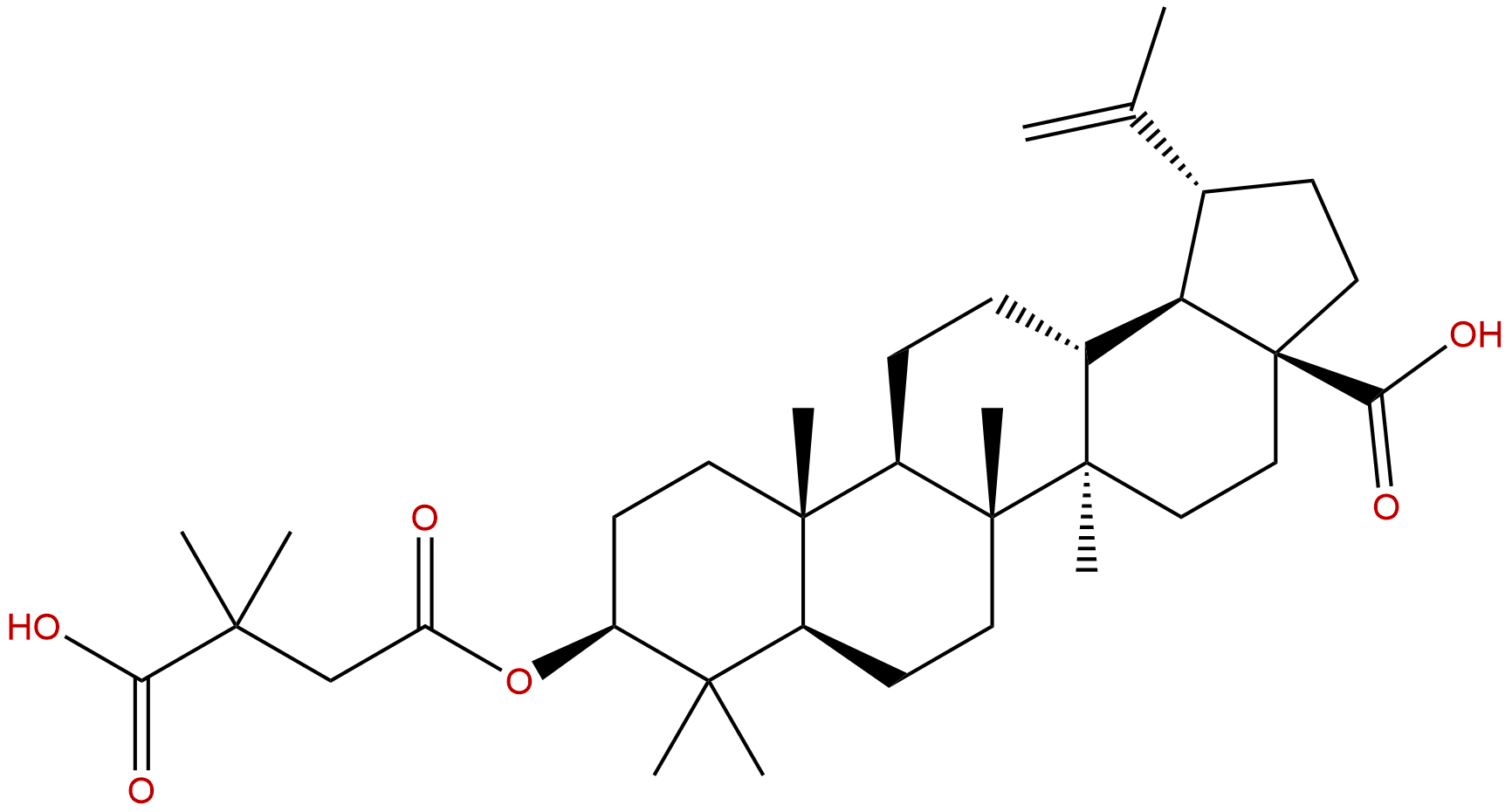


Product name: Bevirimat
Synonym name: PA-457
Catalogue No.: BP3086
Cas No.: 174022-42-5
Formula: C36H56O6
Mol Weight: 584.838
Botanical Source:
Physical Description:
Type of Compound:
Purity: 95%~99%
Analysis Method: HPLC-DAD or/and HPLC-ELSD
Identification Method: Mass, NMR
Packing: Brown vial or HDPE plastic bottle
The product could be supplied from milligrams to grams. Inquire for bulk scale.
Description:
Bevirimat, also known as MPC-4326 and PA-457, is an anti-HIV drug derived from a betulinic acid-like compound, first isolated from Syzygium claviflorum, a Chinese herb. It is believed to inhibit HIV by a novel mechanism, so-called maturation inhibition. Like protease inhibitors, bevirimat and other maturation inhibitors interfere with protease processing of newly translated HIV polyprotein precursor, called gag. Bevirimat prevents this viral replication by specifically inhibiting cleavage of the capsid protein (CA) from the SP1 spacer protein. (http://en.wikipedia.org/wiki/Bevirimat).
References
1: Coric P, Turcaud S, Souquet F, Briant L, Gay B, Royer J, Chazal N, Bouaziz S. Synthesis and biological evaluation of a new derivative of bevirimat that targets the Gag CA-SP1 cleavage site. Eur J Med Chem. 2013 Apr;62:453-65. doi: 10.1016/j.ejmech.2013.01.013. Epub 2013 Jan 19. PubMed PMID: 23399723.
2: Dang Z, Ho P, Zhu L, Qian K, Lee KH, Huang L, Chen CH. New betulinic acid derivatives for bevirimat-resistant human immunodeficiency virus type-1. J Med Chem. 2013 Mar 14;56(5):2029-37. doi: 10.1021/jm3016969. Epub 2013 Feb 20. PubMed PMID: 23379607; PubMed Central PMCID: PMC3600082.
3: Qian K, Bori ID, Chen CH, Huang L, Lee KH. Anti-AIDS agents 90. novel C-28 modified bevirimat analogues as potent HIV maturation inhibitors. J Med Chem. 2012 Sep 27;55(18):8128-36. Epub 2012 Sep 14. PubMed PMID: 22978745; PubMed Central PMCID: PMC3478670.
4: Dang Z, Qian K, Ho P, Zhu L, Lee KH, Huang L, Chen CH. Synthesis of betulinic acid derivatives as entry inhibitors against HIV-1 and bevirimat-resistant HIV-1 variants. Bioorg Med Chem Lett. 2012 Aug 15;22(16):5190-4. doi: 10.1016/j.bmcl.2012.06.080. Epub 2012 Jul 3. PubMed PMID: 22818973; PubMed Central PMCID: PMC3426442.
5: Nguyen AT, Feasley CL, Jackson KW, Nitz TJ, Salzwedel K, Air GM, Sakalian M. The prototype HIV-1 maturation inhibitor, bevirimat, binds to the CA-SP1 cleavage site in immature Gag particles. Retrovirology. 2011 Dec 7;8:101. doi: 10.1186/1742-4690-8-101. PubMed PMID: 22151792; PubMed Central PMCID: PMC3267693.
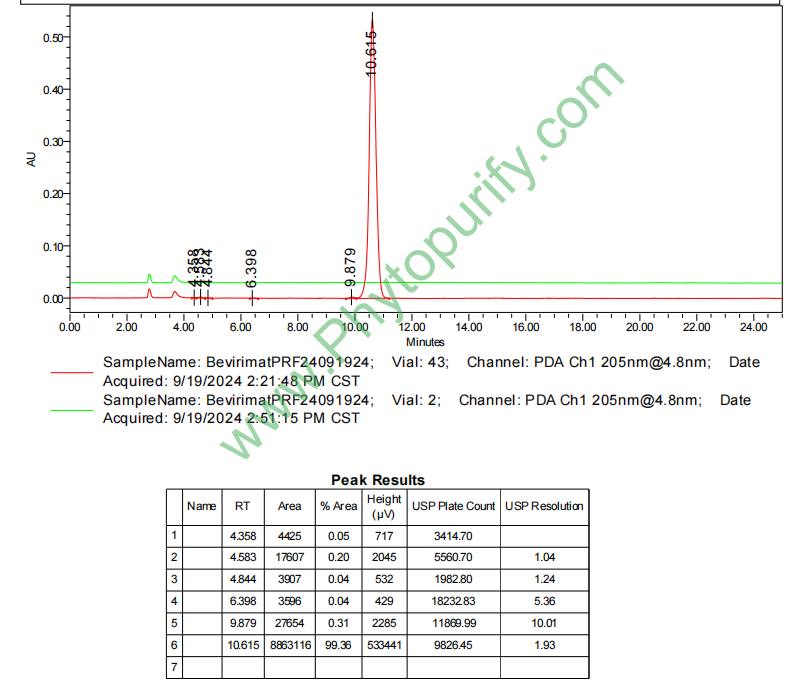
HPLC of Bevirimat
Storage conditions:Short-term storage at 2~8℃, long-term storage at -20 ~ -80℃
100.9000
6.9025
3.7519
.0013
4.4597
1.8838
Low
92.7306
4.9316
No
No
Yes
No
No
No
0.0
No
No
No
No
Human immunodeficiency virus (HIV-1) infection and its associated acquired immunodeficiency syndrome (AIDS) are significant public health challenges that persist globally. Although the application of highly effective antiretroviral therapy (HAART) has successfully transformed AIDS into a manageable chronic disease, problems such as virus resistance, drug toxic side effects, long-term drug compliance, and the economic burden of lifelong treatment have prompted researchers to constantly explore anti HIV drugs with novel mechanisms of action. In this context, targeting other key links in the lifecycle of viruses besides reverse transcriptase and protease has become an important direction for new drug development. Among them, the maturation process of viral particles, as a crucial and virus specific step, has attracted widespread research interest. Bevirimat (formerly codenamed PA-457, MPC-4326, YK FH312) is a representative compound that stands out in this field. It is the first HIV-1 mature inhibitor to enter the clinical development stage, marking an important milestone in the development of anti HIV drugs.
Bever's immediate discovery was due to the screening and optimization of natural products. Its parent nucleus structure is a lupine type triterpenoid acid, which was initially isolated from plants. Through systematic structural modification and structure-activity relationship research, a significantly enhanced activity and improved drug properties of Beveramide were ultimately obtained. Its mechanism of action is completely different from traditional antiretroviral drugs. It specifically interferes with the final step of HIV-1 Gag protein precursor processing, which is the cleavage between capsid protein (CA) and spacer peptide 1 (SP1), resulting in the production of morphologically abnormal, non infectious immature viral particles. This unique mechanism of action allows it to maintain activity against existing drug-resistant virus strains, which has important clinical significance. This article will provide a systematic review of the chemical structure, sources, pharmacological activity, mechanism of action, drug properties, and clinical prospects of Beveramide.
The chemical name of Beveramide is 3-O - (3 ′, 3 ′ - dimethylsuccinyl) - betulinic acid, and its CAS number is 174022-42-5. Structurally, Betulinic acid is a semi synthetic modified derivative based on the natural triterpenoid compound Betulinic acid. Its molecular skeleton is a classic lupine type pentacyclic triterpene, which introduces a 3 ', 3' - dimethylsuccinyl group on the hydroxyl group at the C-3 position of betulinic acid. This key structural modification greatly improves its anti-HIV-1 activity and physicochemical properties.
Its molecular formula is C ∝₆ H ₅₆ O ₆, and its molecular weight is 584.8380. This compound exhibits typical lipophilic characteristics, with a calculated lipid water partition coefficient (LogP) of 6.9025, indicating its high hydrophobicity. The topological polar surface area (TPSA) is 100.9000 Å ², reflecting the presence of polar groups such as ester bonds and carboxyl groups in the molecule. However, its high lipophilicity dominates its dissolution behavior, and the predicted water solubility is extremely low, only 0.0013 mg/mL, which poses a challenge for its formulation development. In pharmacokinetic related predictions, the ability of bevacizumab to immediately penetrate the blood-brain barrier is evaluated as' low ', which may be a limiting factor for treating the HIV virus pool in the central nervous system, but may also reduce the potential risk of neurotoxicity. In early safety screening, it did not show significant inhibition of hERG potassium channels (predicted as' no '), indicating a low risk of causing cardiac QT interval prolongation. In addition, the Ames test predicted a value of 0.0, indicating that there is no mutagenic signal in this prediction model, but actual experiments should be used as a reference. These physicochemical and pharmacological parameters together outline a lead compound profile with high lipophilicity, low solubility, and specific development challenges and potential.
The direct precursor and inspiration for Beveramide is the natural triterpenoid compound, betulinic acid. Birch acid is widely present in various plants, especially in birch bark (birch bark) Betula platyphylla The hanging branch birch Betula pendula Etc.), Elenium bark(Terminalia species)、 Rose eggplant(Hibiscus sabdariffa)And some jujube species(Ziziphus)The content is relatively abundant in plants. Among them, birch bark is the most traditional and primary natural source for obtaining betulinic acid.
The conventional methods for extracting and purifying betulinic acid from plant materials include organic solvent extraction and chromatographic separation techniques. The typical process is as follows: first, the dried birch bark is crushed and subjected to heating reflux extraction or ultrasound assisted extraction using polar solvents such as methanol, ethanol, or methanol chloroform mixture. The crude extract was obtained by vacuum concentration of the extraction solution. The crude extract is usually initially enriched through liquid-liquid partitioning (such as using ethyl acetate and water). Subsequently, separation was carried out by silica gel column chromatography, with different ratios of petroleum ether ethyl acetate or chloroform methanol gradient elution. The fractions containing betulinic acid were collected and monitored by thin layer chromatography (TLC). For further purification, methods such as recrystallization (commonly using methanol or ethanol as solvents) or preparative high-performance liquid chromatography (HPLC) are often used to obtain high-purity betulinic acid.
After obtaining betulinic acid, it needs to be converted into betulinic acid through chemical synthesis steps. The key step is to carry out esterification reaction on the hydroxyl group at C-3 position of betulinic acid, connecting the 3 ', 3' - dimethylsuccinyl group. This synthetic route typically involves the reaction of 2,2-dimethylsuccinic anhydride or its acyl chloride with betulinic acid in the presence of a basic catalyst (such as 4-dimethylaminopyridine DMAP). After the reaction, the target product Beveramide is obtained through post-treatment and purification (such as column chromatography and recrystallization). The entire process from plant extraction to semi synthesis reflects the classic research and development model of using natural products as lead compounds for structural optimization to obtain better drugs.
The core pharmacological activity of Beveramide is its resistance to human immunodeficiency virus type 1 (HIV-1). Its activity as a mature inhibitor has been fully validated in various in vitro experimental models.
1. Antiviral activity:
In cell level experiments, Beveramide immediately showed effective inhibitory concentrations at the nanomolar level (EC ₅₀ typically in the range of 1-10 nM) against laboratory adapted strains (such as HIV-1 IIIB) and clinical isolates. More importantly, due to its unique target of action (the CA-SP1 cleavage site of Gag protein), bevacizumab remains effective against virus strains resistant to reverse transcriptase inhibitors (such as zidovudine and nevirapine) and protease inhibitors (such as nifedipine and indinavir). This provides a theoretical basis for its use in treating drug-resistant patients who have experienced multiple line therapy failures. However, studies have also found that specific mutations in the SP1 region of the viral Gag protein and at the junction of CA-SP1 (such as V362I, V370A, etc.) mediate high resistance to Beveramide immediately, which is one of the main challenges encountered in its clinical development.
2. Exploration of anti malaria activity:
In addition to its main anti HIV activity, betulinic acid and its derivatives (including structural analogues) have also been widely studied in the field of anti malaria due to the broad-spectrum biological activity of natural triterpenoids. Literature reports show that betulinic acid and some of its derivatives have an effect on Plasmodium falciparum(Plasmodium falciparum)Has inhibitory activity. Its potential targets may involve multiple key proteins for malaria parasite survival, such as:
* Multidrug resistance protein Examples include chloroquine resistance transporter protein (PfCRT) and multidrug resistance protein 1 (PfMDR1), which are associated with intracellular accumulation and resistance to antimalarial drugs.
* metabolic enzyme For example, dihydrofolate reductase (PFDHFR) is a target of drugs such as sulfadoxine pyrimethamine.
* Kelch13 protein (PfK13)Key proteins associated with artemisinin resistance.
* Ion pumps and signaling proteins Such as sarcoplasmic/endoplasmic reticulum calcium ion ATPase 6 (PfATP6, potential target of artemisinin), cytochrome bc ₁ complex (PfCYTbc, target of atorvastatin), etc.
* Autophagy related proteins Like PfATG8, it participates in the metabolic adaptation of malaria parasites.
* protein kinase Like PfPK, it plays a regulatory role in multiple stages of the malaria parasite lifecycle.
It should be clearly pointed out that although the parent nucleus structure of Beveramide belongs to the triterpenoid family with antimalarial potential Beveramide itself is a highly specific HIV-1 mature inhibitor, and its anti malarial activity is not its main research direction, nor has it been systematically developed and reported as an anti malarial drug in public literature The above target list is more of a reminder of the multi-target potential of similar natural products and their derivatives in the field of anti malaria, providing ideas for the development of new anti malaria drugs based on triterpenoid frameworks.
3. Other activities:
Betulinic acid itself is known for its anti-inflammatory, anti-tumor, antibacterial and other activities. As a derivative, Beveramide retains its core triterpenoid skeleton while its biological activity spectrum has been focused on anti HIV due to specific structural modifications. At present, there have been no reports of outstanding activity of Beveramide in other disease fields (such as tumors), and its research focus has always been on anti HIV infection.
The mechanism of action of Beveramide is highly specific, focusing on the final stage of the HIV-1 virus lifecycle - the maturation process of viral particles.
1. Action steps:
In the late stage of HIV-1 replication, the Gag and Gag Pol polyprotein precursors encoded by viral genes are recruited to the cell membrane, assembled, and germinated to form immature viral particles. Subsequently, the viral protease (PR) is activated to sequentially cleave the Gag precursor, producing mature matrix proteins (MA), capsid proteins (CA), nucleocapsid proteins (NC), and p6 proteins, and releasing two small peptides, SP1 and SP2. This processing process is crucial for the transformation of the virus from an "immature" (eccentric, dense circular core under electron microscopy) to a "mature" (forming a conical core) morphology, which is a prerequisite for the virus to be infectious.
Bevelimat interferes with the final step of Gag processing, which is the cutting between CA and SP1, in a heterosexual manner. Under normal circumstances, PR cleaves the CA-SP1 junction, releasing the C-terminus of CA and producing mature CA protein. Beveramide immediately stabilizes the CA-SP1 region by interacting with uncut Gag precursors or CA-SP1 intermediates, thereby Physical blockage Protease accesses and cleaves this site.
2. Molecular targets and structural basis:
The direct molecular target of Beveramide is the CA-SP1 junction region in HIV-1 Gag protein. Structural biology studies such as nuclear magnetic resonance and X-ray crystallography have revealed that in uncut CA-SP1 precursors, SP1 peptide segments tend to form helical structures and interact with the C-terminal domain of CA. The binding pocket of Bev<| place | holder | no | 726 |>is located near the interface formed by the C-terminus of CA and the SP1 helix. Its binding may exert inhibitory effects by stabilizing the helical conformation of CA-SP1 or inducing a conformation that is unfavorable for protease cleavage.
3. Phenotypic consequences:
Due to the inhibition of CA-SP1 cleavage, the maturation process of viral particles abruptly stops at the final step. The generated virus particles appear in an abnormal "immature" shape under electron microscopy: the core structure cannot properly condense into a cone shape, but stays under the cell membrane or forms disordered electron dense material. The core of this structural defect is the inability to complete critical steps such as uncoating and releasing viral RNA in the next round of infection, resulting in the complete loss of infectivity of the virus. This' one hit kill 'mechanism prevents the virus from establishing a new infection even after completing budding and packaging.
The pharmaceutical development process of Beveramide<| place | holder | no | 726 |>highlights the challenges faced in converting highly active natural product derivatives into practical drugs.
1. Challenges in drug development:
As mentioned earlier, the high lipophilicity (LogP>6) and extremely low water solubility of Beveramide are its main physical and chemical barriers. This leads to low oral bioavailability and easy absorption in the body influenced by food (high-fat diet can significantly increase its absorption). To address this issue, in the development of clinical formulations Prodrug strategy Bevirimat Dimethyl Succinate Phosphate, a prodrug of Bevirimat, has been developed. This prodrug has significantly increased solubility in water and can be rapidly hydrolyzed by esterases in the gastrointestinal tract, releasing the parent drug Bevirimat and improving its oral absorption performance.
2. Clinical pharmacokinetics (PK):
The pharmacokinetic characteristics of Beveramide and its prodrugs were evaluated in phase I and II clinical trials. The data shows that:
* absorb After oral administration, Beveramide is immediately absorbed slowly and has a longer peak time (Tmax). Food, especially high-fat foods, can significantly increase their exposure (AUC) and peak concentration (Cmax).
* distribution Manifested as a larger apparent distribution volume, indicating its widespread distribution within the organization. The predicted low blood-brain barrier penetration has been confirmed in clinical data, with lower drug concentrations in cerebrospinal fluid and plasma.
* Metabolism and excretion Beveramide is mainly metabolized by the liver cytochrome P450 enzyme system (mainly CYP3A4) to produce hydroxylation and other metabolites. The proportion of its prototype drug excreted through the kidneys is very low, mainly cleared in the form of metabolites. The elimination half-life is relatively long and supports once daily administration.
3. Security:
In clinical trials, Beveramide has overall good tolerability. Common adverse events are mostly mild to moderate, including gastrointestinal discomfort (diarrhea, nausea), headache, rash, etc. No severe cardiovascular signals associated with hERG inhibition were found, consistent with preclinical predictions. Its main R&D setback does not come from traditional security issues, but rather Individual differences in therapeutic efficacy and drug resistance。
4. Differences in therapeutic efficacy and bottleneck of drug resistance:
The Phase IIb clinical trial revealed a key issue: approximately 50% of patients have poor response to immediate treatment with Beveramide. Subsequent studies have found that this difference in response is closely related to the polymorphism present on the Gag protein at the baseline of the patient's virus, especially the natural variation at the junction of SP1 and CA-SP1, such as V370A. These polymorphisms themselves may not cause significant replication defects, but they can significantly reduce the virus's immediate sensitivity to bevacizumab. In addition, during the treatment process, acquired resistance was observed due to mutations at the aforementioned sites under drug selection pressure. The low genetic barrier severely limits the widespread application prospects of Beveramide as a monotherapy or backbone drug.
Although the independent clinical development of Beveramide has been hindered by drug resistance issues, as the first mature inhibitor, it has accumulated valuable experience in this field and pointed out the future development direction.
1. Historical positioning and lessons learned:
Bever immediately proved that "viral maturation" is a feasible drug target, and its pioneering value is indelible. Its development process profoundly reveals that for highly variable RNA viruses, drugs with new mechanisms of action must have a sufficiently high genetic barrier to counteract baseline polymorphism and rapidly emerging resistance mutations. This has prompted further development of mature inhibitors to focus more on targeting the more conserved regions of Gag protein.
2. Subsequent drug development:
Based on the experience of Beveramide, second-generation mature inhibitors have been developed, such as GSK2838232 and GSK3640254(CAB-2)These compounds have been optimized to overcome the limitations of bevacizumab: they act on more conserved sites on the Gag protein (such as different regions at the junction of the N-terminal domain of CA and CA-SP1), exhibit broad-spectrum activity against baseline polymorphic virus strains, and have a higher resistance transmission barrier. At present, some second-generation mature inhibitors have entered the clinical research stage, demonstrating good safety and antiviral activity.
3. Future application prospects:
* An important component of combination therapy Mature inhibitors, due to their unique mechanism of action, have no cross resistance with all other existing classes of antiretroviral drugs, making them an ideal "puzzle" for constructing new combination therapies. They can enrich the selection of HAART regimens, especially for patients with multiple drug resistance.
* The possibility of long-acting formulations Some mature inhibitors (such as new compounds with different structures from Beveramide) are being explored and developed as long-acting injections, which can be used in combination with long-acting reverse transcriptase inhibitors or integrase inhibitors to achieve a simplified maintenance treatment regimen of monthly or even longer dosing, greatly improving patient compliance.
* Auxiliary tools for exploring functional healing In the "shock and kill" strategy aimed at clearing or silencing the HIV latent pool, mature inhibitors can ensure that the virus particles produced by activated latent cells are non infectious, thereby preventing further spread of the virus in the body, theoretically enhancing the safety of this strategy.
Therefore, although Beveramide was not successfully launched, it opened a new chapter in the development of anti HIV drugs. The experience and lessons learned directly catalyzed the birth of better next-generation mature inhibitors, and consolidated the position of mature inhibitors as important supplements and combination therapy choices in the future anti HIV treatment landscape.
The development story of Bev<| place | holder | no | 726 |>is a typical case of the intersection of natural product medicinal chemistry and modern antiviral studies. Starting from the widely distributed plant component betulinic acid, scientists have created an anti-HIV-1 lead compound with a novel mechanism of action through rational structural modification. It precisely targets the final rate limiting step of viral particle maturation, physically blocking protease cleavage by stabilizing the precursor of CA-SP1, resulting in the production of non infectious viral particles. This mechanism is unique in the history of antiviral drugs.
Despite facing significant challenges in its clinical translation due to genetic polymorphism in viral target regions and low resistance barriers, Beverair's immediate contribution was foundational. It successfully validated the clinical feasibility of the target of "mature inhibition" and added a new category of action to the anti HIV drug library. The profound understanding of the structure, function, and resistance mechanism of Gag protein accumulated during its research and development process, as well as the experience in addressing the challenges of drug formation of highly lipophilic compounds, have paved the way for the development of second-generation and third-generation mature inhibitors.
Nowadays, a new generation of mature inhibitors with better mechanisms of action, wider antiviral spectrum, and higher resistance barriers are showing great potential in clinical research. Beveramide immediately became a pioneer in this field, and its scientific value far exceeds its success or failure as a candidate drug. It deeply embodies the research and development paradigm of drawing inspiration from natural products, overcoming challenges through continuous scientific innovation, and ultimately driving medical progress. In the ongoing battle between humans and HIV, the story of mature inhibitors continues, and Bev is undoubtedly an indispensable prelude to this exciting chapter.
