


Synonym name:
Catalogue No.: BP1285
Cas No.: 38710-26-8
Formula: C18H23NO6
Mol Weight: 349.383
Botanical Source: Alkaloid from whole plants of Senecio persoonii (Compositae)
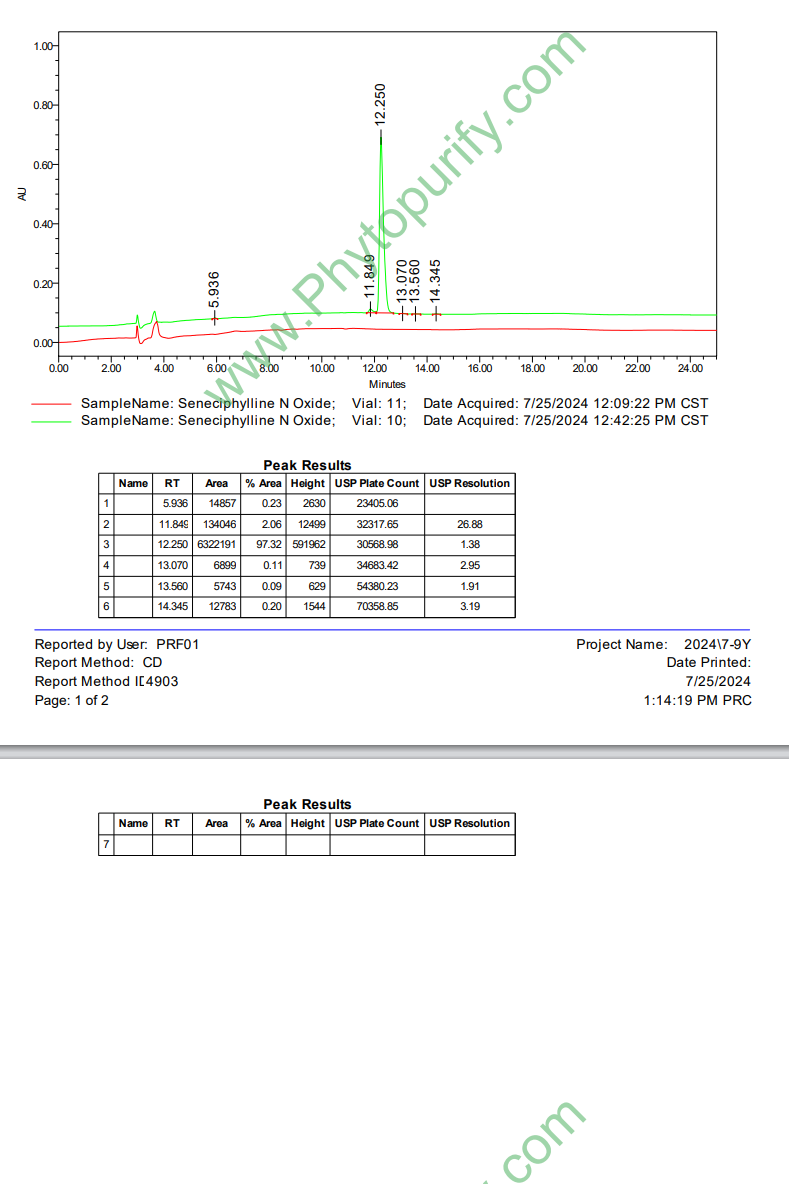
Purity: 95%~99%
Analysis Method: HPLC-DAD or/and HPLC-ELSD
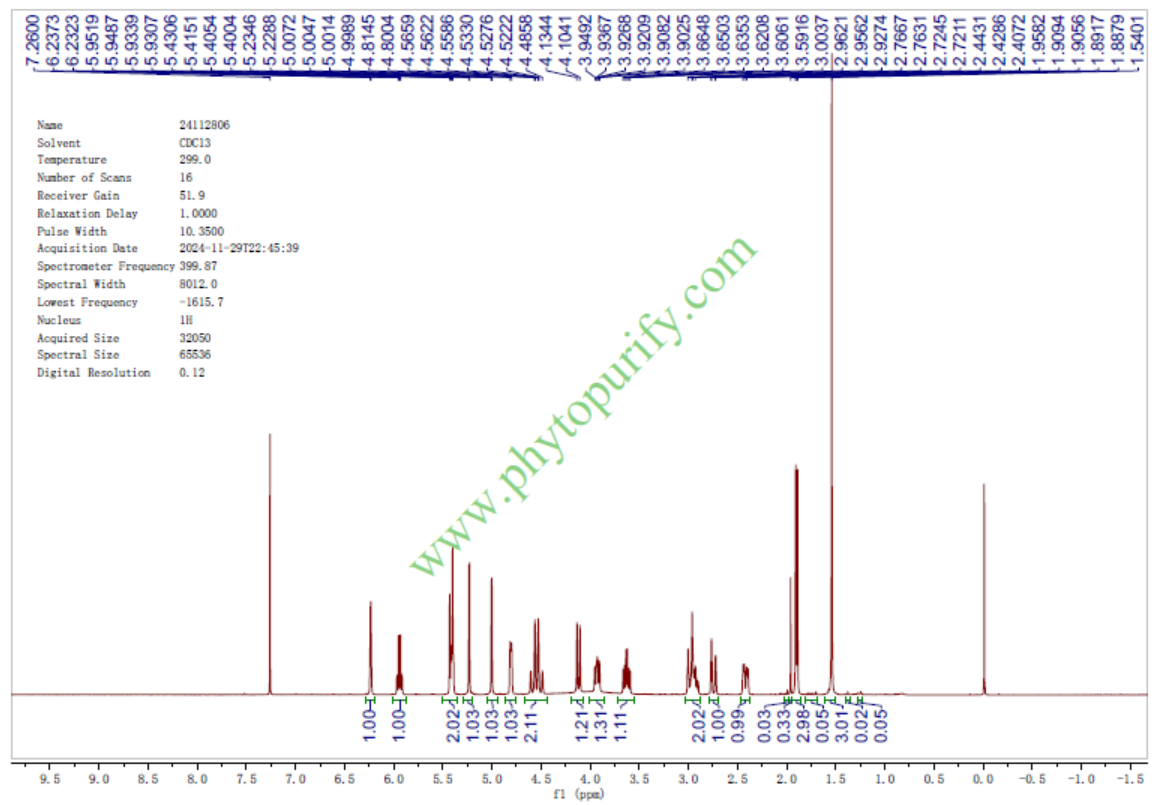
Identification Method: Mass, NMR
Packing: Brown vial or HDPE plastic bottle
Can be supplied from milligrams to grams.
For Reference Standard and R&D, Not for Human Use Directly.
Inquire for bulk scale.
HPLC of Seneciphylline N-Oxide
HNMR of Seneciphylline N-Oxide
Storage conditions:Short-term storage at 2~8℃, long-term storage at -20 ~ -80℃
95.8900
-.7165
-.7165
122.3583
1.7577
2.6169
High
56.5960
5.7993
No
No
No
No
Yes
No
1.2
Yes
Yes
Yes
Yes
Pyrrolizidine alkaloids are a class of secondary metabolites widely distributed in plants of the Asteraceae, Ligularia, and Verbenaceae families, characterized by the presence of a 1-hydroxymethyl-1,2-dehydropyrrolizidine core. This type of compound has attracted much attention due to its significant hepatotoxicity, pulmonary toxicity, and potential genotoxicity, and is a classic model for studying the relationship between plant toxins and human health. Seneciphylline N-oxide (CAS: 38710-26-8), as an important member of the pyrrolizidine alkaloid family, is the nitrogen oxide form of Seneciphylline and can also be regarded as a dehydrogenated derivative of Seneciphylline N-oxide. It is mainly isolated from root cultures of plants in the Asteraceae family, such as Senecio erucifolius. Unlike many highly toxic parent tertiary amine bases, its nitrogen oxide form is generally considered an inert form for detoxification and storage in plants. However, in mammals, it can be reduced by gut microbiota or liver enzymes to reactive toxic metabolites, thereby mediating a series of complex toxic effects. In recent years, with the development of molecular toxicology and chemical biology, research on the nitrogen oxides of camptothecin has surpassed traditional toxicity descriptions and delved into its precise intervention mechanisms on key signaling pathways such as cell apoptosis, oxidative stress, and metabolic enzyme regulation. This article aims to provide a systematic review of the chemical properties, plant sources, pharmacological (toxicological) activities, molecular mechanisms of action, and pharmacological evaluation of the nitrogen oxides of camptothecin, with the aim of providing scientific references for a comprehensive understanding of the dual properties (toxicity/potential biological activity) of this type of compound and related drug safety warnings.
The molecular formula of the nitrogen oxide of Qianguangfeiling alkaloid is C18H23NO6, with a molecular weight of 349.3830. Its core structure is an unsaturated pyrrolizidine bicyclic system (necke base), which is connected by carbon chains at positions C7 and C9 to form an 11 membered macrocyclic diester. Compared with camptothecin, the nitrogen atom in its structure is oxidized to N-oxide, which is the basis for its naming and a key modification that affects its physicochemical properties and biological activity.
In terms of physical and chemical properties, the calculated lipid water partition coefficient (LogP) is -0.7165, indicating that the compound has relatively good hydrophilicity. Its topological polar surface area (TPSA) is 95.89 Å ², and the larger TPSA value is related to polar groups such as N-oxides, hydroxyl groups, and ester bonds in the molecule, which also promote the formation of intermolecular hydrogen bonds. The theoretically calculated water solubility value is 122.36 mg/L, which belongs to the moderate to lower water solubility range, but should have good solubility in polar solvents. These parameters collectively determine its distribution characteristics in living organisms: higher hydrophilicity and larger polar surface area are usually unfavorable for passive transmembrane diffusion, but its nitrogen oxide structure may be absorbed through specific transporters. It is worth noting that its blood-brain barrier permeability is predicted to be "high", indicating that although its polarity is high, it may still enter the central nervous system through some mechanism, which may be related to its potential neurotoxicity or special central effects, and deserves further experimental verification. In terms of safety warning indicators, the inhibitory prediction of hERG is "no", indicating a low risk of causing QT interval prolongation in the heart; The Ames test predicted a value of 1.2 (usually considered>0.8 to indicate a possible mutagenic risk), suggesting the potential for genetic toxicity, which is consistent with the characteristic of pyrrolizidine alkaloids forming DNA adducts after metabolic activation.
The nitrogen oxides of camptothecin naturally exist in various plants of the Asteraceae genus. The literature clearly reports that it was successfully extracted and identified from the in vitro root culture of Senecio erucifolius, a widely distributed plant species in Europe. The use of plant tissue culture technology to obtain target secondary metabolites has the advantages of being unrestricted by seasons and geographical environments, with uniform and controllable products, and avoiding ecological damage caused by field collection. It is a reliable source for studying such alkaloids.
For the extraction and separation of nitrogen oxides from quinquefoline alkaloids, the conventional process of natural product chemistry is usually followed, and optimization is carried out based on the polarity characteristics of its nitrogen oxides. The general steps are as follows:
1. Extract Extract dried and crushed plant materials (or freeze-dried root cultures) using a polar solvent system. Commonly used solvents such as methanol, ethanol, or methanol water mixtures are used to extract polar alkaloids, including nitrogen oxides, through cold soaking, reflux, or ultrasound assisted extraction methods.
2. Enrichment and preliminary separation After the extraction solution is concentrated under reduced pressure, it is dissolved in dilute acid (such as hydrochloric acid or sulfuric acid) aqueous solution to convert alkaloids into salts. This acidic aqueous solution is washed with non-polar organic solvents (such as petroleum ether, chloroform) to remove lipophilic impurities. Subsequently, alkalize the acidic water layer (usually using ammonia or sodium carbonate) to free the alkaloids, and then extract them with organic solvents such as chloroform or dichloromethane. This step mainly extracts the free tertiary amine bases. However, due to their extremely high polarity, N-oxides such as selegiline nitrogen oxides remain mainly in the aqueous phase after alkalization. In order to obtain the N-oxide fraction, the alkalized aqueous phase needs to be repeatedly extracted with medium polarity solvents such as n-butanol, or enriched using macroporous adsorption resins, ion exchange chromatography, etc.
3. purification The crude product rich in N-oxides obtained requires a series of chromatographic techniques for fine separation. Silica gel column chromatography is commonly used for preliminary separation using gradient elution systems such as chloroform methanol ammonia water. Further purification often relies on reverse phase high performance liquid chromatography (RP-HPLC, using a C18 column with methanol water or acetonitrile water as the mobile phase, sometimes adjusting the pH with buffer salts) or medium pressure liquid chromatography (MPLC), ultimately obtaining high-purity quinquefoline alkaloid nitrogen oxide monomers. Structural identification involves the comprehensive use of nuclear magnetic resonance (NMR, especially 1H NMR, 13C NMR, COSY, HSQC, HMBC), mass spectrometry (MS, HR-MS), and comparison with literature data.
The pharmacological activity research of the nitrogen oxide of Qianli Guangfeiling alkaloid mainly focuses on its toxic effects, especially in terms of liver toxicity, which is also the most typical toxicological characteristic of pyrrolizidine alkaloids.
1. Acute and subacute hepatotoxicity The nitrogen oxide of camptothecin, as a prodrug, can be reduced to the corresponding tertiary amine base, camptothecin, after oral absorption by nitrate reductase secreted by gut microbiota or NADPH cytochrome P450 reductase in liver microsomes. The latter further undergoes hydroxylation at C3 and C8 positions under the catalysis of liver cytochrome P450 enzymes (especially CYP3A4 and CYP2E1), generating unstable dehydropyrrolizidine Alkaloids (DHPAs). DHPAs are highly electrophilic active intermediates that can irreversibly covalently bind with thiol, amino, and other groups of important nucleophilic substances (such as proteins, glutathione, and DNA) in cells, leading to the loss of macromolecular function and ultimately causing liver cell damage, necrosis, and apoptosis. Animal experiments have shown that ingestion of plants or pure products containing this type of alkaloid can lead to typical sinusoidal obstruction syndrome, characterized by damage to the central vein endothelial cells of the liver lobules, sinusoidal congestion, hepatocyte necrosis, and subsequent liver fibrosis and even cirrhosis.
2. Oxidative stress and disturbance of antioxidant defense system The generation of active metabolites DHPAs and their binding with glutathione consume a large amount of reduced glutathione (GSH) in cells, disrupting the redox balance of cells. Meanwhile, this process may be accompanied by excessive production of reactive oxygen species (ROS). Research has shown that exposure to nitrogen oxides from camptothecin significantly affects the expression and activity of a range of antioxidant enzymes and oxidative stress-related transcription factors. For example, it may inhibit the activity of key antioxidant enzymes such as superoxide dismutase (SOD1), catalase (CAT), glutathione peroxidase (GPX1), and weaken the cell's ROS clearance ability. On the other hand, as a core regulatory factor for cells to combat oxidative stress, the activation pathway of nuclear factor E2 related factor 2 (NFE2L2/Nrf2) may be subject to complex regulation. In the early stages of exposure, oxidative stress may activate Nrf2, inducing the expression of downstream phase II detoxifying enzymes and antioxidant proteins, which is an adaptive protective response; But under sustained or high-dose exposure, this defense system may be exhausted or inhibited, leading to increased oxidative damage.
3. Apoptosis and mitochondrial pathway regulation Hepatocellular apoptosis is an important manifestation of the hepatotoxicity caused by the nitrogen oxides of camptothecin. Its active metabolites can cause a decrease in mitochondrial membrane potential, open permeability transition pores, and lead to the release of apoptotic factors such as cytochrome C into the cytoplasm. This process is precisely regulated by members of the B-cell lymphoma 2 (BCL2) protein family. Research has shown that this type of alkaloid may downregulate the expression or function of the anti apoptotic protein BCL2, while promoting the activation of pro apoptotic proteins such as BAX, leading to a shift in the balance of mitochondrial apoptosis pathways towards cell death. In addition, endoplasmic reticulum stress and death receptor pathways may also be involved.
4. Effects on drug metabolizing enzymes The metabolic activation of selegiline nitrogen oxides is highly dependent on the CYP450 enzyme system, especially CYP3A4 and CYP2E1. It is interesting that this compound or its metabolites may in turn regulate the expression of these enzymes. Previous studies have suggested that certain pyrrolizidine alkaloids can act as inducers or inhibitors of CYP3A4, which can significantly affect their own and other co administered drug metabolism, leading to unpredictable drug drug interactions and increasing clinical medication risks.
Based on existing research, the toxic mechanism of nitrogen oxides in Qianfengfeiling alkaloid can be attributed to a cascade reaction of "metabolic activation molecular addition pathway disorder", involving multiple clear molecular targets:
Metabolic activation targets:
Detoxification and oxidative stress targets:
Cell death execution targets:
Potential genotoxic targets:
In summary, the toxicity of the nitrogen oxide of Qianfengfeiling alkaloid is the result of the synergistic effect of multiple targets and pathways. The network center is the electrophilic intermediate generated by metabolic activation, and the toxicity outcome depends on the dynamic game between the generation rate of active intermediates and the detoxification/repair ability of cells.
From the perspective of drug development, the nitrogen oxide of Qianfengfeiling alkaloid is currently mainly regarded as a toxic compound that requires caution rather than a candidate drug. The overall evaluation of its medicinal properties faces severe challenges.
Absorption, distribution, metabolism, excretion (ADME) characteristics:
Analysis of drug properties parameters:
Therefore, the nitrogen oxide of Qianli Guangfeiling alkaloid does not meet the requirements for drug properties of traditional small molecule drugs. Its research value lies more in its use as a tool medicine to explore the mechanism of liver toxicity, construct oxidative stress models, and serve as a warning case for the safety evaluation and quality control of traditional Chinese medicine (especially folk medicines containing plants of the Senecio genus).
At present, there is no direct clinical application prospect for the nitrogen oxide of Qianfengfeiling alkaloid itself. However, research on this compound has important scientific significance and application value in the following directions:
As a molecular probe for studying toxicity mechanisms Its clear multi-target toxicity mechanism makes it an ideal chemical tool for studying liver sinusoidal obstruction syndrome, drug-induced liver injury, oxidative stress, and cell apoptosis signaling pathways. By studying it, we can gain a deeper understanding of the defense and death decision-making mechanisms of cells in the face of irreversible damage.
Safety evaluation and standard formulation of traditional Chinese medicine Many traditional herbs or folk remedies may contain plants of the genus Senecio. As one of the characteristic toxic components of this plant species, the establishment of detection and limit standards for the nitrogen oxides of camptothecin is crucial. In depth research on its metabolic kinetics and toxicity threshold in vivo can provide key data for the development of more scientific and stringent quality control standards for traditional Chinese medicine and products, ensuring public medication safety.
Exploration of Detoxification Strategies and Intervention Targets Based on its mechanism of action, targeted detoxification strategies can be explored. For example, developing preparations that can specifically inhibit gut microbiota reductase and reduce the production of toxic tertiary amine bases; Using exogenous GSH precursors (such as N-acetylcysteine) or Nrf2 activators (such as sulforaphane) to enhance cell detoxification and antioxidant capacity; Explore regulators targeting BCL2 family proteins to inhibit excessive cell apoptosis. These studies not only contribute to the treatment of pyrrolizidine alkaloid poisoning, but their principles may also be extended to other types of liver injury.
Structural modification and activity optimization (long-term exploration)Despite the high toxicity of the parent nucleus, pyrrolizidine has a unique chemical space in its structure. In theory, through rational structural modifications such as modifying its ester bond portion, introducing non metabolizable groups to block its activation pathway, or connecting it to a targeted carrier, it is possible to explore its potential other biological activities while reducing or even eliminating its toxicity (for example, some structurally similar alkaloids have been reported to have anti-tumor or anti-inflammatory activities). But this requires extremely rigorous design and comprehensive evaluation, and belongs to a high-risk, high exploratory research direction.
Thousand mile light phenanthrene alkaloid nitrogen oxide is a typical natural product with clear and complex toxicity mechanisms. From a chemical structure perspective, it represents the nitrogen oxide family of pyrrolizidine alkaloids; From a biological perspective, it is a classic model molecule for studying metabolic activation induced toxicity, oxidative stress, and mitochondrial apoptosis. It is converted into highly active electrophilic intermediates through a series of enzymatic reactions, thereby disrupting the cellular redox homeostasis, attacking key proteins and DNA, and ultimately leading to toxic outcomes centered around liver cell damage. The current research has outlined the molecular network of its action on multiple targets such as BCL2, NFE2L2, CYP450, antioxidant enzymes, etc. Although it has moved away from the stage of drug development due to significant risks of hepatotoxicity and genetic toxicity, in-depth research on it has irreplaceable scientific value for understanding the mechanism of action of plant toxins, improving the safety evaluation system of traditional Chinese medicine, and developing new detoxification intervention strategies. Future research should continue to deepen its exploration in population pharmacokinetics/toxicokinetics, individual susceptibility differences (such as gene polymorphism effects), and interactions with other environmental factors. At the same time, strict monitoring of its residues in related herbal products should be carried out to maximize the prevention of its health risks, turn "toxicity" into "awareness", and serve public health safety and basic scientific progress.
